



Bridge Report:(2317)Systena the Fiscal Year Ended March 2026

Systena Corporation (2317) |
 |
Corporate Information
Exchange | TSE Prime |
Industry | Information and communications |
Representative Director & Chairperson | Yoshichika Hemmi |
President and Director | Shingo Hemmi |
Address | 14F・16FShiodome Building 1-2-20 Kaigan, Minato-ku, Tokyo |
Year-end | March |
URL |
Stock Information
Share Price | Shares Outstanding | Total Market Cap | ROE (Actual) | Trading Unit | |
¥417 | 425,880,000 shares | ¥177,591 million | 31.4% | 100 shares | |
DPS (Estimate) | Dividend Yield (Estimate) | EPS (Estimate) | PER (Estimate) | BPS (Actual) | PBR (Actual) |
¥18.00 | 4.3% | ¥29.74 | 14.0x | ¥110.82 | 3.8x |
*The share price is the closing price on June 1. Each value is taken from the brief report on financial results in the fiscal year ended March 2026.
Consolidated Earnings Trends
Fiscal Year | Net Sales | Operating Income | Ordinary Income | Net Income | EPS (yen) | DPS (yen) |
March 2023 (Actual) | 74,526 | 9,844 | 9,955 | 7,317 | 18.89 | 8.00 |
March 2024 (Actual) | 76,940 | 9,713 | 9,942 | 7,232 | 18.67 | 10.00 |
March 2025 (Actual) | 83,621 | 12,067 | 11,855 | 8,480 | 23.17 | 12.00 |
March 2026 (Actual) | 94,400 | 15,367 | 16,145 | 11,312 | 31.65 | 14.00 |
March 2027 (Estimate) | 98,000 | 15,960 | 15,960 | 10,630 | 29.74 | 18.00 |
This Bridge Report reviews the summary of the financial results of the fiscal year ended March 2026, forecasts for the fiscal year ending March 2027, the outline of the medium-term management plan, message from management, etc. of Systena Corporation.
Table of Contents
Key Points
1. Company Overview
2. Medium-term Management Plan (FY 3/27-FY 3/29)
3. Fiscal Year Ended March 2026 Earnings Results
4. Fiscal Year Ending March 2027 Earnings Estimates
5. Message from Management
6. Conclusions
<Reference: Regarding Corporate Governance>
Key Points
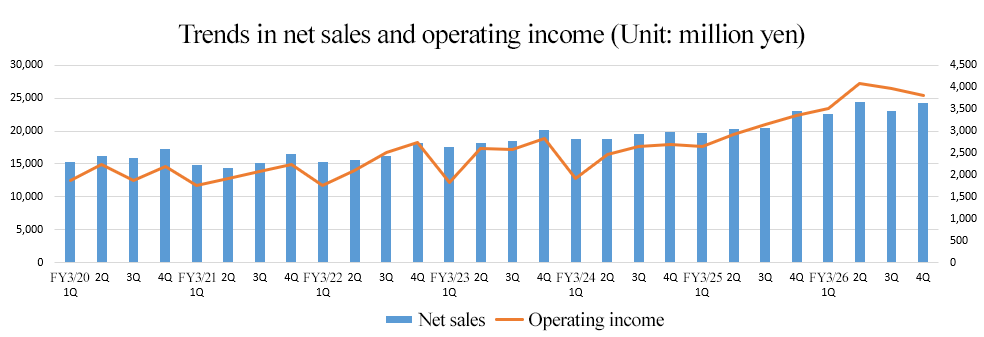
- In the fiscal year ended March 2026, sales and profit grew, exceeding the forecasts. Sales increased 12.9% year on year to 94.4 billion yen. While the performance of the next-generation mobility business remained healthy, the sales of both the digital integration business and the business solution business grew by double digits. Only the project management design business saw a decline in sales. Operating income rose 27.3% year on year to 15.3 billion yen. Through the sales growth, gross profit increased 18.3% year on year and gross profit margin rose 1.2 points. SGA, mainly personnel expenses, augmented 6.0% year on year, but it was offset, and profit grew by double digits.
- In order to reinforce the revenue structure and improve productivity, they kept developing recurring-revenue business, which is not easily affected by economic fluctuations, and concentrated their resources onto high-margin domains, including the support for adoption of generative AI mainly in the software development business, the digital transformation (DX) in enterprises, and project management office (PMO) projects that require advanced management. The young employees they increased have become competent through the in-house program for educating engineers, and their organizational execution capability improved significantly. These contributed to business results considerably.
- They announced a 3-year medium-term plan for the fiscal year ending March 2029. They aim to achieve “sales of 120 billion yen, an operating income of 20.1 billion yen, and an operating income margin of 16.8%” in FY 3/2029. They plan to improve profitability through active investment for growth, and proceed to a new stage as an enterprise that can return value to all stakeholders in a sustainable manner for a long period of time.
- For FY 3/2027, sales are expected to grow 3.8% year on year to 98 billion yen and operating income is projected to rise 3.9% year on year to 15.9 billion yen. Business opportunities are projected to keep increasing, due to the continuous investment in DX by enterprises, the full-scale utilization of AI, the shift to software defined vehicles (SDVs) in the mobility field, etc. On the other hand, the competition is intensifying further due to the worsening of the shortage of engineers, the augmentation of personnel expenses, and the sophistication of customer needs in the entire industry. Considering such changes in the business environment as opportunities to achieve sustainable growth, they “recruit engineers and increase their retention rate,” “enhance the competitiveness of each business,” “enrich recurring-revenue businesses,” and “operate business in growing fields, including AI” as priority measures. Through these measures, they will make efforts to stabilize their revenue base, evolve their business portfolio, and then improve corporate value in the medium/long term. For dividends, they plan to pay 18.00 yen/share, up 4 yen/share from the previous fiscal year. The expected payout ratio is 60.5%.
- We asked the representative director and chairperson Yoshichika Hemmi and president and Director Shingo Hemmi to give their messages. They said, “We consider the targets for the final year of our medium-term management plan not as the finish line, but as a milestone on the path to sustainable growth. As our group embarks on a new beginning as a third founding phase, we hope you will look forward to our new endeavors, and we would sincerely appreciate your continued support and encouragement.”
- In FY 3/3026, sales and profit grew by double digits, exceeding the forecasts. This growth was driven primarily by the next-generation mobility business, which accounts for less than 10% of total sales, but accounts for over 20% of total profit, helping maintain healthy performance represented by a sales growth rate of 36.6% and a profit growth rate of 63.9%. In addition, we heard that the outcomes of the bold structural reform, which has been promoted since 2024, are reflected in the favorable financial results of all group companies. While appointing each employee to his/her suitable position, they strove to shift to a new business model based on project management, in which the senior managing director Shingo Hemmi, who was appointed as a president and Director on April 1, 2026, and expanded their domain, including more upstream processes. They think that through this reform, a robust system for strongly driving the growth of the Systena Group based on the “next-generation mobility business” and the “project management design business” is being established. We would like to pay attention to the initiatives of the company, which considers the launch of this new system as a measure in the “third founding period” and makes efforts to complete the new three-year medium-term management plan.
1. Company Overview
Systena Corporation was founded, when System Pro Corp. absorbed Katena Corp., which was an equity-method affiliate, on April 1, 2010. It is cultivating new domains by operating the business that fuses the former System Pro’s technologies, know-how, and open technologies for designing, developing, and testing mobile terminals and the financial knowledge and infrastructure technologies of the former Katena Corp.
1-1 Management goal and target management indicators
The management goal is “to become one of Japan's leading IT companies and support the Japanese economy from the ground up.”
In order to attain this objective, the company pursues good balances between conflicting items, such as “destruction and creation”, “stability and growth,” and “maintenance and innovation” as its basic policy.
The company sets stably high dividends, high return on equity and high operating income rate as target managerial indicators. To achieve these goals, the company aims to develop a highly profitable structure under its basic policy for business administration.
1-2 Business description
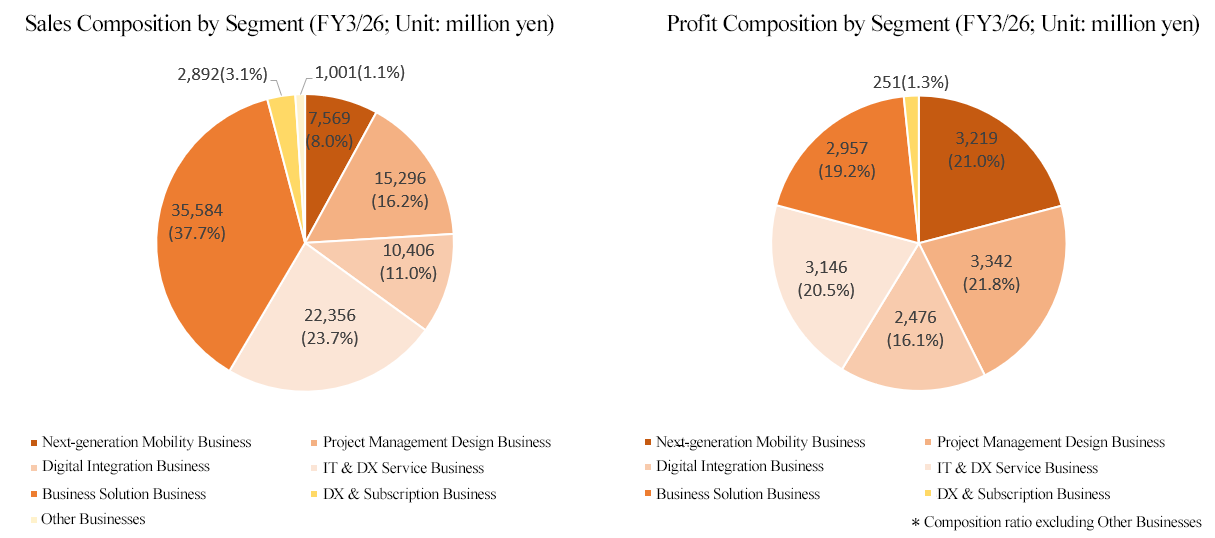
The seven business segments of Systena Corporation are Next-generation Mobility Business, Project Management Design Business, Digital Integration Business, IT & DX Service Business, Business Solution Business, DX & Subscription Business, and Other Businesses.
◆Next-generation Mobility Business
The business is mainly focused on providing the company's in-house services, such as engineering and MaaS, to the automobile industry, especially for vehicle manufacturers and suppliers. The company has built up many years of experience in development of open platforms such as Android and iOS for mobile phones/smartphones, and the mobile development with agile development methods and application frameworks has become necessary for SDV* development, and as a tier 1 software supplier, it provides technical capabilities to various vehicle manufacturers and major suppliers.
*SDV: Software Defined Vehicle. A next-generation automobile whose functions and performance are determined and controlled by software rather than hardware.
◆Project Management Design Business
In this business, the company engages in planning, design, development, and verification support for Internet businesses, apps for business use, online services, social infrastructure-related systems, IoT, artificial intelligence, robot-related services as well as planning, design, development, and verification support for various products and telecommunications carrier services. With telecommunications carriers, telecommunications equipment manufacturers, and Internet business enterprises as its main customers, the company is growing in a wide range of fields, including social infrastructure such as electric power, disaster prevention, aviation, and transportation, as well as digital home appliances, home security, smart devices, and web services, leveraging its extensive know-how and track record cultivated through many years of mobile device development. The company's strength lies in comprehensive solutions, including planning, development, verification, IT consulting and IT service in all fields.
◆Digital Integration Business
In addition to developing mission-critical systems for the financial sector (non-life insurance, life insurance, and banking), industrial sector, public sector, and other sectors, the company develops infrastructure systems. In the development of financial systems that require high reliability, the company leverages its know-how, experience, and proven results accumulated over half a century to provide solutions even in industries other than the financial sector. Recently, the company has expanded its scope of operations from the development of core systems to supporting customers' business transformation through DX. The continuous receipt of orders for central government agency projects is another strength.
◆IT & DX Service Business
The company provides IT services, including IT project promotion, PMO, DX support, system development/operation, data entry, large-scale data output, software testing, and DX verification. As companies increasingly focus resources on core business activities, the company's strength lies in not just providing individual services, but also delivering comprehensive solution services through ALL Systena, enabling support for realizing IT strategies.
◆Business Solution Business
In this business, the company sells IT-related products, including servers, computers, computer peripherals, and software to enterprises. The company provides services relating to IT equipment, including infrastructure construction and virtualization, and robotic process automation (RPA) solutions.
◆DX & Subscription Business
The company provides its original services such as "Canbus.", "Cloudstep," and "Web Shelter." In addition, the company also provides such cloud-based services as "Google Workspace" and "Microsoft 365" and helps clients adopt them. The company provides “Canbus.Lab” as a PMO and direction service that supports clients in promoting digital transformation.
◆Other Businesses
Software development for in-vehicle cockpit information displays at automobile manufacturers, proof-of-concept development for business concepts of startups, and corporate DX promotion using the no-code tool Canbus. Additionally, development, manufacturing, and sale of IoT/M2M 5G gateways, LTE routers, DCM terminals, antennas for IoT/M2M, and 5G/LTE femto base stations. The company handles planning, development, and operation of social games for smartphones and PCs, as well as contract-based app and system development.
1-3 Group Companies
The Systena Group is composed of Systena Corporation, 9 consolidated subsidiaries, and 3 equity-method affiliates, that is, a total of 13 companies.
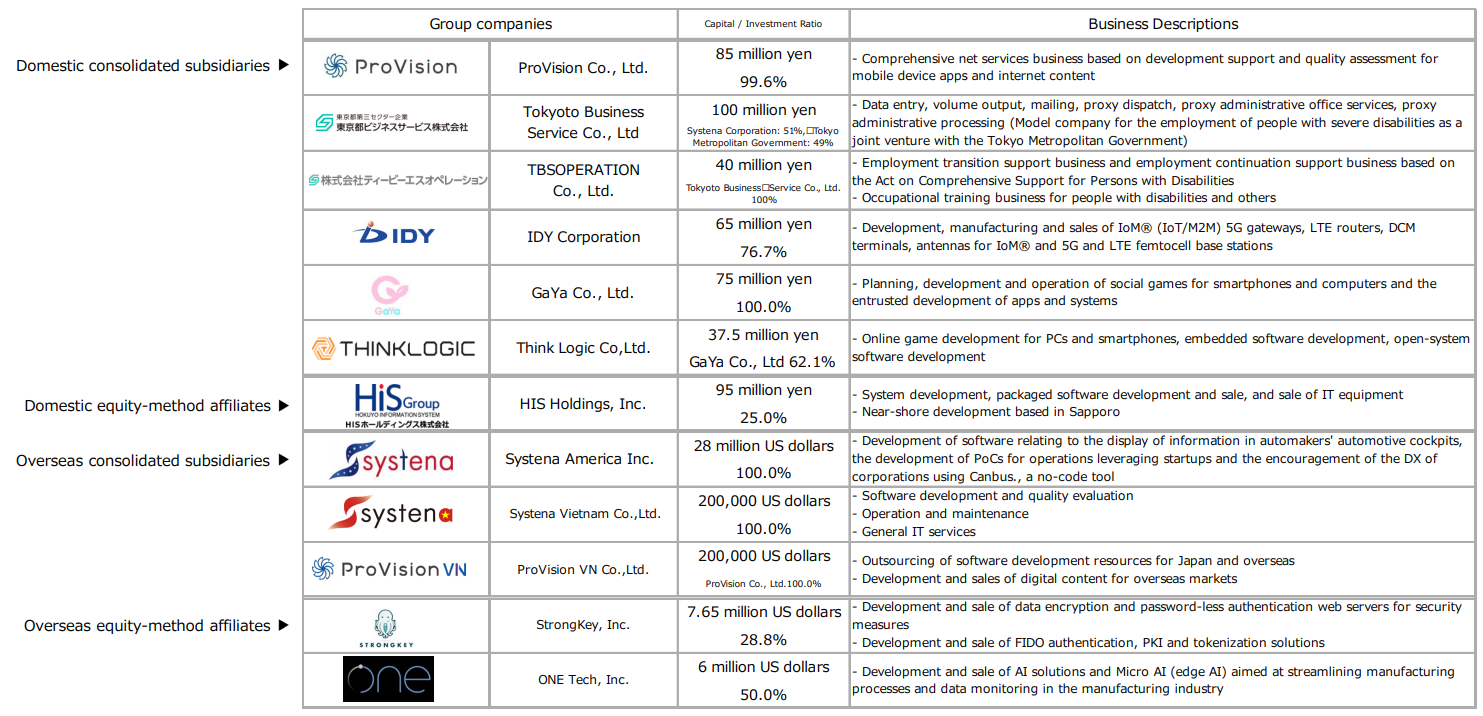
(Taken from the reference material of the company)
2. Medium-term Management Plan (FY 3/27-FY 3/29)
In May 2026, the company announced its three-year medium-term plan for the fiscal year ending March 2029.
The company aims to achieve “sales of 120 billion yen, an EBITDA+S of 21.5 billion yen, an operating income of 20.1 billion yen, and an operating income margin of 16.8%” in the fiscal year ending March 2029. Through active investment for growth, the company plans to enhance profitability and evolve into a new stage as a company capable of delivering long-term, sustainable value to all stakeholders.
EBITDA+S is calculated by adding depreciation & amortization and stock-based compensation expenses (share acquisition rights) to operating income.
2-1: Background and Overview of the Medium-Term Management Plan
The group has been advancing its business in accordance with the medium-term management plan announced in May 2025, which was scheduled to conclude in the fiscal year ending March 2028. As the group’s strategies to date have proven successful and measures to achieve its targets are progressing steadily, they have formulated a new three-year medium-term plan, which will end in the fiscal year ending March 2029, as a new endeavor for its medium/long-term growth.
In the recent business environment, while social uncertainties that could impact business have been increasing, such as fluctuations in semiconductor supply and demand and rising geopolitical risks, new growth opportunities have been expanding, including the full-scale utilization of AI, the shift toward software-defined vehicles (SDVs) in the mobility sector, and the growing complexity of customer challenges.
To ensure that the company capitalizes on these opportunities, they will calmly assess changes in the business environment, build a resilient earnings structure that is not dependent on specific businesses or market conditions, and establish a foundation for sustainable growth.
Under the new plan, the company will further evolve its diverse business portfolio, a core strength of the group, by focusing on strengthening the competitiveness of each business, creating new businesses to drive further diversification, and advancing human capital management.
2-2 Management Policies
The company’s three basic policies are “Strengthening the competitiveness of each business and evolving the business portfolio,” “Evolution of the earnings structure through full-scale operation of AI-related businesses and expansion of recurring-revenue business” and “Evolving human capital management and strengthening the foundation for sustainable growth.”
(1) Strengthening the Competitiveness of Each Business and Evolving the Business Portfolio
The group’s strength lies in its diversified business structure, in which multiple businesses generate revenue independently. Under the new medium-term management plan, the group aims to establish a presence that surpasses competitors in each market by further enhancing its technological capabilities, proposal-giving capability, and expertise in each domain. In particular, within the mobility business, where the shift toward software-defined vehicles (SDVs) is accelerating, the group will pursue expansion into global markets and seek growth opportunities in the domestic market. At the same time, by coordinating businesses that each possess strong competitiveness, the group will create comprehensive value to offer that cannot be achieved by any single business on its own.
(2) Evolution of the Earnings Structure Through Full-Scale Operation of AI-Related Businesses and Expansion of Recurring-revenue Business
The company will transform the changes during the AI era into growth opportunities. Specifically, the company will make the existing businesses AI-driven, expand into new AI-related business domains, and establish diverse revenue models, including recurring-revenue business, to evolve toward a high value-added earnings structure, thereby enhancing the continuity and reproducibility of earnings.
(3) Evolving Human Capital Management and Strengthening the Foundation for Sustainable Growth
Human resources are the source of the group’s competitiveness, and their quality and productivity are directly linked to profitability. Under the new medium-term management plan, the group will enhance its ability to acquire highly specialized professionals, continuously improve value added per employee, and ensure appropriate compensation levels to link human capital to the creation of corporate value. Additionally, the group will improve the effectiveness of corporate governance, address climate change, and develop an environment where diverse talent can thrive, thereby establishing a foundation for sustainable growth.
2-3 Performance Targets
The company has set the following targets:
| Results in FY 3/26 | Forecast for FY 3/27 | Plan for FY 3/29 | CAGR |
Sales | 94,400 | 98,000 | 120,000 | +8.3% |
EBITDA+S | 15,819 | 17,250 | 21,510 | +10.8% |
Operating income | 15,367 | 15,960 | 20,160 | +9.5% |
Operating income margin | 16.3% | 16.3% | 16.8% | - |
*Unit: Million yen. EBITDA+S is operating income plus depreciation & amortization and stock-based compensation expenses (Share acquisition rights). CAGR refers to the compound annual growth rate for the three-year period from the fiscal year ended March 2026 to the fiscal year ending March 2029, as calculated by Investment Bridge.
3. Fiscal Year Ended March 2026 Earnings Results
3-1 Consolidated business performance
| FY 3/25 | Ratio to net sales | FY 3/26 | Ratio to net sales | YoY | Comparison with forecasts |
Net sales | 83,621 | 100.0% | 94,400 | 100.0% | +12.9% | +4.7% |
Gross profit | 20,978 | 25.1% | 24,813 | 26.3% | +18.3% | - |
SG&A expenses | 8,910 | 10.7% | 9,446 | 10.0% | +6.0% | - |
Operating income | 12,067 | 14.4% | 15,367 | 16.3% | +27.3% | +6.0% |
Ordinary income | 11,855 | 14.2% | 16,145 | 17.1% | +36.2% | +8.4% |
Profit Attributable to Owners of Parent | 8,480 | 10.1% | 11,312 | 12.0% | +33.4% | +9.2% |
*Unit: Million yen. Net income refers to profit attributable to owners of parent. Comparison with forecasts is based on the earnings forecast announced in October 2025.
Sales and profit grew, exceeding the forecasts.
Sales increased 12.9% year on year to 94.4 billion yen. While the performance of the next-generation mobility business remained healthy, the sales of both the digital integration business and the business solution business grew by double digits. Only the project management design business saw a decline in sales.
Operating income rose 27.3% year on year to 15.3 billion yen. Through the sales growth, gross profit increased 18.3% year on year and gross profit margin rose 1.2 points. SGA, mainly personnel expenses, augmented 6.0% year on year, but it was offset, and profit grew by double digits.
In order to reinforce the revenue structure and improve productivity, they kept developing recurring-revenue business, which is not easily affected by economic fluctuations, and concentrated their resources onto high-margin domains, including the support for adoption of generative AI mainly in the software development business, the digital transformation (DX) in enterprises, and project management office (PMO) projects that require advanced management. The young employees they increased have become competent through the in-house program for educating engineers, and their organizational execution capability improved significantly. These contributed to business results considerably.
3-2 Trends by segment
| FY 3/25 | Composition ratio/Income margin | FY 3/26 | Composition ratio/ Income margin | YoY |
Next-Generation Mobility | 5,540 | 6.6% | 7,569 | 8.0% | +36.6% |
Project Management Design | 15,669 | 18.7% | 15,296 | 16.2% | -2.4% |
Digital Integration | 8,815 | 10.5% | 10,406 | 11.0% | +18.1% |
IT & DX Service | 20,753 | 24.8% | 22,356 | 23.7% | +7.7% |
Business Solution | 29,795 | 35.6% | 35,584 | 37.7% | +19.4% |
DX & Subscription Business | 2,783 | 3.3% | 2,892 | 3.1% | +3.9% |
Other | 797 | 1.0% | 1,001 | 1.1% | +25.5% |
Adjustment | -534 | - | -707 | - | - |
Consolidated Sales | 83,621 | 100.0% | 94,400 | 100.0% | +12.9% |
Next-Generation Mobility | 1,964 | 35.5% | 3,219 | 42.5% | +63.9% |
Project Management Design | 2,583 | 16.5% | 3,342 | 21.9% | +29.4% |
Digital Integration | 1,954 | 22.2% | 2,476 | 23.8% | +26.7% |
IT & DX Service | 2,848 | 13.7% | 3,146 | 14.1% | +10.5% |
Business Solution | 2,274 | 7.6% | 2,957 | 8.3% | +30.0% |
DX & Subscription Business | 460 | 16.5% | 251 | 8.7% | -45.3% |
Other | -19 | - | -26 | - | - |
Consolidated Operating Income | 12,067 | 14.4% | 15,367 | 16.3% | +27.3% |
*Unit: Million yen
Next-generation Mobility Business
Sales: 7,569 million yen (up 36.6% YoY), Operating Income: 3,219 million yen (up 63.9% YoY)
With the acceleration of the shift toward software-defined vehicles (SDVs) in the automotive industry, demand for software development is expanding across all areas, from the cockpit to the back-end systems. Given this trend, the company continued to perform well in direct business with major Japanese complete vehicle manufacturers while also making steady progress in generating new projects in the North American market through its U.S. subsidiary. By leveraging its strengths in UX design and agile development, the company established a system capable of providing consistent support from the most upstream stages of planning and requirements definition. As a result, it maintained high utilization rates and achieved stable order intake and operations throughout the fiscal year.
Project Management Design Business
Sales: 15,296 million yen (down 2.4% YoY), Operating Income: 3,342 million yen (up 29.4% YoY)
In the fields of next-generation communications technology and AI, the company reallocated resources to strengthen its execution structure. In the communications sector, the company continued to provide support for the migration associated with the refurbishment of system infrastructure platforms. In the AI sector, it expanded its involvement in upstream processes, such as platform restructuring utilizing generative AI and proof-of-concept (PoC) projects. The company’s “execution-oriented” management structure, which provides seamless support from strategy formulation to the completion of on-site operations, was well received, and profitability remained at a high level throughout the fiscal year. Part of the business was transferred from the solution design segment.
Digital Integration Business
Sales: 10,406 million yen (up 18.1% YoY), Operating Income: 2,476 million yen (up 26.7% YoY)
In the financial sector, mission-critical system modernization projects, primarily in the insurance sector, expanded throughout the fiscal year, driving strong sales growth across the entire segment. In the public and corporate sectors, business remained steady, driven primarily by additional projects from existing clients. As a result of prioritizing the shift of resources toward advanced development projects utilizing generative AI and other technologies, as well as high-margin digital transformation (DX) support services, the segment’s overall profit margin improved due to a transformation in the revenue structure, further enhancing the stability of the business portfolio. The company also began efforts to improve productivity through AI-driven development, working to strengthen its technological competitiveness toward the fiscal year ending March 2027.
IT & DX Services Business
Sales: 22,356 million yen (up 7.7% YoY), Operating Income: 3,146 million yen (up 10.5% YoY)
In response to growing corporate interest in investing in digital transformation, demand for business process optimization and “hands-on PMO services” continued throughout the year. In the DX verification service segment, the shift toward the enterprise sector was completed. In the BPO business, three companies, including a special subsidiary, collaborated organically and thoroughly allocated the right resources to the right places, resulting in an increase in orders that significantly contributed to strengthening the foundation of the entire group.
Business Solution Business
Sales: 35,584 million yen (up 19.4% year on year), Operating income: 2,957 million yen (up 30.0% year on year).
Following the end of support for Windows 10 in October 2025, PC replacement projects intensified during the third quarter (October to December), significantly boosting sales. The increase in projects utilizing cloud services, including “lift-and-shift” initiatives, along with the expansion of managed services and orders for security-related system integration projects such as Zero Trust, remained robust through the end of the fiscal year. As a result, the company was able to absorb the post-special demand impact, contributing significantly to an increase in both sales and profits for the full fiscal year.
DX & Subscription Business
Sales: 2,892 million yen (up 3.9% YoY), Operating income: 251 million yen (down 45.3% YoY)
Implementation of the no-code DX platform “Canbus.” by major corporations continued to perform well. Orders for industry-specific packages for the healthcare sector based on “Canbus.” also increased steadily throughout the year. Profit declined as the company prioritized enhancing development capabilities in anticipation of future growth in the number of contracts, as well as maintaining and strengthening its support system to accommodate an expanding customer base.
Other Businesses
Sales: 1,001 million yen (up 25.5% YoY), Operating loss: 26 million yen (a loss of 19 million yen in the previous fiscal year)
In addition to a steady increase of orders for in-vehicle system development at the U.S. subsidiary, measures taken by GaYa Co., Ltd. to stimulate operations for the “Keiba Densetsu” (horse racing simulation game) series proved successful. Efforts to strengthen synergies across the entire group and provide PMO support for contract development also remained stable.
3-3 Financial Conditions
◎BS
| March 2025 | March 2026 | Increase/ decrease |
| March 2025 | March 2026 | Increase/ decrease |
Cash and deposits | 21,860 | 27,377 | +5,517 | Trade payables | 9,063 | 8,730 | -333 |
Trade receivables | 18,604 | 19,051 | +447 | Short-term borrowings | 1,550 | 1,572 | +22 |
Merchandise | 2,053 | 1,194 | -859 | Accounts payable and accrued expenses | 2,530 | 2,799 | +269 |
Current assets | 44,184 | 54,118 | +9,934 | Income taxes payable | 2,167 | 3,584 | +1,417 |
Tangible Assets | 1,321 | 1,327 | +6 | Provision for bonuses | 2,068 | 2,357 | +289 |
Intangible Assets | 169 | 176 | +7 | Liabilities | 18,812 | 20,858 | +2,046 |
Investments and Others | 6,087 | 5,457 | -630 | Net assets | 32,950 | 40,221 | +7,271 |
Noncurrent assets | 7,578 | 6,961 | -617 | Retained earnings | 39,817 | 46,822 | +7,005 |
Total assets | 51,762 | 61,079 | +9,317 | Total Liabilities and Net Assets | 51,762 | 61,079 | +9,317 |
*Unit: Million yen. Trade receivables are the sum of notes, accounts receivable and contract assets.
The total assets as of the end of March 2026 stood at 61.0 billion yen, up 9.3 billion yen from the end of the previous fiscal year due to an increase in cash and deposits. Liabilities increased 2.0 billion yen from the end of the previous fiscal year to 20.8 billion yen. Net assets increased 7.2 billion yen from the end of the previous fiscal year to 40.2 billion yen due to an increase in retained earnings. Equity ratio was 64.9%, up 2.2 points from the end of the previous fiscal year.
◎Cash Flow
| FY 3/25 | FY 3/26 | Increase/decrease |
Operating CF | 7,979 | 13,283 | +5,304 |
Investing CF | -2,576 | -896 | +1,680 |
Free CF | 5,403 | 12,387 | +6,984 |
Financing CF | -14,024 | -4,316 | +9,708 |
Cash and cash equivalents | 21,464 | 29,819 | +8,355 |
*Unit: Million yen.
Operating cash inflow increased year on year due mainly to an increase in net income before taxes. Investing cash outflow decreased due to a decrease in purchase of investment securities compared to the previous period, and free cash inflow significantly expanded. Cash outflow from financing activities shrank, mainly due to significant decrease in purchase of treasury stock. The cash position increased.
3-4 Topics
(1) Launch of the New Management Structure
On April 1, 2026, Mr. Shingo Hemmi (former senior managing director) assumed the position of president.
On May 13, 2026, the company announced candidates for the board of directors, including the appointment of two new directors. These appointments will be submitted for approval at the 44th Annual General Meeting of Shareholders scheduled for June 25, 2026. Following approval, the changes will be formally decided at a board of directors meeting to be held after the shareholders’ meeting.
(2) Exhibited at the “People and Cars Technology Expo 2026 YOKOHAMA”
In May 2026, the company exhibited at the “People and Cars Technology Expo 2026 YOKOHAMA.”
Through its participation in numerous OEM projects, the company has gained a deep understanding of the challenges faced in the field of in-vehicle system development, as well as the practical constraints involved in implementation, verification, and operation. At this exhibition, the company showcased not only the optimization of development processes through AI and automation, but also concrete visions for supporting next-generation mobility development in collaboration with the technologies of its partner companies. Furthermore, the company showcased solutions that support development, evaluation, and operation in the era of software-defined vehicles (SDV), ranging from AI computing infrastructure and data center concepts to high-speed wireless communication and remote operation systems.
4. Fiscal Year Ending March 2027 Earnings Estimates
Consolidated Earnings Estimates
| FY 3/26 Results | Ratio to net sales | FY 3/27 Estimates | Ratio to net sales | YoY |
Net sales | 94,400 | 100.0% | 98,000 | 100.0% | +3.8% |
EBITDA+S | 15,819 | 16.8% | 17,250 | 17.6% | +9.0% |
Operating income | 15,367 | 16.3% | 15,960 | 16.3% | +3.9% |
Ordinary income | 16,145 | 17.1% | 15,960 | 16.3% | -1.1% |
Net income | 11,312 | 12.0% | 10,630 | 10.8% | -6.0% |
*Unit: Million yen. EBITDA+S is calculated by adding depreciation and amortization and stock-based compensation expenses (stock acquisition rights) to operating income.
Sales and operating income are expected to increase.
Sales are expected to grow 3.8% year on year to 98 billion yen and operating income is projected to rise 3.9% year on year to 15.9 billion yen.
Business opportunities are projected to keep increasing, due to the continuous investment in DX by enterprises, the full-scale utilization of AI, the shift to software defined vehicles (SDVs) in the mobility field, etc. On the other hand, the competition is intensifying further due to the worsening of the shortage of engineers, the augmentation of personnel expenses, and the sophistication of customer needs in the entire industry.
Considering such changes in the business environment as opportunities to achieve sustainable growth, they “recruit engineers and increase their retention rate,” “enhance the competitiveness of each business,” “enrich recurring-revenue businesses,” and “operate business in growing fields, including AI” as priority measures. Through these measures, they will make efforts to stabilize their revenue base, evolve their business portfolio, and then improve corporate value in the medium/long term. Operating income, ordinary income, and net income include share-based compensation expenses of 840 million yen related to stock acquisition rights granted to directors and employees.
For dividends, they plan to pay 18.00 yen/share, up 4 yen/share from the previous fiscal year. The expected payout ratio is 60.5%.
5. Message from Management
We interviewed Mr. Yoshichika Hemmi, Representative Director and Chairperson, and Mr. Shingo Hemmi, President And Director, for their messages to shareholders and investors.
<Mr. Yoshichika Hemmi, Representative Director and Chairman>
Q: The company has recently launched a new management structure. Could you tell us about the background and objectives behind this approach?
This organizational change was implemented with unwavering determination to achieve our new medium-term management plan. Our primary objective is to dramatically increase the speed of decision-making and execution so that we can swiftly incorporate the insights and genuine opinions from the front-line teams into management decisions and drive the plan forward by uniting everyone across the company.
Our group has always moved forward by anticipating changes in the business environment and transforming our organization flexibly to adapt to them. Young employees, currently in their early 30s, have grown into the generation serving as the key contributors in each of our businesses and now form the core of our organization. We are confident that this generation will actively lead the way in utilizing AI and responding to new technologies and that this will become a major driving force for our company.
We consider this period as our “third founding phase.” Rather than resting on our past successes, we will build a solid competitive advantage in the rapidly changing IT market and ensure the enhancement of our corporate value over the medium/long term.
Q: Thank you. Could you please give a message to shareholders and investors?
We believe our mission is “to become one of Japan's leading IT companies and support the Japanese economy from the ground up.” We consider shareholder return as one of our top management priorities. Our group has consistently prioritized the continuous payment of stable dividends while maintaining a policy of returning profits in line with our business growth. Going forward, this policy will remain unchanged, and we will strive to further enhance shareholder return as we improve our profitability.
We consider the targets for the final year of our medium-term management plan not as the finish line, but as a milestone on the path to sustainable growth. As our group embarks on a new beginning as a third founding phase, we hope you will look forward to our new endeavors, and we would sincerely appreciate your continued support and encouragement.
<Mr. Shingo Hemmi, President and Director>
Q:You have been appointed as president under the new management structure. Please tell us about your mission as the new president and your vision for the company.
For more than 45 years since our founding, we have achieved steady growth while sincerely meeting the expectations of our customers across a wide range of industries. We are committed to carrying forward this legacy and will strive to further enhance our corporate value.
Even though our organizational structure has changed, there will not be any significant changes to our company’s management policies or philosophy. Above all, I value the relationships of trust we have built with our customers and the sincere attitude toward manufacturing that each and every employee has embodied. I believe my mission is to elevate these values to an even higher level.
Our primary focus is to further deepen our relationships with our customers. Rather than simply responding to their requests, we aim to collaborate with them from the conceptual stage and create value together from their perspective. We intend to take this role as a partner in an even wider range of business areas.
In recent years, we have been promoting initiatives to get involved in our clients’ businesses from the early stages and help create services. We will further accelerate this approach and establish it as a core strength of our entire organization. To achieve this, I will personally visit our clients on a regular basis and directly engage with them to pursue new value that our company can provide. Furthermore, by integrating the strengths cultivated by each of our business units, we will further strengthen our position as an indispensable partner for our clients.
Mobility, telecommunications, finance, and social infrastructure, the industries in which we have been deeply involved are undergoing major transformations, and the evolution of AI is further accelerating this trend. We consider these changes as opportunities for growth rather than threats, and by utilizing AI, we will actively pursue new opportunities in areas where we have not previously been able to enter. Furthermore, by demonstrating synergy across our businesses at an even higher level, we aim to drive medium/long-term growth.
I will keep pursuing the philosophy we have regarded as the most important since the company's founding, that is, “the most valuable work is to make people happy,” and faithfully deliver our company’s value to our customers, society, employees, and shareholders.
We would appreciate your continued support and encouragement.
6. Conclusions
In FY 3/3026, sales and profit grew by double digits, exceeding the forecasts. This growth was driven primarily by the next-generation mobility business, which accounts for less than 10% of total sales, but accounts for over 20% of total profit, helping maintain healthy performance represented by a sales growth rate of 36.6% and a profit growth rate of 63.9%.
In addition, we heard that the outcomes of the bold structural reform, which has been promoted since 2024, are reflected in the favorable financial results of all group companies. While appointing each employee to his/her suitable position, they strove to shift to a new business model based on project management, in which the senior managing director Shingo Hemmi, who was appointed as a president and Director on April 1, 2026, and expanded their domain, including more upstream processes. They think that through this reform, a robust system for strongly driving the growth of the Systena Group based on the “next-generation mobility business” and the “project management design business” is being established. We would like to pay attention to the initiatives of the company, which considers the launch of this new system as a measure in the “third founding period” and makes efforts to complete the new three-year medium-term management plan.
<Reference: Regarding Corporate Governance>
◎Organization type, and the composition of directors and auditors
Organization type | Company with corporate auditors |
Directors | 11 directors, including 4 outside ones |
Auditors | 4 auditors, including 4 outside ones. |
◎Corporate Governance Report (Updated on June 20, 2025)
Basic policy
The Company intends to enhance corporate governance with the aim of responding to rapid changes in the business climate, to promote management emphasizing speed based on promote decision-making to increase management efficiency, to work toward sustainable growth of the business, increasing shareholder value and continuous shareholder returns, to harmonize the interests of shareholders, customers, business partners, employees, local communities and other stakeholders (interested parties) and to maximize general benefits as a whole while endeavoring to secure soundness in management and full regulatory compliance. To archive this, the Company intends to take very seriously the advice and suggestions of external experts (audit firms, lead underwriters, lawyers, social insurance and labor consultants, judicial scriveners, etc.) and stakeholders and will work to enhance the fairness and transparency of management, to build systems appropriate to the size of the Company using its inherent mobility, to further promote self-improvement as a listed company in full awareness of stakeholders, to enhance corporate governance and to disclose information in a timely and appropriate manner.
<Reasons for Non-compliance with the Principles of the Corporate Governance Code (Excerpt)>
[Principle 2-4. To secure diversity inside the company by facilitating women’s participation]
[Supplementary Principle 2-4-1 Ensuring Diversity in the Promotion of Core human Resources, etc.]
The Company promotes employees to management positions regardless of attributes such as gender, age, race, nationality or whether they were hired mid-career or as a new graduate. The Company’s policy is to treat employees according to their abilities and to assign the right people to the right positions. Please refer to the Company’s website for further details.
“Policy for Securing the Diversity of Central Personnel”
https://www.systena.co.jp/sustainability/esg_society/
[Principle 3-1. Enrichment of information disclosure]
[Supplementary Principle 3-1-3 Approaches to Sustainability]
The Company’s initiatives on sustainability are described on the webpage below. Here, the Company explains its disclosures based on the TCFD recommendations or an equivalent framework, which is mandatory only for companies listed on the Prime Market. The Company engages in the business of providing IT service, and does not operate any business with high environmental impact, such as the manufacturing of goods. Accordingly, at present the climate change problem is not expected to affect the Company’s business significantly. However, the Company began to acquire ISO 140001 certification in 2004 and has since been striving to reduce resource consumption and waste emissions based on its understanding that the global environment is an asset held by all of mankind that is valuable and must be preserved for future generations. In addition, all IT-related climate change measures taken by companies are in the Company’s business domain. The increase of the Company’s helps increase the efficiency of customers' business and leads to their reduction of resources they consume and the waste they emit, which contributes to the protection of the global environment. Therefore, the Company believes that its growth leads to the ability to control climate change. The Company plans to start initiatives for measuring Scope 1, 2, and 3 GHG emissions in the fiscal year ending March 2025, and launch projects to achieve a target reduction amount of GHG emissions by the end of the fiscal year ending March 2026, while considering the disclosure based on the TCFD or the like when necessary. The Company’s environmental initiatives are described on the webpage below.
“The Company’s Sustainability Initiatives”
https://www.systena.co.jp/sustainability/
“The Company’s Environmental Initiatives”
https://www.systena.co.jp/sustainability/esg_environment.html
[Principle 4-1. Roles and duties of the board of directors (1)]
[Supplementary Principle 4-1-3 Succession plan for the CEO and others]
Our company established a nomination and remuneration committee, enhancing the independence and objectivity of functions and accountability of the board of directors regarding the nomination, remuneration, etc. of directors (including the plan for successors), but has not formulated a plan for successors. We will consider this matter in the future as necessary.
<Disclosure Based on the Principles of the Corporate Governance Code (Excerpt)>
[Principle 1-4 Strategically held shares]
In principle, our company will not hold any shares in a listed company strategically. However, if strategically important cooperation or transactions could be maintained or developed for improving our corporate value, the board of directors will discuss the purposes, meanings, etc. of shareholding for each stock, and decide whether or not to hold shares.
[Principle 3-1 Enhancement of information disclosure]
(1) Management philosophy, management strategies and management plans of the Company
We have formulated and disclosed our management philosophy, management strategies, and medium-term management plan. For details, please refer to our website.
“Management Philosophy and Code of Conduct”
https://www.systena.co.jp/about/idea.html
“Management goals and basic management policies”
https://www.systena.co.jp/ir/management/business_plan.html
“Medium-term management plan”
https://www.systena.co.jp/ir/management/business_plan.html
(6) Measures for realizing business administration conscious of capital cost and share price
The Corporate Group considers that business administration conscious of capital profitability is essential for achieving sustainable growth and improving corporate value in the medium/long term. The Company will allocate managerial resources appropriately, by implementing some measures, including the investment in human capital and the reform of the business portfolio. In addition, the Company aims to improve corporate value in the medium/long term, by achieving a good balance among growth potential, capital profitability, and financial soundness and optimizing the balance sheet.
[Principle 4-10. Utilization of discretionary systems]
[Supplementary Principle 4-10-1 Establishment of independent advisory committees, such as a discretionary nomination or remuneration committee]
Our company established a discretionary nomination and remuneration committee as an advisory organ for the board of directors. The details are as mentioned in the supplementary explanation of “II-1 Status of establishment, member composition, and attributes of the chair of a discretionary committee regarding the institution composition, organizational operation, etc.” in this report.
[Principle 5-1 Policy on Constructive Dialogue with Shareholders]
The Company establishes and discloses a disclosure policy to encourage constructive dialogue with shareholders. Please refer to the Company’s website for further details.
“Disclosure Policy” https://www.systena.co.jp/ir/management/disclosure.html
Please refer to "2. Status of IR Activities" in "III. Implementation Status of Measures for Shareholders and Other Stakeholders" in this Report for information about the development of a framework and initiatives for this.
This report is not intended for soliciting or promoting investment activities or offering any advice on investment or the like, but for providing information only. The information included in this report was taken from sources considered reliable by our company. Our company will not guarantee the accuracy, integrity, or appropriateness of information or opinions in this report. Our company will not assume any responsibility for expenses, damages or the like arising out of the use of this report or information obtained from this report. All kinds of rights related to this report belong to Investment Bridge Co., Ltd. The contents, etc. of this report may be revised without notice. Please make an investment decision on your own judgment. Copyright(C) Investment Bridge Co., Ltd. All Rights Reserved. |