



Bridge Report:(2935)PICKLES the Fiscal Year Ended February 2026

 President Naoji Kageyama | PICKLES HOLDINGS CO., LTD. (2935) |
 |
Corporate Information
Stock Exchange | TSE Prime Market |
Industry | Food products (manufacturing) |
Representative | Naoji Kageyama |
Address | 7-8, Higashisumiyoshi, Tokorozawa-shi, Saitama |
Accounting term | February |
URL |
Stock Information
Share Price | Shares Outstanding (Term-end) | Total Market Cap | ROE (Actual) | Trading Unit | |
¥1,117 | 12,858,430 shares | ¥14,362 million | 7.3% | 100 shares | |
DPS (Estimate) | Dividend Yield (Estimate) | EPS (Estimate) | PER (Estimate) | BPS (Actual) | PBR (Actual) |
¥29.00 | 2.6% | ¥98.33 | 11.4x | ¥1,568.51 | 0.7x |
*Stock price is the closing price on May 7. Each number is based on PICKLES HOLDINGS’ financial results for the fiscal year ended February 2026.
Consolidated Earnings Trend
Fiscal Year | Sales | Operating Income | Ordinary Income | Net Income | EPS | DPS |
February 2023 Act. | 41,052 | 1,538 | 1,650 | 1,138 | 88.80 | 22.00 |
February 2024 Act. | 43,028 | 1,668 | 1,771 | 1,175 | 94.29 | 24.00 |
February 2025 Act. | 41,518 | 1,279 | 1,345 | 958 | 77.09 | 26.00 |
February 2026 Act. | 40,923 | 2,085 | 2,148 | 1,384 | 110.70 | 29.00 |
February 2027 Est. | 41,000 | 1,820 | 1,860 | 1,231 | 98.33 | 29.00 |
*Unit: Million-yen. Net income is the net income attributable to owners of the parent company. The same applies below. Since the first quarter of the fiscal year ended February 2023, the accounting standards for revenue recognition, etc. have been applied.
This Bridge Report presents PICKLES HOLDINGS’ summary of Financial Results of the Fiscal Year Ended February 2026 and the progress of the Medium-Term Management Strategy.
Table of Contents
Key Points
1. Company Overview
2. Fiscal Year Ended February 2026 Financial Results
3. Fiscal Year Ending February 2027 Earnings Forecasts
4. Progress of Medium/Long-Term Management Strategy
5. Conclusions
<Reference: Regarding Corporate Governance>
Key Points
- The sales in the fiscal year ended February 2026 were 40,923 million yen, down 1.4% year on year. In the first half of the fiscal year ended February 2026, sales grew thanks to the campaign of convenience stores, but in the second half, sales were sluggish as consumers became budget-minded and the selection and concentration of products to be procured progressed. Operating income grew 63.0% year on year to 2,085 million yen. Gross profit rose significantly by 8.7% year on year and gross profit margin improved 2.1 points year on year, as the prices of vegetables, such as Chinese cabbages and cucumbers, as ingredients became stable and their measures for improving profitability, such as the revision of prices of Gohan ga Susumu Kimchi and other products turned out to be effective, while SG&A expenses dropped year on year thanks to cost reduction. Sales fell below the forecast, but the prices of vegetables as ingredients were more stable than expected and measures for improving profitability contributed, so operating income exceeded the forecast.
- For the fiscal year ending February 2027, sales are expected to grow slightly and profit is projected to drop. Sales are forecast to grow 0.2% year on year to 41 billion yen. They will actively conduct marketing activities by utilizing their nationwide network and engage in the development of a wide array of products, but the sales growth is projected to be slight because consumers will tend to save money. Operating income is forecast to decline 12.7% year on year to 1.8 billion yen, and EBITDA is projected to drop 5.7% year on year to 3 billion yen. Gross profit is forecast to decrease 3.3% year on year, due to the strategic investment in equipment, the augmentation of production costs through the rise in commodity prices, etc. Gross profit margin is forecast to decline 0.8 points year on year. They aim to steadily increase actual figures excluding temporary positive factors in the previous fiscal year. They plan to pay a dividend of 29.00 yen/share like in the previous fiscal year. The expected payout ratio is 29.5%.
- The “expansion of products for industrial use” and the “evolution of national brand (NB) products” were clearly defined as their medium/long-term priority domains. Based on their forte, including “the nationwide production and distribution systems,” “the functions as a vendor to meet the needs of clients,” “initiatives for safety and peace of mind,” and “capabilities of developing and proposing very unique products,” they aim to concentrate on the two new domains to become an ideal general maker in the fields of vegetables, fermentation, and health, and then become a value creating maker that fosters and introduces a new food culture.
- For the “expansion of products for industrial use,” they will match the needs of clients with the products of suppliers and fuse their proposals, to develop and offer new products in the field of products for industrial use, establish an organization dedicated to products for industrial use, and promote new personnel. They plan to concentrate on the development of technologies for frozen products, the extension of best-before periods, etc. For the “evolution of national brand (NB) products,” they will concentrate on the “strengthening of brands.” They aim to become a “general maker” by “expanding their existing brand,” centered around “Gohan ga Susumu Kimchi,” and “operating multiple brands” by launching new brands. Both require new endeavors while taking advantage of their own strengths. We would like to pay attention to how swiftly they will implement their strategies.
1. Company Overview
As a holding company, PICKLES HOLDINGS CO., LTD. has established a nationwide production and sales network, with PICKLES CORPORATION, which is engaged in the production and sales of lightly pickled vegetables, kimchi, and delicatessen, as well as the purchase and sale of pickles, etc., PICKLES CORPORATION KANSAI, FOOD LABEL CO., LTD. and other group companies.
The theme color of the company, green, represents freshness under a slogan of “We deliver the vitality of vegetables.” The company’s own products are produced using vegetables grown and harvested mainly in Japan by contracted farmers so that their traceability is ensured (about 80% of the vegetables used are supplied by contracted farmers), and no preservatives or synthesized food colorings are used. Furthermore, the company has displayed “a commitment to food safety” at its production sites as demonstrated by such endeavors as thorough temperature control at the factories, checkups of the clothes and health of all the employees before they enter the factories, devotion to the 5S activities (5S represents sorting, setting-in-order, shining, standardizing, and sustaining the discipline) and acquisition of the certification of JFS-B.
1-1 Corporate Philosophy and Vision
PICKLES HOLDINGS’ philosophy is “We deliver tasty and safe foods to consumers and aim at eco-conscious corporate management.” Under the corporate philosophy, it is pursuing the following management policies: (1) quality control for producing safe and delicious food products, (2) environmentally friendly corporate management, and (3) arrangement of a working environment that puts instillation of morals and the principle of safety and health first. In accordance with this policy, they follow JFS-B, which is the standard for food safety, and ISO14001, which is an international standard for environmental management. In addition, they put energy into the education of employees while enriching systems for human resources, education, etc. and make efforts to foster the stance and corporate culture for encouraging employees to take on challenges. The company focuses also on SDGs and sustainability management, and prepares ESG reports with the aim of introducing its efforts and challenges related to ESG and its stories of enhancing the corporate value.
「ESG Bridge Report」
https://www.bridge-salon.jp/report_bridge/archives/2026/02/260210_2935.html
Under the corporate philosophy, they pursue a “general maker of vegetables, fermented food, and health” that keeps creating new value as an ideal state in the medium/long term.
1-2 Market environment
(1) Lightly pickled vegetables and kimchi
According to the sales ranking in the field of pickled foods produced by the company with reference to the articles of the Shokuhin Shinbun, the company occupies the largest share with consolidated sales of 40.9 billion yen, followed by Tokai Pickling with sales of 24.5 billion yen, Bingo Tsukemono with sales of 14 billion yen, Akimoto Foods with sales of 13 billion yen, Yamamoto Shokuhin with sales of 11.3 billion yen, and MIYAMA with sales of 10.2 billion yen. Only six companies earn sales of over 10 billion yen.
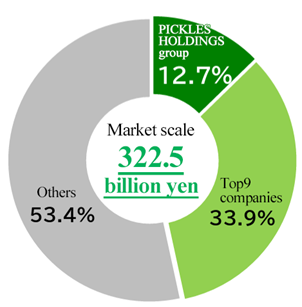
Due to the changes in eating habits and a decline in demand for meals with rice, the scale of the market of pickles shrank from 480 billion yen in 2000 to approximately 320 billion yen in 2024. The number of enterprises has been declining, and integration has been progressing, but the shrinkage of the entire market is subsiding. Under such an environment, lightly pickled vegetables and kimchi account for about 50% of the market of pickled foods.
Under such circumstances, the market share of the company is 12.7%, much higher than that of the second company. The company will keep enhancing product development and strive to expand its market share, in order to increase their share to 15%.
(2) Delicatessen
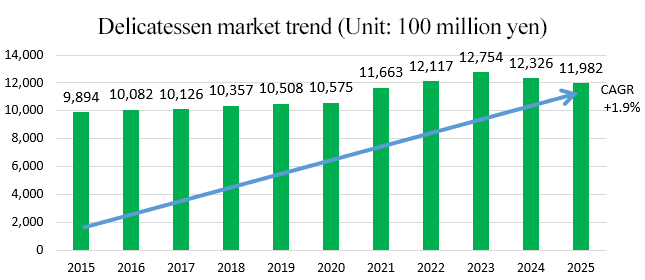
According to the company's data (researched by the Japan Chain Stores Association), the market size of the delicatessen market (Japanese, Western, and Chinese deli foods, boxed meals, sandwiches, etc.) in 2025 was 1,198.2 billion yen, a decrease for the second consecutive year. However, it has been growing steadily since 2015 at a compound annual growth rate (CAGR) of 1.9%.
The growth is believed to be driven by factors such as an increase in single-person households, an aging population, the advancement of women in society, heightened interest in health and nutritional balance, and the need for convenience and time-saving in household chores.
In this field, they are competing with some listed companies, including Fujicco (results from the fiscal year ended March 2025, the same shall apply hereinafte sales of 57 billion yen, net income: 950 million yen in the previous fiscal year), KENKO Mayonnaise (sales: 91.7 billion yen, net income: 3.5 billion yen), and Ebara Foods Industry (sales: 47.9 billion yen, net income: 1.39 billion yen), and subsidiaries, etc. of listed companies, such as Deria Foods (the Kewpie Group) and initio foods (the Nisshin Seifun Group).
(Produced by Investment Bridge Co., Ltd. based on the company's reference material)
1-3 Business Description
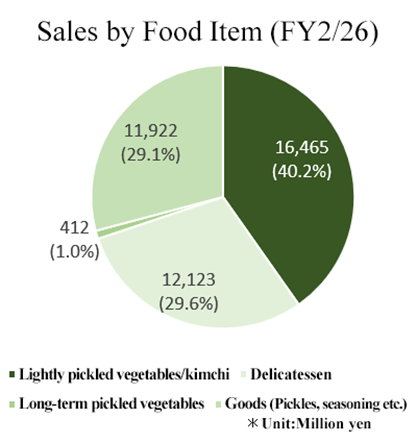
In the fiscal year ended February 2026, sales from products (manufactured by PICKLES CORPORATION at its own factories) accounted for 70.9% (40.2% from lightly pickled vegetables and kimchi, 29.6% from delicatessen, and 1.0% from long-term pickled vegetables), and those from products of a group company, FOOD LABEL CO., LTD., and products purchased from outside companies made up 29.1%.
(Produced by Investment Bridge Co., Ltd. based on the company's reference material)
(1) Product and Goods overview
◎ Lightly pickled vegetables and kimchi
The company offers a lineup of lightly pickled vegetable, which can be eaten like a salad, according to the season of the vegetables.
As the holdings emphasizes the provision of safe and secure food, the main ingredients, such as Chinese cabbage and cucumber, are produced in Japan. No preservatives or synthetic coloring agents are used.
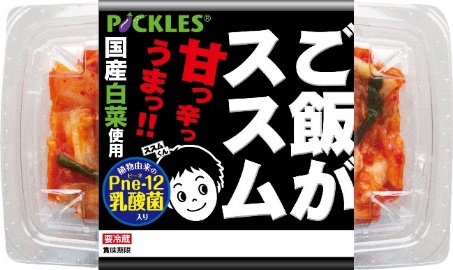
“Gohan ga Susumu Kimchi (kimchi that goes well with rice),” which was released in October 2009 and became a long-selling core product for all generations as the cumulative sales quantity of 3 major products has exceeded about 700 million packs, was embodied based on an idea of a young employee: “kimchi that can be enjoyed by all family members because it is not so spicy” under their stance of taking on challenges, while breaking away from the conventional mindset that kimchi is spicy.
They have developed with an original taste that accentuates sweetness and umami to suit Japanese tastes. In Addition, the package was designed to be slim enough to fit in the refrigerator, and the main color of the package was black instead of red or orange. As a result, the new product was well received by women and children.
They have developed some products in collaboration with some characters and food makers, and expanded the domain of products by utilizing the brand power of the “Gohan ga Susumu Kimchi” series, including delicatessen, seasonings, and frozen food products.
Lightly pickled vegetables and kimchi are made mainly from vegetables and are being reevaluated as low-calorie foods rich in dietary fiber, and future growth in demand is expected.
 |
 |
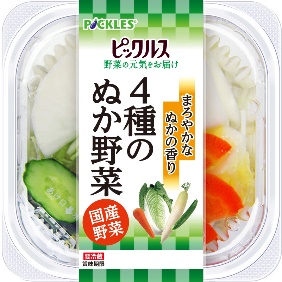 |
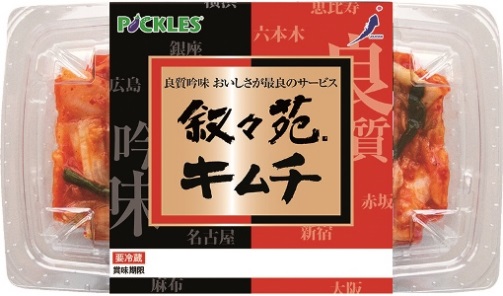
Gohan ga Susumu Kimchi | JOJOEN Pogi Kimchi | 4 Kinds of Bran-flavored vegetables |
(Source: the company)
◎ Delicatessen
The company began handling delicatessen in August 2002 and has been steadily increasing its sales. In recent years, consumers have become more budget-conscious and have been cutting back on eating out, resulting in a growing trend toward eating in at home by buying delicatessen, as well as a change in eating styles due to the increase in the number of elderly people, single-person households, and dual-earner households. Demand for delicatessen is expected to continue to grow in the future.
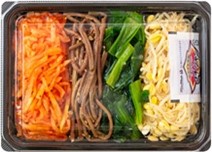
The corporate group is developing products based on the keyword "vegetables," which is one of its strengths, and currently Namul, Salad, rice bran pickles, and other products are doing well. In addition, the corporate group is developing products with originality and added value to its delicatessen, for example, by focusing on different varieties of vegetables and developing salad dressings in-house, etc. In addition, the company utilizes technologies such as pH control to prevent discoloration of green vegetables.
 |
 |
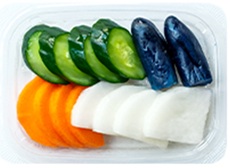 |
4 kinds of Namul Set | Protein-rich Bangbangji Salad | Assortment of rice bran pickles |
(Source: the company)
(Sales Destination)
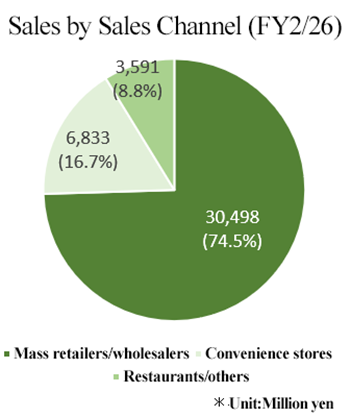
Mass merchandisers, retailers, and wholesalers throughout Japan are the sales destinations, with 74.5% of the total sales channels being mass merchandisers and wholesalers, 16.7% being convenience stores, and 8.8% being restaurants and others as of fiscal year ended February 2026.
(Prepared by Investment Bridge Co., Ltd. based on the company's materials)
1-4 Features, Strengths, and Competitive Advantages
The company has the following features, strengths, and competitive advantages.
(1) Top share in the pickles industry
As mentioned above, PICKLES HOLDINGS group ranked first with consolidated sales of 40.9 billion yen, pulling far ahead of the other companies with a market share of 12.7% while endeavoring to attain its target of a market share of 15% through M&A etc.
(Source: the company)
(2) Highly unique product development capabilities
In order to swiftly and flexibly develop about 400 items per year, they have organized development and marketing teams for respective business partners, including convenience stores, mass retailers, and restaurants, to reflect the opinions of clients in product development and differentiate the products from competitors. The company promotes development from multiple aspects, from the selection of ingredients such as vegetables and seasonings to processing methods, taste, and packaging.
Development personnel are assigned to business establishments around Japan, so that local needs can be grasped and met.
The Research and Development Laboratory, which is responsible for basic research, is engaged in future-oriented initiatives, including research on lactic acid bacteria, such as the plant-derived lactic acid bacteria Pne-12 (Piene lactic acid bacteria), which the company has developed on its own.
(3) Production and distribution system covering the entire country
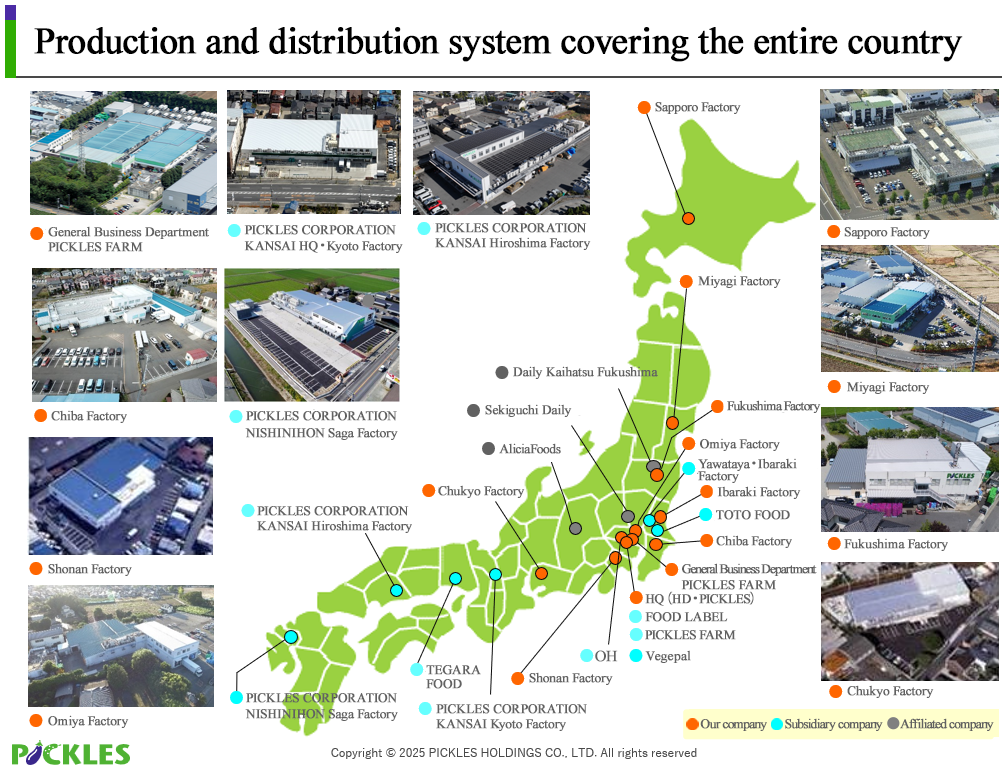
The company operates about 20 production sites. Group companies, mainly PICKLES CORPORATION, cover the entire Japan, and can produce and ship products 365 days a year. It is the only company in the pickles industry that has established a nationwide network of manufacturing, distribution, development, and sales functions. As a result, the company is able to provide the same lightly pickled vegetables, kimchi, and delicatessen to all of its customers' stores nationwide, which is a major selling point for the company.
For production, they have adopted JFS-B as the standards for food safety, and produced an HACCP plan for each factory for pickles and delicatessen, to supply safer and more worry-free products.
(Source: the company)
(4) Proposal-Based Sales with Close Relationships to Customers
There are a broad range of clients, including leading nationwide chains and local small-sized retailers. Their sales offices scattered around Japan had about 60 marketing staff members as of February 2026, who conduct proposal-based marketing for each region and each client and make direct transactions based on the trusting relationships and sales networks they have developed for many years.
In addition to the mainstay lightly pickled vegetables and Kimchi products, the company is enhancing its product lineup for the delicatessen section, and its sales representatives are proposing sales methods, creating sales areas, holding pickle fairs, and considering various approaches to consumers together with the customers. In addition, information obtained from communication with customers is fed back to the company and used for product development based on consumer trends.
(5) Vendor functions to meet the needs of customers
The company has two functions: one as a manufacturer of its own products such as lightly pickled vegetables, kimchi, and delicatessen, and the other as a wholesaler of products such as pickled plums that cannot be manufactured at its own factory, which it purchases from pickle manufacturers throughout Japan. By taking advantage of its vendor function, which allows it to offer both its own products and those of other companies at the same time, the company is able to propose total sales floor development that meets the needs of its customers.
1-5 ROE Analysis
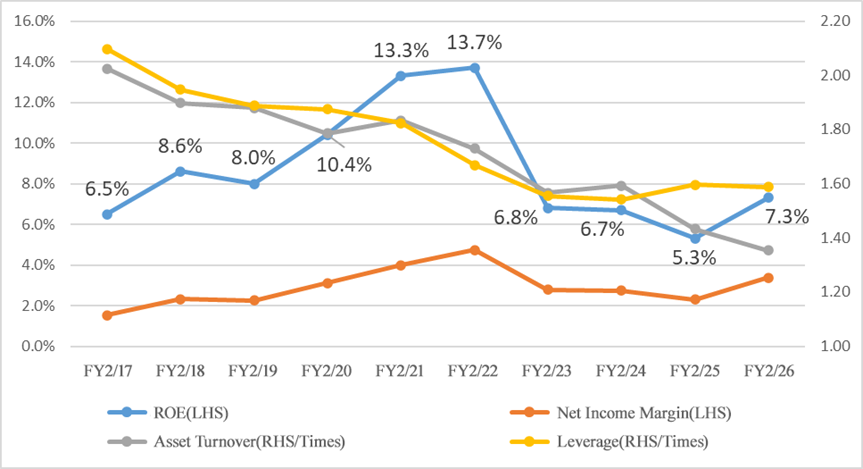
| FY 2/19 | FY 2/20 | FY 2/21 | FY 2/22 | FY 2/23 | FY 2/24 | FY 2/25 | FY 2/26 |
ROE (%) | 8.0 | 10.4 | 13.3 | 13.7 | 6.8 | 6.7 | 5.3 | 7.3 |
Net Profit Margin (%) | 2.26 | 3.11 | 3.98 | 4.73 | 2.77 | 2.73 | 2.31 | 3.38 |
Total Asset Turnover (times) | 1.88 | 1.79 | 1.83 | 1.73 | 1.57 | 1.59 | 1.43 | 1.35 |
Leverage (times) | 1.89 | 1.88 | 1.83 | 1.67 | 1.55 | 1.54 | 1.60 | 1.59 |
*Prepared by Investment Bridge Co., Ltd. based on disclosed material.
ROE was over 10% for 3 consecutive fiscal years until the fiscal year ended February 2022, but it has been lower than 8%, which is the value that should be targeted by Japanese enterprises, although it improved somewhat in the fiscal year ended February 2026. Profitability and asset efficiency need to be improved.
2. Fiscal Year Ended February 2026 Financial Results
2-1 Consolidated Business Results
| FY 2/25 | Ratio to sales | FY 2/26 | Ratio to sales | YoY | Compared to the initial forecast |
Sales | 41,518 | 100.0% | 40,923 | 100.0% | -1.4% | -1.9% |
Gross profit | 8,193 | 19.7% | 8,902 | 21.8% | +8.7% | - |
SG&A expenses | 6,913 | 16.6% | 6,816 | 16.7% | -1.4% | - |
Operating income | 1,279 | 3.1% | 2,085 | 5.1% | +63.0% | +0.3% |
Ordinary income | 1,345 | 3.2% | 2,148 | 5.2% | +59.7% | -0.1% |
Net income | 958 | 2.3% | 1,384 | 3.4% | +44.4% | -3.9% |
EBITDA | 2,284 | 5.5% | 3,227 | 7.9% | +41.3% | - |
*Unit: million yen. EBITDA was calculated with the equation: Operating income + Depreciation. The difference from the forecast means the difference from the earnings forecast announced in September 2025 expressed in percentage.
Sales decreased, but profit increased significantly.
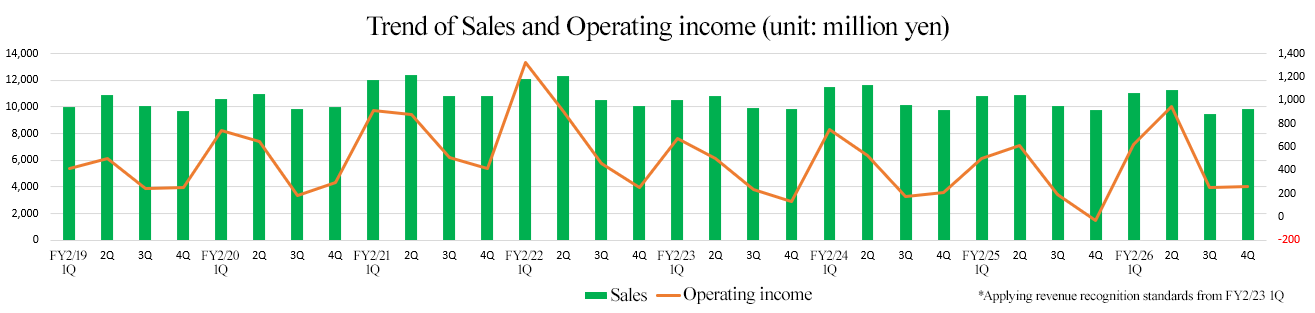
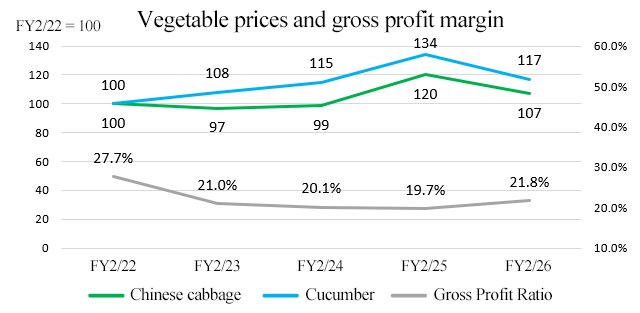
Sales were 40,923 million yen, down 1.4% year on year. In the first half of the fiscal year ended February 2026, sales grew thanks to the campaign of convenience stores, but in the second half, sales were sluggish as consumers became budget-minded and the selection and concentration of products to be procured progressed. Operating income grew 63.0% year on year to 2,085 million yen. Gross profit rose significantly by 8.7% year on year and gross profit margin improved 2.1 points year on year, as the prices of vegetables, such as Chinese cabbages and cucumbers, as ingredients became stable and their measures for improving profitability, such as the revision of prices of Gohan ga Susumu Kimchi and other products turned out to be effective, while SG&A expenses dropped year on year thanks to cost reduction. Sales fell below the forecast, but the prices of vegetables as ingredients were more stable than expected, so operating income exceeded the forecast.
① Trends by Food Item and Sales Channel
◎ Sales by Food Item
| FY 2/24 | Composition ratio | FY 2/25 | Composition ratio | FY 2/26 | Composition ratio | YoY | Compared to the forecast |
Product | 29,259 | 68.0% | 28,702 | 69.1% | 29,000 | 70.9% | +1.0% | -0.3% |
Lightly pickled vegetables /kimchi | 17,545 | 40.8% | 16,769 | 40.4% | 16,465 | 40.2% | -1.8% | -1.4% |
Delicatessen | 11,241 | 26.1% | 11,541 | 27.8% | 12,123 | 29.6% | +5.0% | +1.1% |
Long-term pickled vegetables | 473 | 1.1% | 392 | 0.9% | 412 | 1.0% | +5.1% | +7.3% |
Goods | 13,768 | 32.0% | 12,815 | 30.9% | 11,922 | 29.1% | -7.0% | -5.5% |
Total Sales | 43,028 | 100.0% | 41,518 | 100.0% | 40,923 | 100.0% | -1.4% | -1.9% |
*Unit: million yen. The difference from the forecast means the difference from the earnings forecast announced in September 2025 expressed in percentage.
Sales from lightly pickled vegetables were not strong, but kimchi sold well despite the price revision. Sales from delicatessen items grew steadily. The sales of goods declined, due to the drop in demand for products for industrial use through the rise in commodity prices, as they prioritized measures for improving profit margin.
◎ Sales by Sales Channel
| FY 2/24 | Composition ratio | FY 2/25 | Composition ratio | FY 2/26 | Composition ratio | YoY | Compared to the forecast |
Mass retailers/wholesalers | 32,537 | 75.6% | 31,749 | 76.5% | 30,498 | 74.5% | -3.9% | -1.3% |
Convenience stores | 6,663 | 15.5% | 6,461 | 15.6% | 6,833 | 16.7% | +5.8% | -7.0% |
Restaurants/others | 3,827 | 8.9% | 3,308 | 8.0% | 3,591 | 8.8% | +8.6% | +4.5% |
Total Sales | 43,028 | 100.0% | 41,518 | 100.0% | 40,923 | 100.0% | -1.4% | -1.9% |
*Unit: million yen.
The sales via mass retailers decreased, as they were not able to cover the effects of the revision of selling prices and the selection and concentration of products to be procured. The sales via convenience stores were healthy thanks to sales promotion. The sales to restaurants and others increased. The sales to new restaurants, the sales via drugstores, etc. contributed.
② Gross profit margin and situation surrounding vegetable prices
The prices of vegetables are rising year by year in parallel with commodity prices, but there were few steep price hikes, and the prices of vegetables were stable in the previous fiscal year.
The company strives to improve gross profit margin on a sustainable basis through such continuous efforts as an increase in the number of farmers with which it enters into contracts and establishment of stronger relationships with farmers who have concluded contracts with the company.

2-2 Financial Conditions
◎ Financial conditions
| End of Feb. 2025 | End of Feb. 2026 | Increase/ Decrease |
| End of Feb. 2025 | End of Feb. 2026 | Increase/ Decrease |
Current Assets | 10,888 | 11,579 | +691 | Current liabilities | 8,019 | 6,608 | -1,411 |
Cash | 4,974 | 6,214 | +1,240 | Payables | 2,974 | 2,913 | -61 |
Receivables | 4,083 | 4,550 | +467 | ST Interest-Bearing Liabilities | 2,672 | 852 | -1,820 |
Inventories | 725 | 725 | 0 | Noncurrent liabilities | 3,339 | 3,542 | +203 |
Noncurrent Assets | 19,353 | 18,625 | -728 | LT Interest-Bearing Liabilities | 2,176 | 2,366 | +190 |
Tangible Assets | 17,788 | 17,063 | -725 | Total Liabilities | 11,358 | 10,150 | -1,208 |
Intangible Assets | 186 | 76 | -110 | Net Assets | 18,884 | 20,053 | +1,169 |
Investments and Others | 1,378 | 1,486 | +108 | Total Liabilities and Net Assets | 30,242 | 30,204 | -38 |
Total Assets | 30,242 | 30,204 | -38 | Equity Ratio | 61.0% | 65.1% | +4.1pt |
*Unit: million yen. Interest-bearing liabilities include lease liabilities.
Total assets remained virtually unchanged from the end of the previous fiscal year at 30.2 billion yen, due to the increases in cash & deposits and accounts receivable, and the decrease in tangible assets (buildings, structures, etc.). Total liabilities decreased 1.2 billion yen from the end of the previous fiscal year to 10.1 billion yen, due to the decrease in short-term interest-bearing liabilities, etc. Net assets augmented 1.1 billion yen from the end of the previous fiscal year to 20 billion yen, due to the increase in retained earnings.
Capital-to-asset ratio rose 4.1 points from the end of the previous fiscal year to 65.1%.
3. Fiscal Year Ending February 2027 Earnings Forecasts
3-1 Consolidated Earnings Forecast
Major income statements
| FY 2/26 | Ratio to sales | FY 2/27 Est. | Ratio to sales | YoY |
Sales | 40,923 | 100.0% | 41,000 | 100.0% | +0.2% |
Gross profit | 8,902 | 21.8% | 8,607 | 21.0% | -3.3% |
SG&A | 6,816 | 16.7% | 6,787 | 16.6% | -0.4% |
Operating Income | 2,085 | 5.1% | 1,820 | 4.4% | -12.7% |
Ordinary Income | 2,148 | 5.2% | 1,860 | 4.5% | -13.4% |
Net Income | 1,384 | 3.4% | 1,231 | 3.0% | -11.0% |
EBITDA | 3,227 | 7.9% | 3,042 | 7.4% | -5.7% |
*Unit: million yen. EBITDA is calculated by operating income + depreciation.
It is forecast that sales will grow slightly and profit will decline.
Sales are forecast to grow 0.2% year on year to 41 billion yen. They will actively conduct marketing activities by utilizing their nationwide network and engage in the development of a wide array of products, but the sales growth is projected to be slight because consumers will tend to save money.
Operating income is forecast to decline 12.7% year on year to 1.8 billion yen, and EBITDA is projected to drop 5.7% year on year to 3 billion yen. Gross profit is forecast to decrease 3.3% year on year, due to the strategic investment in equipment, the augmentation of production costs through the rise in commodity prices, etc. Gross profit margin is forecast to decline 0.8 points year on year. Profit is projected to drop, although they will curtail SG&A expenses by streamlining business operations throughout the company. They aim to steadily increase actual figures excluding temporary positive factors in the previous fiscal year.
The impact of the growing tension in the Middle East has not been taken into account in their budget, because the situation is unclear.
They plan to pay a dividend of 29.00 yen/share like in the previous fiscal year. The expected payout ratio is 29.5%.

3-2 Initiatives
◎ Sales by Food Item
| FY 2/26 | Composition ratio | FY 2/27 Est. | Composition ratio | YoY |
Product | 29,000 | 70.9% | 28,893 | 70.5% | -0.4% |
Lightly pickled vegetables /kimchi | 16,465 | 40.2% | 16,703 | 40.7% | +1.4% |
Delicatessen | 12,123 | 29.6% | 11,675 | 28.5% | -3.7% |
Long-term pickled vegetables | 412 | 1.0% | 515 | 1.3% | +24.8% |
Goods | 11,922 | 29.1% | 12,106 | 29.5% | +1.5% |
Total Sales | 40,923 | 100.0% | 41,000 | 100.0% | +0.2% |
*Unit: million yen.
They will reinforce the functions as a vendor by utilizing their networks for procurement and sales and know-how for fabless business. While producing more products in house, they will procure more products, with the aim of optimizing the product mix composed of original and purchased products.
◎ Sales by Sales Channel
| FY 2/26 | Composition ratio | FY 2/27 Est. | Composition ratio | YoY |
Mass retailers/wholesalers | 30,498 | 74.5% | 30,702 | 74.9% | +0.7% |
Convenience stores | 6,833 | 16.7% | 6,599 | 16.1% | -3.4% |
Restaurants/others | 3,591 | 8.8% | 3,698 | 9.0% | +3.0% |
Total | 40,923 | 100.0% | 40,999 | 100.0% | +0.2% |
*Unit: million yen.
At mass retailers, they will promote products in mini deli cups to increase sales.
For convenience stores, they will maintain sales by implementing measures that are consistent with clients’ product policies.
The sales in the fields of restaurants and others are expected to increase, through the cultivation of sales channels for procured products and products for industrial use.
◎ Plan of SG&A Expenses
| FY 2/26 | Ratio to sales | FY 2/27 Est. | Ratio to sales | YoY |
Total SG&A expenses | 6,816 | 16.7% | 6,787 | 16.6% | -0.4% |
Logistics cost | 2,294 | 5.6% | 2,428 | 5.9% | +5.8% |
Personnel cost | 2,934 | 7.2% | 2,946 | 7.2% | +0.4% |
Advertising cost | 38 | 0.1% | 35 | 0.1% | -7.9% |
Others | 1,549 | 3.8% | 1,376 | 3.4% | -11.2% |
Sales | 40,923 | 100.0% | 41,000 | 100.0% | +0.2% |
*Unit: million yen.
While costs, including distribution costs, are forecast to keep augmenting, they will curtail SG&A expenses by streamlining business operations throughout the company and maintain the cost structure that is not easily affected by the external environment.
4. Progress of Medium/Long-Term Management Strategy
4-1 Overall picture
Taking into account management challenges such as the “improvement of profitability considering the soaring prices of raw materials and personnel costs,” the “improvement of PBR” and “expansion of the business scale throughout the group by creating new growth drivers,” the company is promoting the priority strategies of “elevation of profitability,” “management conscious of capital efficiency” and “endeavoring to develop new products and enter new fields.” They aim to become “a general maker in the fields of vegetables, fermentation, and health” that will keep creating new value, which is their ideal state.
The current progress is as follows.
4-2 Progress of priority strategies
(1) Elevation of profitability
The company is working to “improve its operating income margin” and “reduce costs.”
Measures to improve its operating income margin include “narrowing down the number of items” and “revising selling prices in response to soaring costs.”
Their measures for the reduction of costs are “streamlining and automation of the production system” and “revision and streamlining of raw material procurement.”
① Improvement of operating income margin
<To narrow down items>
At Tokorozawa Factory, which is their core factory, they decreased the number of items, mainly minor products handled in small lots, by around 10% year on year in the fiscal year ended February 2025. We were able to reduce it by 10% in the fiscal year ended February 2026, too, attaining their goal.
They carefully communicated with respective clients to reduce the number of items, while proposing alternate products.
While reducing the number of items by about 10% in a year, they were able to keep sales unchanged from the previous year.
Simulation results indicate that if man-hours decrease 20% through the selection and concentration of items, gross profit will rise 1% although it depends on conditions.
At other factories, too, they specified the standard number of items while considering production capacity, and are promoting reduction in the entire group.
At the factories for producing pickled vegetables and delicatessen foods throughout Japan, the company was able to cut the number of items by 8% in the fiscal year ended February 2026 compared to the same period of the year before. Taking into account the fact that sales will drop if the company just reduces the number of items because each of the company’s factories has requirements to satisfy, the company will continue to take measures by considering such matters as the characteristics of each area, requirements regarding each sales destination, and the profitability by item.
<To revise selling prices in response to soaring costs>
As costs for ingredients, human resources, and distribution augmented, they revised selling prices of kimchi imported directly from South Korea and cucumber pickled in rice bran for all clients, by 2024. In September 2024, the company started to raise prices for the three mainstay products in the “Gohan ga Susumu Kimchi” series at wholesalers and some retailers. In May 2025, the company started to raise prices of the three main products of its flagship "Gohan ga Susumu Kimchi" series at all retailers, including mass retailers and convenience stores, and also changed the amount per product.
The annual average of the in-store selling price of Gohan ga Susumu Kimchi in the fiscal year ended February 2026 was 194 yen, up 5.5% from the previous fiscal year, exceeding the average price hike rate in the entire kimchi market: 4.7%.
The company will review and change other products one after another, such as lightly pickled vegetables, while monitoring the balance between the impact on sales and profit improvement, as well as the reaction of retailers.
② Reduction of costs
<Streamlining and automation of the production system>
The investment amount is approximately 5 billion yen, and Ibaraki Factory, which began full-scale operation in December 2024, produces the "Gohan ga Susumu Kimchi" series for the entire Kanto region. The maximum production capacity is over 10,000 packs per hour. However, they are producing over 90% of the maximum amount in the specs.
The gross profit per man-hour in the fiscal year ended February 2026 is over two times larger than the average of Pickles Corporation.
The company plans to establish a stable production system that can be operated throughout the year and maximize production capacity, and have Ibaraki Factory take over production from Miyagi Factory, which produces products for the Tohoku area, and Chukyo Factory, which produces products for the Chukyo and Hokuriku areas.
The company is working to improve production efficiency and automation at its factories other than Ibaraki Factory.
At Tokorozawa Factory, the company will transfer a dedicated production line to the group company TEGARA FOOD (Hyogo and Himeji), improving the production capacity and manufacturing efficiency of “Gohan Ga Susumu Kimchi” in western Japan. In addition to improving quality by utilizing AI-based sorting machines and inspection devices, the company also aims to adopt machines in its various production processes, which could help save manpower and reduce the number of personnel (such as machines for removing the core of Chinese cabbages that are equipped with AI-powered machine learning cameras), and realize a production and logistics system that does not use containers.
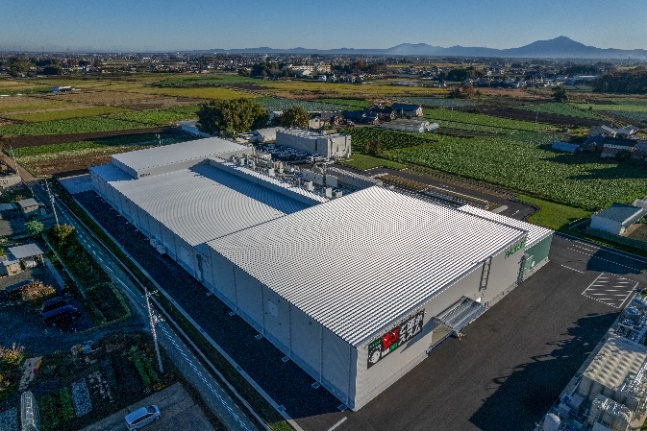 |
Ibaraki Factory |
<Review and streamlining of procurement of raw materials and ingredients>
Divisions related to raw materials and ingredients, such as “Ingredient Division,” which is in charge of vegetables, “Food Product Material Division,” which handles seasonings, and “Packaging Material Division,” which handles packaging materials, are aware of issues and promote respective initiatives.
Division | Policy | Initiatives |
Vegetables: Ingredient Division | * To procure vegetables while considering weather risks and changes in the market environment * To develop systems for procuring local vegetables as ingredients | * To hedge risks for Chinese cabbage, which is a main ingredient, by increasing suppliers * To utilize more stored Chinese cabbage when prices and quality are stable * To disperse risks in areas of production by procuring ingredients from nearby regions of factories around Japan, and strengthen local procurement networks |
Seasonings: Food Product Material Division | * Stable purchase with reference to the information on areas of production, exchange rates, and market prices of ingredients | * To take into account exchange rates * To reconsider suppliers and commercial distribution, including the direct transactions with producers * To conduct procurement by taking advantage of the scale of their corporate group and regional characteristics |
Packaging materials: Packaging Material Division | * To review and revise manufacturing processes and reduce losses thoroughly * To decrease the risk of price fluctuations by optimizing the procurement network | * To reduce the dependence on crude oil by decreasing the weight of each container (thinning) and shifting to plant-derived or recycled materials * To curtail procurement costs by unifying and sharing the specs for packaging materials in their corporate group * To cut down on losses in in-house production processes based on the cooperation among factory staff, equipment engineers, marketing and development sections * To realize stable procurement by gathering information from existing and new business partners and controlling the inventory in packaging material makers and factories |
(2) Management conscious of capital efficiency
Regarding the “Measures to realize management that is conscious of capital costs and share prices” requested by the Tokyo Stock Exchange, the company’s analysis and future initiatives are as follows.
(Analysis of the current situation)
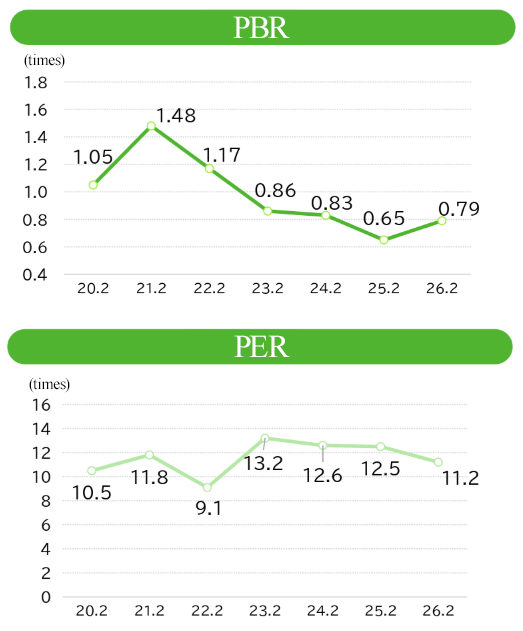
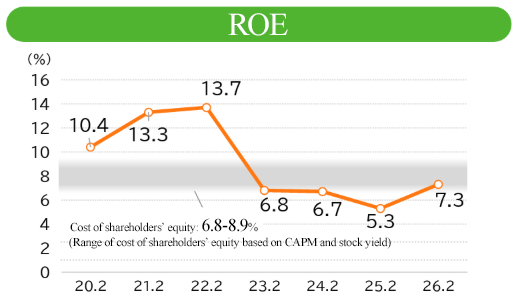
Since the COVID-19 subsided, ROE has declined and PBR has been less than 1.
The company estimates that cost of shareholders’ equity is 6.8 to 8.4% in the CAPM and about 8.9% based on stock yield.
ROE had been above 8% until the fiscal year ended February 2022, but it has been less than 8% for four consecutive fiscal years since the fiscal year ended February 2023.
They think that ROE needs to recover to over 9%, exceeding the cost of shareholders’ equity.
 |
 |
(Source: the company)
(General measures)
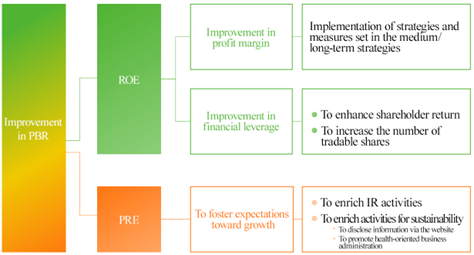
As of the end of February 2026, they satisfied all of the criteria for remaining listed on the Prime Market of Tokyo Stock Exchange, including the required market capitalization of tradable shares. They will carry out the measures disclosed in “the plan for meeting the criteria for remaining listed” and make efforts to grow sustainably and improve medium/long-term corporate value.
(Source: the company)
(Shareholder return)
The company understands that shareholder return is one of its key business issues, so the company will enrich its shareholder return while combining dividends and shareholder benefits. Regarding dividends, they changed their dividend policy from stable dividends to progressive dividends where the dividend amount is maintained or increased.
They also announced the enrichment of their shareholder benefit system. They have been providing shareholders holding 100 or more shares with some selectable benefits. In addition, they will provide shareholders holding 200 or more shares with a QUO card worth 2,000 yen.
(Capital allocation)
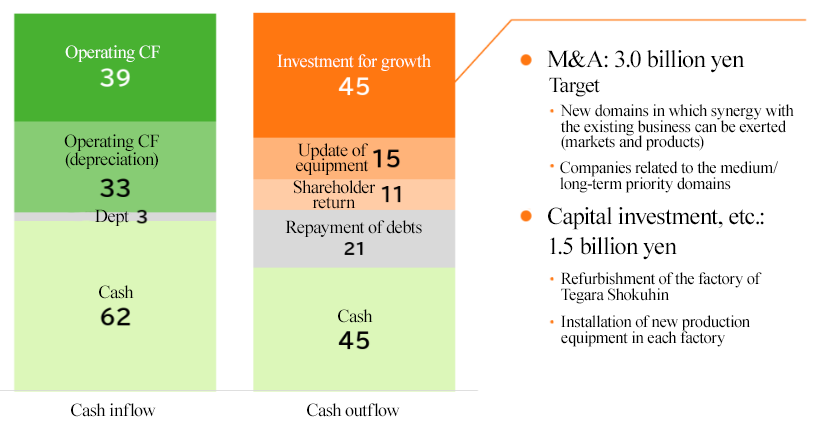
Regarding “Measures to realize management that is conscious of capital costs and share prices,” the company recognizes that the demonstration of Capital allocation to investors is important. The company will invest 4.5 billion yen in growth during the three years from the fiscal year ending February 2027 to the fiscal year ending February 2029. Of this, they plan to invest 3 billion yen in M&A targeting new fields (markets and products) which allow for synergy with existing businesses, and enterprises in the medium/long-term priority fields and 1.5 billion yen in the production of the mini cup series for the selling space for lightly pickled products and labor-saving equipment.
(Source: the company)
(3) Endeavoring to develop new products and enter new fields
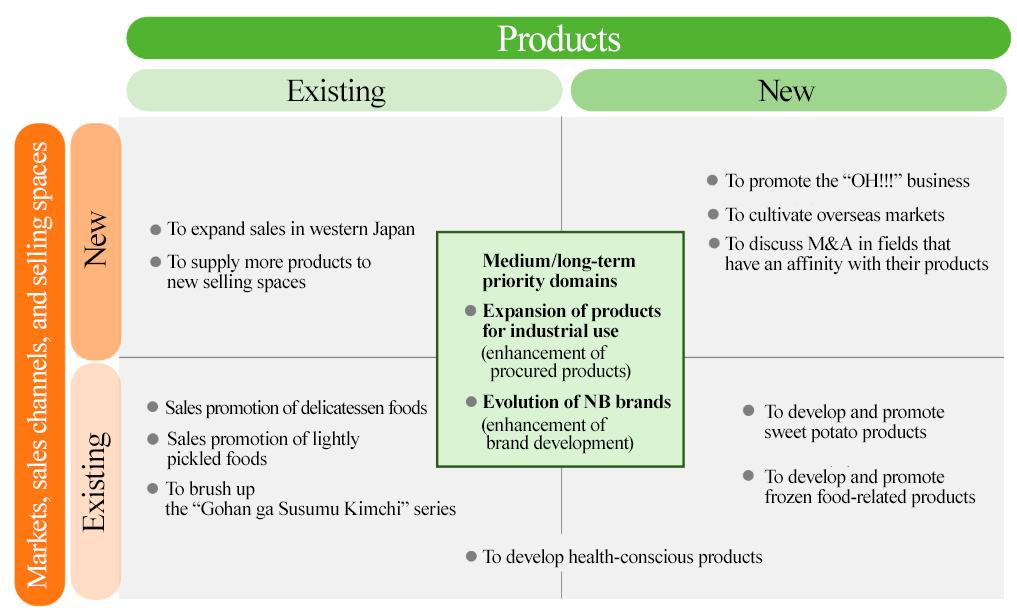
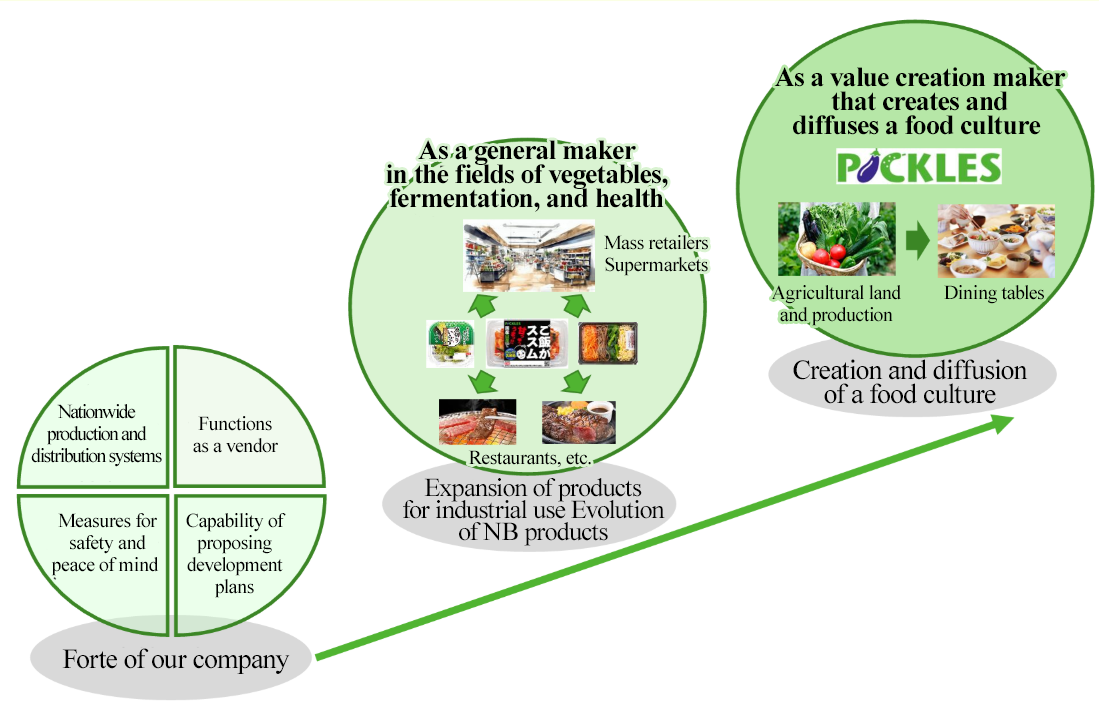
With reference to the previous strategies for new businesses, they defined the medium/long-term priority domains as “the expansion of products for industrial use: enhancement of procured products” and “the evolution of national brand (NB) products: enhancement of brand development.”
Based on their forte, including “the nationwide production and distribution systems,” “the functions as a vendor to meet the needs of clients,” “initiatives for safety and peace of mind,” and “capabilities of developing and proposing very unique products,” they aim to concentrate on the two new domains to become an ideal general maker in the fields of vegetables, fermentation, and health, and then become a value creating maker that fosters and introduces a new food culture.
 |
 |
(Source: the company)
① Regarding the priority domains
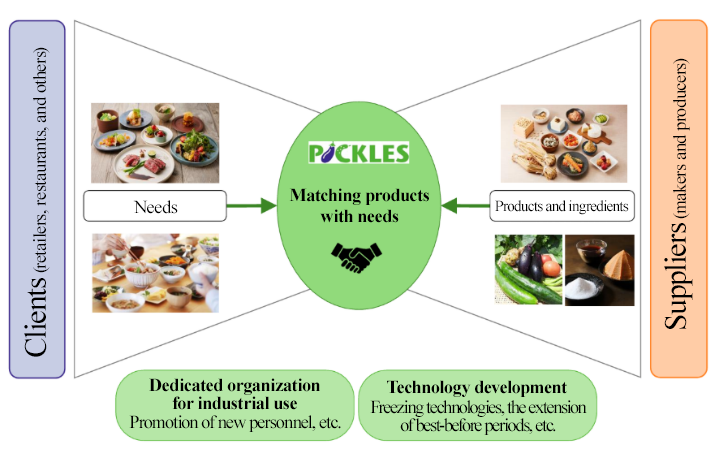
Priority domain (1) Expansion of products for industrial use: enhancement of procured products
They will match the needs of clients with the products of suppliers and fuse their proposals, to develop and offer new products in the field of products for industrial use, establish an organization dedicated to products for industrial use, and promote new personnel. They plan to concentrate on the development of technologies for frozen products, the extension of best-before periods, etc.
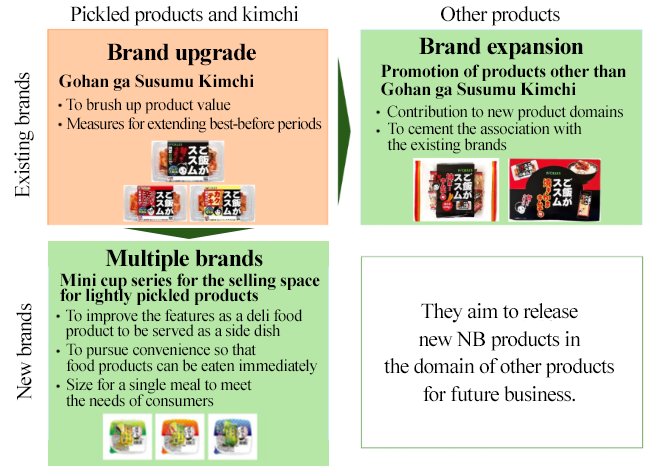
Priority domain (2) Evolution of national brand (NB) products: enhancement of brand development
They aim to become a “general maker” by “expanding their existing brand,” centered around “Gohan ga Susumu Kimchi,” and “operating multiple brands” by launching new brands. For the operation of multiple brands, they will launch the mini cup series for the selling space for lightly pickled products.
They aim to release new NB products in other product fields.
Priority domain 1 Expansion of products for industrial use: Enhancement of procured products
 | Priority domain 2 Evolution of national brand (NB) products: Enhancement of brand development
 |
(Source: the company)
② Main measures
In addition, they continuously engage in the following primary measures.
◎ Brushing up the "Gohan ga Susumu Kimchi" series
Currently, the "Gohan ga Susumu Kimchi" series is the top brand of kimchi.
Sales of “Gohan ga Susumu Kimchi” were on a downward trend through the fiscal year ended February 2023, but have begun to show signs of recovery due to efforts to increase sales through non-supermarket channels such as drugstores in western Japan and promotional campaigns. Based on sales figures using the previous revenue recognition standard, sales have returned to the record-high levels seen during the fiscal year ended February 2021, when demand from housebound consumers arose due to the COVID-19 pandemic.
In the future, the company aims to become the top brand in "rice accompaniments" that are indispensable to rice and appear on the dinner table every day by popularizing products other than kimchi such as easy-to-prepare products, seasonings, frozen foods, and delicatessen foods.
As a concrete measure, the company plans to create fans and promote awareness of the group's product lineup other than kimchi and strive to enhance the customer loyalty through direct communication with customers via "Pickles Shokudo," a fan community site opened in February 2025. The company also plans to explore potential needs and use them in product development for national brands that will lead to increased sales and profits.
◎Developing health-conscious products
As consumers become more health-conscious, the market of health-conscious foods and foods with functional claims is growing. However, manufacturers are developing new products one after another, intensifying competition. The delicatessen food market has also been growing since the COVID-19 pandemic.
In such market environment, they will enhance products pickled in rice bran by utilizing their original pickling technology, in order to survive the competition based on their strengths. In addition, they will add the rice malt blended with the plant-derived lactic acid bacteria Pne-12 to the dough of bread offered by “OH!!!” to add value to various products.
The company has released a "Protein-rich Bangbangji Salad" in the delicatessen food category as a health-conscious product. They are also developing packages and products that highlight its patented the plant-derived lactic acid bacteria Pne-12."
◎ Cultivation of overseas markets
In countries where it is difficult to grow or harvest vegetables, the demand for frozen food products is expected to grow, so it is considered that there is a business chance there. In particular, the markets in Hong Kong and Singapore where food self-efficiency ratio is low and there are many high-income individuals are promising, but the hurdle to local production is high.
Accordingly, they will export products made in Japan. For the foreseeable future, they will export mainly room-temperature and frozen food products. They have tentatively exported some products of rice bran and frozen kimchi pot dishes. They are also proceeding with the export of sweet potato products of VEGEPAL. They will promote the collaborations with Japanese exporting companies and try to cultivate mainly Asian markets in Vietnam, Hong Kong, etc.
They will keep targeting Asia, and cultivate the market with frozen food products. In North America, they are surveying the market.
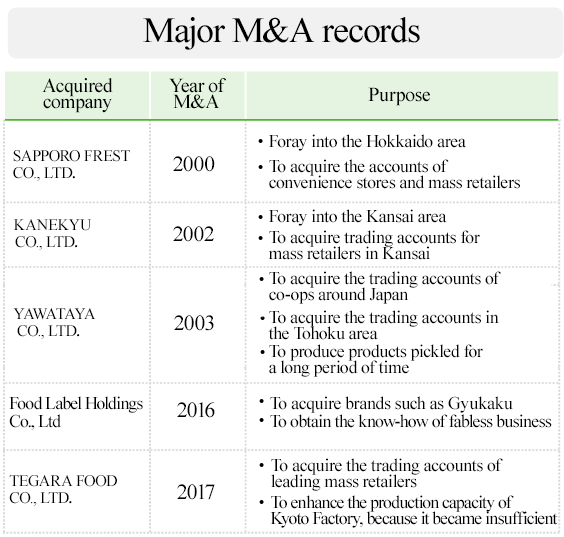
◎ Discussion on M&A in fields with which the company has an affinity
They have conducted the following M&A projects so far. They have accumulated the know-how for post-merger integration (PMI), and will keep conducting M&A projects for accelerating growth.
Assumed target enterprises and fields are those with which the company can evolve or improve their capabilities of development, manufacturing, and sale, which are the strengths of the company and which possess functions, customer bases, products, or human resources the PICKLES Group does not have, so it can be expected that synergetic effects will be produced soon.
(Source: the company)
◎ Development and sales promotion of products related to sweet potatoes
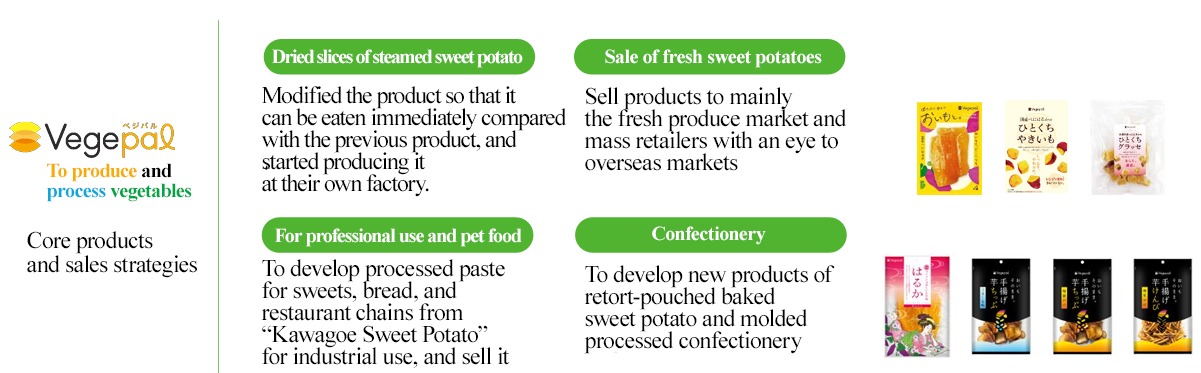
The purposes of use and selling methods of sweet potatoes grown in Japan have diversified, due to the growth of demand for baked sweet potato and the popularization of processed products, such as dried slices of steamed sweet potato, and sweet potato as an ingredient for sweets. As inquiries from outside Japan have increased, export has grown.
VEGEPAL CO., LTD. which is a joint-venture firm, stably receives orders from leading clients. It not only endeavors to improve its core products, but also has established a system for producing dried slices of steamed sweet potato at its own factory.
In the future, in addition to propelling forward the development of products that differentiate the company from other companies and the expansion of channels for selling such products, the company will strive to increase the sale of sweet potato products while enriching the raw material procurement capability of PICKLES FARM CO., LTD., one of its subsidiaries, and cooperating with its group companies.
(Source: the company)
◎ Development and sales promotion of frozen food-related products
The demand for frozen food is growing, because it is possible to shorten cooking time and reduce the amount of waste food significantly.
Leading makers have significant advantages in selling products to consumers, and competition is fierce. Demand for frozen food items for professional use is strong due mainly to labor shortages at restaurants and the like, which means that the demand is highly likely to keep growing.
For consumers, they released “Gohan ga Susumu Kimchi-nabe (kimchi pot dish as an accompaniment to rice)” by utilizing the technology for maintaining the texture of vegetables, which was developed through the production of lightly pickled vegetables, to differentiate their products, and tentatively started selling some products, including the frozen Gohan ga Susumu Kimchi, Chinese cabbage with yuzu, okra, and frozen delicatessen food.
Regarding frozen food items for professional use whose transactions were started, the company is raising the number of clients on the basis of the standards set by the client companies with which it is intensely conducting transactions now.
Regarding products for consumers, they will develop side dishes, snacks for alcoholic beverages, sweets, etc. by utilizing strengths. For industrial use, they will expand sales channels to the wholesalers of frozen food products and local restaurants around Japan, while increasing transactions with the existing clients.
They will promote “Gohan ga Susumu Kimchi” in overseas markets, including North America and Hong Kong.
4-3 Numerical goals
| FY 2/26 | Ratio to sales | FY 2/27 (Plan) | Ratio to sales | FY 2/28 (Plan) | Ratio to sales | FY 2/29 (Plan) | Ratio to sales | CAGR |
Sales | 40,923 | 100.0% | 41,000 | 100.0% | 42,000 | 100.0% | 44,000 | 100.0% | +2.5% |
Gross Margin | 8,902 | 21.8% | 8,607 | 21.0% | 8,862 | 21.1% | 9,416 | 21.4% | +1.9% |
SG&A expenses | 6,816 | 16.7% | 6,787 | 16.6% | 6,972 | 16.6% | 7,348 | 16.7% | +2.5% |
Operating Income | 2,085 | 5.1% | 1,820 | 4.4% | 1,890 | 4.5% | 2,068 | 4.7% | -0.3% |
Ordinary Income | 2,148 | 5.2% | 1,860 | 4.5% | 1,960 | 4.7% | 2,138 | 4.9% | -0.2% |
Net income | 1,384 | 3.4% | 1,231 | 3.0% | 1,300 | 3.1% | 1,420 | 3.2% | +0.9% |
*Unit: million yen. CAGR is the average annual growth rate from the fiscal year ended February 2026 to the fiscal year ending February 2029. Calculated by Investment Bridge Co., Ltd.
It is expected that sales will grow and profit will decline between the fiscal year ended February 2026 and the fiscal year ending February 2029, and they will aim to grow further by developing the medium/long-term priority domain as a growth driver. The company will review and revise the forecasts for the fiscal year ending February 2027 and subsequent years at the beginning of each fiscal year as it executes its rolling plan.
◎ Variation for each food item
| FY 2/26 | FY2/29 (Plan) | CAGR |
Lightly pickled vegetables /kimchi | 16,465 | 18,595 | +4.1% |
Delicatessen | 12,123 | 12,068 | -0.2% |
Long-term pickled vegetables | 412 | 545 | +9.8% |
Goods | 11,922 | 12,791 | +2.4% |
Total | 40,923 | 44,000 | +2.5% |
*Unit: million yen. CAGR is the average annual growth rate from the fiscal year ended February 2026 to the fiscal year ending February 2029. Calculated by Investment Bridge Co., Ltd.
The sales of lightly pickled vegetables and kimchi are expected to grow steadily.
◎ Variation for each sales channel
| FY 2/26 | FY2/29 (Plan) | CAGR |
Mass retailers/wholesalers | 30,498 | 30,825 | +0.4% |
Convenience stores | 6,833 | 6,866 | +0.2% |
Restaurants/others | 3,591 | 6,308 | +20.7% |
Sales | 40,923 | 44,000 | +2.5% |
*Unit: million yen. CAGR is the average annual growth rate from the fiscal year ended February 2026 to the fiscal year ending February 2029. Calculated by Investment Bridge Co., Ltd.
The sales to restaurants and others are projected to increase significantly.
◎ Capital investment and depreciation
| FY 2/24 | FY 2/25 | FY 2/26 | FY 2/27 (Plan) | FY 2/28 (Plan) | FY 2/29 (Plan) |
Capital investment | 951 | 4,700 | 419 | 1,500 | 800 | 900 |
Depreciation | 940 | 1,005 | 1,141 | 1,210 | 1,106 | 1,053 |
*Unit: million yen.
In the fiscal year ending February 2027, they plan to invest in equipment for promoting the mini cup series in each area as well as increasing the capacity of producing Gohan ga Susumu Kimchi in western Japan. Such investment activities are expected to contribute to the improvement in profitability, the expansion of sales channels for products for industrial use, and the sales of new products from the fiscal year ending February 2027. Deprecation will reach a peak in fiscal year ending February 2027.
5. Conclusions
The “expansion of products for industrial use” and the “evolution of national brand (NB) products” were clearly defined as their medium/long-term priority domains. For the “expansion of products for industrial use,” they will match the needs of clients with the products of suppliers and fuse their proposals, to develop and offer new products in the field of products for industrial use, establish an organization dedicated to products for industrial use, and promote new personnel. They plan to concentrate on the development of technologies for frozen products, the extension of best-before periods, etc. For the “evolution of national brand (NB) products,” they will concentrate on the “strengthening of brands.” They aim to become a “general maker” by “expanding their existing brand,” centered around “Gohan ga Susumu Kimchi,” and “operating multiple brands” by launching new brands such as products for the spaces for selling lightly pickled products that can be served as deli food more easily. Both require new endeavors while taking advantage of their own strengths. We would like to pay attention to how swiftly they will implement their strategies.
<Reference: Regarding Corporate Governance>
◎ Organization type, and the composition of directors and auditors
Organization type | Company with an audit and supervisory board |
Directors | 6 directors, including 2 from outside (including 2 independent directors) |
Auditors | 4 directors, including 3 from outside (including 3 independent directors) |
◎ Corporate Governance Report (Updated on May 30, 2025)
Basic Policy
Our company considers corporate governance to be the important issue of business management for acting in conformity with the law and social norms, realizing the management policies, and achieving continuous growth.
<Reasons for Non-compliance with the Principles of the Corporate Governance Code (Excerpts)>
[Principle 1-4: Policy Retention Co.]
In principle, our company will not hold the shares of listed companies. However, if we hold shares for a reasonable purpose, such as the maintenance or strengthening of transaction relationships, we regularly check whether the purpose is satisfied.
We will discuss methods for examining the appropriateness of strategic shareholding and disclosing the detailed information on strategic shareholding.
Regarding the exercise of voting rights for strategically held shares, we judge each case individually. We appropriately exercise voting rights, while comprehensively considering whether they would contribute to the improvement in mid/long-term corporate value of our company and invested companies.
[Supplementary Principle 2-4-①]
Our group promotes highly motivated and skilled employees to management posts regardless of age, nationality, gender, etc. Regarding the promotion to management posts, the ratio of female managers is 8.6%, and we will increase this ratio. The percentage of women in management positions above is based on the values of PICKLES CORPORATION (our main subsidiary). For non-Japanese employees, the ratio of them is low, so we have not set a goal for them. For mid-career workers, we promote them to management posts while comprehensively considering their experiences, abilities, etc., so we have not set a goal for them.
With the aim of honing the ability of each employee, we make efforts to foster the stance of learning voluntarily, adopting systems for supporting self-development, incentives for acquiring qualifications, etc. In addition, we recognize the development of a comfortable working environment as an important management issue, so our corporate group has adopted refreshing holidays, overtime-free working days, etc.
[Supplementary Principle 3-1-③]
Regarding sustainability, we recognize the environment, safety, reliability, etc. as important issues, and take initiatives. As the investment in human capital, we develop educational systems and pursue a comfortable working environment for employees, and as the investment in intellectual property, we research lactic acid bacteria, etc. These are disclosed via our ESG reports and IR documents, which are available in our website. For more information about our corporate group's sustainability efforts, please visit our website.
We will consider disclosure based on the TCFD, a globally established disclosure framework, or an equivalent framework, going forward.
<Disclosure based on the Principles of the Corporate Governance Code (Excerpts)>
[Principle 3-1 Enrichment of information disclosure]
(1) Our corporate philosophy and policy are disclosed in our website, etc.
(2) Our basic policy for corporate governance is disclosed in this report.
(3) The basic policy for our directors’ remuneration is to contribute to the sustainable improvement in corporate performance and value and set the remuneration of each director at an appropriate level according to each post. In detail, the remuneration of each executive director is composed of the basic remuneration, which is fixed, a bonus, and a stock option. The remuneration of each outside director is composed of only the basic remuneration, because of their duties. The details of the policy and procedure for determining the remuneration of each director are disclosed in this report.
(4) The board of directors choose candidates for internal directors from those who possess expertise in their respective fields and can respond to changes in the business environment swiftly and accurately, and candidates for outside directors from those who can oversee our business administration from an objective, independent standpoint without seeking the benefits of the management or specific stakeholder. Candidates for auditors are chosen by the board of auditors from those who possess plenty of experience and advanced insight, and then determined by the board of directors after having discussions and reaching an agreement. If the above policy for appointing directors cannot be fulfilled or a director violates or is suspected of violating a law, a regulation or the articles of incorporation, the board of directors will discuss the dismissal of said director.
(5) The reasons for choosing candidates for directors and auditors are disclosed in convocation notices for a general meeting of shareholders.
[Supplementary Principle 4-11①]
The board of directors of our company is composed of directors who possess technical knowledge and plenty of experience in respective fields, such as business administration and finance, while securing an appropriate scale and diversity of gender, work history, and age so that the board can fulfill its roles and duties effectively. The policy and procedure for appointing directors are as described in Section (4) of “Principle 3-1.”
This report discloses the skill matrix, which lists the knowledge, experience, abilities, etc. of each director. Independent outside directors include those who have the experience of business administration in another company.
[Principle 5-1. Policy on Constructive Dialogue with Shareholders]
With a basis in transparency, fairness, and continuity, we strive to disclose information promptly so that our shareholders and investors can understand our company correctly.
We will strive to disclose information based on related laws and regulations such as the Financial Instruments and Exchange Act as well as the timely disclosure rules established by financial instruments exchange, and to actively disclose information that can be considered effective for understanding our company with appropriate measures.
In detail, a financial results briefing sessions is held twice a year, and a briefing session for individual investors is held when necessary, and the representative director and president gives explanations. Individual interviews are handled by the publicity/IR division. We have the persons in charge thoroughly manage insider information when holding dialogue with shareholders.
We strive to make the most of opinions and other feedback obtained through dialogue with shareholders by sharing them with the directors and reporting them to the board of directors as needed.
[Measures to realize management that is conscious of capital costs and stock prices]
Regarding measures to realize management that is conscious of capital costs and stock prices, these measures are described in the reference material for the session for briefing the financial results for the fiscal year ended February 2025 held on April 18, 2025. This material is disclosed on the company's website (https://pickles-hd.co.jp/ir/).
This material considers such matters as the enhancement of profitability, the enrichment of shareholder returns, and ambitious initiatives to develop new products and break into new fields to be our company’s medium/long-term important strategies. We will aim to raise our corporate value and the price of the shares in our company by showing how our corporate group should operate our business as we grow, actually implementing the ideal way to run business, and attaining our medium-term management goals and improving capital efficiency. We also endeavor to improve our price book-value ratio (PBR) through these initiatives.
This report is not intended for soliciting or promoting investment activities or offering any advice on investment or the like, but for providing information only. The information included in this report was taken from sources considered reliable by our company. Our company will not guarantee the accuracy, integrity, or appropriateness of information or opinions in this report. Our company will not assume any responsibility for expenses, damages or the like arising out of the use of this report or information obtained from this report. All kinds of rights related to this report belong to Investment Bridge Co., Ltd. The contents, etc. of this report may be revised without notice. Please make an investment decision on your own judgment. Copyright(C) Investment Bridge Co., Ltd. All Rights Reserved. |