


Bridge Report:(3538)WILLPLUS the First Half of the Fiscal Year ending June 2026

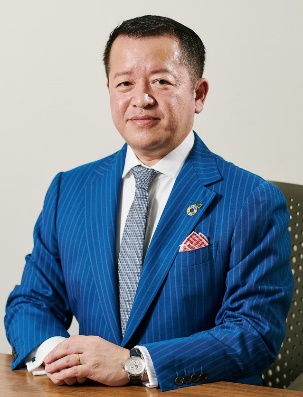 President Takaaki Naruse | WILLPLUS Holdings Corporation (3538) |
 |
Company Information
Market | TSE Standard |
Industry | Retail (Commercial) |
President | Takaaki Naruse |
HQ Address | 5-13-15, Shiba, Minato-ku, Tokyo, Shiba Mita Mori Building 8th Floor |
Year-end | June |
Homepage |
Stock Information
Share Price | Shares Outstanding (Term-end) | Total Market Cap | ROE Act. | Trading Unit | |
¥1,047 | 10,358,400 shares | ¥10,845 million | 14.0% | 100 shares | |
DPS Est. | Dividend Yield Est. | EPS Est. | PER Est. | BPS Act. | PBR Act. |
¥46.00 | 4.4% | ¥143.62円 | 7.3x | ¥1,187.23 | 0.9x |
* The share price is the closing price on April 1. From the Brief Report on Financial Results for the Second Quarter of the Fiscal Year Ending June 2026. ROE and BPS are figures in the previous fiscal year.
Earnings Trend
Fiscal Year | Sales | Operating Income | Ordinary Income | Net Income | EPS | DPS |
June 2022 Act. | 39,696 | 2,366 | 2,377 | 1,550 | 162.84 | 34.90 |
June 2023 Act. | 44,115 | 1,867 | 1,943 | 1,302 | 135.45 | 41.17 |
June 2024 Act. | 47,745 | 1,494 | 1,559 | 1,124 | 116.46 | 43.51 |
June 2025 Act. | 88,614 | 1,849 | 1,897 | 1,443 | 158.43 | 45.06 |
June 2026 Est. | 92,160 | 2,328 | 2,244 | 1,305 | 143.62 | 46.00 |
*Unit: million yen or yen. Estimates are those of the company.
This report includes Willplus Holdings Corporation's financial results for the first half of the fiscal year ending June 2026, earnings forecast for the fiscal year ending June 2026, and other information.
Table of Contents
Key Points
1. Company Overview
2. Mid- to Long-Term Strategy
3. Growth Strategy
4. 1H of Fiscal Year ending June 2026 Earnings Results
5. Fiscal Year ending June 2026 Earnings Forecasts
6. Conclusions
<Reference: Regarding Corporate Governance>
Key Points
- Willplus Holdings Corporation is a holding company with 7 dealers handling 17 brands of imported cars, including Jeep, BMW, Mini, and Volvo, and a consolidated subsidiary that operate used-car purchase, wholesale, and export. It is actively working to expand its business through an M&A strategy with an aim to acquire "new areas" and "new brand." At the same time, while continuing to "maximize business," the company is also committed to "maximizing GHG emissions reduction" by "greening its stores," seeing "solving climate change issues" as an "opportunity."
- In the first half of the fiscal year ending June 2026, sales increased 2.5% year over year to 42,096 million yen. This increase was driven by higher demand in the used car market and our expanded service network. Operating income increased 18.8% year on year to 813 million yen. Gross profit increased 7.1%, outpacing the sales growth rate, due to improved profitability at subsidiaries acquired through M&A in the previous fiscal year. Gross profit margin increased 0.6 percentage points year on year. Although selling, general, and administrative expenses, including labor costs, rent, and depreciation, augmented, these costs were fully absorbed. This was also aided by the absence of special investigation related expenses incurred during the same period in the previous year.
- There are no changes to the earnings forecast. They expect net sales to increase 4.0% year on year to 92,160 million yen and operating income to increase 25.9% to 2,328 million yen. Although the domestic imported car market is projected to remain sluggish, new sales are expected to hit a record high. Despite the challenging business environment, the "Imported Car Dealership Business" will continue to conduct M&A to expand its revenue base, aiming to improve profitability through post-merger integration (PMI). They expect earnings to improve as their "used car export business" enters its peak season in January. They plan to pay a dividend of 46.00 yen per share, up 0.94 yen per share from the previous fiscal year. The expected dividend payout ratio is 32.0%.
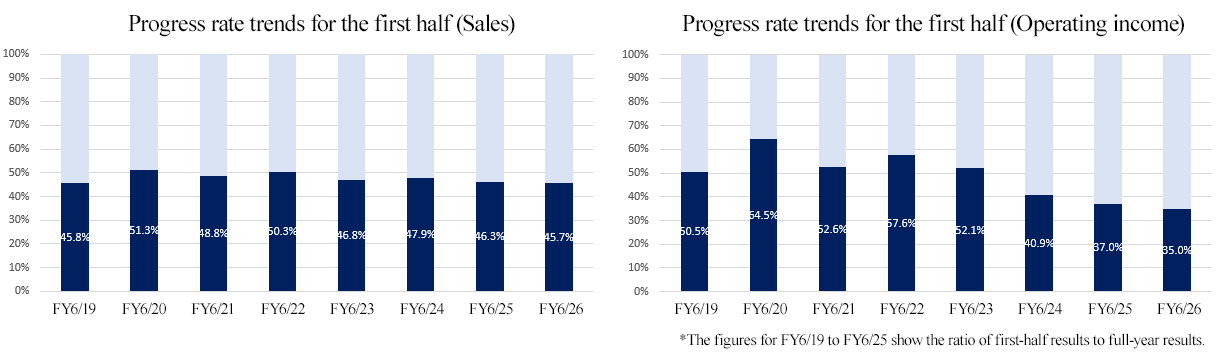
- Progress rates in the first half of the year were 45.7% for net sales and 35.0% for operating income. Net sales were almost unchanged from those in the previous years, while operating income remained low. The majority of factors in the increase in profits resulted from the PMI effect and the normalization of one-time factors in the previous fiscal year. Although there are negative factors, such as a decline in insurance commission revenue, which had been growing steadily until now, due to regulatory changes, attention is focused on how much profit the company can accumulate in the second half of the fiscal year through further profitability improvements driven by PMI. While this will contribute to the performance in the next fiscal year and beyond, we also anticipate progress in strengthening the revenue base through a series of M&A transactions.
1. Company Overview
Willplus Holdings Corporation is a holding company with 7 dealers handling 17 brands of imported cars, including Jeep, BMW, Mini, and Volvo, and a consolidated subsidiary that operate used-car purchase, wholesale, and export. It focuses on improving customer satisfaction and pursues growth through a multi-brand strategy, a dominant strategy, and an M&A strategy. It has a significant advantage in business revitalization capabilities in the M&A field. The company aims for further growth, taking the major environmental changes surrounding automobiles, including the shift to EVs, as an opportunity.
[1-1 Corporate History]
In January 1997, the father of President Takaaki Naruse established Sunflower CJ Co., Ltd., an imported car sales company, in Kitakyushu City, Fukuoka Prefecture. The company was the first official Chrysler dealer in western Japan.
In October 2004, President Naruse acquired all of the company's shares and started business activities as the Willplus Group.
Although it was a small dealer with a few staff members, including President Naruse, it achieved excellent results nationwide in sales of Chrysler cars and received high acclaim, which led him in 2005 to take over Chrysler's directly managed store in Ohta-ku, Tokyo, and advance to Tokyo. In 2006, the company opened a store in Kurume City, Fukuoka Prefecture. It also started a dominant strategy in Tokyo and Fukuoka.
Willplus Holdings Corporation was established in October 2007 to flexibly acquire dealers through optimal allocation of management resources and prompt management decision-making.
Under the holding company structure, the company actively expanded its business scope and was listed on the JASDAQ of the Tokyo Stock Exchange in March 2016. In September 2017, as the market changed, it shifted to the Second Section of the Tokyo Stock Exchange, and then it was listed on the First Section of the Tokyo Stock Exchange in February 2018. The company got listed on the Prime Market of Tokyo Stock Exchange in April 2022 in step with the market restructuring, and then listed on the Standard Market in October 2023.
[1-2 Corporate Philosophy]
In this section, we state the company's significance and core values.
Our Significance (MISSION STATEMENT) We propose a life with imported cars, share affluence, fun, and joy with more people, and continue to take on the challenge of drawing warm smiles on the face of everyone involved. |
Core Values ・Love our cars, love our colleagues, and work with pride. ・Always take on challenges and break through our limits. ・Achieve great results through teamwork. ・Make sure we reach our goal on time. ・Never give up until the end, and do our best. ・Provide richness, enjoyment, and joy. ・Never forget to be sincere and grateful. |
[1-3 Market Environment]
The business environment, which is essential in understanding the company, is as follows.
Regarding the business environment related to the M&A strategy, which is the company's growth driver, see
“2. Mid- to Long-Term Strategy”.
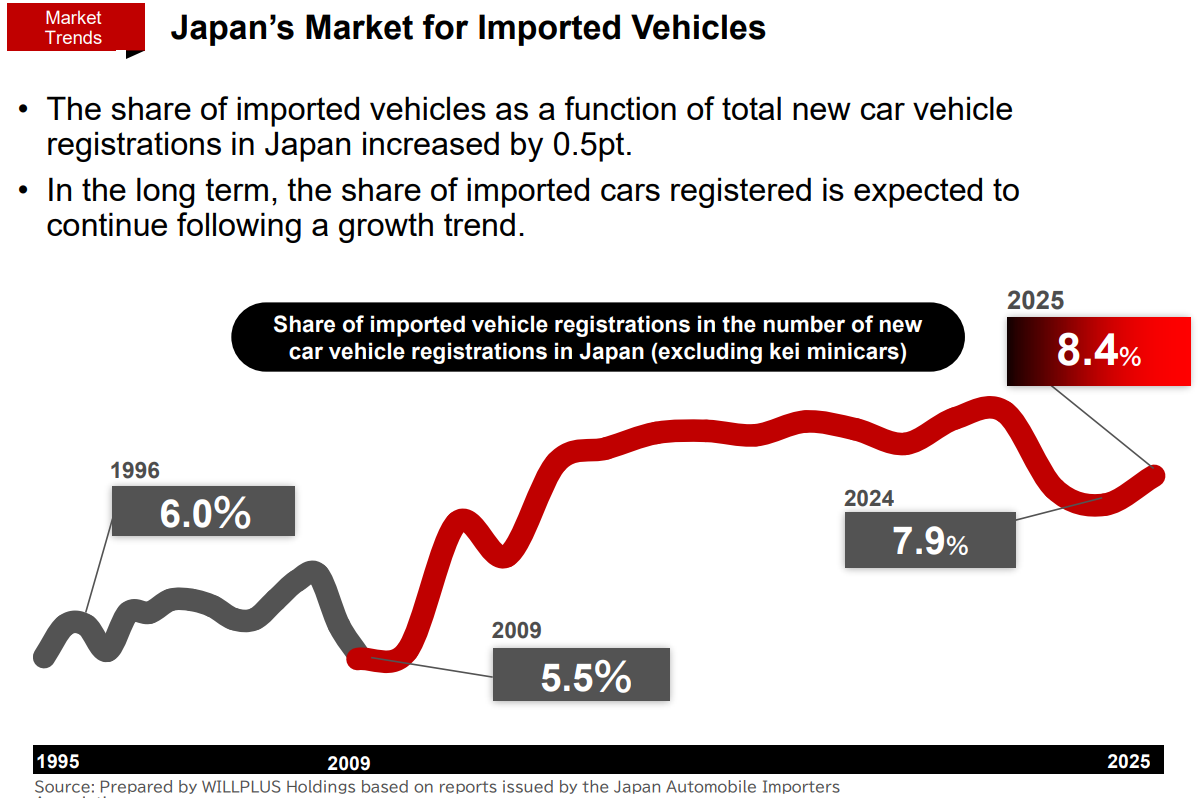
◎ The share of imported cars in the domestic passenger car market continues to increase, and the number of imported cars owned in Japan is growing steadily.
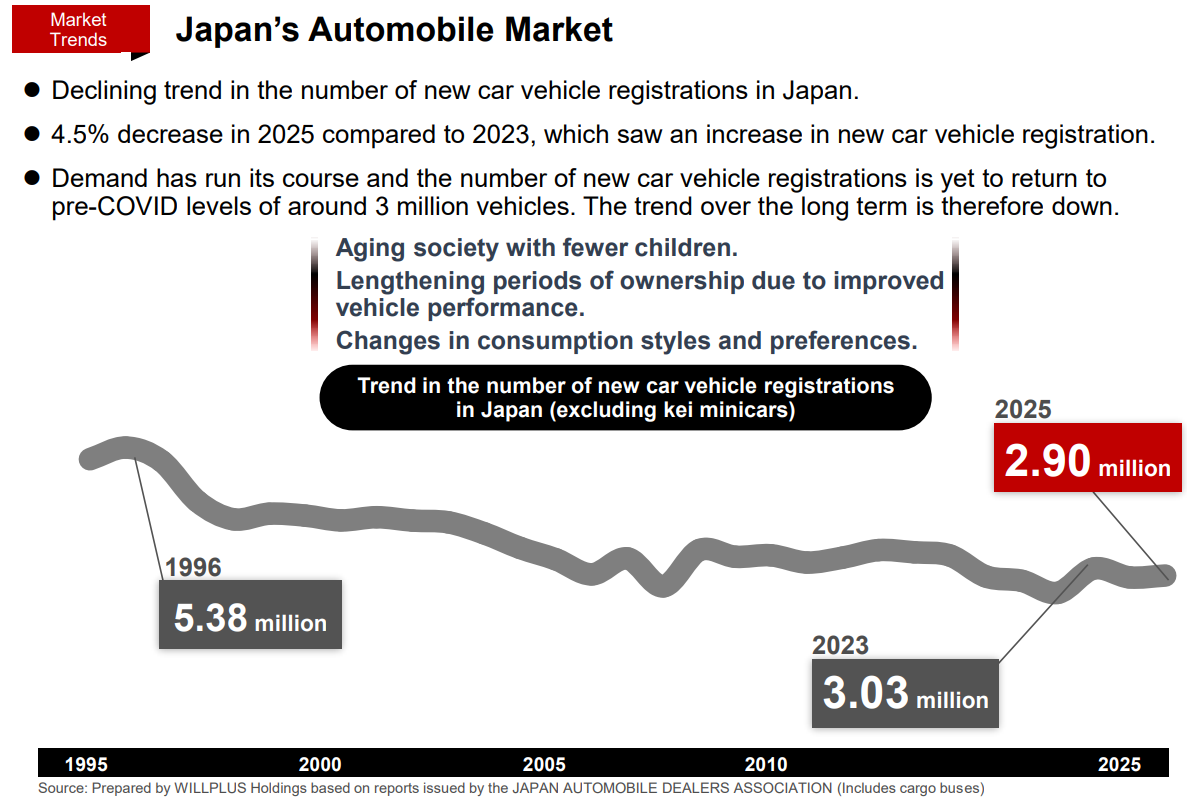
The number of new cars registered in Japan shows a decreasing trend due to the declining birth rates and aging population, the prolongation of the period of owning a car due to the elevation of functionality, changes in consumption styles and preferences (decrease of young people who own automobiles), etc.
(From the reference material of the company)
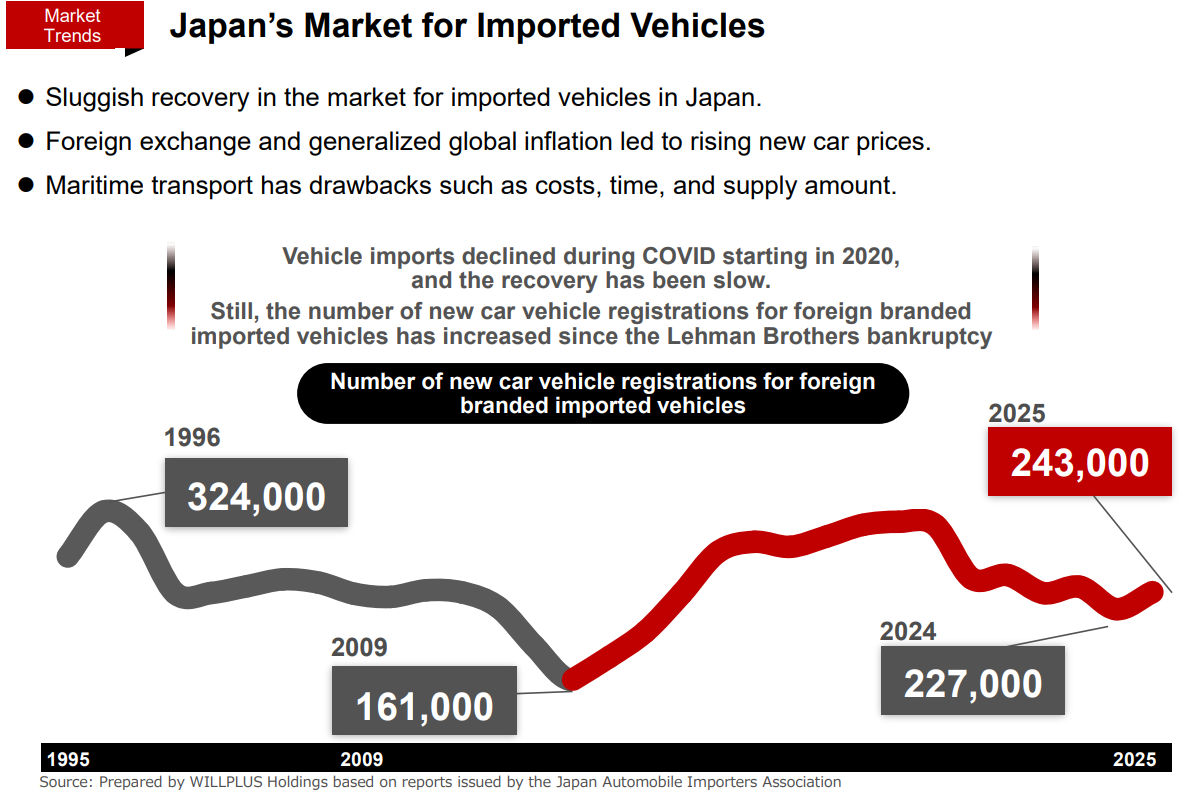
Against this backdrop, the recovery of the domestic imported vehicle market has been sluggish due to the rise in new car prices due to exchange rate fluctuations and inflation. However, the market share of imported vehicle registrations (foreign manufacturers) increased 0.5 percentage points year on year in 2025. In the long term, the market share of imported vehicle registrations is increasing.
 |
 |
(From the reference material of the company)
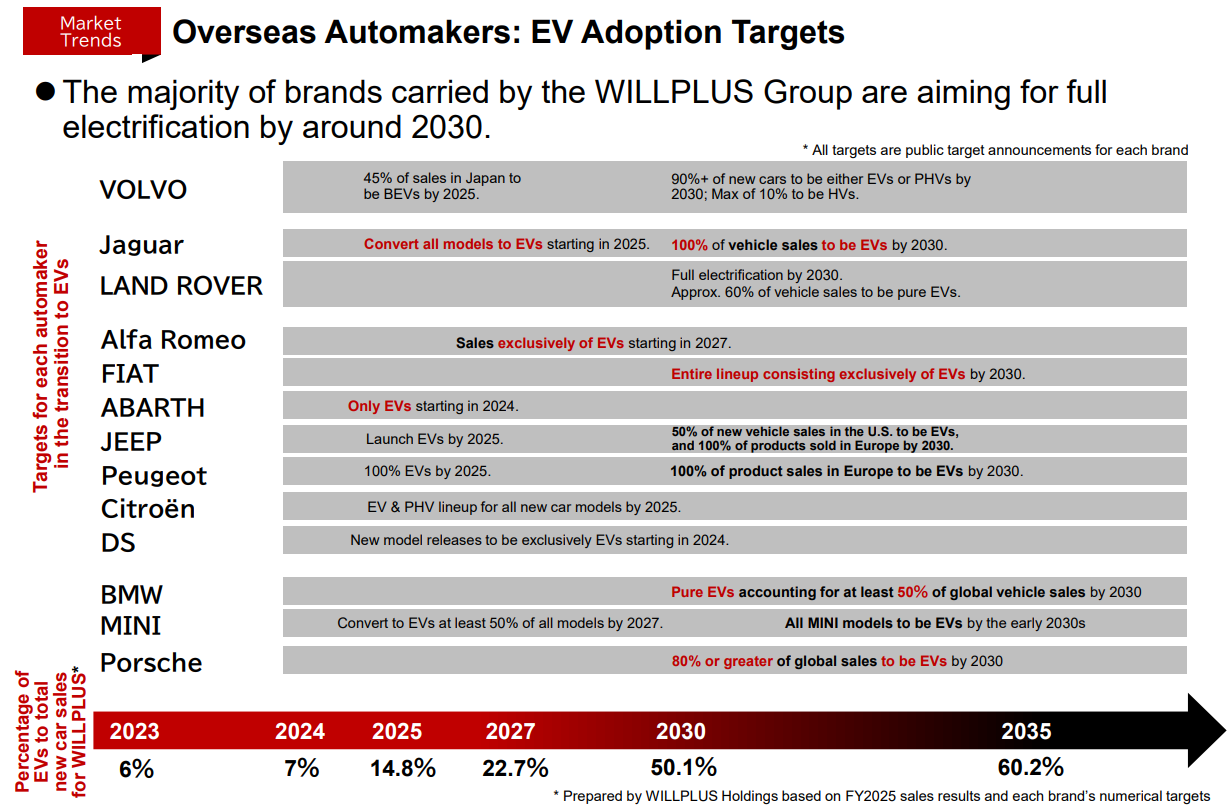
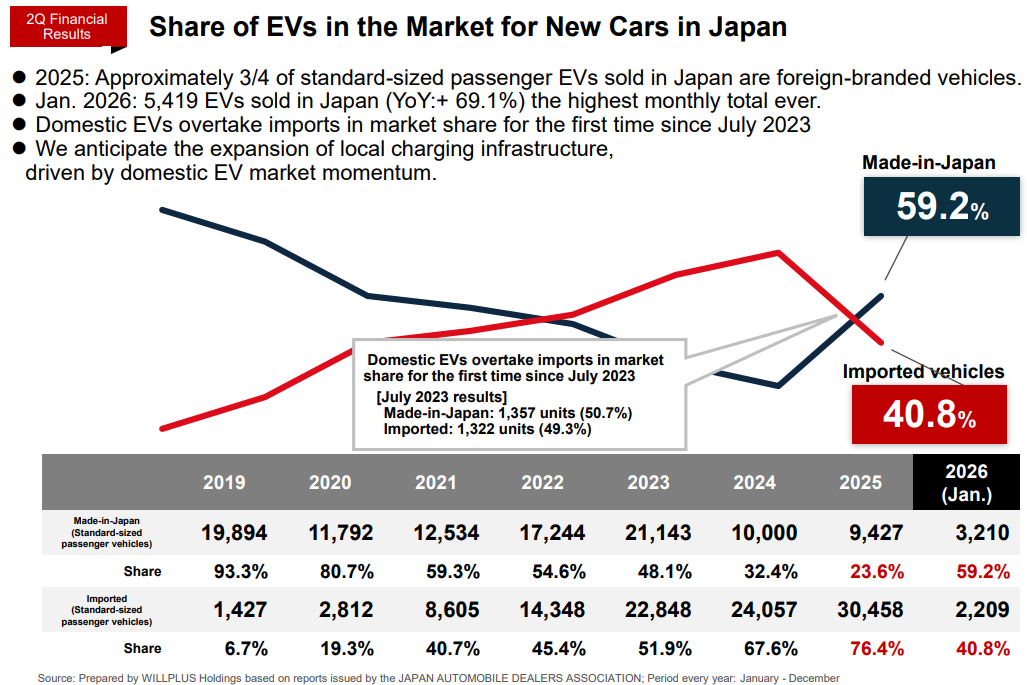
The imported car manufacturers are proactively addressing environmental issues and the majority of brands in which the company deals have announced plans aiming for complete electrification by 2030. On the other hand, while Japanese manufacturers have set targets for EV sales volume and sales ratios, their expansion pace has been slower than overseas competitors; however, in January 2026, the share of domestically produced EVs in the domestic new car market exceeded that of imported vehicles. This is the first time since July 2023. The revitalization of the domestic EV market is expected to lead to the expansion of infrastructure.
 |
 |
(From the reference material of the company)
◎ Comparison with other companies in the same industry
Code | Company | Sales | Sales growth rate | Operating income | Profit growth rate | Operating income margin | ROE | Market Capitalization | PER | PBR |
3184 | ICDAHLD | 38,500 | +0.8 | 1,910 | +5.4 | 5.0% | 13.0 | 9,114 | 7.2 | 0.9 |
3538 | Willplus HLD | 92,160 | +4.0 | 2,328 | +25.9 | 2.5% | 14.0 | 10,845 | 7.3 | 0.9 |
7593 | VT HLD | 370,000 | +5.2 | 13,000 | +19.7 | 3.5% | 7.4 | 62,516 | 8.6 | 0.9 |
8291 | Nissan Tokyo Sales HLD | 132,000 | -6.8 | 4,600 | -37.9 | 3.5% | 7.6 | 30,981 | 11.5 | 0.5 |
9856 | KU HLD | 155,000 | -3.1 | 8,600 | -6.4 | 5.5% | 10.1 | 53,613 | 6.8 | 0.6 |
* Units: million yen and %. Sales and operating income are company forecasts for this term. ROE is the result of the previous fiscal year. Market capitalization is the number of shares at the end of the most recent quarter × the closing price on March 24, 2026. PER (forecasted figures) and PBR (actual figures) are based on the closing price on March 24, 2026.
Although ROE is the highest, PBR remains below 1 with PER being single-digit. The company expects to make steady progress with the measured mentioned in “2-5 Measures for Achieving Management Focusing on Capital Costs and Stock Prices” below.
[1-4 Business Description]
(1) Overview
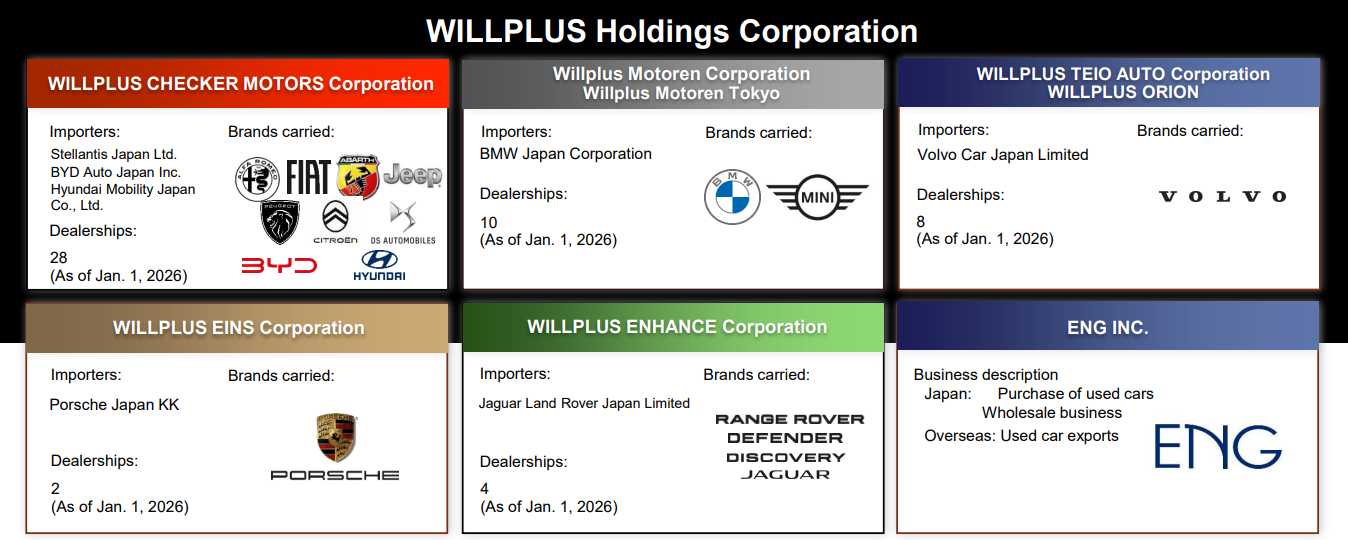
Under the holding company Willplus Holdings Corporation, eight consolidated subsidiaries engage in sales of imported new and used cars, vehicle maintenance, non-life insurance agency business, and used-car export. The company handles 17 brands. The company has an official dealer contract with an importer (a company that handles imported cars in Japan) for each brand it handles.
(From the reference material of the company)
(2) Segments
There are two segments to be reported: the imported vehicle dealer business and the used car export-related business.
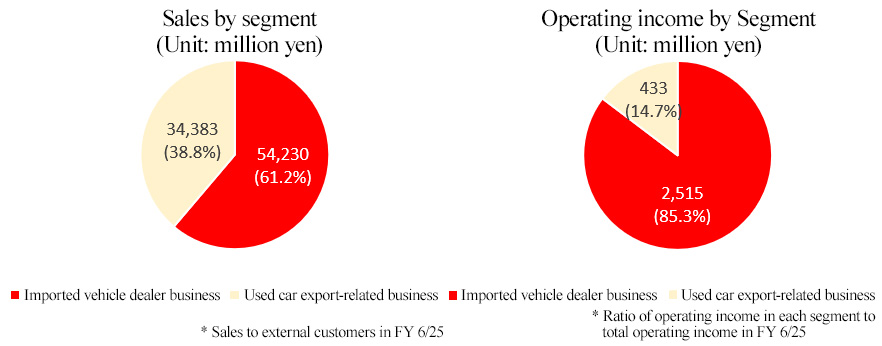
(3) Products and services (business description)
The company discloses sales classified into the categories of new cars, used cars, auto auction sales, vehicle maintenance and other services in the summary of financial results. The company also discloses the domestic and overseas breakdowns of used car sales.
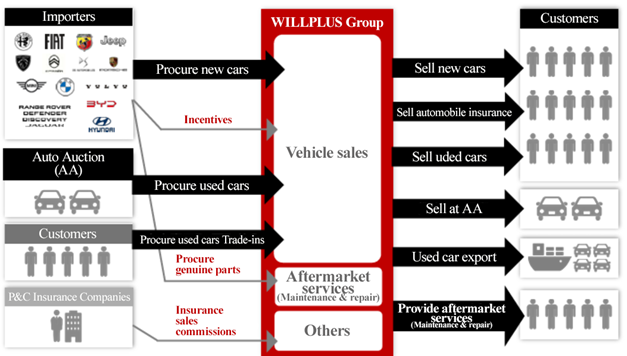
(From the reference material of the company)
Products and Services | Description |
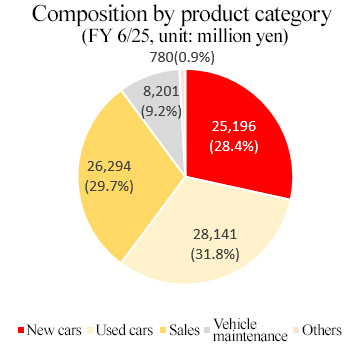 |
New cars | As authorized dealers, the companies sell all new car brands procured from each importer. | |
Used cars | It mainly sells certified used cars of recent models of each brand with a short travel distance. Products are purchased through trade-ins at the time of selling new cars, purchases, and automobile auctions. ENG INC. exports used cars purchased in Japan mainly to Malaysia. | |
Sales | It sells trade-in used cars of other brands at automobile auctions. In addition, at the request of dealers of other companies, it may sell new and used vehicles owned by the corporate group. | |
Vehicle maintenance | The main services are maintenance, repair, and inspection of the sold vehicles. With the exception of some stores, service centers are set up alongside showrooms. | |
Others | It sells compulsory automobile liability insurance and voluntary insurance as an agent for non-life insurance companies. Incentive income related to new car sales from importers is also included. |
Although the sale of new cars is the main business. The company is focusing on the sale of used cars and strengthening customer relationships by providing services that customers need after purchasing a car, such as vehicle maintenance and car insurance sales.
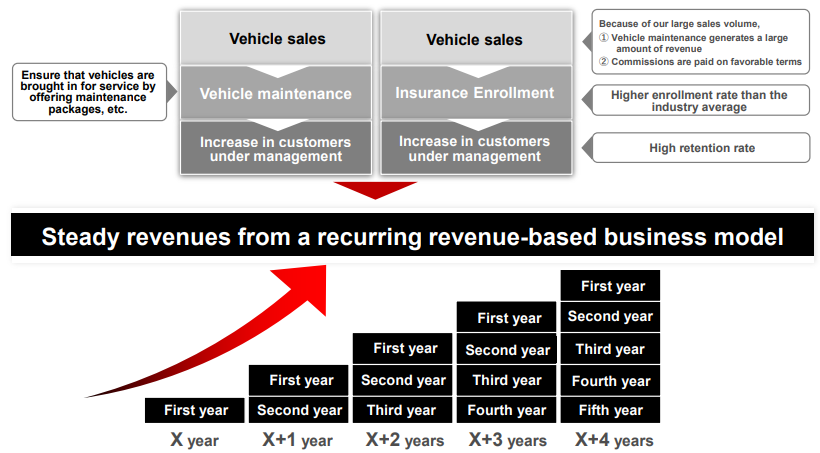
Regarding vehicle maintenance, maintenance packages are provided to ensure maintenance after sale. As for insurance sales, the provision of detailed information on insurance products has been highly evaluated, and the enrollment and retention rates are higher than the industry average.
In addition to “the increase in the number of units sold = the increase in one-shot revenue,” an increase in the number of stores through M&A has led to an increase in recurring revenue in the form of “increase in the number of car maintenance and insurance contracts.”
Additionally, the inclusion of the "used car export-related business" in the business portfolio has enabled the company to enter a growing market and mitigate foreign exchange risk on a group-wide basis.
(4) Number of stores
As of the end of January 2026, the number of stores is 24 in Kyushu, 23 in Tokyo, Kanagawa and Saitama, 1 in Yamaguchi, 2 in Miyagi, and 2 in Fukushima, for a total of 52 stores.
[1-5 Characteristics, Strengths, and Competitive Advantages]
(1) Advanced capability to revitalize business through M&A
From the perspective of "purchasing time," many companies currently use M&A strategies as a pillar of their growth strategies. It goes without saying that finding excellent deals and executing them at appropriate prices are essential for a successful M&A. However, the post-M&A process called PMI (Post Merger Integration) to create the expected synergy effect is seen as more important. There are countless cases of M&A failing due to a lack of prior assessment of factors that impede integration and the inability to manage differences in corporate culture.
Under such circumstances, investors should pay attention to the company's business revitalization ability. Since the establishment of Willplus Holdings in October 2007, the company has carried out 10 M&A deals to date. All deals have turned profitable. *Excluding those conducted less than last three fiscal years.
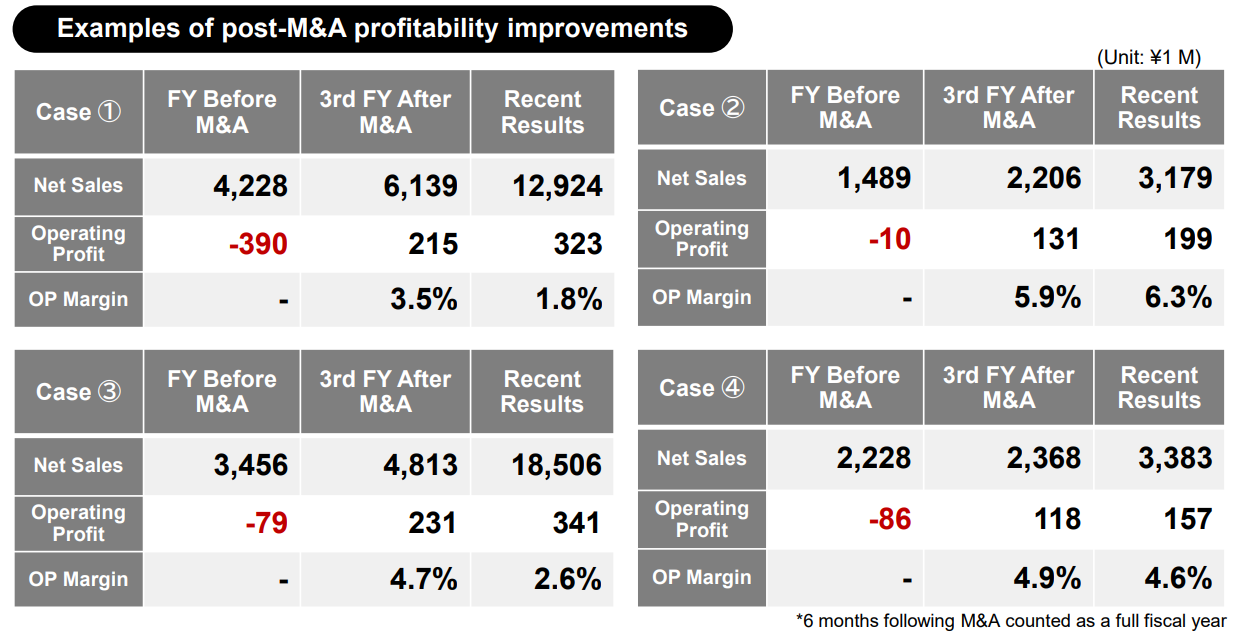
(From the reference material of the company)
The key to a successful M&A is sharing philosophies, such as pursuing the improvement of customer satisfaction and clarifying the evaluation criteria, which includes respecting challenges to the maximum extent possible. The company believes these key factors can drastically change companies and has great confidence in its ability to revitalize its business.
(2) The only listed company whose main business is being an authorized dealer of imported cars
While there are many companies that are authorized dealers of imported cars while mainly relying on selling used cars, the company is the only listed company that mainly sells new cars.
The company estimates that the scale of the new imported car market will reach 1.75 trillion yen in 2025. Believing that the share of imported cars in the domestic passenger car market (excluding mini cars) shows an increasing trend in the long term, the company intends to pursue further growth of revenues by expanding their market share based on an M&A strategy.
(3) Stable revenue structure based on the recurring revenue business
The stable revenue structure based on car maintenance and insurance sales, which are recognized as recurring revenue businesses, represents another significant characteristic and forte of the company.
The sum of car maintenance and insurance sales commissions has been growing for ten consecutive years since the company became publicly listed, reaching a new record high, partly due to M&A.
While a significant increase of owned cars in Japan can hardly be expected, a rising trend can be seen in the average number of years of using a car due to the changes in the economic situation, elevation of awareness concerning the environment, etc., inevitably making maintenance more important.
In addition, with the development of “CASE,” maintenance work is expected to become more complex, and maintenance work for imported vehicles is expected to be concentrated at authorized dealers.
Given these factors, the company believes that opportunities for earnings in the vehicle maintenance business will continue to increase, and it will seek to strengthen the foundation of this business by increasing the percentage of vehicles that come in for maintenance by adding maintenance packages and extended warranties for new vehicles.
In addition, the company will continue to brush up its staff's insurance knowledge to further improve customer satisfaction with regard to insurance commission income, which has been growing every fiscal year, and further strengthen the foundation for stable growth in the recurring revenue businesses of insurance sales and vehicle maintenance.
(From the reference material of the company)
2. Mid- to Long-Term Strategy
While today’s companies are required to improve their social significance and corporate value to solve social issues, the company formulated and implemented a mid- to long-term strategy based on its basic growth strategies (multi-brand strategy, dominant strategy, M&A strategy).
[2-1 Willplus Group Policy Regarding Mid- to Long-Term Strategy]
The company aims to enhance social value and corporate value. In other words, the company aspires to solve social issues and achieve corporate growth.
The company will strive to “contribute to the realization of a sustainable society” and “create social value” as a step toward the elevation of their social value.
Concretely, they will forge ahead with making their stores greener and decarbonizing the store areas, aiming for an enterprise that is needed by society.
They aim for “sustainable growth” and “elevation of corporate value in the medium term” as a step toward the elevation of their corporate value.
Concretely, they will promote their growth strategy, centered on M&A, and engage in solving issues through corporate revitalization in the car sales industry, where many small and medium-sized enterprises exist, by resolving the challenge of finding a successor, reusing assets (resources), improving profitability, and reeducating and stimulating human resources (human capital) while aiming for the maximization of sales and profit, as described below.
They view “the solving of issues concerning climate change” as an “opportunity,” aim for “dominating,” “expanding areas,” and “acquiring new brands,” make proactive efforts to expand their business through “M&A” and work toward the “maximization of market capitalization” through the elevation of their social value and corporate value.
[2-2 Goal]
As the commitment to issues concerning climate change including the supply chain is sought, brand manufacturers are starting to demand the accurate grasping of GHG emissions from store operation, setting of goals for the reduction of GHG emissions and concrete initiatives to achieve these goals (ratio of EVs among demo cars, ratio of renewable energy use, ratio of recycled waste, etc.) from official dealers.
The company, which aims to be a leading company in solving climate change issues, has set the following GHG emission reduction targets.
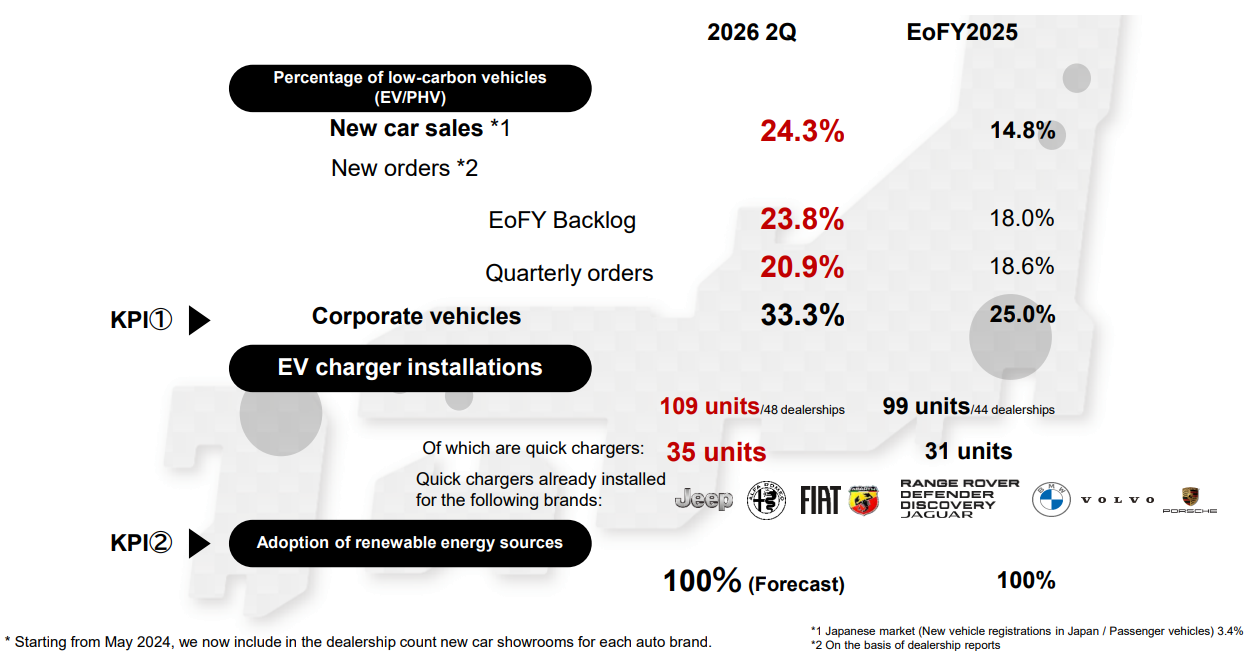
To reduce Scope 1 + Scope 2 GHG emissions by 50% in FY 2030 compared to FY 2022 (6.25% reduction per year).
Concretely, they set goals of
①increasing the ratio of low-carbon vehicles to company vehicles (including test-vehicles) to 80% or higher by FY 2030”
②adopting renewable energy at all stores by FY 2025
In March 2025, we obtained a third-party assurance on their GHG emissions in FY 2024.
Regarding Scope 2, we have continued to achieve zero emissions by switching to renewable energy contracts and utilizing green certificates. In FY 2024, the company has achieved a 25.8% reduction in emission levels compared to FY 2023, when the group target was achieved ahead of schedule.
[2-3 Initiatives of the Willplus Group]
The company’s initiatives for realizing “the elevation of social value” and “elevation of corporate value” at the same time are outlined below.
(1) Social Value Enhancement
① Contribute to the realization of a decarbonized society by promoting green store operations
In addition to setting the above reduction targets, the company intends to make capital investments to promote the spread of EVs in its store areas as an imported car dealer striving to be one of the first to promote green store operations, thereby contributing to the decarbonization of the domestic automobile industry.
The achievements they have made so far are as follows.
(From the reference material of the company)
The number of EV chargers installed is increasing in parallel with the expansion of the EV lineup of the brands handled by the company. As of the end of December 2025, a total of 109 units have been installed, including 35 rapid chargers and 74 standard chargers. Renewable energy rate is expected to be 100% for the fourth consecutive year.
The ratio of low-carbon vehicles to new car sales and company-owned cars also continues to increase. In the first half of the fiscal year ending June 2026, low-carbon automobiles accounted for 24.3% of new vehicle sales and 33.3% of company-owned vehicles, representing a significant increase from 7.0% and 16.4%, respectively, in the fiscal year ended June 2024.
② Other Initiatives and Responses
◎ Obtained the score B in the CDP “Climate Change” questionnaire for four consecutive years
In response to requests from institutional investors and purchasing companies around the world, the company answered the questionnaire regarding climate change conducted by the international organization Carbon Disclosure Project (CDP), which promotes companies to disclose environmental information, and obtained Score B for four consecutive years (2022, 2023, 2024, and 2025).
The CDP questionnaire is aimed at evaluating each organization’s disclosure of environmental information with the grades A to F as a global standard regarding “E” of ESG (environment, society, and governance). As of 2025, about 22,000 companies, which account for over two thirds of the global market cap, were scored by CDP, and institutional investors and purchasing companies around the world refer to such information when making decisions. In Japan, about 2,100 companies, including over 1,000 companies listed on the Prime Market, answered the questionnaire.
(2) Enhancement of corporate value through promotion of M&A
M&A is an important measure for quickly entering new areas, acquiring new brands, and expanding the market shares of existing brands. In the saturated domestic automobile market, the company believes that M&A is the most appropriate and priority strategy from the perspectives of customer acquisition, early return on investment, and securing profits.
Armed with the "advanced capability to revitalize business through M&A" mentioned in [1-5 Characteristics, Strengths, and Competitive Advantages,] they will strive to expand their sales and profit through M&A and steady PMI.
① Business Environment for M&A Promotion
◎ Dealer Status
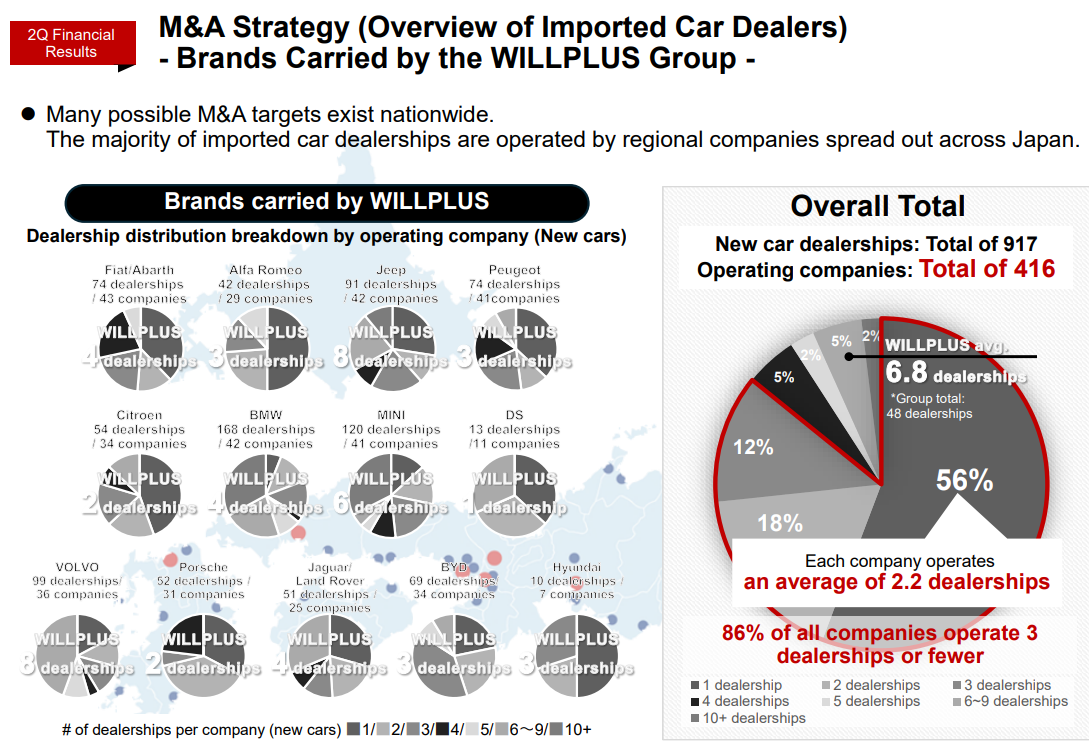
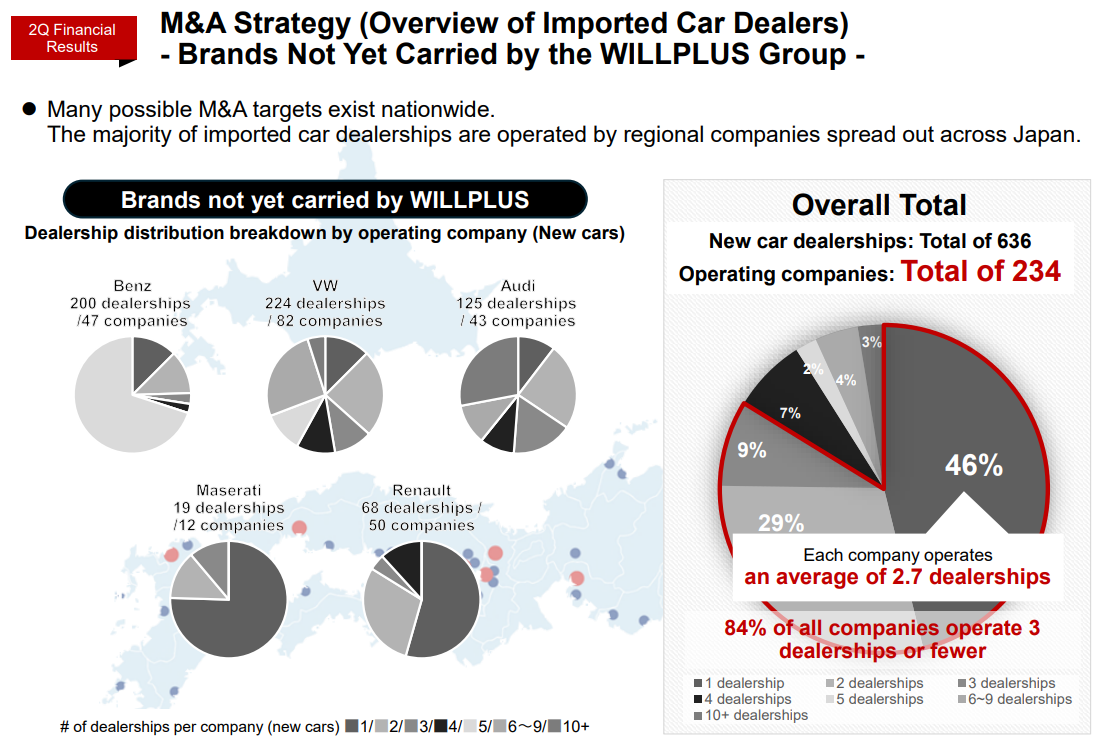
According to the company's assessment, there will be a total of 650 imported automobile dealers operating throughout Japan by the end of 2025, with a total of 1,553 new car sales offices. Each company had an average of 2.3 shops, while small and medium-sized businesses with three or fewer shops accounted for approx. 80% of the total number of dealers.
Store operation varies from brand to brand, and some brands are consolidating capital.
In addition, many dealers are struggling with the difficulty in finding successors, a common problem for small and medium-sized companies in Japan.
 |
 |
(From the reference material of the company)
For these imported car dealers, the "CASE" of automobiles, of which "Electric Vehicle" and "Connected" are the most important management issues for the future.
* "CASE" stands for Connected, Autonomous, Shared & Services (which may refer to car sharing and services/sharing only), and Electric. They are drastically changing the conventional concept of a "car" and creating new demand and markets in each of these areas.
◎ Enhanced Environmental Awareness and the Progress of the Shift to EVs
With heightened awareness of the global warming crisis, efforts to reduce greenhouse gas emissions and realize a decarbonized society are progressing rapidly.
One of the most significant concerns is reducing automotive emissions, and as governments try to attain carbon neutrality by 2050, automobile manufacturers are shifting from traditional gasoline and diesel engine cars to electric vehicles (EVs) in order to survive.
As mentioned in [1-3 Market Environment], manufacturers headquartered in Europe, which has long had a high degree of environmental awareness, have been particularly engaged in the transition to EVs.
On the other hand, while Japanese manufacturers set targets for the number and ratio of sold EVs, the expansion pace is sluggish in comparison with overseas competitors.
At the same time, brand car manufacturers must commit to developing a firm understanding of emissions throughout their supply chains and to reducing them, so they are increasingly urging dealers to not only understand their current emissions, but also to make appropriate capital investments and responses to climate change issues, such as increasing EV purchases, installing quick chargers, and disclosing emission reduction targets.
Many dealers, however, face financial and human resource limits that make it difficult for them to respond adequately, and some analysts predict that brand car manufacturers may take the lead in further combining and restructuring vendors who can respond appropriately to such demand.
◎ Complication of car maintenance through the spread of connected systems and EVs
The term "connected" refers to the usage of communication equipment in automobiles to enable continuous external contact. Equipping vehicles with a SIM card will allow for grasping the state of a car and the situation on a road, exchange of information between cars and between a car and infrastructure, remote control, etc.
The connected automobile will evolve into smartphone-like devices, improving convenience while potentially complicating maintenance work in the case of a breakdown or vehicle inspection.
Furthermore, the previously noted shift to EVs will have a significant influence on car maintenance. Through the distribution of EVs, high-voltage battery and generator failures will increase, and vehicle maintenance will need to manage high-voltage systems, prompting substantial investment in high-voltage equipment and special training for safety reasons. Because the shift to connected systems and electric cars will need greater investment in both hardware and software, maintenance work for imported vehicles is likely to be concentrated in the hands of authorized dealers and large capital organizations with substantial investment capacity.
② The company's policy on M&A
◎ Actively addressing climate change issues
While responding to EVs and connected automobile is an urgent task for imported car dealers, the company intends to differentiate itself by building stores that are preferred by brand car manufacturers and by acquiring dealers who find it challenging to address these issues through M&A. By doing so, it hopes to expand into new areas and pick up new brands in order to grow and boost its corporate value. Additionally, the company wants to help with social issues by creating new brands and working to make its stores greener.
The company will not only decarbonize the neighboring area and turn the stores green, but it will also reinvigorate the social capital that already exists by repurposing resources and assets including stores, retraining personnel, and enhancing productivity by streamlining processes using DX.
◎ Favorable M&A Conditions after the subsiding of COVID-19
The company believes that the M&A strategy is beginning to receive a tailwind as COVID-19 is coming to an end.
*2020-2022: Business environment in which M&A (sale of business) is unlikely to be conducted
In the wake of the outbreak and spread of COVID-19, the demand for automobiles as a safe transportation means or for domestic travel as an alternative to overseas travel grew rapidly from 2020 to 2021.
In 2022, the prices of new automobiles skyrocketed due to the shortage of supply caused by the global shortage of semiconductors and the rise in material prices, and the shortage of new automobiles led to the growth of demand for used automobiles, and the prices of used automobiles rose significantly.
In such business environment, the sale and order receipt of automobile dealers were healthy. Inventory declined, working capital shrank, and order backlog increased steeply, so even dealers with weak marketing capabilities and small capital stock were able to operate business without trouble.
On the other hand, dealers thinking of selling their businesses decreased in that situation. It was unfavorable for the M&A strategy of the company, but the company’s growth and operating income margin exceeded the average in the industry, and the company concentrated managerial resources onto M&A in the next phase.
*2023-2025: Acceleration of M&A in parallel with the recovery of supply of new automobiles
The environment has been changing from 2023 to 2025.
Although the supply of new vehicles is recovering as the pandemic subsides and the semiconductor shortage eases, persistently high prices of new cars, driven by the yen depreciation and inflation, are putting pressure on the operations of small and medium-sized auto dealers. These dealers are facing increased costs resulting from higher investments in company-owned vehicles and higher depreciation expenses, a decline in customer visits, and worsening cash flow due to rising sales inventory and working capital requirements.
Additionally, as the focus on addressing climate change increases and automakers seek to consolidate dealerships, coupled with the shortage of successors at import car dealerships, M&A deals are expected to increase, especially among small and medium-sized dealerships with fragile financial foundations.
The company plans to allocate its management resources toward M&A activities to stimulate business growth.
[2-4 Medium- to Long-term Shareholder Return Strategy]
The company, which has increased dividends consecutively since its listing, has established the following policy.
☆ | To target a medium- to long-term ROE of 15% or higher (14.0% in the fiscal year ended June 2025). |
☆ | The company will gradually raise its dividend payment ratio to 30% by fiscal year 2026 in order to "keep sufficient capital" and "further boost shareholder return" at the same time. |
☆ | From the fiscal year 2027 onward, the company will continue to pursue a dividend policy of pursuing a payout ratio of 30% while aiming for progressive dividends. |
☆ | The company will sustain and increase consistent and ongoing returns to shareholders, with a DOE of 4.5% or higher. |
They are forecasting a dividend of 46.00 yen/share and a payout ratio of 32.0% for this fiscal year ending June 2026.
In order to demonstrate its extremely aggressive profit growth policy and shareholder return stance, the company aims to achieve ROE that significantly exceeds the cost of shareholders' equity, increase the dividend payout ratio gradually, and increase dividends in excess of profit growth.
(ROE Analysis)
| FY 6/18 | FY 6/19 | FY 6/20 | FY 6/21 | FY 6/22 | FY 6/23 | FY 6/24 | FY 6/25 |
ROE (%) | 18.2 | 14.3 | 13.9 | 22.5 | 19.0 | 14.0 | 11.5 | 14.0 |
Net income margin (%) | 3.16 | 2.44 | 2.29 | 3.76 | 3.91 | 2.95 | 2.35 | 1.63 |
Total asset turnover (times) | 2.49 | 2.30 | 2.24 | 2.43 | 2.23 | 2.09 | 1.71 | 2.55 |
Leverage (x) | 2.31 | 2.54 | 2.71 | 2.46 | 2.18 | 2.28 | 2.85 | 3.37 |
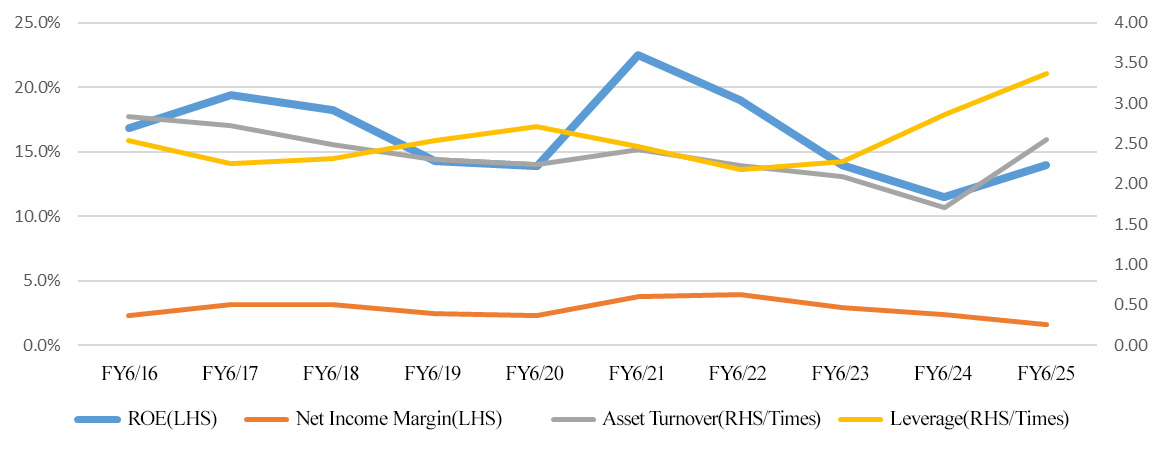
Although it exceeds 8%, which is generally considered as a target for Japanese companies, it is declining. It was mainly due to an increase in leverage in the fiscal year ended June 2025. If profitability improves, ROE can be expected to rise further, and PBR can be expected to recover to the 1x level.
[2-5 Measures for Achieving Management Focusing on Capital Costs and Stock Prices]
Regarding the “Measures for Achieving Management Focusing on Capital Costs and Stock Prices” requested by the Tokyo Stock Exchange, the company has presented the following analysis and future initiatives.
*Taken from the previous report (results in the fiscal year ended June 2025).
(1) Analysis of the Current Situation
(Stock Price)
While the supply of new cars has recovered after the COVID-19 pandemic, car prices have remained high due to the weak yen. As the overall imported car market has been sluggish, ROE has declined due to deteriorating business performance. As a result, stock price has been low, with PBR less than 1x despite the support of dividend yield.
(Trends in Sales and New Store Openings)
During periods of strong business performance (FY 2021 and FY 2022), no M&A transactions were made. From FY 2023, business performance declined due to the deterioration of the imported car market, but M&A increased rapidly. However, stock price does not represent the outcome of M&A (sales growth). The company acknowledges that "profit improvement through PMI" is required to mitigate the effects of the declining imported car market.
(ROE and PBR)
The company acknowledges its cost of equity as 5.3% based on the CAPM, and ROE has been exceeding the capital cost since the company’s public listing. Although ROE improved to 14.0% in the fiscal year ended June 2025, PBR did not improve due to the gain on negative goodwill through M&A, which has increased net income. PBR ranged between 0.8x and 2.2x, with the current level considered to be near the bottom.
(2) Initiatives to Improve PBR
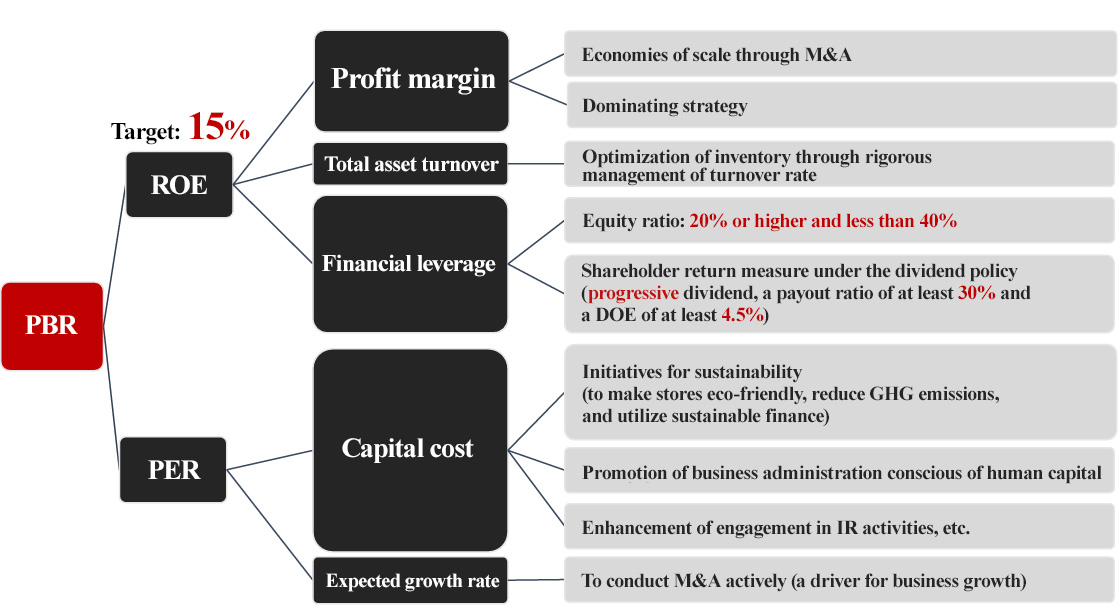
The company is implementing the following measures from the perspective of profit margin, total asset turnover, financial leverage, capital cost, and expected growth rate.
 |
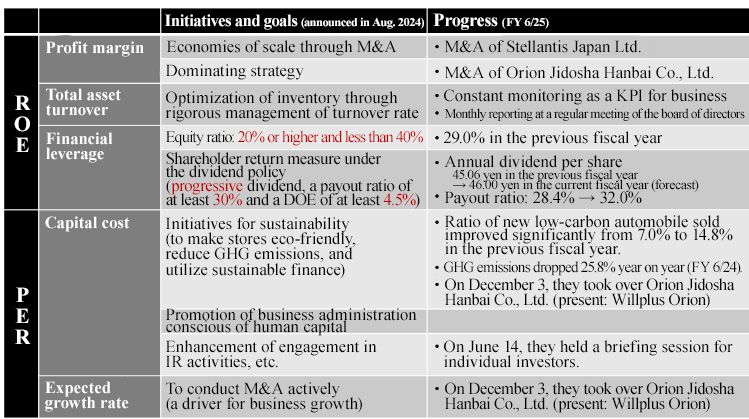 |
As a financial strategy, they have set the optimal capital structure at “an equity ratio of 20% or higher, but less than 40%.” The company will constantly monitor the inventory level and turnover rate in the imported vehicle dealer business along with the receivable level of accounts, collection period, and default rate in the used car export-related business. In addition, they will aim to maintain an ROE of 15% or higher while maintaining appropriate capital by pursuing management that “does not hold” fixed assets as much as possible.
As a result, the company will be able to maintain ROE well above the cost of shareholders' equity of 5.3% over the long term. Going forward, they will continue to maintain a system in which ROE consistently and stably exceeds the capital cost, regardless of β value fluctuations, in order to maximize corporate value (market capitalization).
Regarding shareholder returns, as stated in “2-4 Medium- to Long-term Shareholder Return Strategy,” they will strive to maintain and improve stable and consistent profit returns through progressive dividends with a target dividend payout ratio of 30% and a minimum DOE of 4.5%.
In addition, they will strengthen shareholder returns through the flexible acquisition of treasury shares and commit to improving corporate value through the introduction of various equity-based initiatives.
In terms of IR, the company intends to hold the general meeting of shareholders, build a forum for interaction with shareholders, both individual shareholders and institutional investors, with the goal of promoting two-way communication by the management.
3. Growth Strategy
Three strategies promote the company's growth: "multi-brand strategy," "dominant strategy," and "M&A strategy."
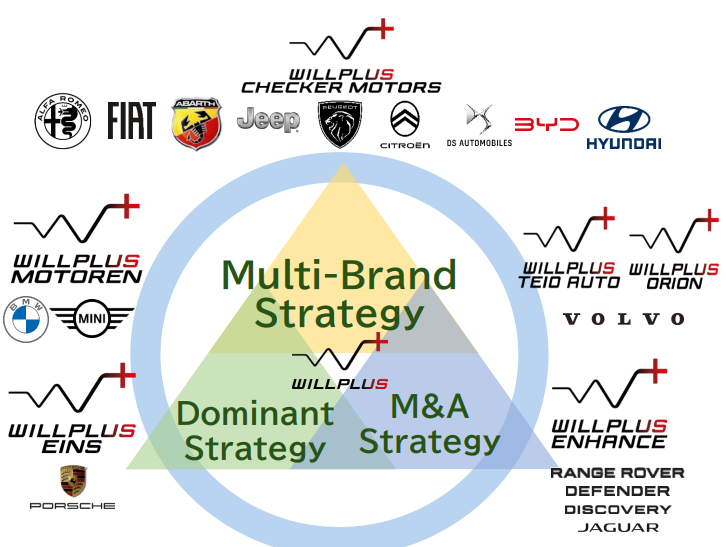
(From the reference material of the company)
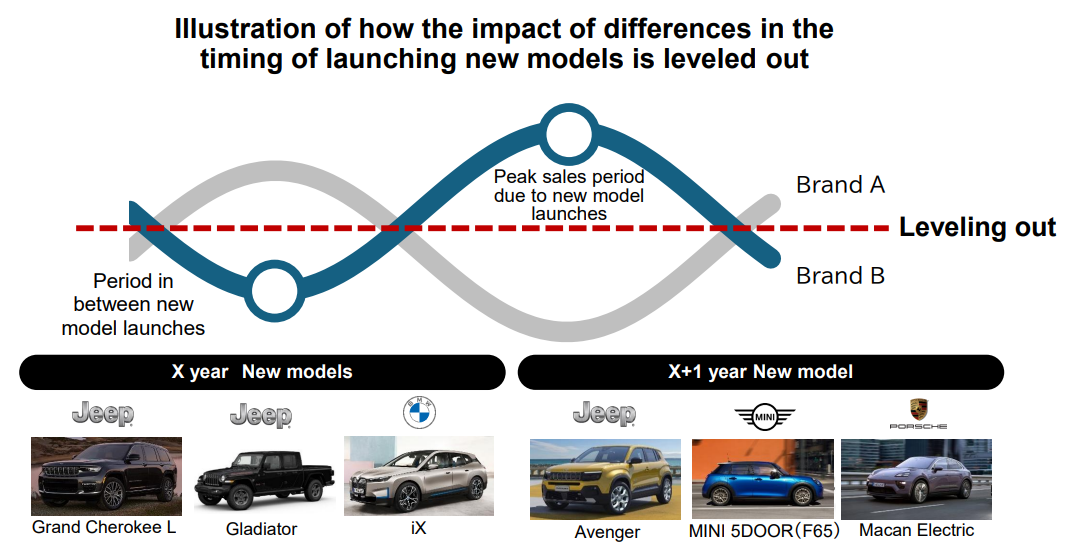
[3-1 Multi-brand strategy: Expansion of earnings and leveling of the sales cycle]
By handling multiple brands without relying on a specific brand, the company aims to even out the impact of the sales cycle caused by differences in the timing of new model launches among brands.
The company currently handles 17 brands and aims to expand the number of brands through M&A strategies.
(From the reference material of the company)
[3-2 Dominant strategy: Increase the market share and maximize profit in the same trade area]
The company is opening new stores in cities with a population of 1 million and surrounding cities as specified areas in order to increase its market share by attracting customers in the same trade area, improve productivity through efficient personnel allocation among stores, and maximize profit.
Currently, the company focuses on Tokyo, Kanagawa, and Fukuoka, which are Japan's top markets in terms of new car registrations and ownership of imported cars (passenger cars), but it is also aiming to expand into other areas through the M&A strategy.
[3-3 M&A Strategy: Speed Up]
M&A is an important measure for quickly entering new areas, acquiring new brands (multi-brand strategy), and expanding the market share of existing brands. Following the acquisition of a huge number of stores, trade areas, and new brands via M&A, the company has been extending its business by building additional stores in neighboring regions to complement its trade areas.
There are many brands that the company targets but does not handle, such as Mercedes-Benz, Volkswagen, and Audi, and there is a tremendous opportunity for growth through the M&A acquisition of additional brands.
Aside from direct approaches from the company to the target companies and direct contact from the target companies back to the company, the company searches out deals through introductions from importers, financial institutions, and M&A brokerage firms.
The company will carry out due diligence and only engage in negotiations with those agreements that satisfy the company's investment recovery requirements following internal discussions that focus on prospects for future development and synergies.
Since their founding in October 2007, WILLPLUS Holdings has implemented 10 projects of M&A (*Excluding projects implemented within the last 3 fiscal years). They have achieved profitability in all these projects by injecting their know-how, etc. in addition to opening new stores and making investments in stores, including relocation and renovation, and the high level of their PMI capability is attracting attention.
4. 1H of Fiscal Year ending June 2026 Earnings Results
[4-1 Overview of Financial Results]
| FY 6/25 1H | Ratio to sales | FY 6/26 1H | Ratio to sales | YoY |
Sales | 41,058 | 100.0% | 42,096 | 100.0% | +2.5% |
Gross Profit | 5,748 | 14.0% | 6,157 | 14.6% | +7.1% |
SG&A | 5,062 | 12.3% | 5,343 | 12.7% | +5.5% |
Operating Income | 685 | 1.7% | 813 | 1.9% | +18.8% |
Ordinary Income | 692 | 1.7% | 810 | 1.9% | +17.0% |
Interim Net Income | 672 | 1.6% | 719 | 1.7% | +7.0% |
*Unit: million yen. Interim net income is interim net income attributable to owners of the parent.
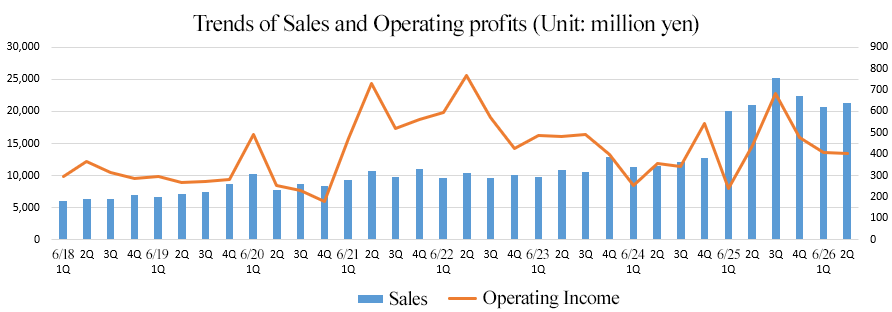
Sales and profit increased
Sales increased 2.5% year over year to 42,096 million yen. This increase was driven by higher demand in the used car market and our expanded service network.
Operating income increased 18.8% year on year to 813 million yen. Gross profit increased 7.1%, outpacing the sales growth rate, due to improved profitability at subsidiaries acquired through M&A in the previous fiscal year. Gross profit margin increased 0.6 percentage points year on year. Although selling, general, and administrative expenses, including labor costs, rent, and depreciation, augmented, these costs were fully absorbed. This was also aided by the absence of special investigation related expenses incurred during the same period in the previous year.
[4-2 Market Environment]
In the first half of the year, the number of domestic new passenger car registrations fell 6.3% year on year to 1.207 million. In contrast, the number of registrations of new passenger cars from foreign manufacturers increased 6.6% to 120,000. During the same period of the previous year, imported cars increased their market share in Japan by 1.2 percentage points, rising from 8.7% to 9.9%.
Conversely, new car registrations for the brands the company represents decreased 1.6% year on year, suggesting that the business environment surrounding the company remains challenging. The sales in January 2026 were also lower than those in the previous year. Among its core brands, Jeep and MINI performed poorly. Jaguar Land Rover is still affected by the production halt caused by the cyberattack in the UK in September 2025.
[4-3 Trend of each business and sales by product category]
◎ Trend of each business
| FY 6/25 1H | Composition ratio | FY 6/26 1H | Composition ratio | YoY |
Sales |
|
|
|
|
|
Imported vehicle dealer business | 25,305 | 61.6% | 27,109 | 64.4% | +7.1% |
Used car export-related business | 15,752 | 38.4% | 14,986 | 35.6% | -4.9% |
Total | 41,058 | 100.0% | 42,096 | 100.0% | +2.5% |
Segment profit |
|
|
|
|
|
Imported vehicle dealer business | 1,031 | 4.1% | 1,197 | 4.4% | +16.1% |
Used car export-related business | 189 | 1.2% | 150 | 1.0% | -20.4% |
Adjustment | -535 | - | -533 | - | - |
Total | 685 | 1.7% | 813 | 1.9% | +18.8% |
*Unit: million yen. The composition ratio of profit is the profit margin on sales.
◎ Sales by product category
(FY6/26 1H)
| Import (*1) | YoY | Export (*2) | YoY | Total (*3) | YoY |
New cars | 11,885 | -2.2% | - | - | 11,885 | -2.2% |
Used cars (Japan) | 7,618 | +14.7% | - | - | 7,618 | +11.4% |
(Overseas) | - | - | 2,971 | -45.9% | 2,971 | -45.9% |
Used car total | 7,618 | +14.7% | 2,971 | -47.8% | 10,590 | -14.1% |
Auto auction sales | 2,603 | +21.9% | 12,010 | +19.5% | 14,614 | +19.9% |
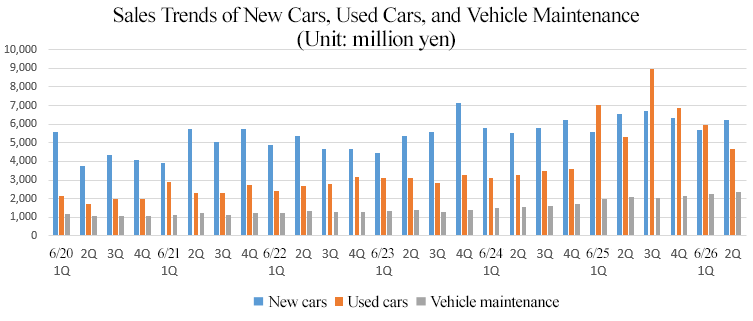
Subtotal of sales of cars | 22,108 | +5.6% | 14,982 | -4.8% | 37,090 | +1.2% |
Car maintenance | 4,591 | +13.5% | - | - | 4,591 | +13.5% |
Other | 409 | +22.7% | 4 | -63.0% | 414 | +19.7% |
Total | 27,109 | +7.1% | 14,986 | -4.9% | 42,096 | +2.5% |
*Unit: million yen. Import (*1) represents imported vehicle dealer business, Export (*2) represents used car export-related business, Total (*3) represents Group total.
<Imported vehicle dealer business>
*New Car Sales
Although stores acquired through M&A, primarily involving new brands, contributed to revenue, overall sales in the imported car dealership business were slightly lower than those in the same period of the previous year. As a result, revenue in the first half of the fiscal year decreased 2.2% year on year.
*Used Car Sales
The company's revenue increased 14.7% as it focused on the sale of used cars, particularly those from brands where new car sales had declined due to factors such as the waning effect of new model launches.
*Recurring-revenue business
Revenue from vehicle maintenance increased 13.5% year on year in the first half of the fiscal year. This growth surpassed the scope of M&A activities carried out between the previous and current fiscal years. The benefits of post-merger integration (PMI), including the recruitment of maintenance staff and customer management, are evident.
Although the total number of insurance policies increased, insurance commission revenue decreased 1.9% year over year in the first half of the year and 4.4% in the second quarter (October–December), indicating sluggish performance. This decline was primarily due to the negative impact of revisions to the agency commission system. Addressing these changes is considered an urgent priority.
<Used car export-related business>
The Malaysian economy, our primary export market, continues to show signs of expansion, and the weak yen against the Malaysian ringgit has also been a tailwind for our export business. Conversely, revenue in the first half of the year decreased 45.9%. This was due to the country reaching its import quota for 2025 by early August, coupled with the beginning of a period of declining demand. Meanwhile, wholesale sales increased 19.5% due to efforts to boost sales and prioritize inventory turnover.
As a result, total revenue from overseas sales and auto auction sales decreased 4.8% year on year.
[4-4 Financial Standing and Cash Flow]
◎ Main Balance Sheet
| End of June 2025 | End of December 2025 | Increase/ Decrease |
| End of June 2025 | End of December 2025 | Increase/ Decrease |
Current Assets | 26,675 | 25,607 | -1,067 | Current Liabilities | 18,051 | 17,363 | -687 |
Cash and Deposits | 8,245 | 7,848 | -397 | Payables | 4,182 | 3,122 | -1,060 |
Inventories | 13,276 | 14,879 | +1,602 | ST Borrowings | 10,362 | 10,579 | +217 |
Noncurrent Assets | 10,555 | 10,102 | -453 | Noncurrent Liabilities | 6,975 | 5,710 | -1,265 |
Tangible Assets | 8,865 | 8,416 | -448 | LT Borrowings | 6,171 | 4,873 | -1,298 |
Buildings and Structures | 4,325 | 4,366 | +40 | Total Liabilities | 25,026 | 23,073 | -1,953 |
Intangible Assets | 266 | 240 | -25 | Net Assets | 12,204 | 12,636 | +431 |
Investment, Others | 1,424 | 1,445 | +20 | Retained Earnings | 10,167 | 10,624 | +457 |
Total Assets | 37,231 | 35,709 | -1,521 | Total Liabilities and Net Assets | 37,231 | 25,709 | -11,521 |
*Unit: million yen.
Although they increased inventory due to expanded purchasing in anticipation of the peak season of export to Malaysia beginning in January, total assets decreased 1.5 billion yen from the end of the previous fiscal year. This was primarily due to a decline in cash and deposits, as well as accounts receivable. It was also due to the sale of a portion of land through a sale-and-leaseback arrangement.
Total liabilities decreased 1.9 billion yen year on year, primarily due to a reduction in long-term debt.
Net assets increased 400 million yen year on year, primarily due to an increase in retained earnings.
As a result, capital-to-asset ratio grew 3.0 points from the end of the previous fiscal year to 32.0%
◎CF
| FY 6/25 1H | FY 6/26 1H | Increase/ Decrease |
Operating CF | -3,203 | 454 | +3,657 |
Investing CF | -306 | 610 | +917 |
Free CF | -3,509 | 1,065 | +4,574 |
Financing CF | 1,991 | -1,470 | -3,461 |
Cash and Equivalents | 5,985 | 7,829 | +1,844 |
*Unit: million yen.
Operating cash flow and free cash flow turned positive due to an increase in interim net income before taxes and a decrease in trade receivable..
The cash position improved.
[4-5 Topics]
(1) Continuous implementation of M&A
The company actively conducted M&A, which is a key pillar of the growth strategy.
① Acquisition of the business of Sojitz Auto Group Japan Inc.
In April 2026, the company acquired the “Authorized Volvo Dealer Business” operated by Sojitz Auto Group Japan Inc. The acquired business generated a revenue of 3.4 billion yen (in the fiscal year ended March 2025).
By acquiring the five stores operated by Sojitz Auto Group Japan —“Volvo Car Nishinomiya,” “Volvo Car Takamatsu,” “Volvo Select Tokushima/Service,” “Volvo Select Matsuyama/Service,” and “Volvo Gallery Matsuyama”—the company has established its first business presence in the Kansai and Shikoku regions. As the exclusive authorized Volvo Car dealer in the Shikoku region, they have established a dominant market position there, following their success in the Kyushu region.
② Acquisition of the business of Wako Motoren K.K
In January 2026, the company acquired the “Authorized BMW Dealer Business” operated by Wako Motoren K.K. The acquired business generated a revenue of 5.1 billion yen (in the fiscal year ended December 2024).
The company acquired "BMW Koshigaya, BPS Koshigaya, BMW Ageo, and BPS Kasukabe"—all operated by Wako Motoren—marking its first entry into Saitama Prefecture.
The opening of BMW stores in the Tokyo metropolitan area will strengthen the group’s network.
③ Acquisition of the business of GRAND CIEL SEKISHO Co., Ltd.
In January 2026, the company acquired “part of the authorized Peugeot dealer business” operated by GRAND CIEL SEKISHO Co., Ltd. The acquired business generated a revenue of 290 million yen (in the fiscal year ended March 2025).
Through the acquisition of "Peugeot Koriyama," which is currently operated by GRAND CIEL SEKISHO Co., Ltd., the company will establish its second business location in Fukushima Prefecture, thereby strengthening its business structure in the Tohoku region. This will be the third Peugeot dealership to open.
④ Acquisition of the business of Sanyo Automobiles Co., Ltd.
In January 2026, the company acquired part of the “authorized Jeep dealer business” operated by Sanyo Automobiles Co., Ltd. This business generated 330 million yen in sales (in the fiscal year ending December 2024).
They have acquired “Jeep Oita,” operated by Sanyo Automobiles Co., Ltd., and established their second business location in Oita Prefecture. This move further strengthens their business structure in the Kyushu region. Jeep Oita is the only authorized Jeep dealer in the prefecture, expanding their dominant market area. This marks the opening of their ninth Jeep dealership.
(2) Status of store openings
In October 2025, the “Hyundai Citystore Tokyo Preparation Office” was opened in Setagaya, Tokyo.
In December 2025, the company opened the “BYD AUTO Kitakyushu Preparatory Office” in Munakata City, Fukuoka Prefecture. The office was established within “Checker Motors Approved Munakata,” a store specializing in used cars, with the aim of inducing synergetic effects.
Since they started dealing in BYD vehicles in July 2024 and Hyundai vehicles in June 2025, the company has opened a total of six stores across Tokyo and two prefectures in approximately one and a half years. It is actively investing in these stores to establish them as hubs for promoting the adoption of EVs in Japan.
In January 2026, the BYD and Hyundai brand operations previously managed by Willplus Enhance Co., Ltd. were transferred to Willplus Checker Motors Co., Ltd.
5. Fiscal Year ending June 2026 Earnings Forecasts
[Earnings Forecast]
| FY 6/25 | Ratio to Sales | FY6/26 (Est) | Ratio to Sales | YoY | Progress rate |
Sales | 88,614 | 100.0% | 92,160 | 100.0% | +4.0% | 45.7% |
Operating Income | 1,849 | 2.1% | 2,328 | 2.5% | +25.9% | 35.0% |
Ordinary Income | 1,897 | 2.1% | 2,244 | 2.4% | +18.3% | 36.1% |
Net Income | 1,443 | 1.6% | 1,305 | 1.4% | -9.6% | 55.1% |
*Unit: million yen. Estimates are those of the company.
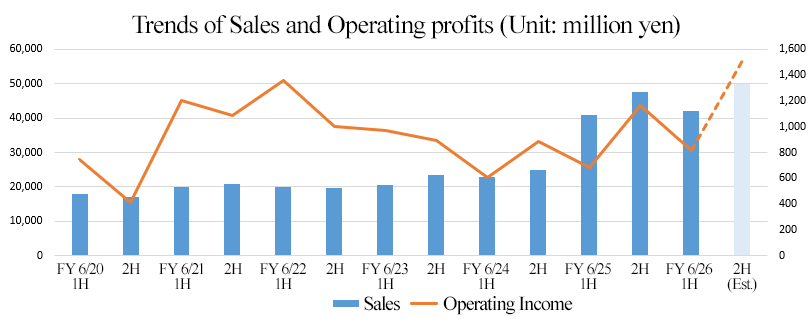
There are no changes to the earnings forecast. Sales and profits are expected to increase. Sales are forecast to hit a record high.
They expect net sales to increase 4.0% year on year to 92,160 million yen and operating income to increase 25.9% to 2,328 million yen. Although the domestic imported car market is projected to remain sluggish, new sales are expected to hit a record high. Despite the challenging business environment, the "Imported Car Dealership Business" will continue to conduct M&A to expand its revenue base, aiming to improve profitability through post-merger integration (PMI). They expect earnings to improve as their "used car export business" enters its peak season in January. They plan to pay a dividend of 46.00 yen per share, up 0.94 yen per share from the previous fiscal year. The expected dividend payout ratio is 32.0%.
6. Conclusions
Progress rates in the first half of the year were 45.7% for net sales and 35.0% for operating income. Net sales were almost unchanged from those in the previous years, while operating income remained low. The majority of factors in the increase in profits resulted from the PMI effect and the normalization of one-time factors in the previous fiscal year. Although there are negative factors, such as a decline in insurance commission revenue, which had been growing steadily until now, due to regulatory changes, attention is focused on how much profit the company can accumulate in the second half of the fiscal year through further profitability improvements driven by PMI. While this will contribute to the performance in the next fiscal year and beyond, we also anticipate progress in strengthening the revenue base through a series of M&A transactions.
<Reference: Regarding Corporate Governance>
◎ Organization type, and the composition of directors and auditors
Organization type | Company with audit and supervisory committee |
Directors | 8 directors, including 5 outside directors (5 of which are independent executives) |
Audit committee members | 5 members, including 5 outside directors (5 of which are independent executives) |
◎ Corporate Governance Report
Last update date: September 25, 2025
<Basic Policy>
Our company’s basic approach on corporate governance is to establish a sound management system that can respond to rapid changes in society and is efficient and compliant with laws and regulations, for maximizing our corporate value. To achieve this, we continue to strive to ensure transparent management and appropriate and prompt disclosure, by strengthening our relationships with stakeholders and further enhancing management governance functions.
<Reasons for Non-compliance with the Principles of the Corporate Governance Code (Excerpts)>
Our company follows all principles of the Corporate Governance Code.
<Disclosure Based on the Principles of the Corporate Governance Code (Excerpts)>
■Principle 1-3: Fundamental Capital Policy
Our fundamental capital policy is to maintain an appropriate capital base, consistently achieve an ROE that exceeds our cost of capital, and enhance corporate value.
Detailed information regarding our efforts to manage the company with a focus on our cost of capital and share price is disclosed on our company website.
https://contents.xj-storage.jp/xcontents/AS01236/c344ad3a/f422/40ec/9afb/9d116046c9e6/140120250814541929.pdf
■ Principle 1-4 [Strategic Shareholding]
(1) Policies concerning strategic shareholding
Our company does not hold shares strategically. Unless such shareholding is necessary to maintain and strengthen relationships for capital tie-ups and collaboration with our business partners and it is determined that their business benefits are worth the risk and cost of capital from the medium/long-term perspective, we shall adhere to our company’s policy of not holding shares strategically.
(2) Review process concerning strategic shareholding, and criteria for exercising voting rights related to strategically held shares
If it is considered appropriate to hold shares strategically, we will establish a method to review the reasonableness of continued holding of such shares as well as specific criteria for the exercise of voting rights on such shareholding.
■ Supplementary Principle 2-4 ① [Ensuring Diversity in Appointment of Core Personnel, etc.]
< Our view on ensuring diversity >
Our company aims to provide an environment where every and each staff member can utilize their ability to the maximum extent, and our basic policy is to promote human resources based on individual ability, aptitude, achievements and motivation, regardless of gender, nationality and attributes.
<Voluntary and measurable targets for ensuring diversity>
Regarding ensuring the diversity of core human resources, we have set targets for the ratio of female directors and managers and the ratio of male employees who have taken childcare leave, which serve as indices for ensuring diversity. The targets and results for each category are shown in the chart below.
| Result in FY 6/25 | FY 6/30 (target) |
Ratio of female directors | 12.5% | 30.0% |
Ratio of female managers | 7.1% | 10.0% |
Ratio of male employees who have taken childcare leave | 41.7% | 50.0% |
*As of the date on which this report was submitted, the ratio of female directors was 12.5%.
We have not set concrete numerical targets for the promotion of foreigners to managerial positions as there are few employees of foreign nationality at our company, but we shall keep discussing the necessity of setting such targets for ensuring further diversity.
Furthermore, as the proportion of highly specialized and experienced mid-career recruits is high in our corporate group, mid-career recruits account for 96.1% of managers (as of the end of June 2025). We have therefore not set any targets for the ratio of mid-career recruits in managerial positions.
■ Supplementary Principle 3-1 ③ and Supplementary Principle 4-2 ② [Issues related to Sustainability]
Our company has formulated basic sustainability policies, and established a Sustainability Committee and a Risk Management Committee to strengthen our corporate group’s sustainability initiatives and proactive risk management platform, and to focus on expanding our business scope by promoting growth strategies, responding to technological innovations including EVs in the automotive industry, and promoting DX, in order to achieve a sustainable society and enhance corporate value through our corporate activities. Details concerning concrete activities centered on these committees and investments in human capital, etc. for elevating the corporate value in the medium/long term are disclosed in our financial results presentation materials, annual security reports, etc.
https://contents.xj-storage.jp/xcontents/AS01236/73a1773f/f10e/4676/be8e/00e6a0e3b739/140120250827548317.pdf
In addition, our efforts to address climate change issues are disclosed through CDP.
For details, please refer to the “Sustainability” section on our company website.
https://www.willplus.co.jp/sustainability/
■ Principle 5-1 [Policies concerning the establishment of a system to promote constructive dialogue with shareholders and the initiatives for it]
Our company believes that clearly explaining our management policies and growth strategies to shareholders and institutional investors and deepening their understanding through active and constructive dialogue (interviews) with them will contribute to enhancing our company’s medium/long-term corporate value.
Dialogue with shareholders and institutional investors is conducted reasonably through visits, office visits, telephone calls, etc. by representative directors and IR staff, with the IR Office of the Corporate Strategy Division as a point of contact. In addition to individual interviews, in order to provide opportunities for direct dialogue with many investors, our company holds financial results briefings for investors and analysts as well as briefings for individual investors at which representatives themselves give explanations, and uses such opportunities to promote mutual understanding between our company and investors. Furthermore, we broadly disseminate information by video streaming of the meetings or posting material on our website.
When engaging in dialogue, we take all necessary precautions to ensure that there is no leakage of unpublished important information.
This report is not intended for soliciting or promoting investment activities or offering any advice on investment or the like, but for providing information only. The information included in this report was taken from sources considered reliable by our company. Our company will not guarantee the accuracy, integrity, or appropriateness of information or opinions in this report. Our company will not assume any responsibility for expenses, damages or the like arising out of the use of this report or information obtained from this report. All kinds of rights related to this report belong to Investment Bridge Co., Ltd. The contents, etc. of this report may be revised without notice. Please make an investment decision on your own judgment. Copyright(C) Investment Bridge Co., Ltd. All Rights Reserved. |