



Bridge Report:(3608)TSI the Fiscal Year ended February 2026

 President and CEO Tsuyoshi Shimoji | TSI HOLDINGS CO., LTD. (3608) |
 |
Company Information
Market | TSE Prime Market |
Industry | Textile (Manufacturing) |
President | Tsuyoshi Shimoji |
HQ Address | 8-5-27 Akasaka, Minato-ku, Tokyo |
Year-end | February |
Homepage |
Stock Information
Share Price | Share Outstanding | Total Market Cap. | ROE (Act.) | Trading Unit | |
¥1,195 | 63,438,793 shares | ¥75,809 million | 3.7% | 100 shares | |
DPS (Est.) | Dividend Yield (Est.) | EPS (Est.) | PER (Est.) | BPS (Act.) | PBR (Act.) |
¥70.00 | 5.9% | ¥132.17 | 9.0x | ¥1,704.79 | 0.7x |
*The share price is the closing price on May 12. All figures are from the financial results for the fiscal year ended February 2026.
Earnings Trends
Fiscal Year | Sales | Operating Income | Ordinary Income | Net Income | EPS | DPS |
Feb. 2023 Act. | 154,456 | 2,329 | 3,859 | 3,063 | 35.21 | 10.00 |
Feb. 2024 Act. | 155,383 | 1,760 | 3,758 | 4,849 | 59.97 | 15.00 |
Feb. 2025 Act. | 156,606 | 1,636 | 2,076 | 15,230 | 210.02 | 65.00 |
Feb. 2026 Act. | 167,085 | 4,325 | 5,440 | 3,793 | 60.48 | 40.00 |
Feb. 2027 Est. | 200,000 | 7,500 | 7,200 | 7,700 | 132.17 | 70.00 |
* Unit: million-yen, yen. The forecasted values are from the company.
This report provides the overview of TSI Holdings Co., Ltd.’s financial results for the fiscal year ended February 2026 and the earnings forecast for the fiscal year ending February 2027.
Table of Contents
Key Points
1. Company Overview
2. Fiscal Year ended February 2026 Earnings Results
3. Fiscal Year ending February 2027 Earnings Forecasts
4. Progress of Structural Reform in the Medium-Term Management Plan “TSI Innovation Program 2027”
5. Interview with President Shimoji
6. Conclusions
<Reference: Regarding Corporate Governance>
Key Points
- In the fiscal year ended February 2026, sales increased and profit grew considerably due to the structural reform. Sales increased 6.7% year on year to 167 billion yen, thanks to the inclusion of Daytona International Co., Ltd. and Waterfront Co., Ltd. in the scope of consolidation, although the existing businesses struggled. Operating income rose 164.4% year on year to 4.3 billion yen. Gross profit increased 8.9% year on year, and gross profit margin rose 1.1 points year on year thanks to the disposal of inventory in the previous fiscal years and a decline in provision for loss from inventory valuation as well as pricing and procurement cost reduction. SGA increased 5.8% year on year, but distribution costs, advertisement & sales promotion expenses, etc. were rationalized through the structural reform, leading to significant profit growth. Both sales and operating income fell below the forecast as the existing major brands struggled.
- For the fiscal year ending February 2027, too, it is expected that sales will grow and profit will rise considerably. Sales are projected to grow 19.7% year on year to 200 billion yen. In addition to the growth of the existing businesses, Daytona International and Waterfront, which were acquired through M&A, will contribute to their full-year performance. Operating income is forecast to increase 73.4% year on year to 7.5 billion yen. In addition to the sales growth, the structural reform will produce some effects this fiscal year as well. They plan to pay basic dividends amounting to 55.00 yen/share and a special dividend of 15.00 yen/share for a total of 70.00 yen/share. The expected payout ratio is 41.6% for basic dividends and 53.0% for the total dividend amount. They are expected to achieve a DOE of 4%, which is the initial goal set in TIP27.
- Thanks to the progress of structural reform, they are expected to achieve the target sales, net income, ROE, and DOE in the final fiscal year of the medium-term management plan TIP27 (which will end in February 2027), but the sales of the existing businesses fell below the target sales by around 10 billion yen, and the sales are not projected to recover enough, so they revised the target operating income downward from 10 billion yen to 7.5 billion yen.
- We interviewed President Shimoji about the overview of their current business, the progress of TIP27, his message to shareholders and investors, etc. He said, “We have identified a variety of issues and implemented structural reform over the past two years. In the fiscal year ended February 2026, the reform was finished. Our strong brands are producing positive impacts and garnering substantial customer approval as we continue to review our brand portfolio. Sales at our existing stores have been steadily improving since the second half of the previous fiscal year, and I genuinely feel that the company's general momentum has changed and the impact of our structural reform has become more apparent. The decision to bring Daytona International into our group reflects our commitment to transitioning from an apparel company to an enterprise with a “retail” mindset and pursuing higher profitability. Furthermore, while everyone is familiar with our individual brands, the reality is that many people are not yet aware of “TSI” or “mix.tokyo,” which is the integrated e-commerce site. Therefore, guided by our purpose—“We create empathy and social value across the world through the power of fashion entertainment.”—we will not only refine our individual brands, but also build the “TSI brand” into something truly remarkable. We sincerely hope you will continue to support us.”
- Most of the initially planned measures for structural reform were completed in FY 2/2026 as assumed. As they laid off some employees in early days of the structural reform, employee satisfaction survey scores dropped significantly, but it has bottomed out and is recovering, while the structural reform is progressing steadily. We would like to pay attention to the future of TSI Holdings, which possesses a spirit of retailing business: “To sell all procured products and pursue higher profitability,” through the inclusion of Daytona International in the TSI Group.
1. Company Overview
TSI Holdings is an apparel enterprise operating over 50 brands. It clearly specifies targets (gender, age, preferences, etc.) for each brand, and provides a broad range of customers with its products. They aim to proceed with transformation, evolve from an enterprise that conducts apparel business only, and become a “creator of fashion entertainment” that links social value to its corporate growth and not only provides products but also creates original value with the fashion entertainment, from the perspectives of “the environment and society,” “markets,” and “consumers.”
[1-1 Corporate history]
As the environment surrounding the apparel industry was becoming severe, Tokyo Style Co., Ltd. and Sanei-International Co., Ltd. established TSI Holdings Co., Ltd. through the transfer of shares in June 2011, with the aim of achieving sustainable growth by utilizing their respective strengths. It was listed on the Tokyo Stock Exchange (TSE). After the market restructuring, it was listed on the Prime Market of TSE in April 2022.
[1-2 Corporate philosophy]
With the following corporate philosophy, vision, purpose, and group’s code of conduct, they aim to become a “creator of fashion entertainment.”
Corporate philosophy | We create value that shines the hearts of people through fashion and share the happiness of living tomorrow together with society. |
Vision | We aim to become the world’s most beloved global group through the best and a step-ahead-of-the-times creation and lifestyle proposal. |
Purpose | We create empathy and social value across the world through the power of fashion entertainment. |
Group's code of conduct | 1. We value our spirit of fairness/impartiality and honesty, and work with passion and responsibility. 2. We remain mindful of challenges, continuously develop our skills, and proactively embrace new ideas with flexibility. 3. We respect each person's individuality, communicate well, and contribute to the team by playing our own roles. 4. We deliver excitement and pleasure to our customers with sincere hospitality and strive to improve customer satisfaction. 5. We respect each stakeholder's position to realize mutual benefit and contribute to the sustainable growth of the company. 6. We sincerely appreciate society and the natural environment and contribute to social development through our business. |
[1-3 Business description]
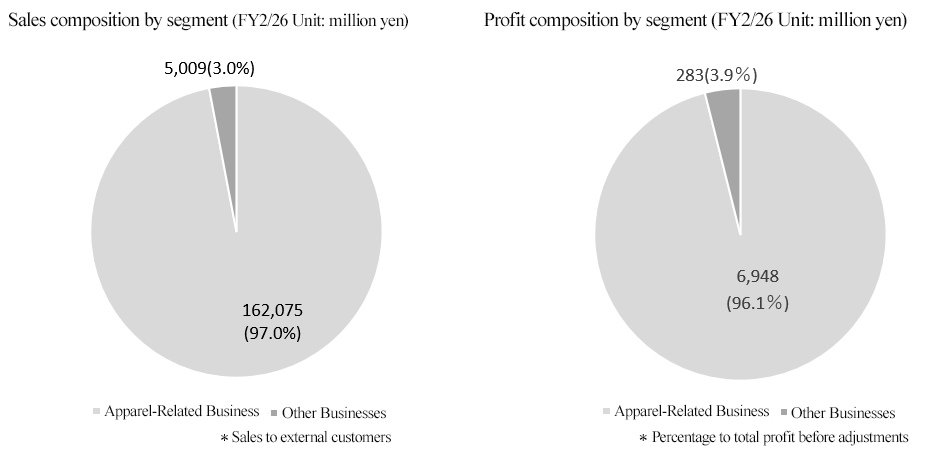
The TSI Group consists of TSI Holdings, which is a holding company, 21 consolidated subsidiaries, and one equity-method affiliate.
In the “apparel-related business,” mainly includes planning, manufacturing, and sale of apparel products, as well as licensed brand operations and production/logistics functions. The “other business” includes sales agency and staffing services, store design and management, and food and beverage operations.
(1) Brands
Currently, they operate over 50 brands. They set clear targets (by gender, age, preferences, etc.) for each brand and provide products to a broad range of customers.
The top 10 brands account for about 60% of total sales. The gross profit margin is about 50-65%.
*Outline of major brands
Brand | Targets | Concept |
PEARLY GATES
 | Women and men | OUT ON THE WEEKEND (leaving urban areas on weekends) Under the concept: “Let’s play golf more casually and more enjoyably,” it proposes new golf apparel, highlighting the intrinsic appeal of the sport.
|
NANO universe
 | Women and men | Under the concept of “glamour yourself up,” this brand brings out the attractive points of each customer and gives them confidence, with refined designs and high-quality functional materials. |
MARGARET HOWELL
 | Women and men | In 1970, the British designer MARGARET HOWELL started producing clothes at home. Clothing is not a passing fad but part of daily life, so she puts importance on materials, craftsmanship, and styles. This brand operates a broad range of businesses, including the sale of clothing and home-use products and the operation of cafes. |
NATURAL BEAUTY BASIC
 | Women | Based on the intrinsic natural beauty of each woman, this fashion store brand is for women who live each day beautifully, elegantly, and simply embracing their own unique femininity. |
AVIREX
 | Men | Established in 1975 as an official supplier to the U.S. Air Force, the brand has revived numerous flight jackets for urban wear. Drawing on decades of technical expertise, AVIREX produces military-inspired items known for their exceptional functionality and design, earning lasting popularity among consumers around the world. |
(2) Sales channels
They sell apparel via physical stores and EC inside and outside Japan.
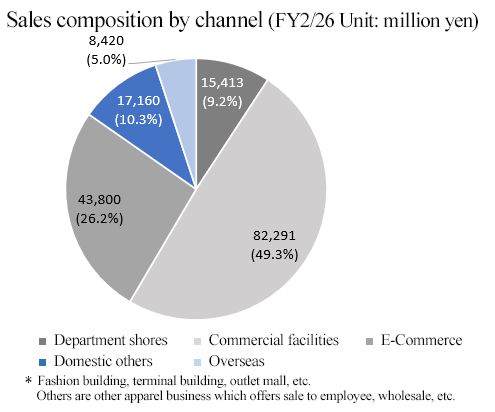
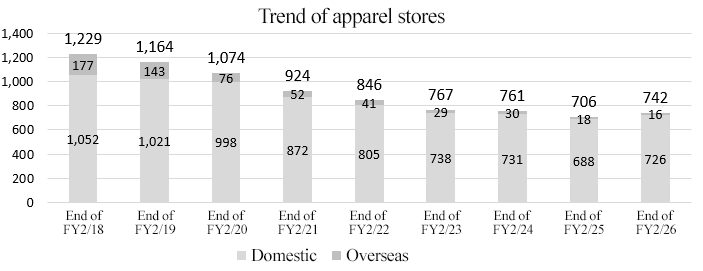
The number of physical stores was 777 (including overseas) as of the end of the fiscal year ended February 2026. Among them, 742 stores sell apparel.
While closing unprofitable stores as part of its business restructuring, the company, described as a "creator of fashion entertainment," believes that physical stores remain important for articulating brand narratives and providing entertainment to customers. The company will continue to develop stores focused on brands popular with customers while implementing a “scrap and build” approach to update the image. By opening stores with large floor sizes and/or in prime locations, they will reform the revenue structure of their physical store business.
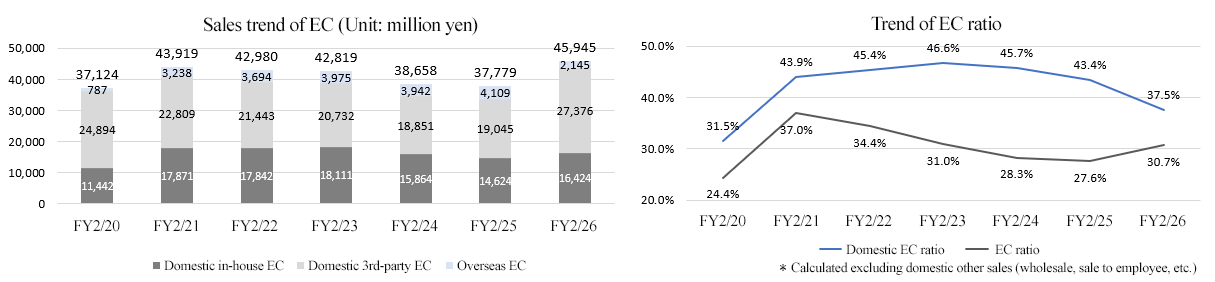
EC sales reached a peak in FY 2/2021, declined after that, but marked a record-high in FY 2/2026. However, this is attributable to mainly M&A. They need to recover the ratio of sales via their own website, which has been declining for 3 consecutive fiscal years.
[1-4 Characteristics, strengths, and competitive advantages]
The company excels at seeking, finding, and developing categories and brands that are in line with the trends of the times.
In segments such as athleisure, wellness, outdoor, and streetwear, they grasped consumer preferences and attracted foreign visitors to Japan, too. This resulted in strong performance, particularly among men's brands.
The company has successfully found brands through its networks in the U.S., U.K., and beyond. In the past decade, few companies have introduced new brands and made them successful, like TSI Holdings.
The company’s competitive advantages come from its base and experience in taking risks, as well as its know-how and track record of developing brands.
[1-5 ROE analysis]
| FY 2/19 | FY 2/20 | FY 2/21 | FY 2/22 | FY 2/23 | FY 2/24 | FY 2/25 | FY 2/26 |
ROE (%) | -0.2 | 2.2 | 4.0 | 1.1 | 3.1 | 5.0 | 14.9 | 3.7 |
Net income margin (%) | -0.12 | 1.28 | 2.88 | 0.73 | 1.98 | 3.12 | 9.73 | 2.27 |
Total asset turnover (times) | 0.93 | 0.99 | 0.85 | 0.95 | 1.12 | 1.16 | 1.14 | 1.06 |
Leverage (times) | 1.68 | 1.76 | 1.64 | 1.52 | 1.41 | 1.37 | 1.34 | 1.52 |
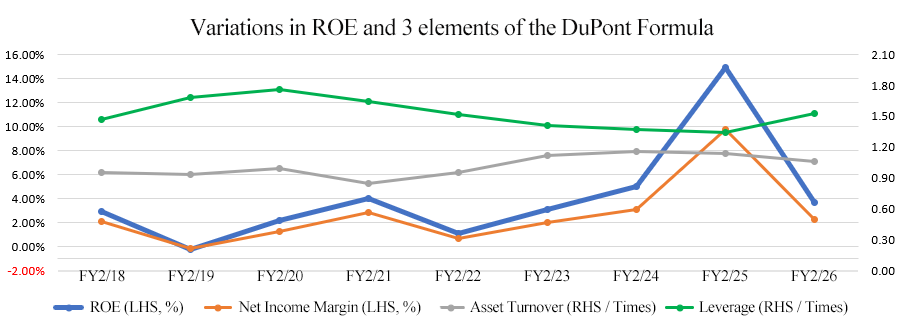
*Produced by Investment Bridge Co., Ltd. with reference to the material of TSI Holdings.
In the fiscal year ended February 2025, ROE rose significantly from the previous fiscal year, primarily due to a gain of 23.9 billion yen from the sale of fixed assets recorded as extraordinary income.
In FY 2/2026, there were no longer temporary factors, so the net income margin dropped to 2.27% and ROE stood at 3.7%. In order to achieve the ROE target of 8.0% or higher by the fiscal year ending February 2027, as set forth in the medium-term management plan "TIP27," continued efforts to improve profitability and asset efficiency will be essential.
2. Fiscal Year ended February 2026 Earnings Results
[2-1 Overview of business results]
| FY 2/25 | Ratio to sales | FY 2/26 | Ratio to sales | YoY | Ratio to forecast |
Sales | 156,606 | 100.0% | 167,085 | 100.0% | +6.7% | -1.1% |
Gross profit | 83,995 | 53.6% | 91,458 | 54.7% | +8.9% | - |
SG&A | 82,359 | 52.6% | 87,132 | 52.1% | +5.8% | - |
Operating income | 1,636 | 1.0% | 4,325 | 2.6% | +164.4% | -24.1% |
Ordinary income | 2,076 | 1.3% | 5,440 | 3.3% | +162.0% | -9.3% |
Net income | 15,230 | 9.7% | 3,793 | 2.3% | -75.1% | -9.7% |
*Unit: million yen. The ratio to forecast is the ratio to the forecast figures announced in October 2025.
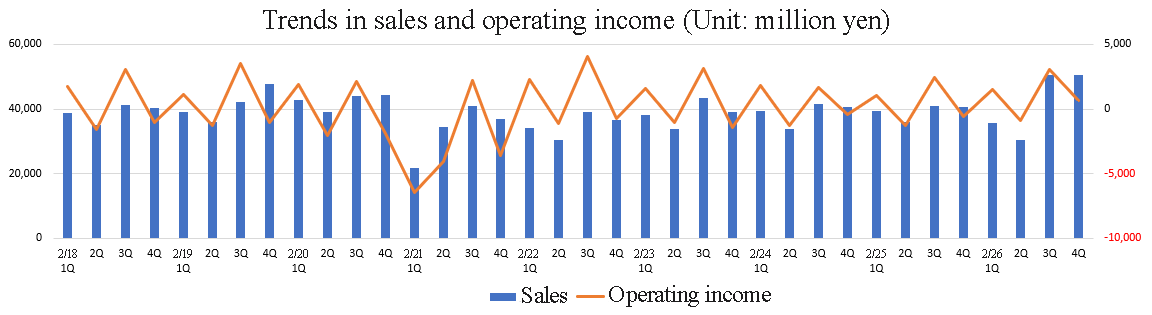
Sales increased and profit grew considerably due to the structural reform.
Sales increased 6.7% year on year to 167 billion yen, thanks to the inclusion of Daytona International Co., Ltd. and Waterfront Co., Ltd. in the scope of consolidation, although the existing businesses struggled.
Operating income rose 164.4% year on year to 4.3 billion yen. Gross profit increased 8.9% year on year, and gross profit margin rose 1.1 points year on year thanks to pricing initiatives, procurement cost reductions, the completion of inventory clearance in the previous fiscal years, and a decline in provision for loss from inventory valuation. SGA increased 5.8% year on year, but distribution costs, advertising & sales promotion expenses, etc. were rationalized through the structural reform, leading to significant profit growth. Both sales and operating income fell below the forecast as the existing major brands struggled.
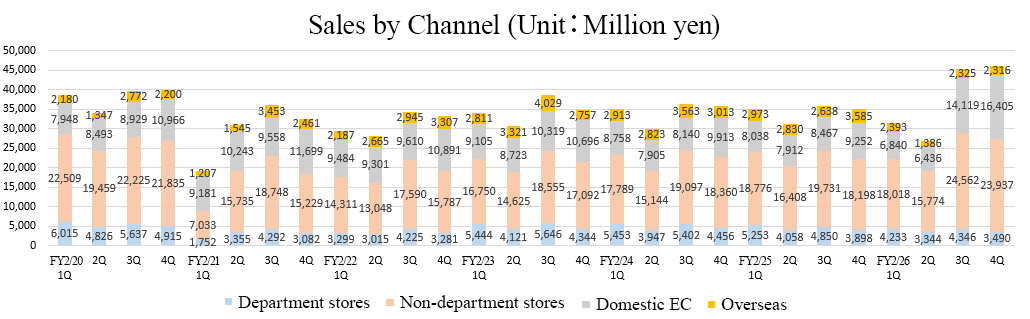
[2-2 Trend in each channel]
| FY 2/25 | FY 2/26 | YoY |
Department stores | 18,059 | 15,413 | -14.7% |
Non-department stores | 73,113 | 82,291 | +12.6% |
Domestic EC | 33,669 | 43,800 | +30.1% |
Other domestic channels | 19,737 | 17,160 | -13.1% |
All domestic channels | 144,580 | 158,665 | +9.7% |
Overseas | 12,026 | 8,420 | -30.0% |
Total | 156,606 | 167,085 | +6.7% |
*Unit: million yen.
*Non-department stores: fashion malls, station buildings, outlet stores, etc. Othe other apparel businesses, including wholesale and sales to employees and non-apparel businesses of group companies.
* | The sales at department stores declined due to the business exits and the closure of stores. |
* | The sales at stores other than department stores grew by double digits, thanks to the performance of Daytona International and the existing men’s casual clothing brands. |
* | Domestic sales via other channels decreased due to the business exits in the previous fiscal year. |
* | Outside Japan, sales declined due to the continued weakness of the U.S. business and the impact of a business divestiture in the previous fiscal year. |
◎EC Sales Trends
| FY 2/25 | FY 2/26 | YoY |
Domestic EC | 33,669 | 43,800 | +30.1% |
In‐house EC | 14,624 | 16,424 | +12.3% |
Other | 19,045 | 27,376 | +43.7% |
Overseas EC | 4,109 | 2,145 | -47.8% |
Total amount for EC | 37,779 | 45,945 | +21.6% |
*Unit: million yen.
Daytona International, which was included in the scope of consolidation in September, contributed significantly to the domestic EC sales via its own website and other sites.
Overseas EC sales dropped considerably, as the divestiture of a U.S. business and weak sales in the existing businesses also weighed on EC sales.
[2-3 Number of Stores and Brand Overview]
(1) No. of stores
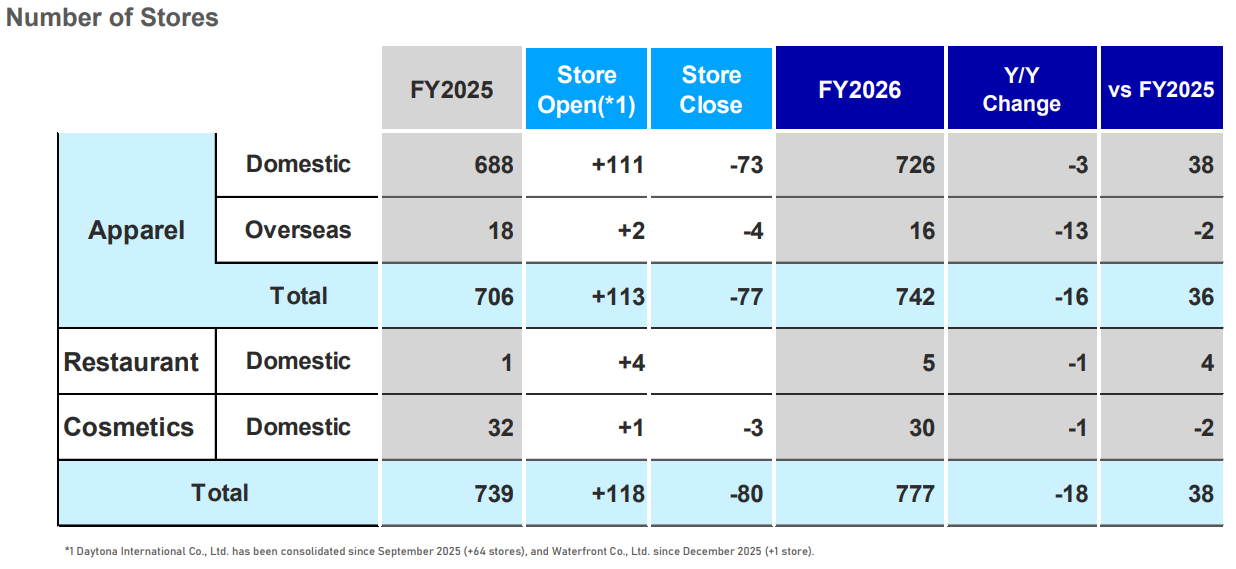
(Taken from the reference material of the company)
They acquired Daytona International Co., Ltd. (64 stores) in September 2025 and Waterfront Co., Ltd. (1 store) in December 2025 as consolidated subsidiaries.
The company continues efforts to improve the efficiency and productivity of store personnel through initiatives such as optimizing staff allocation across brands and regions, consolidating or closing unprofitable stores, and opening large-sized stores.
(2) Sales and gross profit margin of each brand
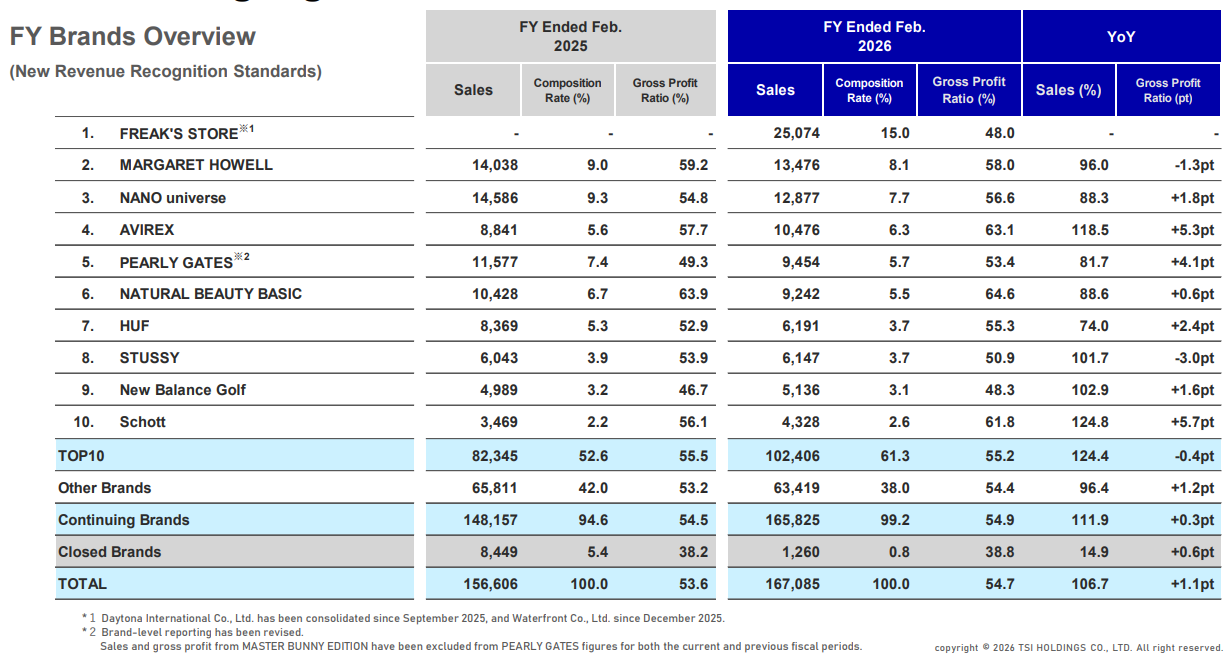
(Taken from the reference material of the company)
◎ Status of each major brand
* | FREAK’S STORE (which became a consolidated subsidiary in the second half of the previous fiscal year) Sales grew by double digits from the previous fiscal year, thanks to the growth of other companies’ EC and enhanced categories, including “PUBLUX” and “CAHLUMN” as well as their own EC “Daytona Park” and the healthy performance of existing stores. Sales promotion measures, including “Ikuzoo Festival,” helped retain customers. |
* | AVIREX Up 18.5% from the previous fiscal year Its performance remained healthy, contributing to their business growth. The full-year collaborative campaign for commemorating the 50th anniversary received favorable reviews as a whole, and the live event at the end of the campaign provided a precious opportunity to feel the passion of the community. In FY 2/2027, they will enhance the lineup of women’s apparel. |
* | MARGARET HOWELL Down 4.0% from the previous fiscal year Average spending per customer improved through price revisions, and the business in Europe and domestic men’s categories performed well. On the other hand, sales declined partially due to the decrease in customers in the domestic business. They have been accelerating store openings and closures to improve efficiency through the expansion of larger-format stores, and plans to continue these efforts in FY 2/2027. |
* | NATURAL BEAUTY BASIC Down 11.4% from the previous fiscal year The number of customers declined, particularly on their own EC channel, and the closure of stores, including major ones, decreased sales. In March 2026, they revised the brand strategy for “N. Natural Beauty Basic*” and transitioned to a new operating structure. They will approach customers with proposals tailored to a wide range of lifestyles. |
* | NANO universe Down 11.7% from the previous fiscal year Sales dropped as unprofitable stores were closed and the number of customers of existing stores decreased. Profitability improved significantly, thanks to the improvement in average spending per customer, etc. They launched the new content “Koresaeareba (This is all you need),” creating new contact points with customers. |
* | PEARLY GATES Down 18.3% from the previous fiscal year The number of customers and average spending per customer were sluggish mainly in the first half of the fiscal year, following the inventory clearance in the previous fiscal year. In the second half of the fiscal year, there were signs of recovery in full-price sales. Events inviting professional golfers we sponsor and character-based campaigns including “Snoopy,” helped attract customers. They will continuously enhance campaigns for fans to improve their loyalty. |
In addition, they saw favorable performance in Schott (up 24.8% from the previous fiscal year), Rirandture (up 18.7% from the previous fiscal year), and FREE’S MART (up 14.6% from the previous fiscal year). These brands launched hit products that resonated with current trends, increased brand awareness and consumer interest by enhancing social media strategies, and increased EC sales. In March 2026, “Daytona Park” began selling the products of “FREE’S MART” with the aim to generate synergies.
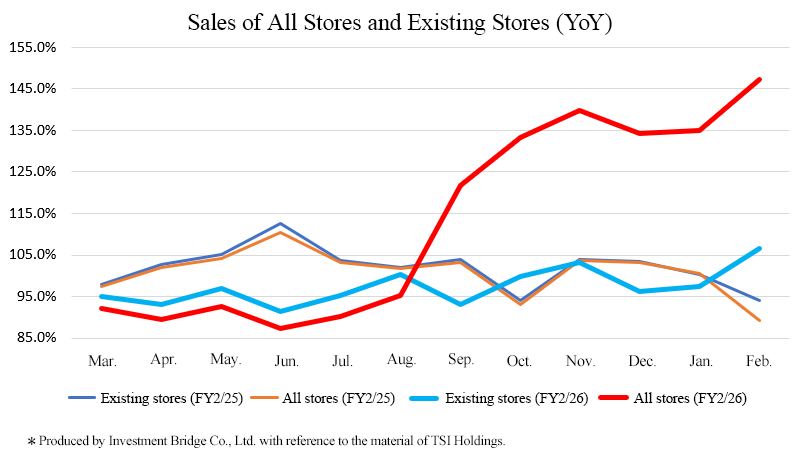
(3) Domestic Sales of All Stores and Existing Stores
The annual sales of existing stores in FY 2/2026 were 97.2% of those in the previous fiscal year, and the annual sales of all stores in FY 2/2026 were 113.9% of those in the previous fiscal year. The annual sales of existing stores decreased 2.8 points year on year, but the annual sales of all stores increased 13.9 points year on year as Daytona International was included in the scope of consolidation in September 2025.
[2-4 Financial statement and cash flow]
◎ Key Balance Sheet Items
| End of Feb. 2025 | End of Feb. 2026 | Increase/ decrease |
| End of Feb. 2025 | End of Feb. 2026 | Increase/ decrease |
Current assets | 86,273 | 79,682 | -6,591 | Current liabilities | 26,864 | 35,190 | +8,326 |
Cash and deposits | 46,325 | 28,478 | -17,847 | Accounts payable | 8,005 | 10,566 | +2,561 |
Accounts receivable | 11,450 | 13,855 | +2,405 | Short-term interest-bearing liabilities | 1,247 | 13,190 | +11,943 |
Inventory assets | 25,909 | 30,841 | +4,932 | Non-current liabilities | 6,063 | 39,693 | +33,630 |
Non-current assets | 54,885 | 94,522 | +39,637 | Long-term interest-bearing liabilities | 408 | 31,624 | +31,216 |
Property, plant and equipment | 6,165 | 7,394 | +1,229 | Total liabilities | 32,928 | 74,883 | +41,955 |
Intangible assets | 6,318 | 39,970 | +33,652 | Net assets | 108,230 | 99,321 | -8,909 |
Investments and other assets | 42,401 | 47,157 | +4,756 | Retained earnings | 74,140 | 73,374 | -766 |
Total assets | 141,159 | 174,204 | +33,045 | Total liabilities and net assets | 141,159 | 174,204 | +33,045 |
*Unit: million yen. Interest-bearing liabilities include lease obligations.
Total assets stood at 174.2 billion yen, up 33.0 billion yen from the end of the previous fiscal year, due to the increase in goodwill through the acquisition of Daytona International as a subsidiary, etc. Total liabilities stood at 74.8 billion yen, up 41.9 billion yen from the end of the previous fiscal year, due to the augmentation of interest-bearing liabilities, etc. Total net assets stood at 99.3 billion yen, down 8.9 billion yen from the end of the previous fiscal year, due to the decrease in capital surplus and retained earnings.
The equity ratio dropped 19.4 points from the end of the previous fiscal year to 57.0%.
◎ Cash Flow
| FY 2/25 | FY 2/26 | Increase/ decrease |
Operating CF | 5,717 | -7,717 | -13,435 |
Investing CF | 28,328 | -27,353 | -55,682 |
Free CF | 34,045 | -35,070 | -69,115 |
Financing CF | -15,135 | 16,995 | +32,130 |
Cash and cash equivalents | 45,822 | 27,955 | -17,867 |
*Unit: million yen.
Operating cash flow, investing cash flow, and free cash flow turned negative, due to a decline in net income before taxes and other adjustments, and an increase in expenditures related to acquisitions of subsidiaries that would change the scope of consolidation, etc.
Financing cash flow turned positive, due to the increase in borrowings.
The cash position declined.
[2-5 Topics]
① Establishment of the TSI Foundation for Future Fashion
In April 2026, they resolved to establish TSI Fashion Future Foundation, and dispose of treasury shares through the allocation to third parties for the purpose of supporting the activities of the foundation continuously and stably.
(Outline of TSI Foundation for Future Fashion)
They consider that a society or culture where people can keep enjoying fashion needs to be fostered so that they can keep delivering happiness through fashion by selling products that can meet the needs of customers. They decided to establish this foundation for the purpose of developing a society in which more people can enjoy fashion by not only conducting corporate activities but also addressing social issues related to fashion in cooperation with the foundation. They hope to develop next-generation creators who will lead the establishment of a future apparel industry and the fostering of a future fashion culture, carry out activities for local communities that preserve the environment and biodiversity, and support our sound society for public interest, contribute to the development of a society with an affluent fashion-enjoying culture, and then improve corporate value in a sustainable manner.
(Regarding the disposal of treasury shares)
They will sell 630,000 common shares in TSI Holdings to the foundation at 630,000 yen. They consider that the continuous stable support for the activities of the foundation would lead to market growth and the expansion of human capital in the entire fashion industry, and contribute to the improvement in corporate value through brand development and the establishment of a firm supply chain.
Here, the establishment of the foundation and the disposal of treasury shares require approval through a special resolution at the annual meeting of shareholders scheduled to be held on May 22, 2026, and they plan to establish the foundation in June 2026. In addition, in the articles of incorporation, they plan to include a provision stipulating that the foundation will not exercise the voting rights accompanying the shares in TSI Holdings the foundation will hold after the disposal of treasury shares.
② To acquire Toyo Enterprise Co., Ltd. and Lei Lani Trading Co., Ltd. as subsidiaries
In April 2026, they concluded a basic agreement for acquiring shares in Toyo Enterprise Co., Ltd. and Lei Lani Trading Co., Ltd. to make them subsidiaries.
(Outline of Toyo Enterprise)
Established in 1965. Toyo Enterprise imported and exported cloth in the early days. They first started business as a street vendor around a U.S. base, and grew as a supplier of souvenirs jackets for U.S. soldiers. In “pursuit of authenticity,” they are committed to the reproduction of materials, cutting, sewing, and even atmosphere of that era not merely as a fashion brand, but also as a successor of culture. Toyo Enterprise has some brands, including “Tailor Toyo,” which is a primary supplier of souvenir jackets, inherited the embroidery technology since the period just after the war, and reproduced vintage souvenir jackets, and “Buzz Rickson’s,” which is famous for military clothes, thoroughly researches the materials and specs of flight jackets, and aims to reproduce them perfectly. Lei Lani Trading Co., Ltd. is a distributor fully owned by Toyo Enterprise.
*Toyo Enterprise Co., Ltd. (FY 10/2025)
Sales | Operating income | Net income | Total assets | Net assets |
4,455 | 946 | 718 | 7,175 | 6,189 |
*Unit: million yen
*Lei Lani Trading Co., Ltd. (FY 7/2025)*
Sales | Operating income | Net income | Total assets | Net assets |
431 | 99 | 79 | 471 | 279 |
*Unit: million yen
(Background of the acquisition as subsidiaries)
TSI Holdings expect that the acquisition of these subsidiaries will produce synergetic effects from various aspects, including the operation of unique limited lines combining Toyo Enterprise’s craftsmanship for “ultimate reproduction and cultural inheritance” and the “diverse brand portfolio” of TSI Holdings, the increase of new customer segments through “mix.tokyo,” and the joint dissemination of “Japan quality” in the global market. In addition, it is expected to lead to the expansion of shares of the existing brands “Avirex” and “Alpha Industries,” which have growing significantly in recent years, in the American casual clothing market.
(Outline of share transfer)
They will acquire all shares in Toyo Enterprise and Lei Lani Trading. The acquisition price has not been disclosed. The official date of share transfer is currently under discussion.
③ Acquisition of treasury shares
In April 2026, they acquired treasury shares. The acquired 630,000 treasury shares will be disposed of through a third-party allotment to TSI Foundation for Future Fashion, and all shares excluding the 630,000 shares are scheduled to be cancelled on January 29, 2027.
Total number of acquired shares: 2.11 million
Total acquisition price: 3 billion yen
Period: April 13 to 30, 2026
3. Fiscal Year ending February 2027 Earnings Forecasts
[Earnings forecast]
| FY 2/26 | Ratio to sales | FY 2/27 Est. | Ratio to sales | YoY |
Sales | 167,085 | 100.0% | 200,000 | 100.0% | +19.7% |
Operating income | 4,325 | 2.6% | 7,500 | 3.8% | +73.4% |
Ordinary income | 5,440 | 3.3% | 7,200 | 3.6% | +32.4% |
Net income | 3,793 | 2.3% | 7,700 | 3.9% | +103.0% |
*Unit: million yen. This forecast was made by the company.
It is projected that sales will grow and profit will rise significantly.
Sales are projected to grow 19.7% year on year to 200 billion yen. In addition to the growth of the existing businesses, Daytona International and Waterfront, which were acquired through M&A, will contribute on a full-year basis. Operating income is forecast to increase 73.4% year on year to 7.5 billion yen. In addition to the sales growth, the effects of the structural reform will continue to be realized this fiscal year as well.
They plan to pay basic dividends amounting to 55.00 yen/share and a special dividend of 15.00 yen/share for a total of 70.00 yen/share. The expected payout ratio is 41.6% for basic dividends and 53.0% for the total dividend amount. They are expected to achieve a DOE of 4%, which is the initial goal set in TIP27.
4. Progress of Structural Reform in the Medium-Term Management Plan “TSI Innovation Program 2027”
The progress of the structural reform in the medium-term management plan “TSI Innovation Program 2027” is outlined below.
[4-1 Overview of structural reforms]
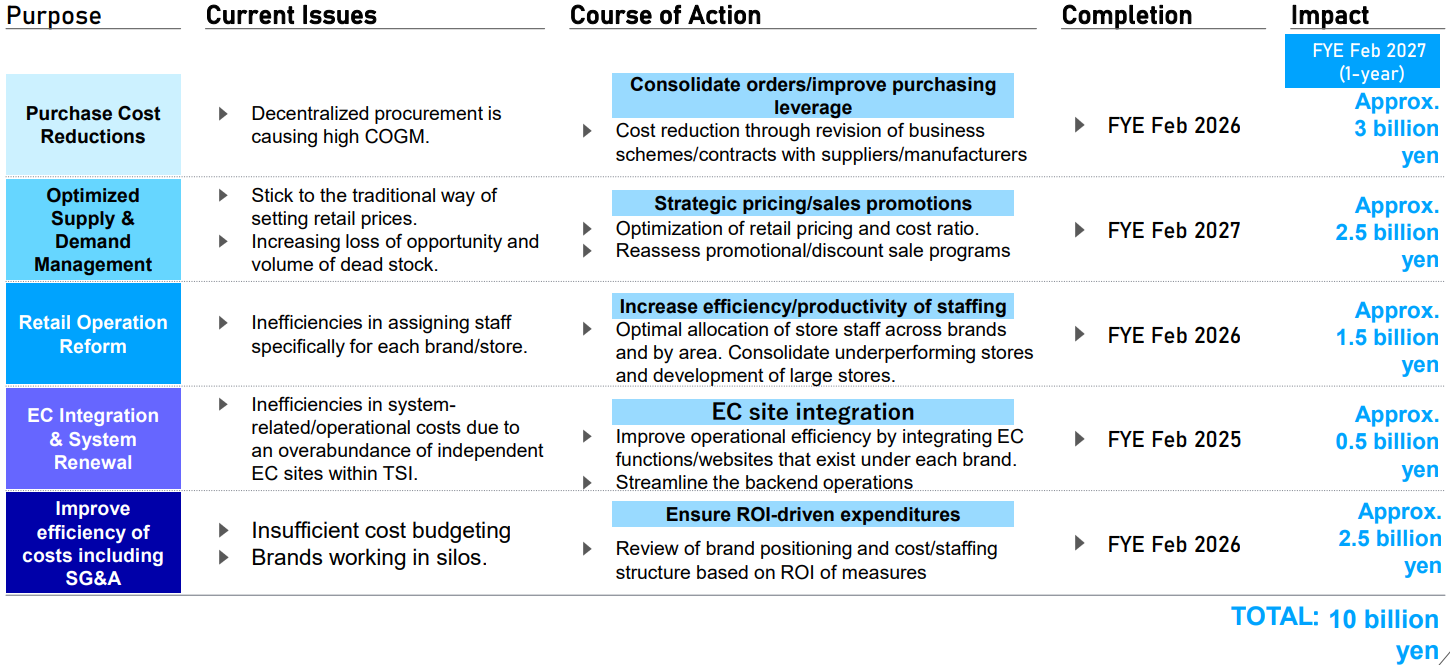
The company strives to increase revenues by approximately 10 billion yen by the fiscal year ending February 2027 in five reform items: “purchase cost reduction,” “the optimization of supply-and-demand management (strategic pricing),” “store operation reform,” “EC integration and system refurbishment,” and “the rationalization of costs, including selling expenses.”
The progress of and initiatives for each item and others are as follows:
(Taken from the reference material of the company)
[4-2 Progress until the fiscal year ended February 2026]
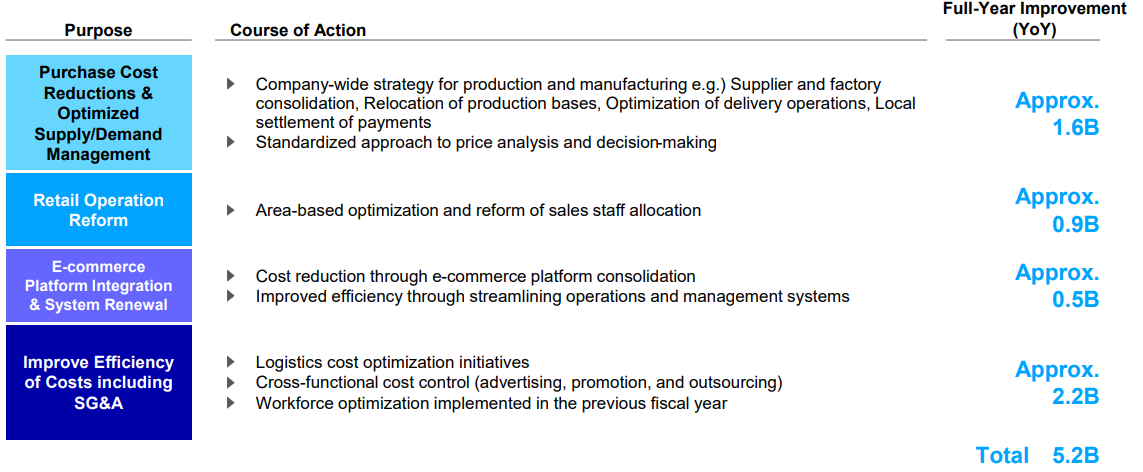
In each target field of structural reform, a year-on-year improvement was seen throughout the year, and operating income increased by around 5.2 billion yen as a whole. While they aim to achieve a 10-billion-yen improvement in three years, they have realized a 7.5-billion-yen improvement, including a 2.3-billion-yen improvement in FY 2/2025. In FY 2/2027, too, they will strive to maximize the effect while reviewing and revising measures and are expected to achieve a 1.9-billion-yen improvement (for a total of around 9.5 billion yen in three years).
(Taken from the reference material of the company)
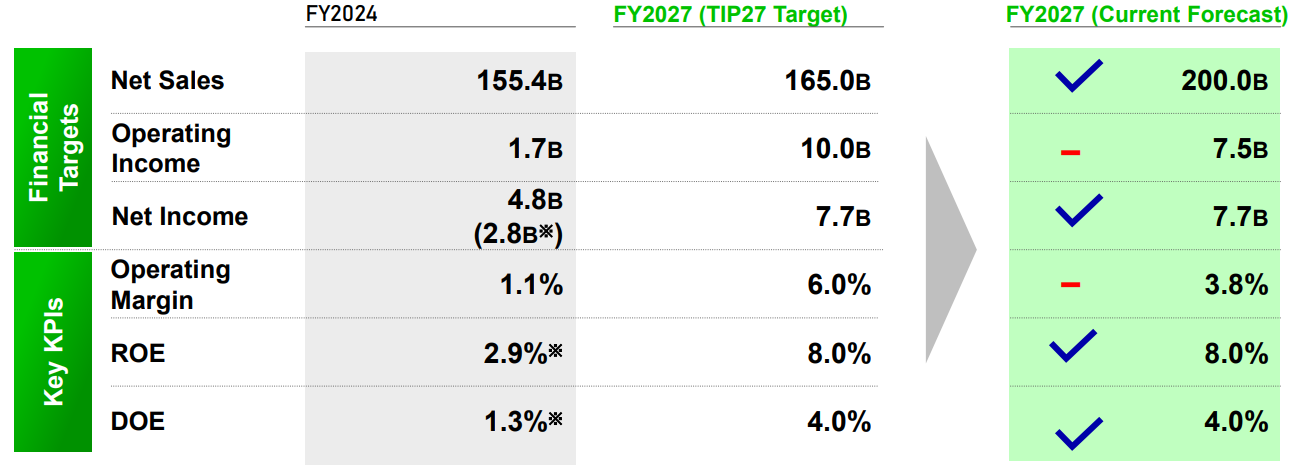
◎ Regarding the profit/loss forecast, they revised the forecast operating income downwardly.
Structural reform has steadily progressed, so they are expected to attain the target sales, net income, ROE, and DOE set for the final fiscal year of TIP27, but the sales of the existing businesses fell below the target sales by around 10 billion yen, and the sales are not expected to recover sufficiently, so they have revised the target operating income downwardly from 10 billion yen to 7.5 billion yen.
(Taken from the reference material of the company)
◎“mix.tokyo,” the online shopping mall integrating their 11 brands
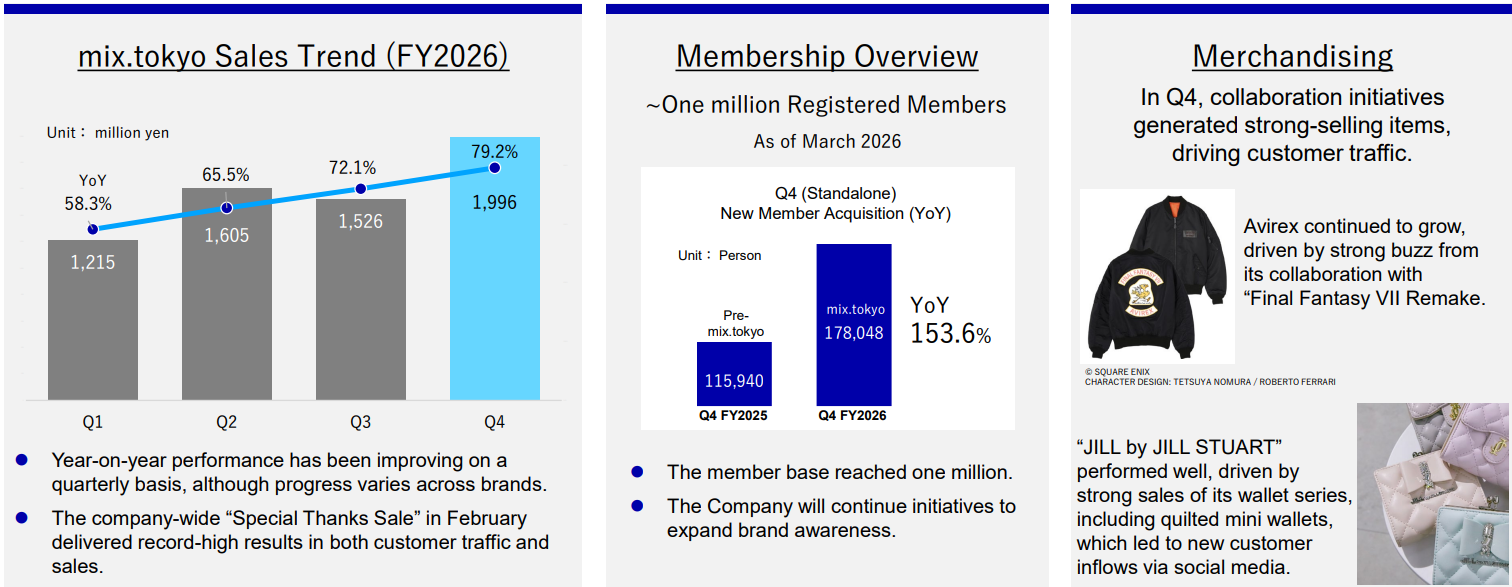
The online shopping mall integrating 11 proprietary EC sites and membership services “mix.tokyo” had an unfavorable start in terms of sales in FY 2/2026, but the growth of men’s brands contributed, and sales are catching up with the annual target gradually. The number of registered members reached the milestone of 1 million in March 2026. In the fourth quarter (Dec. to Feb.), in which many stores hold a sale, hit products emerged from collaborative campaigns, etc., reeling in customers, so they think that a foundation for future growth has been developed. They are reviewing the performance in FY 2/2026 from various perspectives, and based on its results, they will launch diverse promotional measures, including the campaign to commemorate the first anniversary, cross-brand campaigns, and the release of individual brands.
(Taken from the reference material of the company)
5. Interview with President Shimoji
We interviewed President Shimoji about the current status of the business, the progress of TSI Innovation Program 2027 (TIP27), his message to shareholders and investors, etc.
Please tell us about the current business environment and the status of your company's business.
Although external factors such as rising interest rates and inflation contribute to market volatility, what I notice most is that “customers have become much more discerning in their choices.”
While we own many brands, those that align well with customer needs and prioritize individuality to establish a unique identity are performing exceptionally well. Customers show strong purchasing interest in high-value brands, even if the prices are a bit higher.
On the other hand, even brands with a long history are performing poorly if they are unable to fully meet market needs or are competing with other brands in the low-price segment. In this context, we are continuously working to reform our brand portfolio.
How is the progress on structural reform—one of the key focuses of the Medium-Term Management Plan “TIP27”?
We have identified a variety of issues and implemented structural reform over the past two years. In the fiscal year ended February 2026, the reform was finished, although there are still areas that need continuous improvement, such as the integration of our e-commerce sites.
As I previously stated, our strong brands are producing positive impacts and garnering substantial customer approval as we continue to review our brand portfolio. Sales at existing stores have been steadily improving since the second half of the previous fiscal year, and I genuinely feel that the company's general momentum has changed and the impact of our structural reform has become more apparent.
Under TIP27, we aim to improve operating income by 10 billion yen in three years. Since the improvement amount was 2.3 billion yen in the fiscal year ended February 2025 and 5.2 billion yen in the fiscal year ended February 2026, we still need to increase operating income by 2.5 billion yen.
Our structural reform has been primarily focused on improving our structures through rationalization and streamlining, and these efforts are proceeding largely as originally planned.
On the other hand, we are having trouble increasing gross profit through price adjustments and reducing procurement expenses. One of the main reasons for this is that the sales of our main brands have not increased as anticipated, partly because of the closure of large-scale stores with an area of over 100 tsubo (≒ 330 m2) in our current business. As a result, gross profit decreased. Despite the planned reduction in fixed costs and streamlining operations being on track, operating income has not increased, and the operating income margin remains far from reaching double digits.
Therefore, moving forward, as we review our brand portfolio, we will focus on further expanding our growing brands while implementing various improvement measures for those that have not yet realized their full growth potential, with the aim of increasing overall sales.
When President Shimoji was appointed, you stated your goal is to “create exciting and interesting fashion that brings joy to our customers.” What is the current atmosphere within the company?
I feel that the driving force to move forward is growing stronger across the entire company. Although there are various political and economic uncertainties in the current business environment, each business unit is putting forward innovative proposals and taking action, as if to overcome these challenges.
We conduct an employee satisfaction survey every year. Two years ago, when we launched structural reform and streamlined our workforce, the survey score fell significantly. Last year, however, it bottomed out and is on a recovery trend, and we are seeing positive signs of progress.
Our company has stepped up its efforts to improve working conditions in 2026 more than in previous years. In addition, we have clearly communicated to our employees that our company is entering a growth phase, including the acquisitions of Daytona International and Waterfront in 2025. As a result, employee morale appears to be on the rise, and we look forward to seeing the results of this year’s satisfaction survey.
Could you also tell us about the current status of the growth strategy, which is another key focus of the Medium-term Management Plan “TIP27”?
(1)Selecting brands to strengthen and defining the brand portfolio
For our existing brands, we monitor each brand’s performance on a quarterly basis. For growing brands, we develop concrete strategies to further accelerate their growth. For underperforming brands, we identify early warning signs, and swiftly make decisions and take action, such as providing support or discontinuing the brand.
While strengthening the profitability of existing brands in this way, we are also working to expand into areas with significant growth potential through M&A activities such as the acquisitions of Daytona International and Waterfront in the previous fiscal year.
Regarding the establishment of new businesses and the cultivation of new business areas, we have not relied solely on M&A; as the first initiative for our company, we solicited ideas from employees. We received a total of approximately 80 ideas, from which we selected five that we are currently working on for incubation.
(2)Entering new fields and expanding into overseas markets
Soliciting ideas from employees I mentioned earlier is not limited to a new apparel brand. It also aims to expand the scope of the entire group by operating businesses in non-apparel sectors leveraging existing brands. As for our overseas operations, unfortunately, I cannot say we have made sufficient progress at this point. However, Daytona International is a very well-known brand among young people in Taiwan, and in domestic stores, foreign customers show a strong willingness to buy. We intend to use this as a foundation to pursue overseas expansion with full commitment.
(3) Store strategy
While we are closing unprofitable stores as part of our business structural reform, we remain convinced that physical stores remain essential as hubs for conveying our brands’ aesthetic vision and providing customers with enjoyment and excitement—in line with our identity as “a creator of fashion entertainment.” We are upgrading our existing stores through renovations and repairs, in addition to the strategic opening of stores, such as large stores and attractive stores in prime locations.
Lastly, could you please share a message for shareholders and investors?
The acquisition of Daytona International, which accounts for over 20% of the group's total revenue, is of immense significance to our group. Looking at the apparel industry as a whole, many successful companies—the industry leaders—began as retailers. While Daytona International owns a diverse portfolio of brands, the fundamental philosophy driving the company since its founding has been rooted in “retail.”
This decision to bring Daytona International into our group reflects our commitment to transitioning from an apparel company to an enterprise with a “retail” mindset. In other words, we are shifting our approach to ensure that all purchased merchandise is sold out, thereby pursuing higher profitability.
By selling the products of the leading brands owned by our group through FREAK'S STORE, operated by Daytona International, we aim to further enhance our group's profitability while focusing on two key areas: improving the profitability of these brands and strengthening the selling capabilities of FREAK'S STORE.
Furthermore, while everyone is familiar with our individual brands, the reality is that many people are not yet aware of “TSI” or “mix.tokyo,” which is our integrated e-commerce site. Therefore, guided by our purpose—“We create empathy and social value across the world through the power of fashion entertainment.”—we will not only refine our individual brands, but also build the “TSI brand” into something truly remarkable.
We sincerely hope you will continue to support us.
6. Conclusions
Most of the initially planned measures for structural reform were completed in FY 2/2026 as assumed. As they laid off some employees in the early days of the structural reform, the employee satisfaction survey scores dropped significantly, but it has bottomed out and is recovering, while the structural reform is progressing steadily. They said they're looking forward to this year's results. We would like to pay attention to the future of TSI Holdings as it embraces a retail mindset focused on selling through all procured products and pursue higher profitability,” through the inclusion of Daytona International in the TSI Group.
<Reference: Regarding Corporate Governance>
◎ Corporate Governance Structure and the Composition of Directors and Audit & Supervisory Board Members
Organization type | Company with an Audit & Supervisory Board |
Directors | 5 (including 2 Outside Directors, both of whom are Independent Officers) |
Audit & Supervisory Board Members | 3 (including 2 Outside Audit & Supervisory Board Members, both of whom are Independent Officers) |
◎ Corporate Governance Report
The latest update: May 26, 2026
<Basic concept>
The Company seeks to enhance its internal control, including rigorous compliance with laws and regulations and risk management, and develop a structure that enables decision-making that is highly sound, transparent, and swift in order to build a business operation system befitting a fashion and apparel company engaged in business globally, under the corporate philosophy that “we create value that lights up people’s hearts through fashion and share the happiness of living tomorrow together with society.” Through these initiatives, we will make efforts to keep our corporate value growing, which is our basic business policy, to enhance our corporate governance further while building good relationships with our stakeholders.
<Reasons for not following the principles of the Corporate Governance Code (fully or partially excerpted)>
[Principle 1-4. Cross-shareholdings]
Our company holds shares on a strategic basis when it can be considered that we can improve its medium- to long-term corporate value by building stable business or transactional relationships, creating business opportunities, or facilitating smooth business operations.
The appropriateness of strategic shareholding will be periodically examined and reported to the Board of Directors. For shares whose effects are fading, we will reduce the number of shares held after taking into consideration the situation of the target companies, such as dividends.
In exercising voting rights, the Company comprehensively decides to vote in favor of or against each of the proposals based on whether it is consistent with the purpose of strategic shareholding and whether it contributes to the maintenance and improvement of the corporate value of the target company and the shareholder value.
<Disclosure based on the principles of the Corporate Governance Code (fully or partially excerpted)>
[Principle 2-3. Issues related to sustainability, mainly social and environmental matters]
[Supplementary Principle 2-3-1]
[Principle 3-1.Full disclosure]
[Supplementary Principle 3-1-3]
[Principle 4-2. Roles and responsibilities of the Board of Directors (2)]
[Supplementary Principle 4-2-2]
(1) The Company’s Sustainability Efforts
The Company released a sustainability statement:
“Creating a sustainable future with fashion entertainment—A beautiful planet, radiant society, happy life,” laying down materialities and key goal indicators (KGI) that would be the foundation for generating long-term and sustainable well-being through business activities.
In September 2021, we established the SDGs Promotion Office, which was reorganized into the SDGs Promotion Department in March 2025. With this change, our company has strengthened our sustainability initiatives while actively working to build internal structures and raise awareness among employees.
For reports on specific activities, please see TSI Holdings Sustainability Website
https://sustainability.tsi-holdings.com/index.html
(2) Investment in human capital and intellectual property, etc.
(i) Investment in human capital
People are the source of value in our business activities and our greatest asset.
By setting diversity, employee wellbeing, health and safety, and fair labor conditions as part of our essential material issues, we will strive to improve the environment to enable all staff working together to thrive happily both physically and mentally.
Furthermore, to deal with the era of change, the Company will invest in employee education, training, and development. We will establish programs through which employees acquire needed skills by enhancing job rotations, training schemes, and self-learning systems to develop a multi-skilled workforce.
[Principle 2-4. Ensuring diversity within the Company by promoting the active participation of women, etc.]
[Supplementary Principle 2-4-1]
(1) Ensuring diversity
The TSI Group will create a diverse environment where anyone can thrive by actively promoting initiatives to realize diversity and flexibility in work and life for all in a manner that suits each one of them.
(2) Voluntary and measurable goals for ensuring diversity, and their statuses
(i) Promotion of women to managerial positions
While female managers accounted for 30.9% of the total number of managers in the Group at the end of February 2026, we have set a goal of raising the ratio to 35% by the end of February 2027.
(3) Human resources development and in-house environment improvement policies to ensure diversity, and their statuses
(i) Human resources development policy to ensure diversity
To ensure diversity in promoting core personnel, we evaluate and promote employees solely based on their skills, regardless of gender, age, or nationality.
Moreover, in addition to hiring new graduates, we actively hire highly skilled mid-career professionals, including those from other industries. As for promoting female employees to managerial positions, we will proactively work to raise the ratio of female employees in managerial positions further, which is already over 30% of all managers in the Group.
Moreover, while more than 100 foreign national employees already work for the Group as a whole, mainly at overseas subsidiaries, we intend to actively conduct recruitment activities to further secure highly skilled professionals as we focus on expanding the overseas business in the coming years.
(iv) Status of efforts to ensure diversity
The following efforts are in progress to ensure diversity in accordance with employees’ characteristics.
◎ Promotion of active engagement of women
While female managerial positions accounted for 30.9% of all managerial positions in the Group at the end of February 2026, we set the goal of raising the ratio to 35% by the end of February 2027 and strive to recruit and promote employees to increase the ratio of female managerial positions among highly senior positions.
◎ Further employment of workers of foreign nationalities
Employment of workers of foreign nationalities by the Group has been growing year after year, and we are now in the process of employing workers of foreign nationalities in a more planned manner.
◎ Utilization of elderly professionals with experience and past achievements
The Group is working to proactively employ personnel up to age 65 and continues to recruit and promote employees irrespective of age. Thus, the number of employees aged 65 or above actively contributing is increasing.
◎ Empowerment of people with disabilities
To date, the Group, mainly through its special subsidiaries, has avidly promoted the participation of people with disabilities. Its employees with disabilities accounted for 2.88% of the total workforce as of the end of February 2026. We will continue to work on creating opportunities for them to find fulfillment directly linked to operations.
◎ Promotion of understanding of LGBT
To date, the Group has a culture with a high level of understanding of LGBT, different surnames for married couples, and common-law marriage, and is now in the process of eliminating gender-based discrimination by comprehensively reviewing and amending various packages, such as the congratulatory/condolence cash gift rules (including congratulatory allowances for marriage).
Moreover, the Group is working on the following initiatives that focus not only on employee characteristics but also on workstyle diversity.
[Principle 5-1. Policy for constructive dialogue with shareholders]
As a policy regarding system development and initiatives to promote a constructive dialogue with shareholders, the director overseeing investor relations, legal affairs, stock administration, and finance will be responsible for the overall dialogue with shareholders and will cooperate actively with relevant internal divisions that assist the dialogue by sharing information properly. To promote a constructive dialogue with shareholders, we will not only arrange for opportunities to have one-on-one meetings but also hold briefing meetings. Furthermore, as a means of managing important matters in dialogue with shareholders, we will work to prevent the leakage of insider information by ensuring that the internal information and insider trading management rules are widely understood and strictly enforced.
In addition, at the meeting of the board of directors held on December 12, 2025, we established a “communication policy” of our corporate group from the viewpoint of further promoting constructive dialogue with all stakeholders, including shareholders and investors, and disclosed it on our website.
[Action to Implement Management that is Conscious of the Cost of Capital and the Stock Price]
The Company establishes its business strategy based on an understanding of its own capital cost and discloses and explains its outline at the general shareholder meetings and the financial results briefing meetings. To achieve our strategy, we regard various measures, such as capital investments, as crucial factors in the decision-making process.
The company recognizes that improving its PBR, which is currently below the level requested by the Tokyo Stock Exchange, is a critical management issue.
In the medium-term management plan, TSI Innovation Program 2027 (TIP27), we have disclosed the entire program, including the basic policy on the business portfolio.
“Medium-Term Management Plan: TSI Innovation Program 2027”
https://www.tsi-holdings.com/pdf/TIP27.pdf
For an update, see the most recent financial briefing material titled “Full-Year Financial Results Briefing for the Fiscal Year Ended February 2025.”
https://www.tsi-holdings.com/pdf/250414_Result%20Briefing.pdf
This report is not intended for soliciting or promoting investment activities or offering any advice on investment or the like, but for providing information only. The information included in this report was taken from sources considered reliable by our company. Our company will not guarantee the accuracy, integrity, or appropriateness of information or opinions in this report. Our company will not assume any responsibility for expenses, damages or the like arising out of the use of this report or information obtained from this report. All kinds of rights related to this report belong to Investment Bridge Co., Ltd. The contents, etc. of this report may be revised without notice. Please make an investment decision on your own judgment. Copyright(C) Investment Bridge Co., Ltd. All Rights Reserved. |
The back issues of the Bridge Report (TSI HOLDINGS CO., LTD.: 3608) and the contents of the Bridge Salon (IR Seminar) can be found at: www.bridge-salon.jp/ for more information.