



Bridge Report:(3937)Ubicom the Interim Period of the Fiscal Year ending March 2026

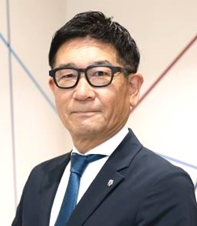 President Masayuki Aoki | Ubicom Holdings, Inc. (3937) |
 |
Company Information
Exchange | TSE Prime Market |
Industry | Information and communications |
CEO | Masayuki Aoki |
HQ Address | 7th floor of Ichibancho Tokyu Bldg., 21 Ichibancho, Chiyoda-ku, Tokyo |
Year-end | End of March |
Homepage |
Stock Information
Share Price | Shares Outstanding (Term-end) | Market Cap. | ROE (Act.) | Trading Unit | |
¥1,064 | 12,123,241 shares | ¥12,899 million | 16.8% | 100 shares | |
DPS (Est.) | Dividend Yield (Est.) | EPS (Est.) | PER (Est.) | BPS (Act.) | PBR (Act.) |
¥40.00 | 3.8% | ¥78.20 | 13.6x | ¥456.77 | 2.3x |
*The share price is the closing price on December 10. Figures are based on the financial results for the interim period of the fiscal year ending March 2026. ROE and BPS are the results in the previous fiscal year. The number of outstanding shares excludes the number of treasury shares.
Earnings Trends
Fiscal Year | Net Sales | Operating Income | Ordinary Income | Net Income | EPS | DPS |
March 2022 (Act.) | 4,726 | 1,033 | 1,055 | 832 | 70.38 | 9.00 |
March 2023 (Act.) | 5,246 | 1,011 | 1,004 | 573 | 48.68 | 11.00 |
March 2024 (Act.) | 5,942 | 1,072 | 935 | 526 | 44.73 | 13.00 |
March 2025 (Act.) | 6,340 | 1,315 | 1,341 | 858 | 71.13 | 40.00 |
March 2026 (Est.) | 6,572 | 1,351 | 1,364 | 948 | 78.20 | 40.00 |
*Unit: million yen, yen. Forecasts are those of the company. The definition for net income means net income attributable to owners of parent.
This Bridge Report overviews the financial results of Ubicom Holdings, Inc. for the interim period of the fiscal year ending March 2026.
Table of Contents
Key Points
1. Company Overview
2. Interim Period of the Fiscal Year ending March 2026 Earnings Results
3. Fiscal Year ending March 2026 Earnings Forecasts
4. Initiatives and Outlook for the Second Growth Phase
5. Conclusions
<Reference: Regarding Corporate Governance>
Key Points
- In the interim period of the fiscal year ending March 2026, sales dropped 5.2% year on year to 2,975 million yen. The sales of the medical business grew, but the sales of the technology consulting business declined. Operating income rose 12.6% year on year to 665 million yen. Gross profit margin improved year on year from 38.2% to 41.8%, SG&A expenses dropped, and operating income margin increased year on year from 18.8% to 22.4%, so they secured a double-digit profit growth. Ordinary income grew 7.5% year on year to 676 million yen, and net income rose 27.9% year on year to 566 million yen. All kinds of profits hit a record high.
- The full-year forecast was left unchanged. For the fiscal year ending March 2026, it is expected that sales will grow 3.6% year on year to 6,572 million yen, operating income will rise 2.7% year on year to 1,351 million yen, and ordinary income will increase 1.7% year on year to 1,364 million yen. In the medical business, they will accelerate the investment for growth based on M&A strategy. They will strive to diversify revenue sources based on new solutions, which are under development, in addition to the remote service platform. In the technology consulting business, they will implement measures for enhancing the revenue earning capacity while expecting further growth from the third quarter and forecasting that costs will augment in the short term. The stagnation of sales due to the selection of orders, which started in the fourth quarter of the fiscal year ended March 2025, ended in the second quarter. From the second half of the fiscal year ending March 2026, they will conduct strategic investment for establishing an AI center for utilizing watsonx. They plan to pay a year-end dividend of 40.00 yen/share.
- In the medical business, they concluded a basic agreement for acquiring the shares in ISM Co., Ltd. via the consolidated subsidiary AIS Co., Ltd. to make ISM a subsidiary. By cooperating with ISM more closely, they will strengthen their business operation in the Kyushu region. They will also promote the M&A strategy further. Targeting enterprises that have a community-based healthcare network, they will conduct M&A of 8 to 10 companies between 2025 and 2030, with the aim of improving the ratio of direct sales of the corporate group. They aim to increase the ratio of direct sales of the corporate group from 4.8% to 35% between 2025 and 2030.
- In the technology consulting business, the company will establish an AI center at the base in the Philippines, by utilizing “watsonx,” a business AI platform for enterprises as a strategic partner of IBM Japan. By combining “development, AI, and consulting,” the company will transform its business model into a high value-added, highly profitable AI solutions company. They will implement measures for enhancing the revenue earning capacity in the medium/long term while expecting further growth from the third quarter and forecasting a short-term augmentation of costs.
- In the medical business, the M&A strategy set at the beginning of the fiscal year is being implemented on a full-scale basis after the acquisition of ISM. They secured a double-digit profit growth in the interim period while offsetting the costs for M&A. This can be highly evaluated. The technology consulting business was affected by the U.S. tariffs, but they started new projects while expecting business expansion from the third quarter, and it seems that they have already completed preparations for catching up in the second half of the fiscal year.
- In the interim period, operating income grew 12.6%, but they have not revised the full-year forecast that operating income will increase 2.7% year on year.
1. Company Overview
Ubicom Holdings is a one and only business innovation company that creates IT solutions to social issues, such as the shortage of manpower and a medical crunch. It recognizes the medical, financial/public, automotive (EV), mobile, and real estate sectors, as strategic markets, and offers a broad range of IT solutions and services utilizing AI and IoT.
1-1 Corporate History
Mr. Masayuki Aoki, who had entrepreneurial ambition all along, took the position of President and CEO at WCL Co., which was a new business subsidiary of WORLD CO., LTD. in March 2005, and then found out that there are many young talented engineers who work vigorously in the Philippines when he visited there during his domestic and international search for seeds of various new businesses. As the adoption of IT on internal operations of companies progressed in Japanese companies, he thought that conducting the system development in the Philippines will open the possibilities to offer a wide array of system solutions globally at high performance and capture the demand and decided to commercialize the idea. In December 2005, He founded Advanced World Solutions, Ltd. (currently: Ubicom Holdings, Inc.)
Following the trend of ICT adoption, the increase of new clients progressed well, and the business expanded thanks to the competitive advantage of having a development center in the Philippines, which possesses many capable top-class engineers. In 2012, the company acquired AIS Co., Ltd., which is the largest company in the field of systems for medical claims, as a subsidiary. In June 2016, the company was listed on Mothers of Tokyo Stock Exchange. After it changed its name to Ubicom Holdings, Inc. in July 2017, it was listed on the First Section of the Tokyo Stock Exchange in December of the same year. In April 2022, the company got listed on the Prime Market of TSE after the restructuring of the market.
1-2 Corporate Ethos and Vision
The company advocates the following three management visions as the one and only business innovation company that creates innovative IT solutions combining people and technology.
1. Unique beyond comparison To remain a one-of-a-kind business innovation company that looks ahead to the future and creates IT solutions to social issues |
2. Go Global To use the business scheme of the Ubicom group globally mainly in the U.S. and Asian countries |
3. Win-Win To increase the “fellows” of the Ubicom group, by prospering together with customers, collaboration partners, and all other stakeholders |
Based on five core assets: technology, human resources, intellectual property (IP), foresight, and partnerships, the company creates business innovations aimed at solving issues such as Japan’s aging society, healthcare strain, a lack of IT personnel, and digital transformation (DX), which it sees as its social responsibility and raison d’être.
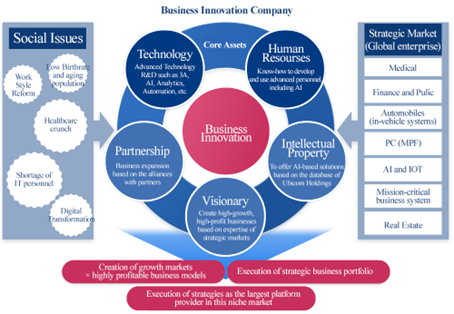
(From the company’s website)
1-3 Business Description
1-3-1 Overview
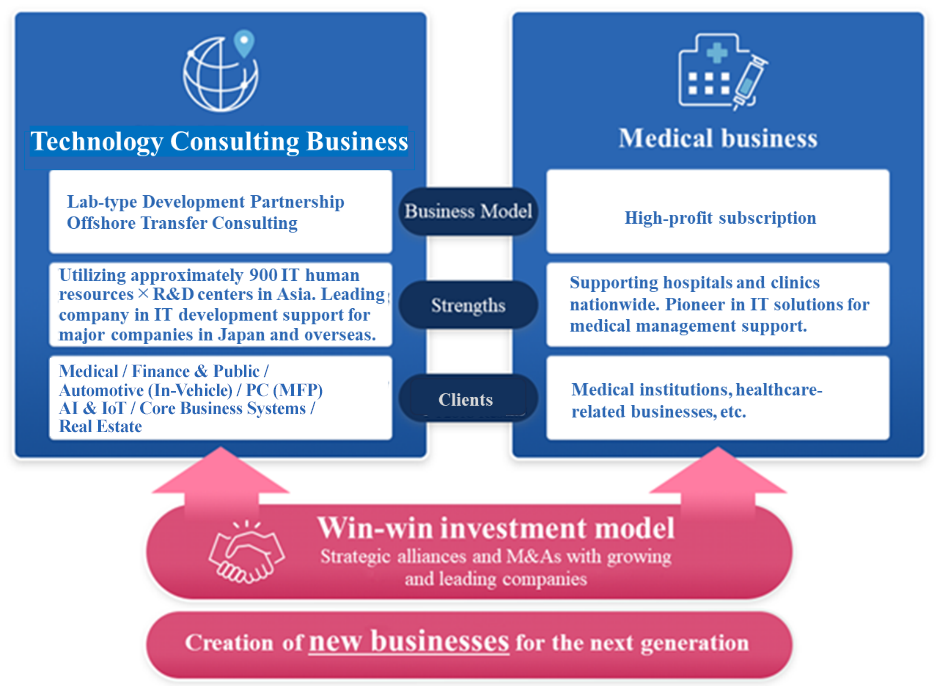
As a leading company offering IT solutions for supporting the management of medical institutions, Ubicom Holdings operate the two core businesses: the medical business, in which they develop and sell software for healthcare information systems, undertake development projects, analyze medical data, and offer consultation services for medical institutions, such as hospitals, and related facilities, and the technology consulting business, in which they offer a variety of IT solutions in the fields of healthcare, finance, the public sector, automobiles (EV), mobile devices, real estate, etc., which are their strategic markets, from mainly Japan and the Philippines. By reestablishing their businesses in a scrapping-and-building manner, they have established a profitable business model. Furthermore, they will promote a win-win investment model for accelerating business growth through the strategic alliances and M&A with leading companies and growing enterprises, and aim to establish new businesses with different approaches from the existing businesses, such as the platform business.
1-3-2 Business model
Considering the changes in social structures, including globalization, the declining birthrate, and the aging population, and technological innovation in the fields of medicine, life science, robots, and artifical intelligence as chances to create new businesses and positioning the core solutions evolved and advanced based on “3As: automation (automation of execution and management of software tests, etc.), analytics (big data and analysis), and AI (artificial intelligence)” for the fields of healthcare, finance, the public sector, automobiles (EV), mobile devices, real estate, etc., which are their strategic markets, as next-generation solutions, they apply their business model. In the “financial field,” they support the development of applications for business operations mainly for financial institutions and the development for meeting the demand for migration to new systems for the fintech age. In the “healthcare field,” they have established a system in which they develop and sell software for medical information systems and actively implement business model strategies centered around the analysis of medical data, mainly through AIS Co., Ltd., which develops software for inspecting medical claims taking the central role in the healthcare business.
| Medical business | Technology consulting business |
Missions | To reform the workstyles of healthcare workers To increase the revenues of medical institutions To improve the safety and quality of healthcare | To deal with the shortage of IT engineers (787,000 IT engineers short in 2030) To produce advanced IT engineers from foreign countries |
Business models | AI × a subscription model Operating income margin: 60% or higher | To start preparations for establishing an AI center to develop an AI-driven development system The Ubicom group employs over 900 excellent young engineers. |
Strengths | Healthcare database developed for over 30 years Owning a lot of AI engines | Trust and a track record of offshore development, which was conducted for over 30 years Partnership for lab-based development Consulting for the shift to offshore development |
Clients | Over 22,000 medical institutions, healthcare-related business operators, etc. | Technology: AI, IoT, etc. Strategic markets: healthcare, finance, the public sector, automobiles, PCs, IT devices, real estate, energy, infrastructure, etc. |
(1) Nationwide promotion of digitalization、Worsening labor shortage in the IT field
With the government's flag-waving for digitization in full swing, according to “Survey on the demand and supply of IT personnel” published by the Ministry of Economy, Trade and Industry in March 2019, it is important to secure IT personnel who can contribute to the improvement in productivity by creating added value and streamlining business operations in an innovative fashion, but it is difficult to secure them, due to the declining birthrate and the aging population. When the growth of IT demand is classified into “minor,” “medium,” and “significant” ones, it is estimated that Japan will be 584,000 engineers shortage in 2025 and 787,000 engineers shortage in 2030 in the case of “significant” growth.
(2) Augmentation of national medical expenditure and tightening of examination of Medical Claims, Strain in medical institution management, work-style reforms for healthcare providers
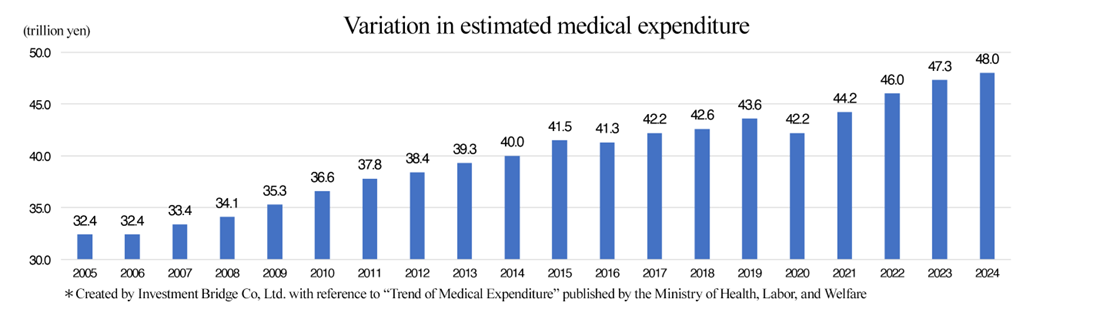
The estimated medical expenditure (excluding expenses such as workers’ accident compensation insurance and payments when the full payment is covered with own expenses. It accounts for about 98% of the national medical care expenditure, which is the overall estimate of all expenses required for treating injuries or diseases after examinations by doctors in medical institutions) has marked a record high in 2024 at 48.0 trillion yen.
Medical expenses are in an increasing trend due to the progression of the aging population, so the financial situation of each health insurance is worsening. In order to reduce insurance costs, the national government is implementing a measure for rationalizing medical expenses by tightening the examination of Medical Claims,etc.
(What are the medical claims?)
Under the current system of health care services provided by health insurance, medical institutions receive up to 30% from patients and the other 70% or more from the health insurance association, mutual aid associations, city or ward offices, etc.
Medical institutions define the detailed statement of diagnosis and treatment, which is required to claim the amount covered by insurance from these public institutions, a Medical Claim; and the tasks performed to issue the Medical Claim are a very important procedure, which makes up most of the revenue of medical institutions.
The submitted Medical Claims are meticulously scrutinized by the Examination and Payment institutions. In case there is a mistake in its content, the Medical Claim may be sent back (returned) by the Examination and Payment institution, or the scores of medical fees may be reduced. In case the Medical Claim is returned, it must be carefully examined, revised, and resubmitted. Submitting appropriate Medical Claims is an extremely important task for the efficient management of medical institutions.
In 2009, medical institutions were obligated to make online requests for Medical Claims, as a general principle.
(Workstyle reform for doctors, etc.)
While Japan's medical needs are rapidly expanding, diversifying, and becoming more sophisticated with the progress of a super-aging society, the problems of shortage and uneven distribution of medical doctors and workloads such as long working hours are becoming apparent.
In order to alleviate the ever-increasing burden on doctors and promote reforms in the way doctors work in the medical field, a cap on overtime work for doctors with penalties will come into effect in April 2024. As a result, medical institutions are faced with the urgent task of streamlining and optimizing the work of doctors and others.
The strain in medical care provision systems and deterioration of hospital management caused by the COVID-19 pandemic are serious social issues. Against this backdrop, examination and payment institutions are moving to tighten the examination of medical claims, and work-style reforms are in progress for health care providers. Accordingly, it is now essential for the management of medical institutions to improve revenues through better operational efficiency for medical claim checks, etc., ensure the safety and quality of medical care, and deal with work-style reforms.
(3) Medical cloud market is expected to grow rapidly
Thanks to the notice of the Ministry of Health, Labor and Welfare titled “Regarding places for storing medical records” partially revised in February 2010, it became possible to store medical information at data centers owned by private enterprises, which made it easier for private enterprises to offer medical cloud services.
It is expected that application platforms and cloud services in which servers exist in networks will be utlized in the medical field for electronic medical record, medical image management systems, regional medical cooperation systems, and various services for home care support, remote image diagnosis, clinical trials, and dispensaries.
Especially, as the volume of data in today’s medical instiutions increased steeply and networks are used more widely, expectations toward medical cloud services are growing, as cloud services have merits, such as “It is easy to cooperate with other facilities,” “It is unnecessary to maintain and manage data by yourself,” and “They are inexpensive,” and they turned out to be useful for anti-disaster measures after many medical records were lost in areas devastated by the Great East Japan Earthquake in March 2011. Furthermore, the medical strain due to the spread of COVID-19 made us strongly aware of the necessity of online diagnosis and electronic records.
Some point out the problem of safety from the viewpoint of protection of personal information, but the medical cloud market is expected to grow considerably for offering solutions to social issues while keeping a balance between the tightening and easing of regulations.
1-3-3 Strategic business domains
The company focuses its efforts to expand its business based on the strategic business domains of the “3As” fields, which will usher in the new age.
Field | Current situation and future plans |
AI | After the practical use of AI chatbots in the Global Consulting Group, a leading auditing corporation’s group, and the support for installation of AI in product appearance inspection equipment for a manufacturer, they aim to expand the AI-related business in more diverse fields by enhancing the development of cutting-edge personnel. After finishing development for audio AI and chatbots (automatic conversation programs), the company is promoting cross-sectoral application. |
Analytics | The company finished the development phase of Japan’s number one Medical Claims Inspection Software, the Mighty series, and analysis tools, and will proceed to a phase of achieving a new monetization model by building an engine that analyzes medical-related fields to improve the quantity and quality of the data. In addition, the company provides solutions for predictive maintenance for factories and shipping companies. |
Automation/RPA | The company has established an engine for software testing automation and is pursuing robotics and RPA (automation of business operations with robots). It aims to expand its market reaching leading robotics and FA manufacturers. |
1-3-4 Segments
They have two business segments to be reported: the medical business for helping solving problems with the management of medical institutions and promoting the digital transformation (DX) of healthcare mainly by developing and selling software for medical information systems, undertaking development projects, and offering consultation services, and the technology consulting business, in which they develop systems for mainly global enterprises inside and outside Japan by utilizing the overseas subsidiaries Advanced World Systems, Inc. and Advanced World Solutions, Inc. in the Philippines, AWS (Beijing), Ltd. in China, and the equity-method affiliate Alsons/AWS Information Systems, Inc.
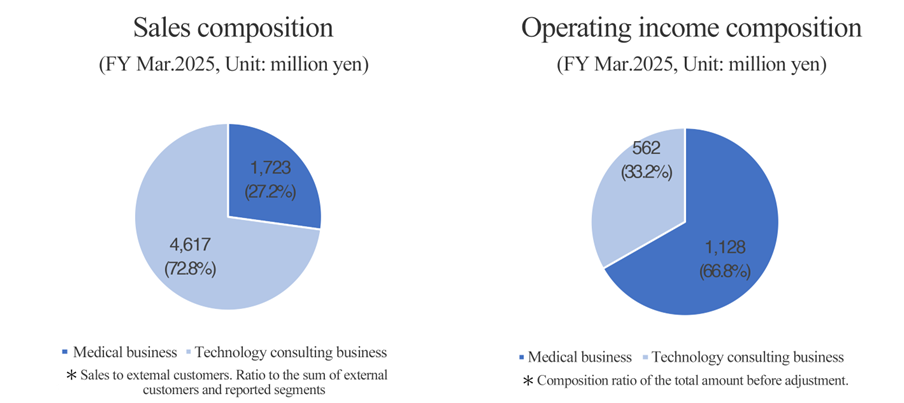
(From the company’s website)
(1) Medical business
① Overview
AIS Co., Ltd., which is a 100% subsidiary, engages in the development and sale of packaged solutions for medical institutions, cloud services, data analysis solutions, development support, and consulting services, contributing to the reform of workstyles of medical professionals and staff in medical institutions, the improvement of revenues at medical institutions, and the improvement in safety and quality of healthcare.
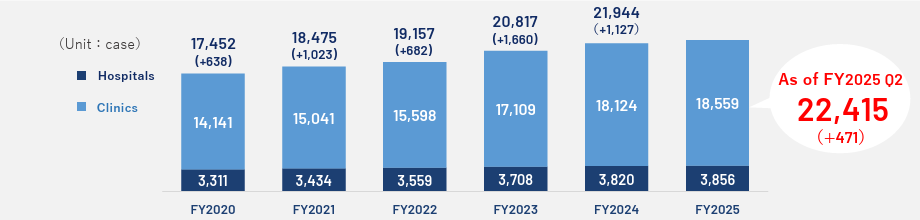
The “Mighty Series,” which improves the management quality and increases the work efficiency in medical fields, is well-received thanks to its abundant and useful functions. Due to the impact of work style reforms, which became applicable to doctors in April 2024, and revisions to medical treatment fees, DX investment by medical institutions is accelerating. While they are focusing on the switching by existing users, the number of new users is steadily increasing. As of the end of September 2025, the Mighty series occupied the top market share and was being used by approximately 48% of hospitals with a patient capacity of 20 or more (3,856 facilities), and 18% of clinics with a patient capacity of less than 20 (18,559 facilities), for a total of 22,415 facilities.
The company supports the reform of workstyles of medical doctors by providing these products and solutions, and based on transactions with some of the largest medical institutions in Japan, the company promotes a new platform business, with the aim of creating a new market based on intellectual property.
They will earn significant revenues stably based on the profitable subscription model of this series.
(From company’s document)
② The Medical Claims Inspection Software “MightyChecker®”
Medical institutions will be obligated to submit medical claims only except some cases. As the examination and payment organization is tightening their examination, it is essential for medical institutions to improve the precision and efficiency of the inspection of medical claims. As the electronic processing and online submission of medical claims are now common, “MightyChecker®” series are an indispensable tool for medical institutions. It has the functions to deal with the revision and rejection of medical claims during in-hospital screening, and its enhanced functions have made it possible to point out an point out the possibility of failure to submit claims, additional remuneration items, etc. The company has also mounted it with graphic functions, realized the inspection in the order of assessed amount, and added the functions to extract assessed medical claims by reading data on revision and rejection, revise the database smoothly, collect and analyze data, and keep supplying it as a unique, pioneering product in this industry.
<Major products and features of Mighty Checker® Series>
Product name | Features |
MightyChecker® EX | - Next-generation software for inspecting Medical Claims with the AI-based detection function - Two Medical Claims can be checked at once with the function to display multiple Medical Claims. - When an error message is clicked after Medical Claims inspection, it will display points and insurance rules will be described in an understandable manner. - A tag and a status can be inputted for each patient, considerably increasing the efficiency of inspection of Medical Claims. - Medical institutions can improve revenues by preventing errors in claims and the failure to submit claims. - For the product targeted at medical affairs sections, the return on investment (sales growth effect) at medium-sized hospital with 300 beds is 62 million yen and 1,154% per year. - For the product targeted at medical affairs sections, the return on investment (sales growth) at medium-sized hospitals with 300 beds is 9 million yen and 411% per year. |
MightyChecker® PRO Advance | - A standard version of Medical Claims inspection software. - Validates the disease name, medicines, and medical care of the indication. - Inspects the measures for assessment and return (cross-check inspection, general inspection, calculation day check, etc.) - Validation by the claims support functions (checks items that can be calculated as consultation fees, etc.) |
MightyChecker® for ORCA | - Mighty Checker® PRO Advance is linked with “ORCA,” the standard software for Medical Claims of Japan Medical Association. - The data inputted with ORCA can be inspected smoothly with the same function as that of Mighty Checker® PRO Advance. |
MightyChecker® DENTAL | - Software for inspecting dentists’ Medical Claims - When combined with Mighty Checker® PRO, it is possible to inspect medical and dental ones. |
MightyChecker® Cloud | - Provision of an online service of inspecting Medical Claims - Even if an application has not been installed in a PC, it is possible to use Medical Claims inspection software by accessing a server. |
(Marketing strategy for increasing orders received for MightyChecker® EX)
The company will focus on switching from old products used by existing users.
With regard to the clinic domain, “MightyChecker®for ORCA,” which is linked with “WebORCA” provided by ORCA Management Organization, has been used at 1,100 facilities. However, the company is forging ahead with the switch from “MightyChecker®for ORCA” to “MightyChecker® EX,” and the number of medical institutions using the API connection for “WebORCA” and “MightyChecker® EX” is increasing steadily.
Owing to this switch, the average spending per user has grown 1.5 times.
From now on, the company will push forward with the switch at the existing 1,100 clinics while focusing on expansion of sales targeting as many as 19,296 medical institutions (total number as of April 15, 2025) that use the standard software for Medical Claims of Japan Medical Association.
As the support for “MightyChecker® PRO,” the old product, is no longer available, the company is also proceeding with the switch from this product to “MightyChecker® EX.”
This also contributed to the elevation of profitability.
③ The ordering check software “Mighty QUBE®”
The legislation for reforming the workstyles of medical doctors enforced in April 2024 stipulates that the upper limit of overtime working hours of medical doctors is 960 hours as there is the issue of overwork of medical doctors, so it is imperative to conduct digital transformation (DX) in healthcare scenes. This software was developed in collaboration with the University of Tokyo to provide a system for inspecting diseases, indications of medical examinations and medication, dosage, the number of dosing days, etc. by utilizing the database of “MightyChecker®” when prescriptions are ordered, and displaying an error message when there is any mistake or a disease name has not been inputted. By preventing human errors in inputting and operation at the time of ordering, it can avoid medical accidents (near-miss events) and revisions of medical claims (reduction of insurance money), reduce overtime working hours of medical doctors, and reduce expenses at medical institutions.
<Major products and features of the “Mighty QUBE®” series>
Product name | Features |
Mighty QUBE® PRO | ・Real ordering check software utilizing the database of MightyChecker® ・Inspection of diseases, indications of medical examinations and medication, dosage, the number of dosing days, etc. at the time of ordering prescriptions ・To display an error message when there is any mistake or a disease name has not been inputted ・By preventing human errors in inputting and operation at the time of ordering, it can avoid medical accidents and revisions of medical claims (reduction of insurance money), reduce overtime working hours of medical doctors, and reduce expenses at medical institutions. |
Mighty QUBE® Hybrid | ・The evolved version of Mighty QUBE® PRO ・Real-time inspection software embedded in electronic charts that can be connected to either an in-hospital server (on-premises) or a cloud server ・Equipped with the function to inspect medical claims, to avoid inappropriate claims (resulting in the reduction of insurance benefits). |
◎ Mighty QUBE Hybrid, a system linked with electronic medical records
(Outline of the system)
The electronic medical record-linked system “Mighty QUBE Hybrid” is the advanced version of “Mighty QUBE® PRO” (which will be described later). This is electronic medical record-incorporated software for real-time inspection that can be connected to either an in-hospital server or a cloud server, and instantly points out the failure to input administration costs and additional remuneration, to secure the increase in revenues of each hospital. In addition, this system is mounted with the function to cross-check the data in several months, to avoid the downward revision of medical claims and contribute to medical safety while reducing the working hours of doctors and supporting workstyle reform for doctors and hospital management.
Return on investment (sales growth effect) for a medium-sized hospital with 300 beds is about 62 million yen and 1,154% per year.
(Assumed market size)
The Ministry of Health, Labor and Welfare states in the “Healthcare DX Reiwa Vision 2030” that they are “aiming to adopt electronic medical records for sharing the required medical information about patients at most medical institutions by 2030,” and electronic medical records are treated as some of the most important tools in healthcare DX.
◎ Medical Ordering check software, “Mighty QUBE® PRO”
This system utilizes the database of Mighty Checker® to immediately check appropriateness of treatment and medication with disease, dosage, number of days and administration at the time of ordering prescriptions, and report errors when there is any inappropriate treatment, or any disease name is missed. By preventing the erroneous input of medical instructions and mis operation, it can avoid medical accidents (near-miss accidents) and assessment (reduction of claimed amount), thus medical doctors can concentrate on their primary tasks and responsibilities. It is highly evaluated because it supports the financial and managerial improvement of hospitals through the pursuit of the safety and quality of medical treatment and the streamlining of business operation, and it also brings benefits to both hospital and patients, so many medical institutions have adopted it.
(2) Technology consulting business (former global business)
◎ Overview
Using the 100% subsidiaries Advanced World Systems, Inc. and Advanced World Solutions, Inc. in the Philippines as major development sites, they develop embedded software, develop, maintain, and test applications for business operations, while focusing on finance, the public sector, healthcare, automobiles, manufacturing, and robotics.
The company defines “3As” (AI, Analytics and Automation/RPA) as a strategic business domain, and develops its own core solutions, utilizing these 3As technologies. The advanced capability of developing solutions is derived from its development centers in the Philippines, which has a top-class engineering group composed of over 900 engineers. This gives it a strong competitive advantage. (Refer to 【1-4 Characteristics and Strengths of Ubicom】 for more details.)
In response to the increase of inquiries from clients who are affected by the Economic Security Promotion Act, the company integrated the strategic divisions of the enterprise solution business and the global business, establishing the technology consulting business division, to enhance consulting-based marketing in the fiscal year ended March 2025. The company has launched a consulting business utilizing their know-how, which has been nurtured through offshore development for 30 years, targeting leading enterprises inside and outside Japan.
◎ Clients
Their client enterprises are in a broad range of fields, including healthcare, finance, the public sector, automobiles, mobile devices, and real estate.
As mentioned above, in addition to the worsening IT personnel shortage, there have been strong needs for the reduction of costs for development and operation, but the company, which has about 900 IT person who are proficient in Japanese and English, is steadily meeting such needs.
On top of that, the rich experience of development for numerous big domestic clients over many years has further earned their trust and built its reputation.
1-4 Characteristics and Strengths of Ubicom
1-4-1 Training and utilizing over 900 engineers, mainly at its development sites in the Philippines
As was touched upon in the corporate history section, the president Aoki had visited the site several times, and considered the Philippines as an optimum location for IT development. It is not only the source of the company's competitive advantage, but also plays an extremely important role for driving the future growth strategy.
The development center in the Philippines and its predecessor have about 30 years of development experience, and their main characteristics are as follows:
① The optimum location for global IT development: the Philippines
The Philippines enjoys the demographic dividend period, where a long-term population growth, especially in young age groups, continues. It maintains an economic growth rate of roughly 6% on average. Moreover, young citizens are full of vigor and strive for upward mobility.
In addition, the fact that English is the official language plant the seeds for engagement in global activities, the high IT literacy, its easily accessible location at the center of ASEAN countries, etc. make it an optimum location as a global base for IT development.
② Employing elite staff
As many as about 900 engineers enrolled mainly in development centers in the Philippines, but it does not only boast of the quantity (number of people), but also the quality (their aptitude), which is unrivaled.
Backed up by the achievements throughout long years, development centers in the Philippines are highly regarded by aspiring engineers and there have been about 4,000 candidates wishing to join the company in previous years. Majority of new graduates hired have graduated from top universities in the Philippines, such as University of the Philippines, De La Salle University and Ateneo de Manila University.
③ Human resources development with original program and training
Building a top-class engineering group cannot be achieved just by hiring elite personnel.
One of the differentiating factors that make it hard for competitors to catch up with the company is, in fact, its educational system and training, which turn staff into capable top engineers.
In April 2003, the corporate group established its own training center ACTION in the Philippines and started in-house developed training programs.
It is constituted by 4 categories: basic concept for IT, advanced technologies, interpersonal skills, and the Japanese language. The training is conducted aiming employees to pass the PhilNITS (The Philippine National Information Technology Standards exam) and the Japanese Language Proficiency Test level 4.
After completing the training, the trainees present their achievements to the board members, and after going through interview assessments, they are finally assigned to projects. Even for elite students, the journey up to the point of being able to handle job assignments is not an easy one. The program graduates who overcome such hurdles acquire the skills needed for fulfilling their duties in an advanced technical field and a Japanese-speaking environment, hence they are overwhelmingly superior in the Japanese IT market, and they are the engine driving the company’s growth.
Furthermore, the company is always handling numerous challenging cutting-edge projects, giving highly motivated staff chances to shine. This is also one of the reasons why the corporate group is so popular as an employer in the Philippines.
④ Further upgrading and reinforcing of solution development capabilities
The company is already outshining competitors with its advanced solution development capabilities, but as it aspires to make robust use of this advantage, the company established the “Advanced Technologies Development Center” in 2017.
About tens of the center’s advanced engineers specialize in AI and big data analysis. By taking advantage of their native English to connect with top-class researchers globally, the company established a system that gives access to the latest cutting-edge technologies.
With this, it became possible to produce a prototype with highly added value that matches clients’ needs in a short period of time at low cost and directly offer it to major clients in Japan. Accordingly, the company’s capability of giving a proposal is improving considerably.
⑤ Receiving external acclaim
The work of its top engineers, who had overcome high hurdles and managed to participate in projects, has received high external acclaim, which led to the winning of numerous awards.
* In 2020, its Philippine subsidiary was awarded the Export Excellence Award for Software Development Services by the country’s Department of Trade and Industry (DTI).
* In 2020, two engineers were selected as Asian top guns, who are outstanding among top passers of Asia’s common standardized version exam of the Japanese Information-Technology Engineers Examination.
* In 2017, its Philippine subsidiary, Inc. was awarded as the best software company across the Philippines in the “International ICT Award.”
* Its training program “ACTION” has been consecutively awarded the Outstanding Company Program award at the “e-Services Philippines Award” for 6 years.
1-4-2 A robust customer base
Armed with a strong competitive advantage of having both a technology consulting business, and a medical division, the company has established a robust customer base.
The robust client assets are considered to play a big role for the expansion of the recurring-revenue business, which is based on subscriptions in the growth strategies, and matching the win-win investment model partners (growing corporations) with client enterprises, etc.
1-4-3 Feeling of partnership inside and outside the Group, and a corporate culture with a sense of ownership
The president Aoki considers all the employees, including those who work overseas, and their family members as “fellows. ” He thinks that one of the Group's strengths is that it achieves leaping growth thanks to all the employees who positively work with a cheerful never fading smile yet are never satisfied with status quo; each and everyone has a sense of ownership and thus pioneer the new times.
This feeling of partnership that values harmonious relationships extends to even outside the Group.
“The win-win investment model,” which is one of important growth strategies of the company, promotes the collaboration and strategic alliances with leading companies and growing enterprises, to accelerate the growth of existing businesses and create new businesses. The mindset that investors and investees aim to grow together as “fellows” regardless of business scale and the relationship between shareholders and portfolio companies is expected to motivate alliance partners further. This is probably the big difference from general VC (venture capital) and CVC (corporate venture capital).
1-5 ROE analysis
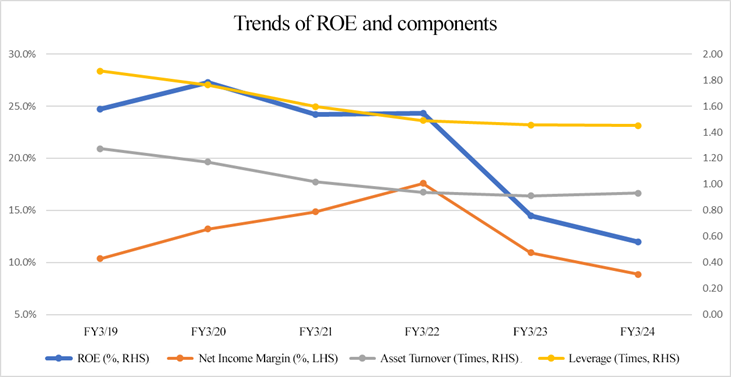
| FY 3/17 | FY 3/18 | FY 3/19 | FY 3/20 | FY 3/21 | FY 3/22 | FY 3/23 | FY 3/24 | FY 3/25 |
ROE(%) | 12.2 | 17.7 | 24.7 | 27.3 | 24.2 | 24.6 | 14.5 | 12.0 | 16.8 |
Net Income to Sales Ratio (%) | 3.76 | 6.63 | 10.37 | 13.21 | 14.86 | 17.61 | 10.94 | 8.85 | 13.54 |
Asset Turnover Ratio (x) | 1.44 | 1.36 | 1.27 | 1.17 | 1.02 | 0.94 | 0.91 | 0.93 | 0.86 |
Leverage (x) | 2.25 | 1.96 | 1.87 | 1.76 | 1.60 | 1.49 | 1.46 | 1.45 | 1.44 |
*The asset turnover ratio and leverage are calculated with the average amount between the beginning and the end of the term. Calculated by Investment Bridge Co, Ltd. based on annual securities reports and brief financial statements.
*Created by Investment Bridge Co., Ltd. based on disclosure material.
In the fiscal year ended March 2025, ROE started rising after two consecutive years of decline, primarily due to an increase in net income margin.
Although asset turnover ratio is on a downward trend, we expect it to exceed 20% again by improving both asset efficiency and profitability.
1-6 Shareholder Return
In order to enhance shareholder return, the company decided to adopt a new dividend policy, combining a “stable dividend” and a “commemorative dividend” in the fiscal year ending March 2025, and a “stable dividend” and a “performance-linked dividend” in the fiscal year ending March 2026. Through this, they intend to boost the long-term investment value of their shares while providing continuous and attractive return on profit to shareholders.
Stable dividend | Dividends will be paid continuously regardless of the performance. The company sets the provision of 25 yen/share as a stable dividend, considerably exceeding the previous dividend level, as their target. |
Commemorative dividend | In addition to the stable dividend of 25 yen, 15 yen/share will be paid as a commemorative dividend only in the fiscal year ended March 2025 on the occasion of the 20th fiscal year since the establishment of the company. |
Performance-linked dividend | Performance-linked dividend, based on performance, will be added to the stable dividend from the fiscal year ending March 2026. |
For the fiscal year ended March 2025, the company paid 40.00 yen/share, about three times that in the previous fiscal year, adding a commemorative dividend of 15.00 yen/share to a stable dividend of 25.00 yen/share.
The company is aiming for a payout ratio of 50% or higher in the medium term.
The company will revise its cash allocation policy to enhance shareholder returns through increased dividends while actively investing in growth.
1-7 ESG-related initiatives
The company believes that it has a social responsibility and raison d'etre to create business innovation based on its five core assets: technology, human resources, intellectual property, foresight, and partnerships, and solve issues such as the declining birthrate and aging population, the shortage of medical care, the depletion of IT human resources, and DX. The company's ESG initiatives are as follows.
Medical Business | * Pursuing the Three Way Satisfaction (insurer/insured/medical institution) through the Platformization of non-competitive areas as represented by the new business for the insurance sector * Workstyle reform for doctors, medical healthcare DX (improvement of healthcare safety and quality, improvement in revenues and business operations of medical institutions, shift to paperless and cloud operations, and support for diversification of medical care, including remote diagnosis) |
Technology Consulting Business | * DX in client companies (to improve the business operations of clients by supporting cutting-edge technologies, including AI, analysis, automation, and cloud computing) * To enhance the global competitiveness of Japan by supporting the globalization of Japanese enterprises |
Group as a whole | * Resilient business management (reinforced business continuity structure including remote working) * Strategic alliances with companies with a high social impact that contribute to the SDGs * Providing training and opportunities to young talent in Asia * Diversity in employees and management positions * Enhancement of incentives for employees |
2. Interim Period of the Fiscal Year ending March 2026 Earnings Results
2-1 Earnings Trends
| FY 3/25 Interim period | Ratio to sales | FY 3/26 Interim period | Ratio to sales | YoY |
Net Sales | 3,138 | 100.0% | 2,975 | 100.0% | -5.2% |
Gross profit | 1,199 | 38.2% | 1,242 | 41.8% | +3.7% |
SG&A | 607 | 19.4% | 577 | 19.4% | -5.0% |
Operating Income | 591 | 18.8% | 665 | 22.4% | +12.6% |
Ordinary Income | 629 | 20.1% | 676 | 22.7% | +7.5% |
Interim Net Income | 443 | 14.1% | 566 | 19.1% | +27.9% |
*Unit: million yen.
Sales decreased but profit grew, all kinds of profits hit a record high.
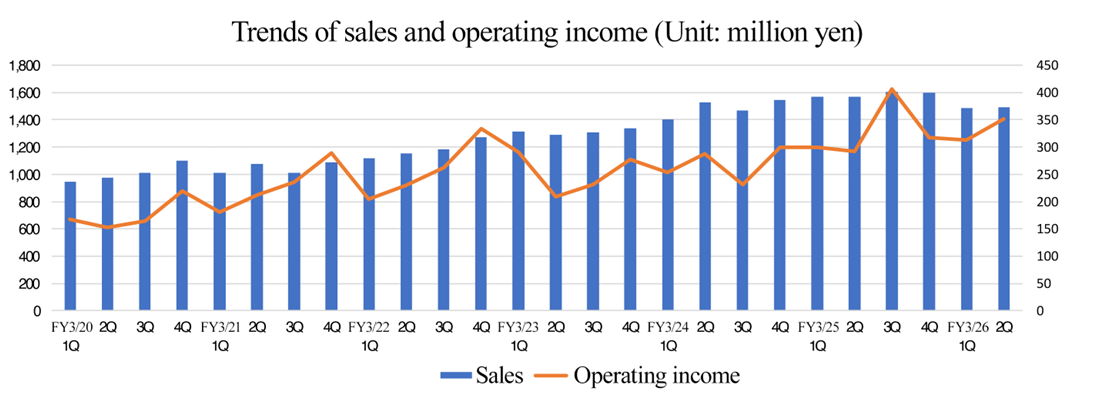
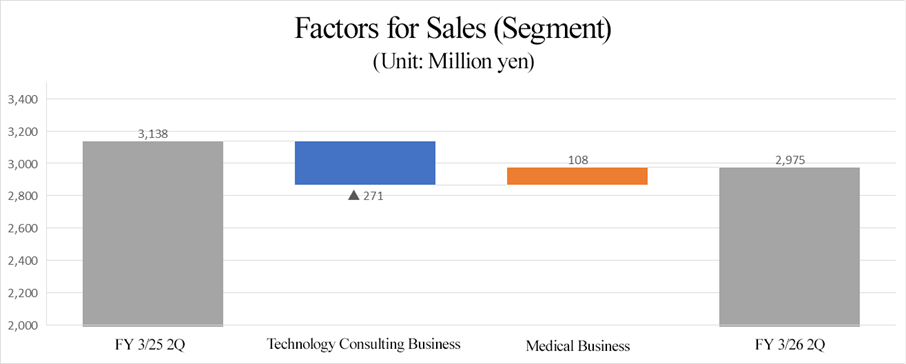
Sales dropped 5.2% year on year to 2,975 million yen. The sales of the medical business grew, but the sales of the technology consulting business declined.
Operating income rose 12.6% year on year to 665 million yen. As a result of the increase in sales, gross profit margin improved year on year from 38.2% to 41.8%, SG&A expenses dropped, and operating income margin increased year on year from 18.8% to 22.4%, so they secured a double-digit profit growth.
Ordinary income grew 7.5% year on year to 676 million yen. Exchange gain shrank year on year from 40 million yen to 17 million yen. As a gain on sale of investment securities was posted, net income rose 27.9% year on year to 566 million yen.
All kinds of profits hit a record high.
2-2 Trend of Segments
| FY 3/25 Interim period | Composition ratio | FY 3/26 Interim period | Composition ratio | YoY |
Medical Business | 840 | 26.8% | 948 | 31.9% | +12.8% |
Technology Consulting Business | 2,297 | 73.2% | 2,026 | 68.1% | -11.8% |
Consolidated Sales | 3,138 | 100.0% | 2,975 | 100.0% | -5.2% |
Medical Business | 541 | 64.4% | 602 | 63.5% | +11.1% |
Technology Consulting Business | 239 | 10.4% | 180 | 8.9% | -24.5% |
Adjustment | -189 | - | -117 | - | - |
Consolidated Operating Income | 591 | 18.8% | 665 | 22.4% | +12.6% |
*Unit: million yen. Sales is the sales toward external customers. Composition ratio in Operating Income is profit margin.
*Created by Investment Bridge Co., Ltd. based on disclosure material.
(Medical Business)
Sales and profit increased.
Sales rose 12.8% year on year to 948 million yen and operating income increased 11.1% year on year to 602 million yen. Both hit a record high.
As the reform of workstyles and the revision to medical treatment fees were applied to medical doctors, too, in April 2024, the DX in medical institutions is accelerating. They included ISM Co., Ltd., which is a distributor of the “MightyChecker” series, in their corporate group in July. They will promote cross-selling, the expansion of sales channels, and the increase of targets in cooperation with ISM. Continuously promoting the M&A strategy, they are negotiating with multiple companies. Through the measures for receiving more orders for “MightyChecker® EX,” they have improved average spending per client and increased revenues. Thanks to the measures for cross-selling “Mighty QUBE® Hybrid,” the number of users increased. As of the end of September 2025, the number of users of the “Mighty” series grew by 471 from 21,944 as of the end of March to 22,415. While they focused on the switch of existing users, the number of new users increased steadily.
In terms of profit, they secured a double-digit profit growth while offsetting temporary expenses, including the costs for post-merger integration of ISM.


(Technology Consulting Business)
Sales and profit declined.
Sales dropped 11.8% year on year to 2,026 million yen, and operating income decreased 24.5% year on year to 180 million yen. In response to the impact of the U.S. tariffs from the fourth quarter of the fiscal year ended March 2025, they kept choosing orders strategically while putting importance on profitability. In addition, they completed the large-scale project, which was continued over the past few years, and entered the transitional phase for starting a new project, so sales declined.
The drop in sales decreased profit by 45 million yen. In addition, costs for entrusted development projects augmented by 14 million yen more than assumed in the fourth quarter of the fiscal year ended March 2025.


2-3 Financial position
◎ Main Balance Sheet
| End of 3/25 | End of 9/25 | Increase /Decrease |
| End of 3/25 | End of 9/25 | Increase /Decrease |
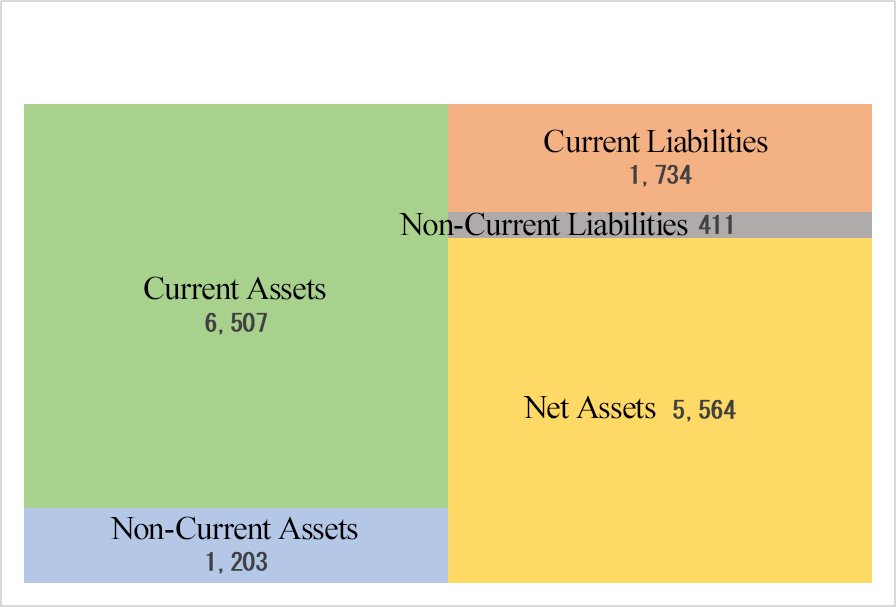
Current Assets | 6,604 | 6,507 | -96 | Current liabilities | 1,771 | 1,734 | -37 |
Cash and Deposits | 4,860 | 4,942 | +81 | ST Interest Bearing Liabilities | 100 | 102 | +2 |
Receivables | 1,533 | 1,380 | -152 | Contract liability | 783 | 862 | +79 |
Noncurrent Assets | 1,266 | 1,203 | -62 | Noncurrent liabilities | 497 | 411 | -85 |
Tangible Assets | 117 | 112 | -4 | Liabilities | 2,268 | 2,145 | -122 |
Intangible Assets | 342 | 298 | -43 | Net Assets | 5,601 | 5,564 | -37 |
Investment, Others | 807 | 792 | -14 | Retained earnings | 3,838 | 3,920 | +82 |
Total assets | 7,870 | 7,710 | -159 | Total Liabilities and Net Assets | 7,870 | 7,710 | -159 |
*Unit: million yen
Totals assets decreased 159 million yen from the end of the previous fiscal year to 7,710 million yen due to a decrease in accounts receivable, etc.
Total liabilities decreased 122 million yen year on year to 2,145 million yen due to the decrease in lease obligations, etc.
Net assets decreased 37 million yen year on year to 5,564 million yen.
Consequently, equity ratio rose 1.5 points from the end of the previous fiscal year to 71.9%.
*Created by Investment Bridge Co., Ltd. based on disclosure material.
2-4 Topics
① Conclusion of an OEM contract with medicalforce Inc.
On July 29, they started offering “Mighty QUBE® Hybrid” of the subsidiary AIS via OEM to “medicalforce,” a cloud-based electronic chart of medicalforce Inc., which develops and provides systems for electronic charts and reservation management systems for clinics for medical treatment not covered by health insurance.
“medicalforce” is a cloud-based electronic chart, which can manage diverse operations of clinics, such as medical treatments not covered by health insurance, plastic surgery, and gynecology in a unified manner. In February 2024, they significantly enhanced the compatibility with medical treatments covered by health insurance, by linking their product with the cloud-based standard medical claims software “WebORCA” provided by the Japan Medical Association. It has been adopted by about 600 clinics, and will be adopted by more clinics as medical institutions that offer medical treatments covered by insurance and those not covered by insurance will increase.
“Mighty QUBE® Hybrid” provided by AIS retrieves candidate disease names on a real-time basis based on the input data, such as prescriptions, injection drugs, and examination orders, by utilizing AI and the medical database developed for over 30 years. It prevents human errors, such as wrong medication and the failure to input disease names, making it possible to improve the safety of healthcare and streamline the operations of medical professionals. Through this provision via OEM, high value-added functions will be added to “medicalforce” as standard functions, supporting the improvement in functions for medical treatments covered by health insurance and contributing to the reform of workstyles of medical doctors, the optimization of management of clinics, and the settlement of social issues.
This OEM model is the second project following the provision to “homis,” a cloud-based electronic chart exclusively for home medical care, which is developed and provided by Medicalinformatics Co., Ltd. in 2024. Through this, they will offer “Mighty QUBE® Hybrid” to more clients in different medical treatment fields, including home medical care, medical treatments not covered by health insurance, and those covered by health insurance.
Going forward, they will accelerate the sales promotion of “Mighty QUBE® Hybrid” in the field of clinics targeting the existing and new users of “medicalforce” with the aim of growing sales by 16% per year on average between the fiscal year ending March 2026 and fiscal year ending March 2028 based on OEM contracts.
② Start of preparations for listing on the Standard Market of Tokyo Stock Exchange
“Aggressive” strategic selection for accelerating growth. They started preparations for obtaining the approval for the switch from the Prime Market to the Standard Market of Tokyo Stock Exchange. This is an “aggressive” strategic selection for accelerating the investment for growth. They will concentrate managerial resources on future growth drivers, including the investment in AI and M&A, to expand their business and improve their corporate value.
■ Medical business: To continue intensive investment in the M&A strategy as a growth driver
・ Between 2025 and 2030, they will promote the M&A strategy for maximizing profitability.
・ To plan M&A of 8-10 companies, targeting distributors that possess a community-based network of medical institutions, and operate the business nationwide
・ To expand sales channels and improve profit margin by establishing the direct sale model of the corporate group
・ To create new revenue sources by developing new solutions
■ Technology consulting business: AI strategy based on “watsonx” of IBM
・ To establish an AI-driven development system based on “watsonx,” a cutting-edge AI platform of IBM
・ As a strategic partner of IBM Japan, it will be possible to directly approach businesses in the fields of finance, healthcare, infrastructure, etc.
・ To newly establish an AI center in the Philippines
・ To obtain the AI knowledge of watsonx acquired in the English speaking region and translate it into Japanese, by utilizing excellent young engineers who are fluent in English and Japanese, and then supply it in the format optimized for development systems of many clients (Japanese enterprises)
・ To break away from the conventional model that depends on “the number of workers and time,” and establish a base for growth with high reproducibility and profitability.
3. Fiscal Year ending March 2026 Earnings Forecasts
Earnings Forecasts
| FY 3/25 | Ratio to sales | FY 3/26 Est. | Ratio to sales | YoY |
Net Sales | 6,340 | 100.0% | 6,572 | 100.0% | +3.6% |
Operating Income | 1,315 | 20.7% | 1,351 | 20.6% | +2.7% |
Ordinary Income | 1,341 | 21.2% | 1,364 | 20.8% | +1.7% |
Net Income | 858 | 13.5% | 948 | 14.4% | +10.4% |
*Unit: million yen. The forecasted values were provided by the company.
Expecting continued revenue and profit growth
The full-year forecast was left unchanged. For the fiscal year ending March 2026, sales are expected to increase 3.6% year on year to 6,572 million yen, operating income is forecast to rise 2.7% to 1,351 million yen, and ordinary income is forecast to rise 1.7% to 1,364 million yen.
In the medical business, they will accelerate the investment for growth based on the M&A strategy. They will make efforts to diversify revenue sources with new solutions, which are under development, such as a remote service platform. They will enhance the supply of “Mighty QUBE® Hybrid” via OEM and offer it to “medicalforce” and “homis,” to expand sales in the field of clinics. They will promote the switch from or replacement of old products, to raise the average spending per user.
In the technology consulting business, they will implement measures for improving their revenue earning capacity while expecting further growth from the third quarter and forecasting the augmentation of costs in the short term. The stagnation of sales due to the selection of orders, which started in the fourth quarter of the fiscal year ended March 2025, ended in the second quarter. From the second half of the fiscal year ending March 2026, they will conduct strategic investment for establishing an AI center for utilizing watsonx.
They plan to pay a year-end dividend of 40.0 yen/share. They announced the following dividend policies so that shareholders will be able to share benefits through the growth of the company, although these were still to be determined at the beginning of the fiscal year.
① The impact of the U.S. tariffs, which generated concern, is projected to be minor compared with the initial assumption, according to currently available information. In addition, recent business performance has been healthy, so they secured a dividend of 40.0 yen/share for the fiscal year ending March 2026. In addition, they will discuss shareholder return measures flexibly and proactively, while comprehensively considering the future performance trend, financial standing, share price, etc.
② Based on the stable dividend of 25 yen/share, they will add performance-linked dividends, which reflect the results in each fiscal year, to return profit stably and continuously and clarify their stance of sharing the fruit of corporate growth with shareholders.
③ In the medium/long term, they aim to achieve a payout ratio of 50% or higher, while positioning sustainable shareholder return as an important policy of business administration.
4. Initiatives and Outlook for the Second Growth Phase
The initiatives and outlook for the next growth phase of the technology consulting and medical businesses, which have been expanding steadily, are as follows.
4-1 Initiatives for the two businesses
① Medical Business
*Building a growth model through strategic alliances with a view to M&A with sales agents
A basic agreement was concluded to acquire shares in ISM Co., Ltd. (making it a subsidiary) through the consolidated subsidiary AIS. Through ISM's regional medical network “Tobiumenet” in Fukuoka Prefecture, the company conducted new business development targeting a total of 835 medical institutions, including 132 existing clients of ISM, through its “campaign for commemorating the inclusion of ISM in their corporate group.”
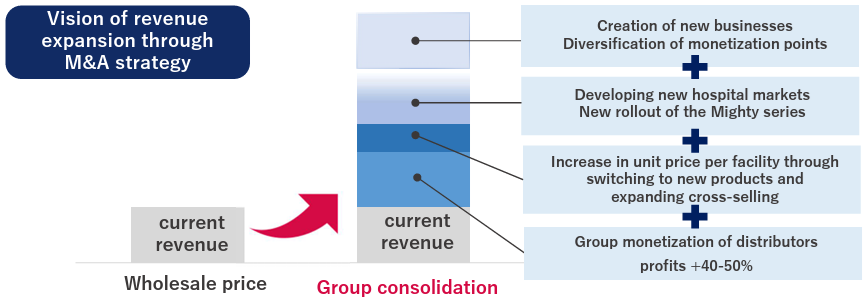
Furthermore, the company plans to further promote its M&A strategy going forward. Negotiations are already ongoing with multiple promising companies. Targeting companies with community-based medical networks, the company aims to execute 8 to 10 M&A deals between 2025 and 2030 to increase the ratio of direct sales of the corporate group. The goal is to raise the ratio of direct sales of the corporate group from 4.8% in 2025 to 35% by 2030.
Through M&A, the following factors contribute to an improvement in Customer Lifetime Value (CLV).
Category | Measures |
Increase in unit price | ① Inclusion of agency profits in group earnings ② Switching to the new product “MightyChecker® EX” and cross-selling of Mighty QUBE® Hybrid |
Increase in continuation rate | Preventing cancellations by reflecting feedback from medical institutions and strengthening customer support (The continuity rate for the Mighty series is already as high as 99.6%, and the current level will be maintained.) |
Rationalization of customer acquisition cost (CAC) | Obtained the acquired agency's “existing customer base (medical institutions),” “medical network,” and “sales channels (human resources).” |
Vision of Revenue Expansion Through M&A of Sales Agencies
(From company’s document)
*Scenarios for medium to long term growth
The company aims for medium/long-term growth by combining organic growth from its stable recurring business with non-linear growth through M&A strategy.
Business Growth Strategy Image

(From company’s document)
Key Initiatives for the Short to Mid/Long Term
From the current fiscal year onward, the company will accelerate investments for growth by focusing on M&A strategy. It aims to diversify revenue sources through its remote service platform and other new solutions, which are currently under development.
Short-term strategy | ・Strengthening the supply of “Mighty QUBE® Hybrid” via OEM → Expanding sales in the field of clinics (e.g., supplying to “medicalforce” and “homis”) ・Switching/replacing legacy products → Increase in unit price per user |
Mid/Long-Term Strategy | ・Expansion of the business foundation through M&A ・Development and diversification of new solutions for medical institutions ・Cultivation of next-generation revenue sources such as a remote service platform |
② Technology Consulting Business
FY3/26 Policy
With a view to further growth in 3Q and beyond, measures to strengthen profitability over the medium to long term, while anticipating short-term cost increases, will be implemented.
01 Continue strategic order selection with a focus on profitability (started in FY3/25 4Q).
02 Strengthen domestic sales and PM structure as well as develop advanced IT personnel
03 Downsize the China base and reduce staff count.
04 Cost overruns from contract projects will have some residual impact (started in FY3/25 4Q).
Building an AI-Driven Development Framework Utilizing watsonx
As a strategic partner of IBM Japan, the company will utilize the enterprise business AI platform “watsonx” to establish an AI center at its Philippine base. By combining “development, AI, and consulting,” the company will transform its business model into a high value-added, highly profitable AI solutions company.
☆What is watsonx?
・watsonx is IBM's business AI platform that enables organizations to safely and efficiently adopt and operate foundational models for generative AI.
・It comprises three key components: the model development environment (watsonx.ai), the data integration platform (watsonx.data), and the AI governance capability (watsonx.governance). Designed to protect data within a closed environment and prevent information leakage to external models, it provides an enterprise AI platform that achieves both security and flexibility.
Based on this global track record, the company will promote the establishment of an AI center in the Philippines as a strategic partner of IBM Japan. Furthermore, by utilizing the excellent English proficiency of Filipino engineers and rapidly absorbing cutting-edge technologies from Western countries, the company will build an AI-driven development framework optimized for the domestic Japanese market. Through this approach, the company will lead the productivity transformation of Japanese enterprises utilizing AI.
Short-term and mid/long-term growth strategies
Short-term strategy | ① Expanding Sales by Deepening Collaboration with Key Partners ・Strengthen collaborative relationships with major SI partners such as IBM. Expand sales through partners to contribute to the achievement of the earnings forecast for the current fiscal year. ・Action: Reinforce direct sales to IBM's project managers by strengthening the domestic sales structure. (Providing software development utilizing watsonx) ② Management Restructuring at the Philippine Base and Unified Operations Across the Group ・Through unified operations between our Japanese headquarters and Philippine base, we accelerate decision-making, enhancing both the speed and effectiveness of the group's strategy. ・Establish an AI center utilizing watsonx at the Philippine base, and then execute strategic investments. (Strengthen organizational restructuring and human resources recruitment) |
Mid/Long-Term Strategy | Strategy for the Rapid Expansion of the Modernization Market ・As corporate IT systems are becoming outdated, the transition to an AI-based system is inevitable. ・At the same time, the adoption of AI in development processes and the revaluation of intangible assets such as IT systems are rapidly increasing enterprises’ willingness to conduct investment. Modernization refers not only to the upgrade of legacy systems, but also to transforming business processes using the latest technologies to optimize operations and create additional business value for the organization. As a strategic partner of IBM, the company's advantage lies in its ability to gain direct access to core customer segments driving modernization demand (such as finance, healthcare, and infrastructure). |
4-2 Growth Vision
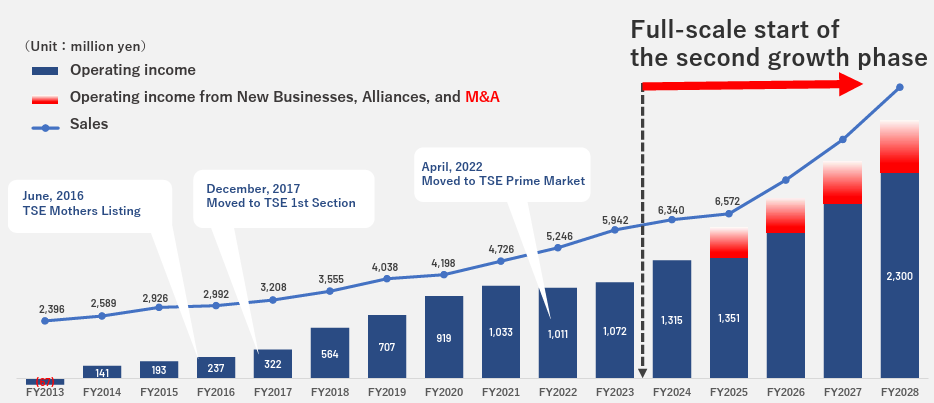
Forging ahead with various measures in both businesses, such as the development of multiple new platforms (medical business), starting the cross-selling of Mighty QUBE® Hybrid and MightyChecker® EX on a full-scale basis (medical business), enhancement of the sales for consulting in Japan based on reorganization (technology consulting business), a foray into the global market (technology consulting business), reeling in major clients (technology consulting business), and M&A and capital and businesses alliances (both businesses), the company will push forward with the second growth phase, which began in the fiscal year ending March 2025, on a full-scale basis, and aim for a rapid expansion of sales and profit.
(From company’s document)
5. Conclusions
In the medical business, the M&A strategy set at the beginning of the fiscal year is being implemented on a full-scale basis after the acquisition of ISM. They secured a double-digit profit growth in the interim period while offsetting the costs for M&A. This can be highly evaluated.
The technology consulting business was affected by the U.S. tariffs, but they started new projects while expecting business expansion from the third quarter, and it seems that they have already completed preparations for catching up in the second half of the fiscal year.
In the interim period, operating income grew 12.6%, but they have not revised the full-year forecast that operating income will increase 2.7% year on year.
In the interim period, it can be said that the outlook for growth improved for both businesses. Share price is fluctuating and valuation is low. Since it is possible to secure a dividend yield, it can be said that the shares in Ubicom Holdings are attractive.

<Reference: Regarding Corporate Governance>
◎ Organizational structure and composition of directors and corporate auditors
Organizational structure | Company with corporate auditor |
Directors | 5, out of which 3 are outside directors. (including 3 independent executives) |
Corporate auditors | 3, out of which 2 are outside auditors. (including 2 independent executives) |
◎ Corporate Governance Report
Last updated: June 27, 2025
*Basic Policy
The corporate ethos of our company is “to remain a one and only business innovation company,” “global business operation,” and “co-prosperity based on a win-win model.” We recognize that it is essential to enrich and tighten our corporate governance, in order to improve our corporate value and maintain our global competitiveness under this ethos. In detail, our basic policy is “to aim to enhance our profitability and maximize the profits for shareholders by conducting more efficient, sound business activities” and put importance on compliance. Under this policy, we strive to strengthen our corporate governance, while considering that it is essential to fulfill our social responsibilities toward all kinds of stakeholders, including shareholders, employees, business partners, and local communities, and achieve sustainable growth and expansion.
<Reasons for Non-compliance with each Principles of the Corporate Governance Code (Excerpts)>
Principle | Reasons for not following |
[Supplementary Principle 4-1-3 Succession Plan for the CEO and others] | The Board of Directors is not currently specifically overseeing succession planning for the CEO and others. The person to be appointed as President and Representative Director, who will become the CEO, will be selected based on knowledge, experience, and ability, and on the circumstances surrounding the company and the issues that need to be addressed at the time. In the future, we will also consider formulating a succession plan. |
[Supplementary Principle 4-2-1 Executive Compensation and Incentives] | Since the term of office of the directors is one year, their compensation is reviewed annually based on the previous year's performance. However, we have not established a compensation system that is linked to medium to long-term performance or a compensation system based on treasury shares. We recognize the need to add incentives to compensation for the management in a manner that reflects our company’s medium to long-term performance and potential risks and contributes to the development of a healthy entrepreneurial spirit, and will continue to consider appropriate methods. |
<Disclosure Based on each Principles of the Corporate Governance Code (Excerpts)>
Principles | Disclosure contents |
[Principle 1-4 The strategically held shares] | Our company may hold shares strategically, if they are considered to contribute to the enhancement of the value of our corporate group from the mid/long-term viewpoint. Our policy is to hold such shares, as long as we can secure the rationality of shareholding purposes, such as the maintenance and cementing of transaction relations through business alliance, collaboration, etc. For exercising the voting rights of the shares, we discuss whether or not a bill is consistent with our shareholding policy. Moreover, there are no strategically held shares as of the day of the submission of this report. |
[Supplementary Principle 2-4-1 Ensuring Diversity in the Appointment of Core Personnel] | (1) Approach to ensuring diversity The corporate group's policy regarding human resources development, including ensuring diversity in the workforce, and the in-company environment are as follows. We are expanding our business by hiring people based on their experience, ability, etc. regardless of gender or nationality. Therefore, we have not set any policies or goals for the promotion of people to managerial positions that are specific to “women,” “foreigners,” or “mid-career hires.” In addition, our company currently has three female directors, including a director (foreign national) of a subsidiary outside of Japan. We intend to continue to promote diverse human resources with excellent character, insight, and management skills, regardless of gender or nationality, and will consider human resources strategies to enhance corporate value over the medium to long term, including a human resources development policy and a company environment improvement policy aimed at ensuring further diversity.
<Human Resources Development Policy> The basic policy for human resources development is as follows: 1. Strengthening recruitment 2. Retraining on new skills 3. Leadership training 4. Pooling of resources (maximizing utilization ratio through collaboration between businesses)
<Engineer training in the global business> Our training and education systems, which develop our engineers into true top engineers who can contribute to the business, are strong differentiating factors that other companies cannot easily beat. Our self-developed training program at our “ACTION” training center in the Philippines consists of four categories: Basic IT concepts, advanced technology, interpersonal soft skills, and the Japanese language, and aims to help students pass the PhilNITS (Philippine National IT Standards Examination) and Level 4 of the Nihongo Kentei (Japanese Language Examination). After finishing their training, the trainees announce the results to management executives and undergo an interview and assessment. Only then they can participate in a project. Even for talented students, the path to being entrusted with actual work is not an easy one, but those who overcome these hurdles and graduate from the program have advanced technical skills and the ability to carry out work in a Japanese environment, demonstrating an overwhelming advantage in the Japanese IT market and becoming a powerful engine for our company's growth.
<Improvement of the in-company environment> In order to ensure diversity, we implement and promote the following measures under our in-company environment improvement policy, which is to create a system, an environment, and a culture that allow diverse human resources to choose their own working style according to their individual personalities and changing life stages. ・Adoption of a reemployment system that treats post-retirement employees according to their performance ・Adoption of a system for working from home
(2) Measurable voluntary goals and progress of activities for ensuring diversity Our corporate group uses the following indicators in its basic policy for human resources development to ensure diversity as described in (1) above, and the targets for these indicators are as follows. ・Indicato Planned annual number of hires in the technology consulting business ・Target: To hire 86 or more people per year from fiscal year ending March 2026 However, in case the utilization rate improves, we are planning to newly recruit additional candidates. |
[Supplementary Principle 3-1-3 Sustainability Initiatives] | We are strongly aware of our corporate responsibility to realize a sustainable society, and in order to work with all stakeholders to solve social issues and continuously improve our corporate value, we have established a basic sustainability policy and set forth the issues to be solved in the areas of environment, society, and governance, as well as our efforts to achieve them.
(1) Basic Sustainability Policy Our management philosophy is “to remain a one-of-a-kind business innovation company that creates IT solutions that contribute to solving social issues,” “global business operation,” and “co-prosperity based on a win-win model.” In addition, we will be one of the first to focus on changes and issues in the social structure, such as climate change, declining birthrates and an aging population, and medical issues, and will pursue the realization of a sustainable society and the improvement of the Ubicom Group's corporate value by providing IT solutions that contribute to solving social issues and taking appropriate risk reduction initiatives.
(2) Environmental, Social and Governance Initiatives The following is a description of the issues we need to resolve and our efforts to address them. 1) Environment: To achieve carbon neutrality ・Promoting the saving of resources (without using paper) within our company and our clients ・Relocation to environmentally friendly offices that use renewable energy only ・By adopting the “MightyChecker Series,” which is the mainstay product of our medical business, overall working hours at medical institutions are reduced by about 390,000 hours per month, contributing to the reduction of about 7,800,000 liters of CO2 emissions. 2) Society: Resolving customer issues by providing solutions ・Support for DX: Reforming clients' operations through advanced technology support ・Further upgrading and strengthening of solution development capabilities at the Advanced Technology Development Center ・Improving Japan's global competitiveness by supporting the globalization of domestic companies ・Developing solutions to reduce medical costs ・Reforming doctors' work styles 3) Governance: Realizing fair and transparent management ・Strengthening compliance and risk management systems based on the Basic Sustainability Policy ・Establishing a governance system that emphasizes diversity |
[Principle 5-1 Policy for constructive dialogue with shareholders] | We positively respond to shareholders’ application for dialogue. The Corporate Planning Division is in charge of our IR activities, and have developed an IR system based on their daily close cooperation, so that they can accept the phone interviews from investors, small meetings, etc. In addition, we hold a result briefing session involving the representative director and distribute a result briefing video twice or more times every year. In addition, our company discloses information and manages insider information in accordance with our disclosure policy (https://www.ubicom-hd.com/ja/ir/policy.html). |
[Action to Implement Management That is Conscious of Cost of Capital and Stock Price] | We engage in management that places importance on ROE (return on equity) as a management indicator in order to work toward the elevation of profitability and capital efficiency. As an appropriate and reasonable calculation of performance forecast is difficult in the rapidly changing business environment, we have not set concrete numerical targets. However, we continuously explain the trends concerning performance and future policies through financial result briefings, information disclosure on our website, etc., and will engage in initiatives that allow shareholders and investors to sufficiently deepen their understanding. |
This report is not intended for soliciting or promoting investment activities or offering any advice on investment or the like, but for providing information only. The information included in this report was taken from sources considered reliable by our company. Our company will not guarantee the accuracy, integrity, or appropriateness of information or opinions in this report. Our company will not assume any responsibility for expenses, damages or the like arising out of the use of this report or information obtained from this report. All kinds of rights related to this report belong to Investment Bridge Co., Ltd. The contents, etc. of this report may be revised without notice. Please make an investment decision on your own judgment. Copyright(C) Investment Bridge Co., Ltd. All Rights Reserved. |