



Bridge Report:(4425)Kudan the Fiscal Year ended March 2026

Kudan Inc. (4425) |
 |
Corporate Information
Exchange | TSE Growth |
Industry | Information and communications |
Managing Director & CEO | Daiu Ko |
Address | 1-23-14 Jinnan, Shibuya-ku Tokyo |
Year-end | End of March |
URL |
Stock Information
Share Price | Shares Outstanding (end of term) | Total market cap | ROE Act. | Trading Unit | |
¥1,679 | 11,301,267 shares | ¥18,974 million | -6.5% | 100 shares | |
DPS Est. | Dividend yield Est. | EPS Est. | PER Est. | BPS Act. | PBR Act. |
0.00 | - | - | - | ¥232.30 | 7.2 x |
*The share price is the closing price on June 8. All figures were taken from the brief report on the financial results for the fiscal year ended March 2026. As it is difficult to forecast foreign exchange gains and losses, which have a significant impact on ordinary income and net income, the company has decided not to disclose specific forecast figures for these items at this time. Accordingly, EPS is not disclosed.
Earnings Trend
Fiscal Year | Sales | Operating Income | Ordinary Income | Net Income | EPS | DPS |
Mar. 2023 (Actual) | 332 | -598 | -394 | -413 | -49.30 | 0.00 |
Mar. 2024 (Actual) | 490 | -527 | -50 | -69 | -7.88 | 0.00 |
Mar. 2025 (Actual) | 517 | -800 | -743 | -801 | -72.85 | 0.00 |
Mar. 2026 (Actual) | 1,196 | -585 | -174 | -188 | -16.68 | 0.00 |
Mar. 2027 (Estimate) | 1,030 | -340 | - | - | - | 0.00 |
*Unit: yen, million yen. Net income is profit attributable to owners of the parent. Hereinafter the same shall apply. The earnings forecasts are that of the company. The company will not disclose the exact forecast figures of ordinary income and net income due to the difficulty in estimating foreign exchange gain or loss, which have a significant impact on them.
This report briefly describes the financial results for the term ended March 2026 of Kudan Inc.
Table of Contents
1. Key Points
2. Vision and Entire Picture of Business of Kudan
3. Business Domains-Digital twins, autonomous robots, and data technologies
4. Market Environment-Rise of physical AI and expansion of demand for spatial perception
5. Fiscal Year ended March 2026 Earnings Results
6. Financial Standing and Cash Flows
7. Fiscal Year ending March 2027 Earnings Forecasts
8. Overview, History, and Technologies of the Company (for reference)
<Reference: Regarding Corporate Governance>
1. Key Points
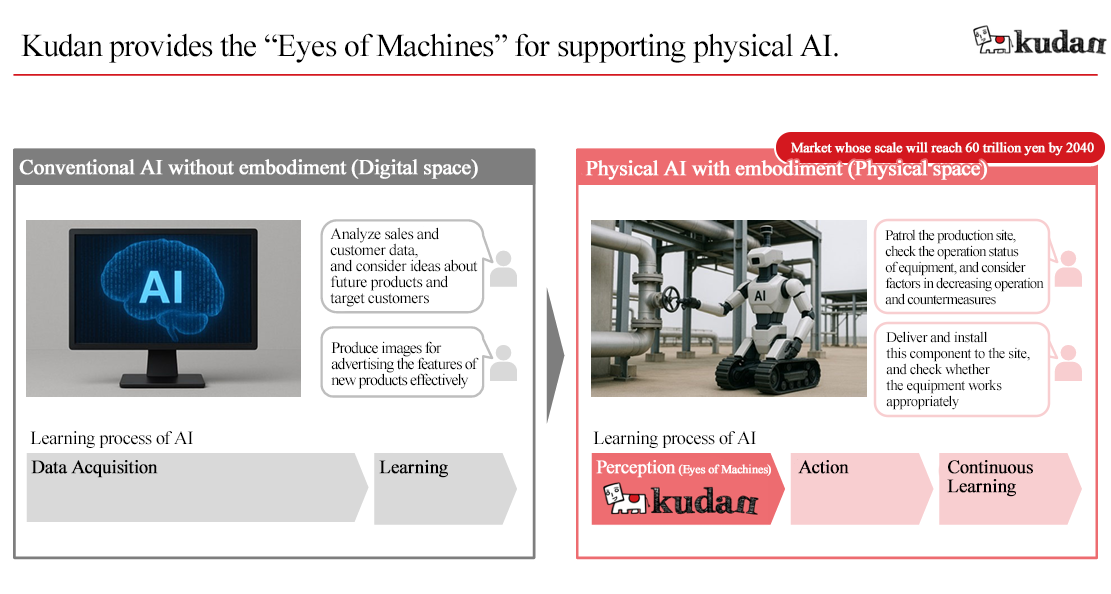
Kudan is a deep-tech company specializing in spatial perception, which is the fundamental technology in the physical AI era, while pursuing the vision “Eyes for All Machines.” Based on the spatial perception technology, which constitutes the “eyes” of machines, they operate a spatial perception platform integrating digital twins, autonomous robots, and data technologies, and take a central role in the fields of next-generation digital twins and robots.
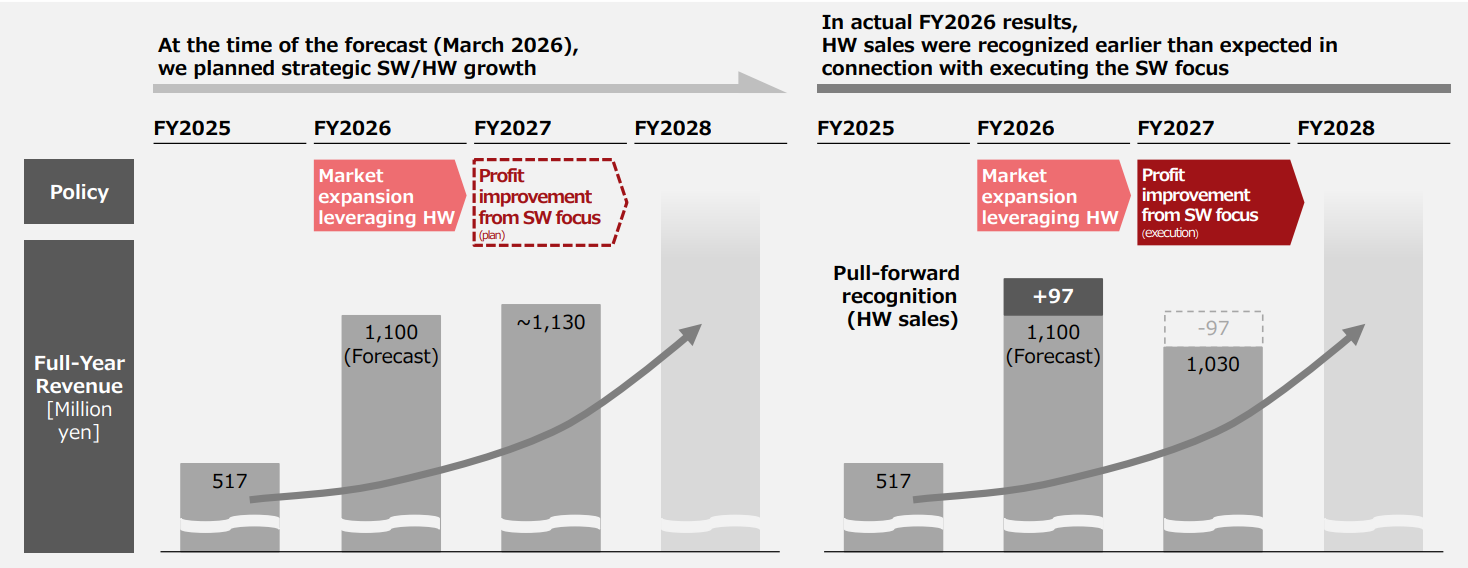
- In the fiscal year ended March 2026, sales grew significantly and operating loss shrank, exceeding the upwardly revised forecasts. Sales increased 131.3% year on year to 1,196 million yen and operating loss shrank 214 million yen year on year to 585 million yen. The considerable sales growth and the shrinkage of profit loss are attributable to the expansion of technological and business domains and the full-scale development of the physical AI market. In accordance with the new policy of concentrating on software with a high profit margin, they reviewed and revised related contracts and optimized their sales plans in the previous and current fiscal years. As a result, both sales and profit exceeded the upwardly revised forecasts, while the sales of hardware were posted earlier than planned.
- For the fiscal year ending March 2027, it is forecast that sales will decline, but loss will shrink due to the significant improvement in profitability. Sales are projected to decrease 166 million yen year on year to 1,030 million yen, and operating loss is expected to shrink 245 million yen year on year to 340 million yen. The sales of hardware are forecast to decrease 530 million yen, but the sales of software with a high gross profit margin are expected to increase 360 million yen. In terms of costs, the investment in R&D will expand 80 million yen, but loss is expected to decrease this fiscal year as well, as profit is forecast to rise 350 million yen as they will concentrate on software. The sales of profitable products are expected to grow and they are projected to move into the black in the next fiscal year or later.
- The growth strategies in the fiscal year ending March 2027 are “to concentrate on software with a high gross profit” and “to provide data technologies for physical AI” as well as “to expand software technologies and solutions.” The policy of “cost optimization” in the previous fiscal year is deemed complete as its purpose has been attained. Regarding financial affairs, cash and deposits decreased 607 million yen to 1,986 million yen, but equity ratio remained as high as 88.2%. As they have secured working capital for about 6 years according to the estimation from the annual cash outflow, so their financial base does not require additional fund procurement for a foreseeable future.
- The sales of digital twins and mobile robots increased in various aspects. In the fiscal year ending March 2027, sales are projected to decline due to the shift to software with a high gross profit. In step with the acceleration of growth of the physical AI market, they aim to spread commercial technologies and sell more software with a high gross profit to grow dramatically in the medium/long term. We would like to pay keen attention to when they will move into the black in the next fiscal year or later.
2. Vision and Entire Picture of Business of Kudan — A Spatial Perception Platform Provider for the Physical AI Era
(Taken from the reference material of the company)
[2-1 Vision and Positioning]
Kudan, guided by its vision of “Eyes for All Machines,” is a deep-tech company engaged in the research, development, licensing, and deployment of solutions for spatial perception—the fundamental technology that enables AI and robots to perceive real-world space.
Kudan’s spatial perception technology enables AI and robots to perceive real-world spaces, serving as a core technology that allows machines to recognize the physical world, determine their position, and act while comprehending their surrounding environment.
While generative AI is spreading and maturing, there is growing global demand for physical AI, which perceives real-world spaces, acts autonomously, and continuously learns. Kudan’s spatial perception technology forms the core foundation of this Physical AI, positioning the company as a central player in next-generation digital twins and robotics.
[2-2 Overview of the Business: Three Business Areas]
Centered on its spatial perception platform, the company operates across three domains: (1) digital twins, (2) autonomous (mobile) robots, and (3) data technologies for physical AI. In the digital twin domain, the company contributes to on-site operational DX and productivity improvement by perceiving real-world spaces, generating digital twins, and enabling AI to interpret them. In the autonomous robot domain, it provides the foundational technology that allows robots to digitally perceive space and act autonomously in complex environments.
By positioning data technologies for physical AI at the intersection of these two domains, the company establishes synergies between them, secures a unique competitive advantage that is difficult for others to imitate, and contributes to revenue generation. Details of each business domain are mentioned in Section 3: Business Domains.
3. Business Domains-Digital twins, autonomous robots, and data technologies
[3-1 Business Vision: Focus on High-Margin Software]
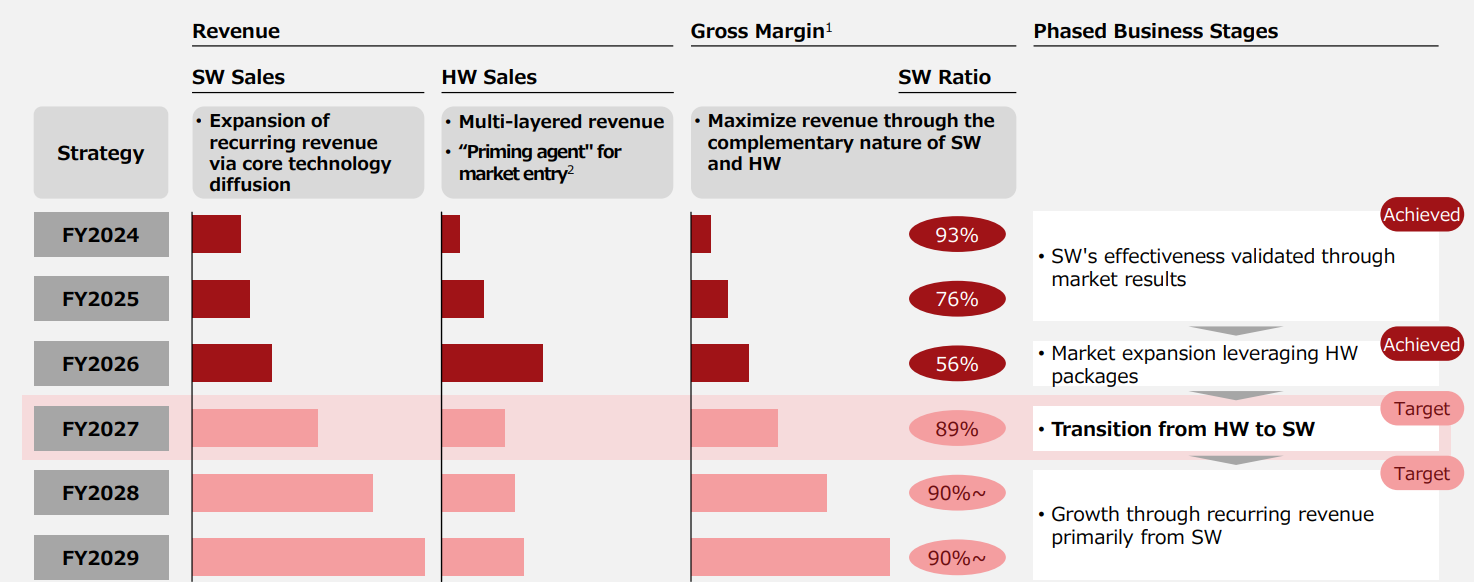
Centered on its spatial perception platform, the company operates its business across three domains: digital twins, autonomous (mobile) robots, and data technologies for physical AI. For the fiscal year ending March 2027, while continuing the expansion of software technologies and solutions, the company will newly adopt two policies: a focus on high-margin software and the provision of data technologies for physical AI. While leveraging low-margin hardware as a “catalyst,” the company aims to maximize revenue over the medium/long term by spreading its core software technologies. Meanwhile, “cost optimization,” which was the policy in the fiscal year ended March 2026, is considered complete, as its objectives have been achieved.
[3-2 Initiatives in Each Business Area]
(1) Focus on high-margin software
While effectively supplementing past hardware sales as a “catalyst,” the company aims to maximize profitability over the medium/long term, through the wider adoption of its core software technologies. By shifting focus from previous hardware to high-margin software, they will significantly improve the ratio of profit from software to gross profit this fiscal year.
As they focused on software, part of the hardware package sales assumed for the current fiscal year was recognized ahead of schedule in the previous fiscal year ended March 2026. Consequently, the fiscal year ending March 2027 will see a temporary decline in revenue. From the fiscal year ending March 2028 onward, however, the company expects sales growth and the posting of profit, driven by enhanced margins.
 |
 |
(2) Expansion of software technologies and solutions
The company will continue to drive technological advancement and business expansion in both core areas—digital twins and autonomous (mobile) robots.
① Digital twins
The market of digital twins for civil engineering, real estate, infrastructure, distribution, and manufacturing has expanded steeply, and they forecast that its scale will reach 100 trillion yen (approx. 700 billion dollars) in 2040.
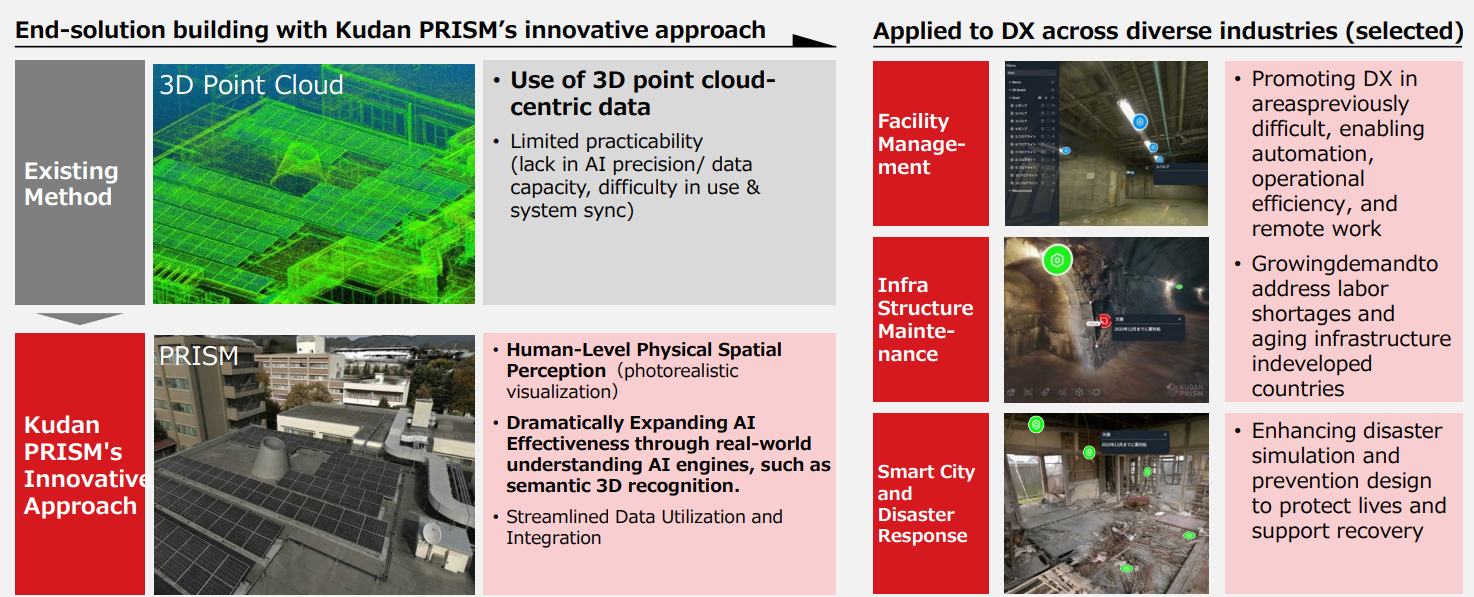
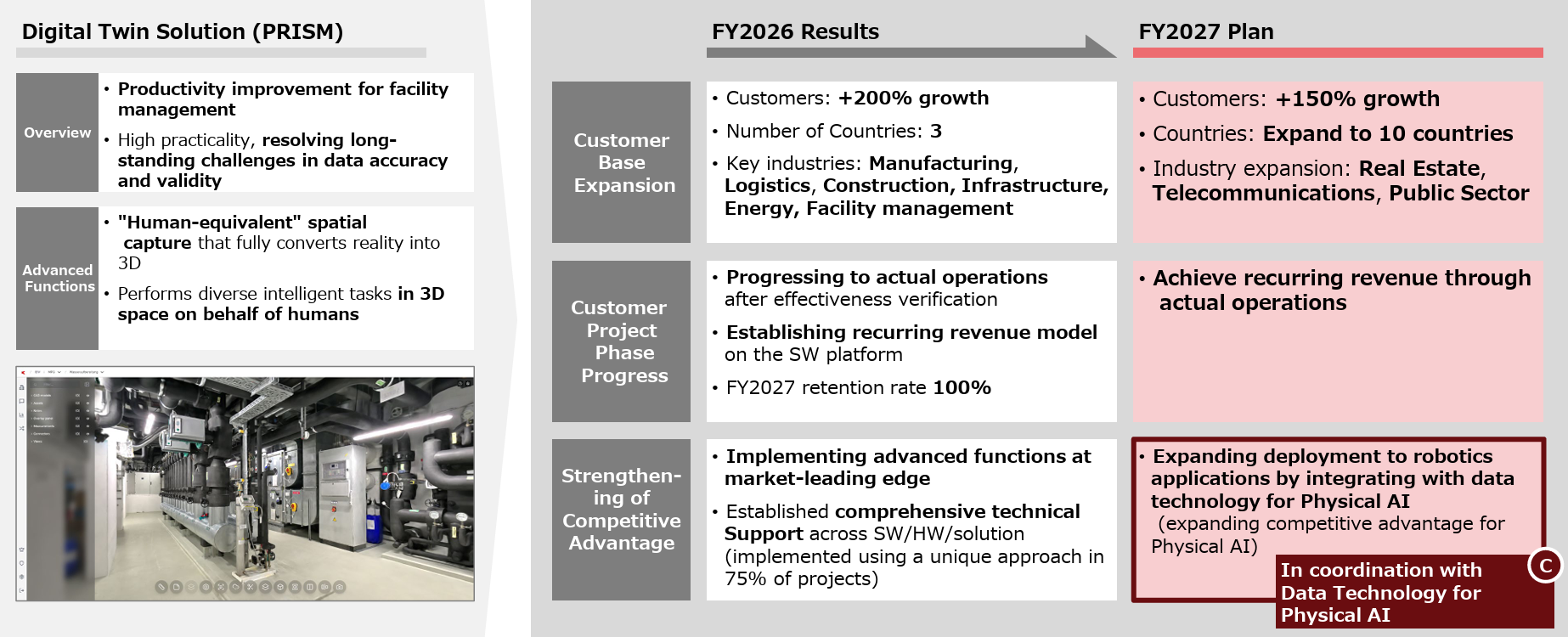
Centered on its solution “Kudan PRISM,” the company will continue to expand its customer base and drive revenue growth. The company will link it with data technologies for physical AI to expand into the robotics sector and strengthen its competitive advantage.
Like in the financial year ended March 2026, the company will significantly expand its customer base, aiming for a 150% increase in the number of customers, expanding the number of countries where they offer their services from three to ten, and broadening the range of target sectors to include real estate, telecommunications and the public sector, in addition to manufacturing, logistics, construction, infrastructure, energy and facility management.
(Outline and features of Kudan PRISM)
In the field of maintenance and management of bridges, tunnels, plants, urban infrastructure, etc., the shortage of measures for coping with deterioration and skillful workers has become serious, and it is required to accurately grasp the current situation and maintain or manage them efficiently. The conventional “3D point cloud-centric” solutions had some significant issues: the heaviness of data, the slowness of display, restrictions on operability, and the difficulty in information linkage.
Kudan PRISM is a platform developed for solving these issues and accelerating the digital transformation (DX) in actual workplaces. Users can swiftly produce and use light, photorealistic 3D digital twins that have sematic information, and share and analyze spatial information intuitively and easily as it has been difficult so far.
It can be utilized in a broad range of fields, including the management of equipment and facilities, infrastructure inspection, and anti-disaster projects. Based on the smooth photorealistic 3D display, the spatial perception technology of Kudan, and automatic processing with AI, it classifies, tags, and analyzes management subjects in a seamless manner. This realizes intuitive data management, information linkage, the streamlining of operations through automation, and the improvement in service quality.
(Cases of utilization)
Subject project | Outline |
Management of facilities and equipment Maintenance and inspection of infrastructure | By promoting digital transformation (DX) in the fields where DX has been difficult, they automate and streamline business operations and make it possible to work remotely. Demand is expected to grow, as it is necessary to deal with the shortage of on-site workers and the deterioration of equipment infrastructure, which are common in advanced countries. |
Smart city and anti-disaster projects | To sophisticate disaster simulation and anti-disaster design, which will be demanded further, and contribute to the protection of human lives and post-disaster restoration. |
 |
 |
② Mobile robots
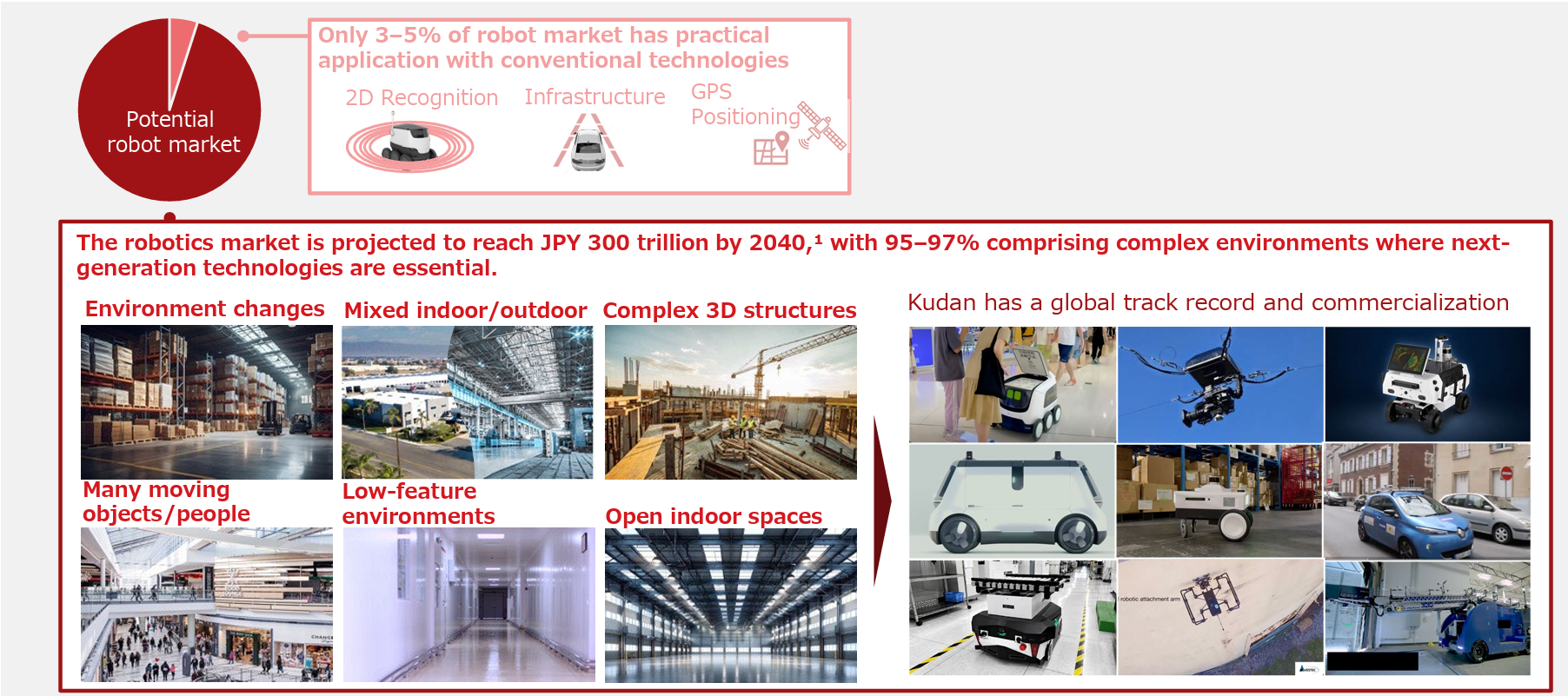
The company aims to continuously drive growth in both revenue and project size through its core technology for autonomous mobility in robots, which it has been advancing since the fiscal year ended March 2026. Sales are projected to increase 100% year on year. The company is also focusing on the introduction of physical AI models that would strengthen its first-mover position in the market, while promoting the linkage with the provision of data technologies. The scale of the robotics market is projected to reach as much as 300 trillion yen in 2040, and there is strong demand for solutions to technical challenges on the path to practical implementation.
 |
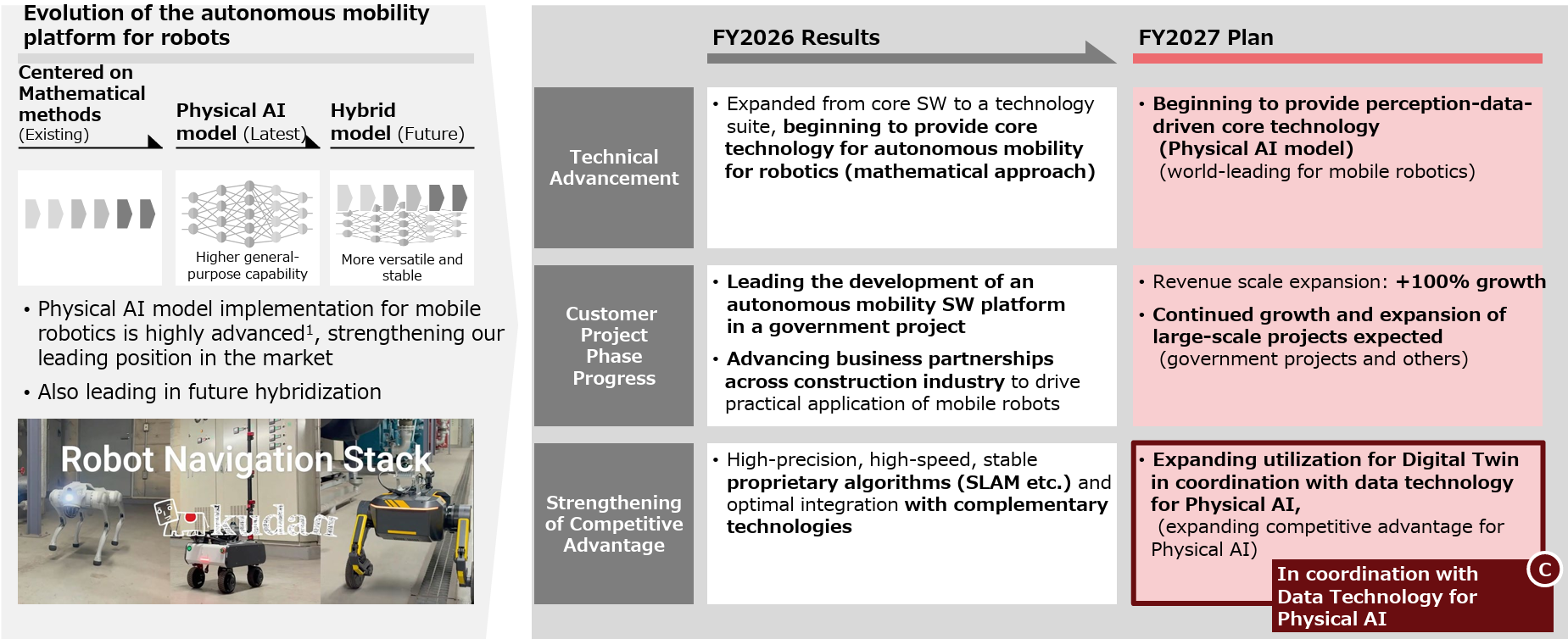 |
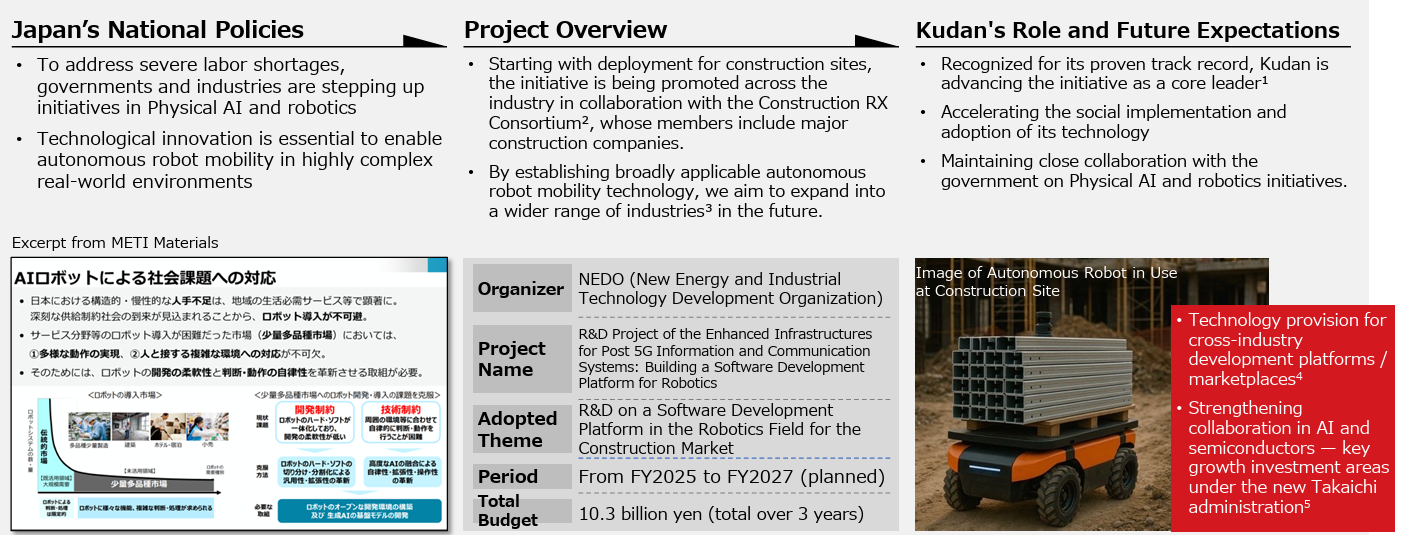
A concrete example of such initiatives is the company’s participation in government projects.
As development leader, Kudan participated in the “R&D Project of the Enhanced Infrastructures for Post 5G Information and Communication Systems: Building a Software Development Platform for Robotics,” which is hosted by New Energy and Industrial Technology Development Organization (NEDO) and participated in by leading companies in the construction industry. They engage in the R&D of a software development base in the robotics field of the construction market, and lead the development of core technologies for autonomous running of robots in Japan. The period and overall budget of this project are 3 years until FY 2027 and 10.3 billion yen, respectively.
The practical use and diffusion of their technologies are expected to accelerate. They aim to remain closely linked with governmental policies related to robots, and their technologies are expected to be applied to a broader range of industries.
The Takaichi administration aims to intensively invest in 17 fields, and AI and semiconductors are main investment targets, so they will cement the cooperation with the government.
(3) Provision of Data Technologies for Physical AI
Kudan’s spatial perception technology is a core technology for building the data foundation of physical AI. By positioning this in the intersection of the robotics and digital twin domains, the company induces synergy between the two areas and secures a unique competitive advantage that is difficult for others to imitate, while using it as a new source of revenue.
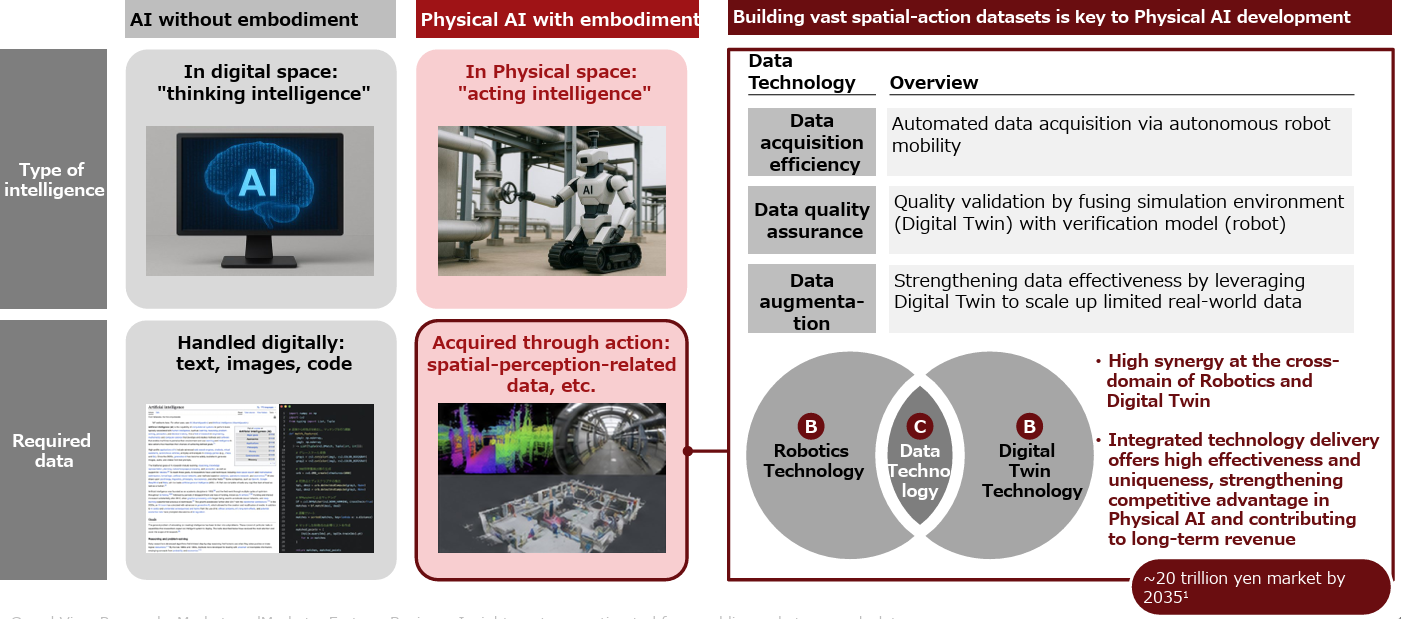
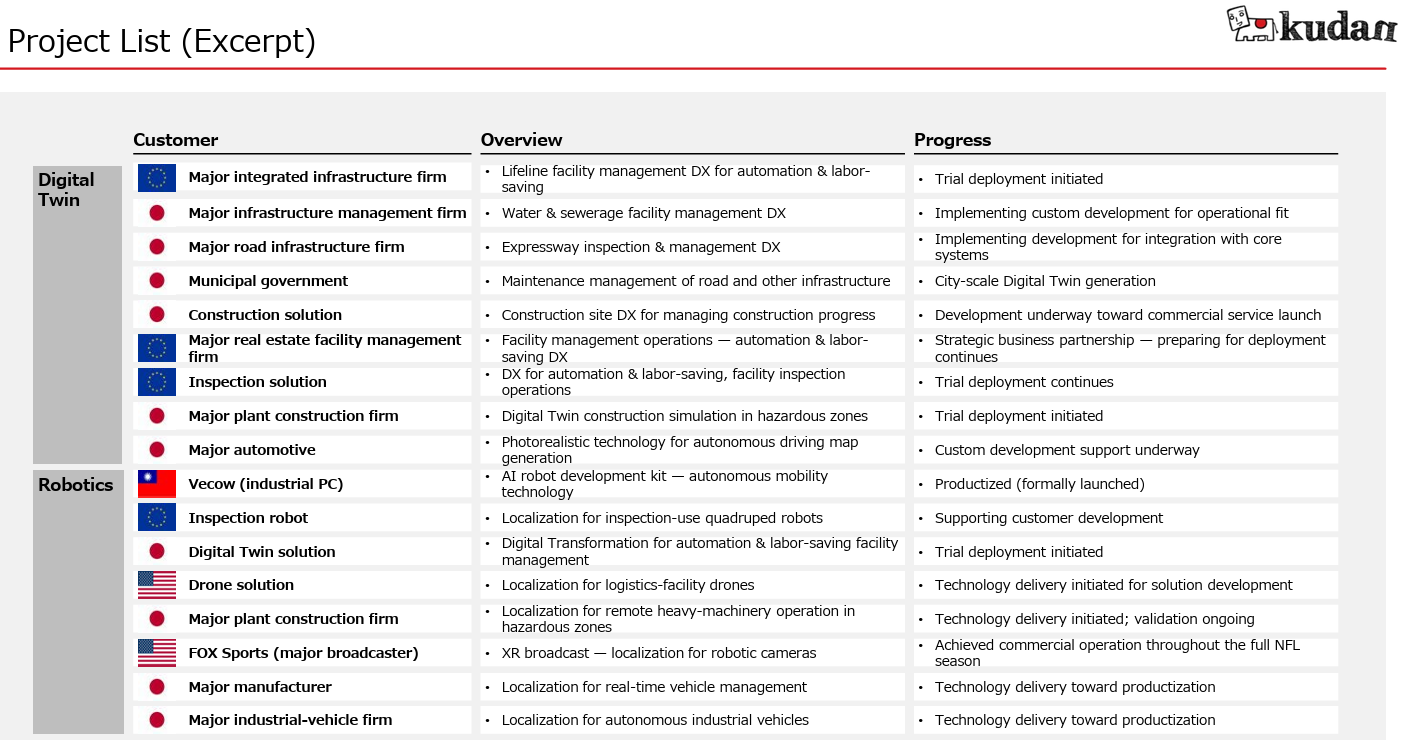
Major projects in the fields of digital twins, robotics, etc. are as follows.
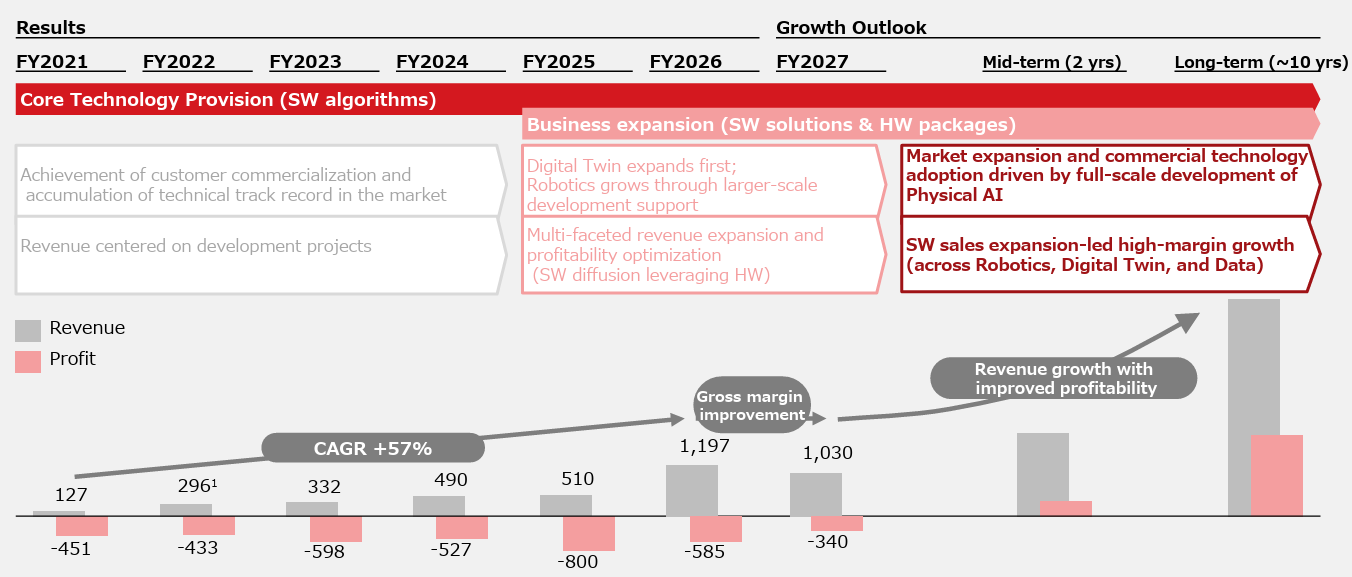
[3-3 Medium/Long-Term Growth Outlook]
Under the strategy of expanding its technological and business domains, the company aims in the short term to drive diversified revenue growth and optimize profitability, while in the medium/long term pursuing accelerated growth in line with the expansion of the physical AI market through the spread of commercial technologies and the expansion of high-margin software sales.
4. Market Environment — Rise of Physical AI and Expansion of Demand for Spatial Perception
[4-1 A Paradigm Shift Toward Physical AI]
In recent years, the social implementation of AI has advanced rapidly, due to the expanding investment in generative AI and the widespread adoption of generative AI by both enterprises and individuals. Against the backdrop of labor shortages, demand for workforce reduction and automation continues to remain at a high level, with automation needs expanding across a wide range of industries through the use of robots, digital twins, and related technologies. Under these circumstances, there is growing global interest in “physical AI,” which perceives the physical world and acts autonomously while continuously learning.
The increasing need for automation of operations in every industry and advancement of hardware technology, including sensors and semiconductors complementary to algorithms, have been rapidly spreading and practically utilizing the spatial perception technology. The growth of demand for automation technology, such as robotics, autonomous driving, and drones, is significant particularly in the fields of logistics, manufacturing, construction, retail, etc.
[4-2 The Economic Impact of the Major Technology Domains]
The market size and economic impact of the major technology domains where spatial perception technology is applied are all expected to see significant growth.
Target technology/device | Economic impact |
AI | GDP in 2030 is expected to be 9.8% (11.2 trillion dollars) to 14% (15.7 trillion dollars) higher with an impact of AI than without. |
Autonomous driving systems | It is projected that the passenger economy (*) will stand at 800 billion dollars in 2035 and 7 trillion dollars in 2050 globally when autonomous cars are put into practice.
The economic impact is broken down into Mobility as a Service (MaaS) for consumers (3.7 trillion dollars), MaaS for businesses (3.0 trillion dollars), and newly emerging driverless vehicle services (0.2 trillion dollars).
*The passenger economy: economic and social value realized by level-5 fully autonomous cars |
Digital twins | “Digital twins,” which reproduce real-world objects and situations in virtual space as “twins,” are increasingly used for simulations as well as the optimization and evaluation of effects, impacts and risks in a variety of fields, such as manufacturing and healthcare. It is expected that the scale of the global digital twin market, which was 283 billion yen in 2020, will grow to 3,914.2 billion yen by 2025. |
Drones | The market scale of the drone business in Japan is forecasted to be 193.2 billion yen in FY 2020, up 37% from the year before, and reach 642.7 billion yen in FY 2025 (about 3.3 times larger than that of FY 2020).
Drone services were the strongest market in FY 2019 with a 68% year-on-year increase to 60.9 billion yen followed by the drone body market which grew 37% year on year to 47.5 billion yen and the drone peripheral services market which showed a 46% year-on-year rise to 32.6 billion yen.
These three markets are expected to continue booming, with the market scales for FY 2025 are estimated at 442.6 billion yen (about 7.3 times greater than that of FY 2019) for the services market, 122.9 billion yen (about 2.6 times greater than that of FY 2019) for the body market, and 77.1 billion yen (about 2.4 times greater than that of FY 2019) for the peripheral services market, respectively, in descending order. |
Autonomous robots | Autonomous (mobile) robots, which independently perceive their environment to move and perform tasks, are seeing accelerated adoption across manufacturing, logistics, construction, and service sectors. The scale of the global market of mobile (autonomous) robots is projected to reach approximately 300 trillion yen in 2040, with the full-scale development of physical AI expected to further accelerate widespread adoption (according to the company’s estimation). |
Beyond the domains where applied development is already advancing, the spatial perception technology is expected to underpin a wide range of emerging advanced technologies. As a result, its application and integration will extend into numerous fields, driving social implementation at a pace surpassing prior expectations.
[4-3 Business Opportunities in Kudan]
Digital twins, which are their core technology, are projected to reach a market size of approximately 100 trillion yen (around 700 billion US dollars) in 2040, while the scale of the autonomous (mobile) robot market is expected to grow to 300 trillion yen. The full-scale development of physical AI is anticipated to further accelerate the expansion of these vast markets. The company’s spatial perception technology, distinguished by its innovativeness and rarity, secures a unique position to meet expanding demand.
5. Fiscal Year ended March 2026 Earnings Results
[5-1 Overview of the consolidated results]
| FY 3/25 | Ratio to sales | FY 3/26 | Ratio to sales | YoY | Compared to the initial forecast | Compared to the revised forecast |
Sales | 517 | 100.0% | 1,196 | 100.0% | +679 | +496 | +96 |
Gross Profit | 340 | 65.8% | 370 | 31.0% | +30 | - | - |
SG&A | 1,140 | 220.4% | 956 | 79.9% | -184 | - | - |
Operating Income | -800 | - | -585 | - | +214 | +194 | +94 |
Adjusted Operating Income | -753 | - | -528 | - | +225 | +192 | +92 |
Ordinary Income | -743 | - | -174 | - | +568 | - | - |
Net Income | -801 | - | -188 | - | +613 | - | - |
*Unit: million yen. Net income is profit attributable to owners of the parent. Hereinafter the same shall apply. The adjusted operating income means the income serving as an indicator of business profitability, which is calculated by adding the recurring governmental subsidy for R&D to operating income or loss.
Sales grew significantly and operating loss shrank, exceeding the upwardly revised forecasts.
Sales increased 131.3% year on year to 1,196 million yen and operating loss shrank 214 million yen year on year to 585 million yen.
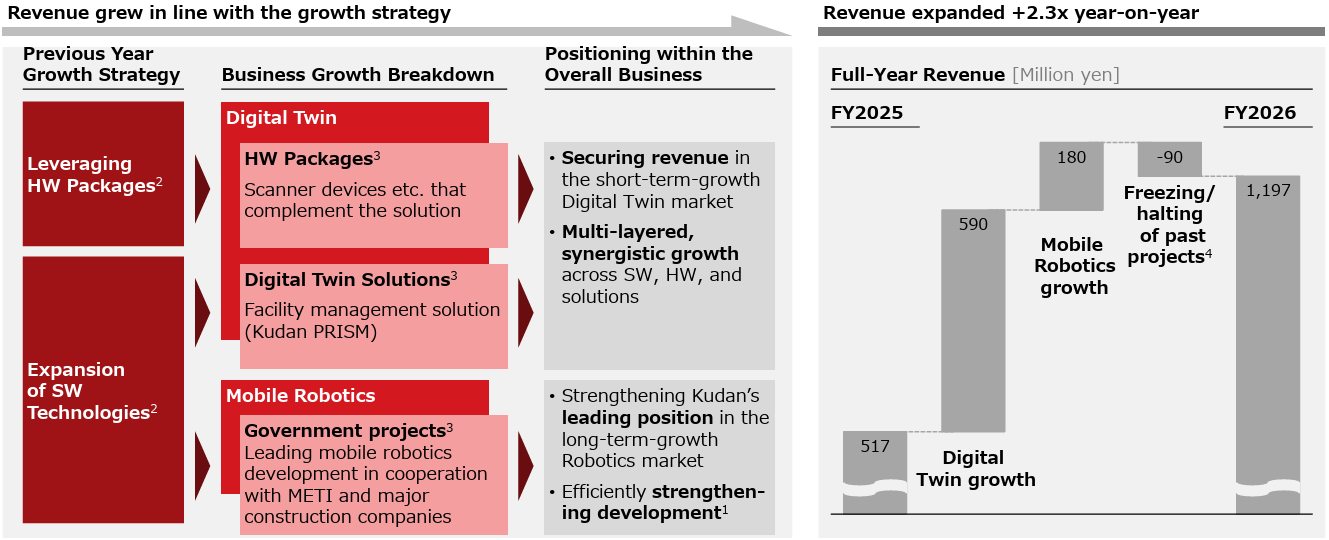
The considerable sales growth and the shrinkage of profit loss are attributable to the expansion of technological and business domains and the full-scale development of the physical AI market. In accordance with the new policy of concentrating on software with a high profit margin, they reviewed and revised related contracts and optimized their sales plans in the previous and current fiscal years. As a result, both sales and profit exceeded the upwardly revised forecasts, while the sales of hardware were posted earlier than planned.
(How to review profitability: gross profit margin and ordinary income/loss)
Gross profit margin dropped from 65.8% in the previous fiscal year to 31.0%, but this does not indicate the decline in their earning capacity. This is due to a structural factor, that is, the posting of development costs related to governmental projects, such as NEDO, as cost of sales, and there has been no change to their intrinsic structure with a high gross profit centered around software licenses.
Ordinary loss decreased 568 million yen year on year to 174 million yen. This decrease in ordinary loss exceeds the decrease in operating loss (214 million yen) significantly, mainly due to non-operating revenues, such as an exchange gain of about 354 million yen and subsidies for R&D. The improvement in the core business (operating income/loss) and temporary factors in changing results, such as exchange rates and subsidies, need to be evaluated separately.
(Background of the growth of business performance)
They strengthened the complementary technologies for software and hardware in order to increase revenues and spread technologies, and expanded the technological and business domains considerably from element technologies to spatial perception platforms.
While the demand for existing technologies for digital twins, mobile robots, etc., into which they put energy, has declined, the shift in demand to next-generation technologies is accelerating. Under these circumstances, they are steadily meeting emerging demand with their strengths, including innovativeness and rarity.
The sales of digital twins and mobile robots are growing in various aspects. For digital twins, they earned revenues in the market that is growing in the short term. They have achieved multifaceted, synergistic growth with software, hardware, and solutions. In the market of mobile robots, which is growing in the long term, they are fortifying the first-mover position and enhancing efficient development.
(Reform of the cost structure)
In the fiscal year before last, they enhanced development for expanding into new technological domains, and in the previous fiscal year, they completed the annual plan, with the aim of optimizing ordinary costs. The transitional period of the structural reform through the execution of strategies ended in the previous fiscal year, and from the current fiscal year, they plan to maintain or expand their sustainable development system while strengthening their core technologies.
6. Financial Standing and Cash Flows
◎ Balance sheet indicating major items
| End of Mar. 2025 | End of Mar. 2026 | Increase/ decrease |
| End of Mar. 2025 | End of Mar. 2026 | Increase/ decrease |
Current Assets | 2,882 | 2,447 | -434 | Current Liabilities | 273 | 335 | +62 |
Cash and deposits | 2,593 | 1,986 | -607 | Total Liabilities | 280 | 335 | +55 |
Noncurrent Assets | 528 | 530 | +1 | Net Assets | 3,131 | 2,642 | -488 |
Tangible Assets | 0 | 0 | 0 | Capital and Capital Surplus | 3,940 | 3,165 | -774 |
Investment, Other Assets | 528 | 530 | +1 | Retained Earnings | -205 | 414 | +619 |
Total Assets | 3,411 | 2,977 | -433 | Total Liabilities and Net Assets | 3,411 | 2,977 | -433 |
*Unit: million yen.
Total assets decreased 433 million yen from the end of the previous fiscal year to 2,977 million yen, due to a decrease in cash and deposits, etc.
Net assets dropped 488 million yen from the end of the previous fiscal year to 2,642 million yen, due to a decrease in capital surplus, etc.
As a result, equity ratio declined 3.5 points from the end of the previous fiscal year to 88.2%.
Considering the annual cash flow, it can be judged that cash and deposits amounting to 1,986 million yen are equivalent to working capital for several years (about 6 years according to their estimate). As loss is shrinking, they have secured a financial base that does not require additional fund procurement for a foreseeable future.
◎ Cash Flow
| FY 3/25 | FY 3/26 | Increase/decrease |
Operating Cash Flow | -815 | -632 | +183 |
Investing Cash Flow | -161 | -13 | +148 |
Free Cash Flow | -976 | -645 | +331 |
Financing Cash Flow | 1,850 | 18 | -1,832 |
Cash and equivalents | 2,593 | 1,986 | -607 |
*Unit: million yen
The cash position declined due to the spending of cash and deposits, but equity ratio remains as high as 88.2%, and the financial standing remains healthy.
7. Fiscal Year ending March 2027 Earnings Forecasts
[7-1 Earnings forecasts]
| FY 3/26 | FY 3/27 Est. | YoY |
Sales | 1,196 | 1,030 | -166 |
Operating Income | -585 | -340 | +245 |
Adjusted Operating Income | -528 | - | - |
Ordinary Income | -174 | - | - |
Net Income | -188 | - | - |
*Unit: million yen. The forecasts were those released by the company. The company will not disclose the exact forecast figures of ordinary income and net income due to the difficulty in estimating foreign exchange gain or loss, which have a significant impact on them. The adjusted operating income means the income serving as an indicator of business profitability, which is calculated by adding the recurring governmental subsidy for R&D to operating income or loss. For the current fiscal year, it has not been disclosed because there are many uncertainties and it is difficult to make an appropriate, rational forecast. As soon as it becomes easier to forecast, they will disclose it.
It is forecast that sales will decline, but loss will shrink due to the significant improvement in profitability.
Sales are projected to decrease 166 million yen year on year to 1,030 million yen, and operating loss is expected to shrink 245 million yen year on year to 340 million yen.
The sales of hardware are forecast to decrease 530 million yen, but the sales of software with a high gross profit margin are expected to increase 360 million yen. In terms of costs, the investment in R&D will expand 80 million yen, but loss is expected to decrease this fiscal year as well, as profit is forecast to rise 350 million yen as they will concentrate on software. The sales of profitable products are expected to grow and they are projected to move into the black in the next fiscal year or later.
8. Overview, History, and Technologies of the Company (for reference)
This chapter provides information for reference, including the company’s history and philosophy, the details of the core technologies, including artificial perception (AP) and SLAM, competitive advantages, and business models. Their businesses and financial results are summarized in Chapters 1 to 7, and this chapter can be used for reference to understand their background. The market environment (including the list of economic effects) is summarized in “4. Market Environment.”
While upholding the vision “Eyes for All Machines,” they conduct R&D of spatial perception technologies, which will become the fundamental technologies in the physical AI era, and offer licenses and solutions. Spatial perception means a technological domain for enabling AI and robots to perceive real space. It is a core technology for enabling machines to perceive the real world, grasp a location, grasp the ambient environment, and then work. They recognize spatial perception as a fundamental technology for physical AI, which makes it possible for AI to exist in real space, and offer a spatial perception platform integrating digital twins, robots, and data technologies.
[8-1 Corporate history]
Mr. Tomohiro Ohno, currently serving as a Managing Director, became convinced of the prospects and growth potential of the AP technology when working at Andersen Consulting (currently Accenture PLC) and set up Kudan Limited in the United Kingdom in January 2011, at which he pursued his own research and development on the Simultaneous Localization and Mapping (SLAM) technology that provides a basis for the AP technology. In November 2014, he established Kudan Inc. intending to extend the administrative department through business expansion while moving further ahead with his research and development. The company started offering evaluation software for demonstration of the Kudan SLAM technology in December 2016 and officially began to provide Kudan SLAM in the term ended in March 2018. It got listed on the Market of the High-Growth and Emerging Stocks (Mothers) of the Tokyo Stock Exchange (TSE) in December 2018. In April 2022, the company got listed on the Growth Market of TSE, through market reclassification.Consisting of four inside directors, Managing Director & CEO Daiu Ko, who joined the company after working for Toyota Motor Corporation and McKinsey & Company, Managing Director Tomohiro Ohno, and Tian Hao, a director and COO, Kudan’s management team places a heavy emphasis on swiftness.
[8-2 Corporate philosophy]
Kudan’s corporate philosophy is “to stand alone, and dare to create what is new and different.”
The philosophy guides the company into avoiding following suit and daring to challenge the generally accepted wisdom. Embracing the philosophy, the company aims to expand its business and research and development, raise shareholder interests, and become a one-of-a-kind company in the market by formulating policies that enable them to stand out from all other companies.
While adopting a corporate vision of “Eyes for All Machines,” Kudan aims to become a player that offers technology essential for full autonomy and automation, goals that all kinds of machines and devices will strive to reach.
[8-3 Market environment (For details, see “4. Market Environment.”)]
In recent years, the social implementation of AI has advanced rapidly, due to the expanding investment in generative AI and the widespread adoption of generative AI by both enterprises and individuals. Against the backdrop of labor shortages, demand for workforce reduction and automation continues to remain at a high level, with automation needs expanding across a wide range of industries through the use of robots, digital twins, and related technologies. In addition, there is growing global interest in “physical AI,” which perceives the physical world and acts autonomously while continuously learning.
Target technology/device | Economic impact |
AI | GDP in 2030 is expected to be 9.8% (11.2 trillion dollars) to 14% (15.7 trillion dollars) higher with an impact of AI than without. |
Autonomous driving systems | It is projected that the passenger economy (*) will stand at 800 billion dollars in 2035 and 7 trillion dollars in 2050 globally when autonomous cars are put into practice.
The economic impact is broken down into Mobility as a Service (MaaS) for consumers (3.7 trillion dollars), MaaS for businesses (3.0 trillion dollars), and newly emerging driverless vehicle services (0.2 trillion dollars).
*The passenger economy: economic and social value realized by level-5 fully autonomous cars |
Digital twins | “Digital twins,” which reproduce real-world objects and situations in virtual space as “twins,” are increasingly used for simulations as well as the optimization and evaluation of effects, impacts and risks in a variety of fields, such as manufacturing and healthcare. It is expected that the scale of the global digital twin market, which was 283 billion yen in 2020, will grow to 3,914.2 billion yen by 2025. |
Drones | The market scale of the drone business in Japan is forecasted to be 193.2 billion yen in FY 2020, up 37% from the year before, and reach 642.7 billion yen in FY 2025 (about 3.3 times larger than that of FY 2020).
Drone services were the strongest market in FY 2019 with a 68% year-on-year increase to 60.9 billion yen followed by the drone body market which grew 37% year on year to 47.5 billion yen and the drone peripheral services market which showed a 46% year-on-year rise to 32.6 billion yen.
These three markets are expected to continue booming, with the market scales for FY 2025 are estimated at 442.6 billion yen (about 7.3 times greater than that of FY 2019) for the services market, 122.9 billion yen (about 2.6 times greater than that of FY 2019) for the body market, and 77.1 billion yen (about 2.4 times greater than that of FY 2019) for the peripheral services market, respectively, in descending order. |
Autonomous robots | Autonomous (mobile) robots, which independently perceive their environment to move and perform tasks, are seeing accelerated adoption across manufacturing, logistics, construction, and service sectors. The scale of the global market of autonomous (mobile) robots is projected to reach approximately 300 trillion yen in 2040, with the full-scale development of physical AI expected to further accelerate widespread adoption (according to the company’s estimation). |
* The part concerning AI, autonomous driving systems, and drones were quoted from the “Reference material 2: Case studies for estimating the economic impact of advanced technology” used at the 10th meeting for discussing new governance models for realizing Society 5.0 as posted on METI’s website, and the part concerning digital twins was quoted from the “2023 White Paper on Information and Communications in Japan (digital twins)” by the Ministry of Internal Affairs and Communications. The red and bold parts were provided by Investment Bridge Co., Ltd.
In addition to these applications that are already under development, there are many areas where AP (Artificial Perception) technology will be applied and integrated in the future by supporting various advanced technologies, and it is expected that AP (Artificial Perception) technology will be implemented in society at a speed beyond what was previously expected.
[8-4 Business content (Description of AP and SLAM technologies)]
Kudan has issued a license for Kudan SLAM, a software for integrating such algorithms as SLAM, which is the mission-critical technology of AP, into hardware, and grants it to customers. It is essential to learn about AP (Artificial Perception) and SLAM to understand the business and technological superiority of Kudan. Below are descriptions of AP and SLAM.
<What is AP?>
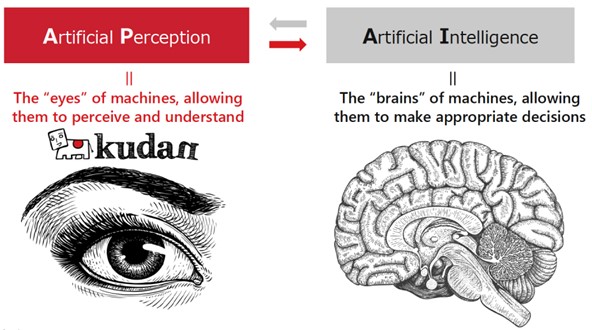
Artificial perception (AP) is a technology proposed, researched, and developed by the Kudan Group and an element technology that constitutes the central part of spatial perception, which is mentioned in this report. Namely, AP is a group of technologies for the eyes of machines to perceive and understand real-world space, and an AP platform can be developed by integrating AP with digital twins, robots, and data technologies and systematizing them.
The evolution of AI (artificial intelligence), a technology that replaces the human brain, is remarkable.
However, the recent evolution of AI is mainly limited to “Internet AI” that does not directly operate in the real (physical) space. At the same time, the demand for “physical AI” that can directly affect the real space is expected to increase significantly in the future. Machines (computers and robots), which have remained in the Internet space for a long period of time, are heading toward autonomous functions in the real space.
However, autonomous actions and functions of machines cannot be realized by AI alone. It can only be realized by mutually linking and complementing AI (Artificial Intelligence) with the advanced technology AP (Artificial Perception), which is equivalent to the “eyes” for understanding the surroundings. AP (Artificial Perception) is an essential technology that gives machines advanced visual capabilities like human eyes.
With the evolution of AI, the need for AP technology that connects machines and the real world is expected to grow even more in the future.
Recently, the company has redefined artificial perception (AP) as the base for enabling AI to exist and work in real-world space = spatial perception (SP) and positioned it as a core technology in the physical AI era. The spatial perception used in Chapters 1 to 4 of this report is the concept that has advanced and includes artificial perception, which will be described here.
<What is SLAM?>
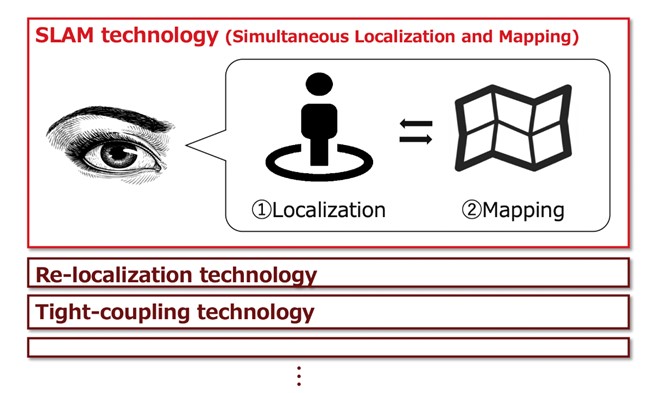
“SLAM: Simultaneous Localization and Mapping” plays a key role in enabling the AP (Artificial Perception) to fully demonstrate its required capabilities.
Robots are wandering about in deep darkness as they lack sight. So that they can accurately travel under such circumstances, it is indispensable for them to obtain the map of the place where they should drive and find out their current location on the map.
SLAM is a technology for each computer to concurrently “estimate the self-location (localization: checking where you are)” and “produce an environmental map (mapping: checking your surroundings)” in the real environment based on data input from external sensors, such as cameras and lidar.
It is possible to record how you have travelled in a new environment while producing a map (tracking) and recognize where you are based on a previously produced map (re-localization).
Unlike GPS and beacons, which detect the position from external radio waves, robots perceive their surroundings and location based on visual information (camera and Lidar) like humans, which enables usage in an even broader variety of environments, situations and use cases.
Taking a car applied with the SLAM technology as an example, the technology localizes the car based on a computer program of mathematically processing the distance that the car has travelled, camera images, and sensor information provided by Lidar, which is a sensor using laser light, and outputting three-dimensional information (such as the direction, distance, and size) and kinesthesia (such as the location and movement) on a real-time and precise basis and, at the same time, makes a three-dimensional map based on data on the surroundings amassed by the sensors.
In the case of cars, SLAM enables drivers to obtain basic information for safe travel by car by using a three-dimensional map drawn from time to time by the technology while driving cars, even if they have no information in advance on road conditions (such as the location of cars driving in the front, back, left, and right of their cars, how fast the cars in all directions drive, the road width, and the number of road lanes).
Differing from GPS, which detects a position with external radio waves, and beacons, it recognizes the self-position in a stand-alone manner, so it can be used in a broader range of environments, situations, and cases.
SLAM is the most critical technology for AP, and what are extremely important are precision and processing speed when it comes to ensuring the safety in autonomous cars. Such technological issues have been pointed out as obstacles to using SLAM for general purposes.
Meanwhile, “Kudan GrandSLAM,” which is provided by the Kudan Group, is composed of “KdVisual (Visual SLAM)” equipped with a camera and a group of SLAM software, including “KdLidar (3D-Lidar SLAM)” equipped with 3D-Lidar, and respective components exert their strengths in different areas and environments. The company gives a license to use a commercial-grade SLAM framework as a globally rare listed company that specializes in the SLAM algorithm.
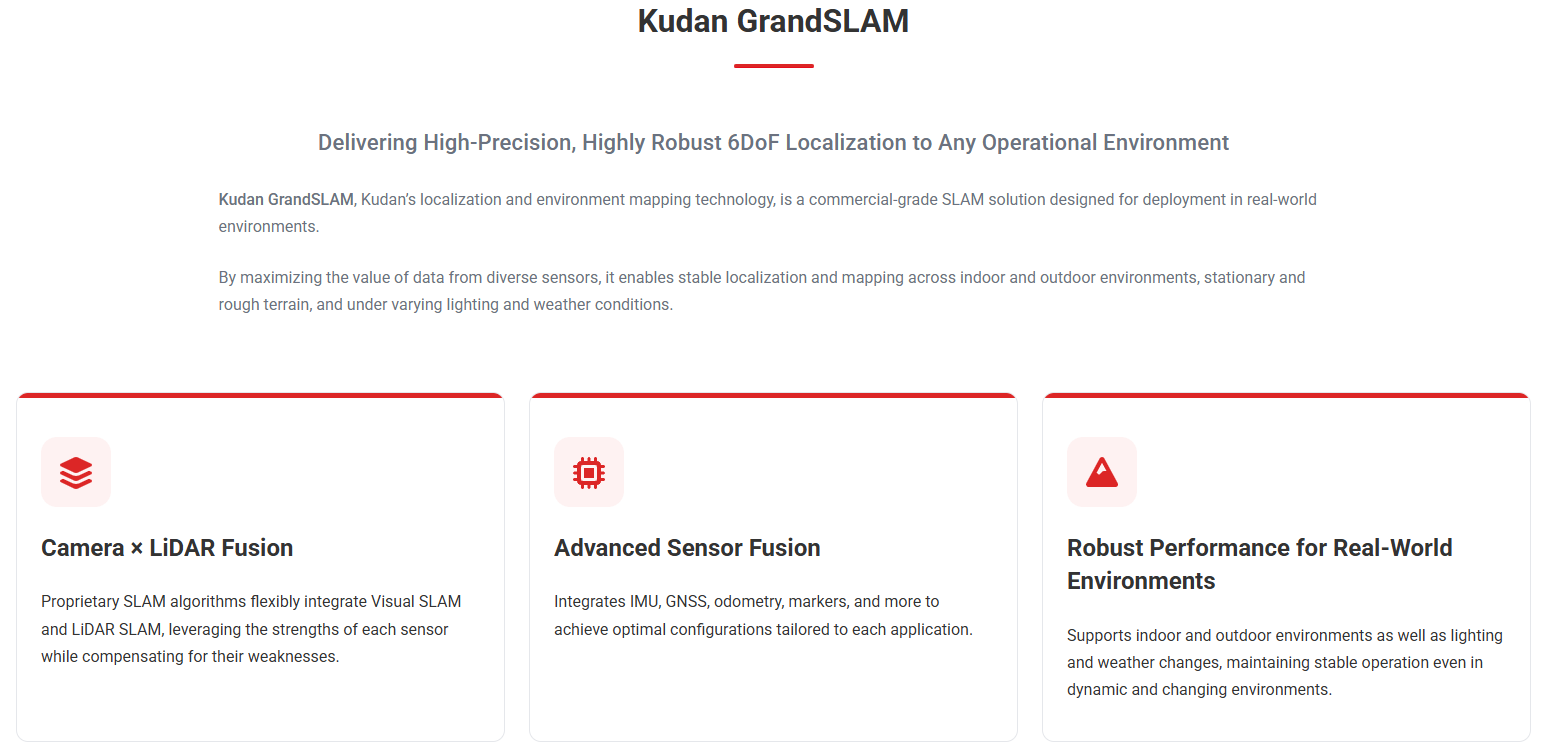
(From the company’s website)
KdVisual (camera-based Visual SLAM) is software for estimating a self-location and producing a map based on camera footages, which has a good balance among speed, precision, and robustness and is easy to integrate. It actualizes a processing speed 2-10 times higher than that of the most popular open source ORB-SLAM2 with a smaller processing capacity, and can operate in low-power devices, such as smartphones. It can realize a repeat accuracy of less than 1 cm for maps, which is required of industrial robots (AGV and AMR), and determine a self-location on an existing map much swiftly than the SLAM technologies of other companies. It can maintain its precision even if people and objects in a camera view move or the landscape changes after the time of map production, and it is possible to solve the operational problem of “forgetting a self-location” just by adding a camera and Kudan’s software to a 2D-Lidar-based robot.
KdLidar (3D-Lidar SLAM equipped with 3D-Lidar) estimates a self-location in a highly precise and robust manner and produces a three-dimensional map based on the point cloud data of 3D-Lidar. Even in an indoor environment where GPS cannot be used and an environment where indoor and outdoor spaces coexist, its precision is at the cm level, and it can automatically identify its own location without any rough data on the initial location. It is scalable, so large-scale operation is possible, and it is compatible with not only the rotary type, but also the solid state type of LiDAR, so it can be applied to a broad range of environments of clients. The high-precision 3D point cloud map is utilized for digital twins. Furthermore, by fusing sensors, such as IMU, GNSS, ToF, and wheel odometers, (sensor fusion) in addition to cameras and LiDAR, it estimates a self-location stably while curtailing cumulative errors even in an environment where there are many moving objects and in a broad outdoor environment.
This technological superiority has been enhanced further by the acquisition of Kudan Germany (former Artisense Corporation) as its subsidiary as mentioned later.
Kudan began offering camera-based SLAM (KdVisual) under the name of Kudan SLAM in the term ended March 2018. Then, it started to provide Kudan 3D-Lidar SLAM in March 2020. The company has been striving to broaden the customer base in the following three areas:
Area | Example customers |
Augmented reality (AR) and virtual reality (VR) application area | Optical sensor manufacturers, optical equipment manufacturers, mixed reality (MR) glasses manufacturers, telecommunications equipment manufacturers, electrical equipment manufacturers, e-commerce platforms, computer games producers etc. |
Robotics and IoT area | Optical equipment manufacturers, heavy industrial and industrial robot manufacturers, electrical equipment manufacturers, transportation equipment manufacturers, signal processing internet protocols (IPs), etc. |
Application area targeting cars and maps | Car components manufacturers, digital map companies, spatial information consulting companies, etc. |
Like this, having both Visual SLAM and Lidar SLAM, Direct SLAM and Indirect SLAM in Visual SLAM, and having a hybrid technology combining them is a major strength of the company. For the details of their SLAM technology, please see their website (https://www.kudan.io/jp/localisation-and-mapping).
<Growing number of fields in which AP can play roles>
Using one of the existing technologies called computer vision (a set of base technologies of sensor and image processing mainly on a two-dimensional basis) as the foundation after reconstructing it, Kudan has developed its own unique AP technology.
As AP is the base technology necessary for every kind of device that uses cameras and three-dimensional sensors, the company expects that it will be the base technology adopted to diverse next-generation solutions on a cross-cutting basis.
It has been a technology essential for automatic control of all autonomous machines as robotics in a broad sense, including industrial robots, domestic robots, next-generation mobility such as cars, and flying machines such as drones, just to name a few.
It will also be required for spatial perception in AR and VR that will serve as user interfaces of next-generation computers.
In addition, the technology will be applied to an extremely wide range of purposes as the base technology for next-generation digital maps, dynamic maps (a dynamic mapping system that swiftly reflects the conditions of the reality environment), digital twin (information on the virtual space synchronized with the reality environment on a real time basis), and the like.
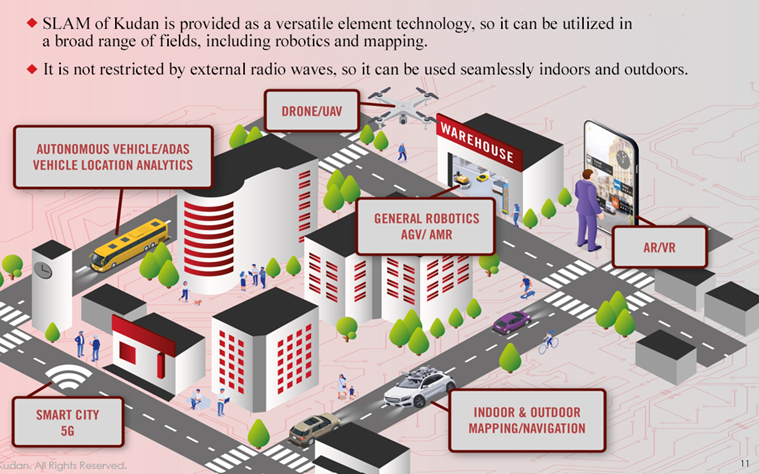
Among these technologies, Kudan places robotics and digital twins at the center of next-generation solutions they aim to realize, believing that the true potential, which is not limited or inefficient, will be released through authentic “eyes of a machine.”
For instance, many autonomous mobile robots equipped with SLAM currently in use work with 2D Lidar SLAM. However, 2D Lidar can grasp the surrounding information only in a two-dimensional way, which poses challenges, such as limitations on the environment for robot usage.
In contrast, 3D-Lidar SLAM using Kudan’s Visual SLAM and 3D Lidar enables three-dimensional perception of the environment, allowing robots to autonomously travel in a broader variety of environments.
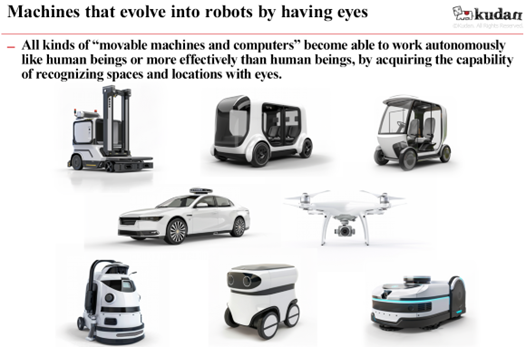 |
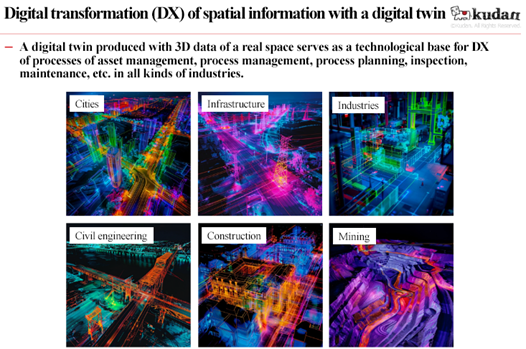 |
<Examples of practical application>
Amid such circumstances, the practical application of technologies is starting to show progress through the customer commercialization and Kudan’s technologies are gradually starting to reach the market.
*Robotics
・Autonomous Mobile Robots (AMR) Provided to NVIDIA and Intel in the United States. Kudan offers the SLAM algorithm for business use to platforms for robot developers. This algorithm was adopted on an Intel platform in 2022 as the first case of an algorithm for business use in the semiconductor industry.
 | ・Automated driving vehicles for delivery and sale Kudan provides the technological base to the Chinese company Whale Dynamic, and services to Robomart, a company in the U.S. They will realize highly accurate perception even with a low-cost sensor composition, forging ahead with practical application as a step toward automated driving services with a high cost-performance and high social demand.
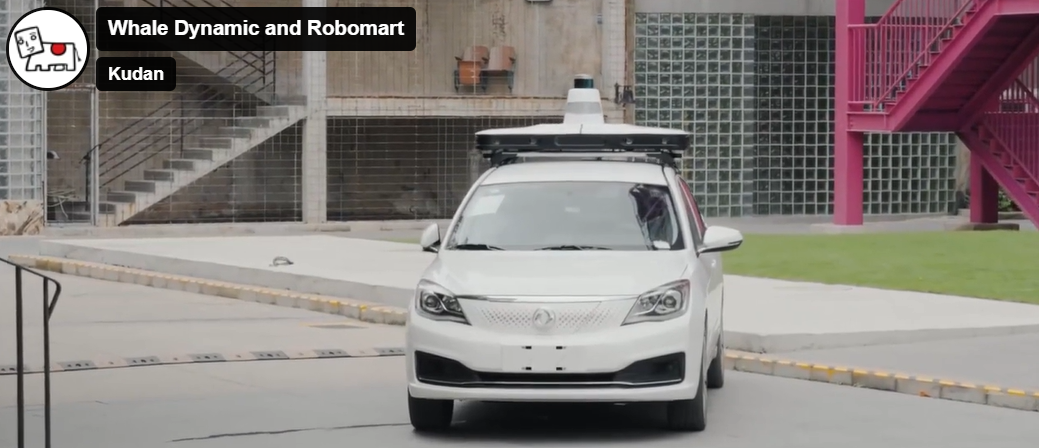 |
(Taken from the reference material of the company)
*Digital Twins
・Forest management Provided to the Finnish Ministry of Agriculture and Forestry and Cornell University in the U.S. Kudan is currently developing a solution for digitizing a vast amount of information on trees through 3D scans of large forests and making a database for forest management, such as preservation and logging.
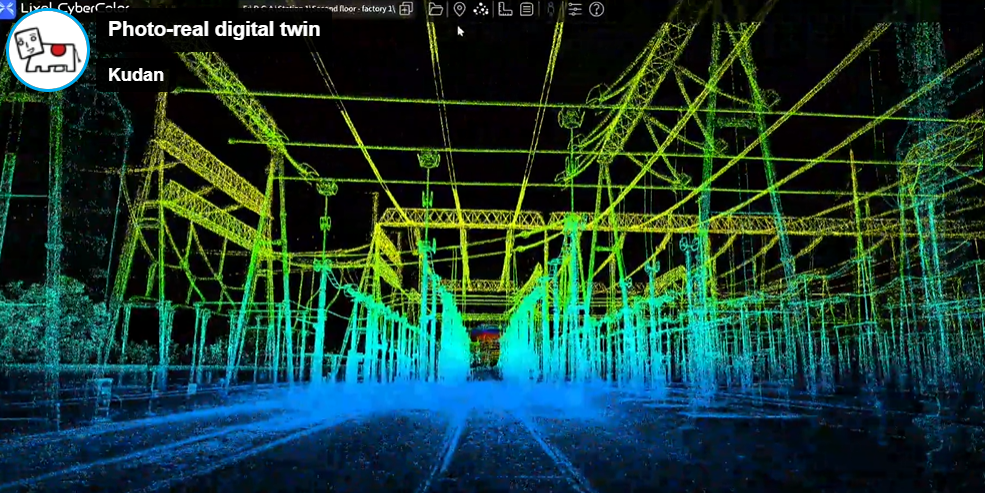
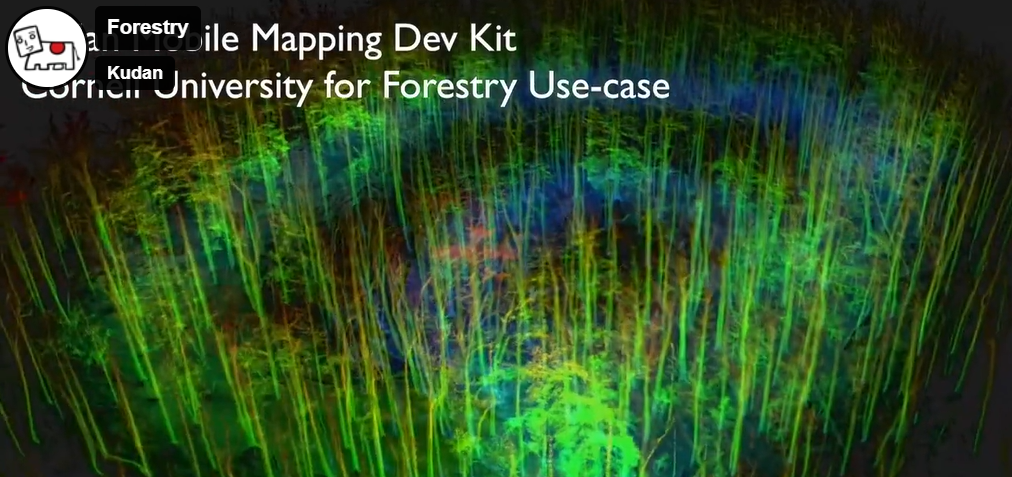 | ・Solution for photo-real 3D digital twins Provided to the Chinese company XGRIDS. It allows the user to freely move within the digital twin created by scanning the real world, displaying photo-real pictures. It is anticipated to bring innovation to various types of industries, such as construction, real estate and manufacturing.
 |
(Taken from the reference material of the company)
Many other projects are underway, including public, non-public and anonymous ones.
◎ Management Strategy
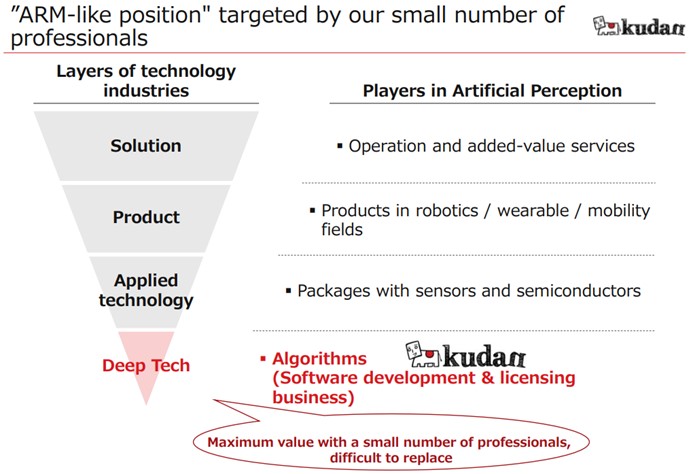
Based on the technology strategy, the company is focusing on algorithm research, software development, and licensing in Deep Tech, which is equivalent to the fundamental technology located in the deepest technological layer below solutions, finished products, and applied technology.
With overwhelming technological strength as its weapon, the company is promoting customer acquisition globally and aiming for “maximization of corporate value with a select few employees” and “positioning that is difficult for customers to replace.”
(Taken from the reference material of the company)
[8-5 Competitive advantages]
(1) Technological features
Kudan believes that its AP technology has enormous advantages in taking in not only the existing demand for product development but also demand for research and development on highly novel and complex future technologies, because the AP technology can help the company strategically take in technological demand fueled by continuous advancement and wider applications of the technology in mid-/long-term.
According to the company, the AP technology has the following five features.
Kudan can flexibly fulfill future demand, which is expected to grow and be diverse, by combining their sophisticated and flexible research and development capabilities that they cultivated by focusing on the AP field:
Feature | Overview |
(1) Uniqueness of the algorithms | The Kudan Group possesses diverse families of technologies that consist of uniquely developed algorithms.
Regarding how to perceive image feature points (fairly noticeable local areas in an image) that provide the basis for perceiving three-dimensional geometric structures at an advanced level, for example, the company has developed a unique, high-speed and greatly precise method by integrating and hybridizing a high-speed perception method and a highly precise and stable perception method. Furthermore, the density of feature points perceiving within an image can be adjusted flexibly to optimize the precision of perceiving three-dimensional structure (a set of three-dimensional feature points) and the processing speed, according to the practical application environment. In addition, a wide range of unique mathematical models that guarantee the feasibility of the technology are integrated, including optimized calculation that increases the precision of a group of three-dimensional feature points perceived sequentially in a three-dimensional manner, and a high-speed matching method with already-known, stored data. |
(2) Flexibility and powerful performance | The uniqueness of the algorithms allows high-speed processing (with a light calculation load) as well as realizes great perception precision (which means that deviation from a true value is slight) and robustness (which indicates that the technology performs stably regardless of the environment and conditions in which it is used).
In addition, the AP technology will be able to deliver strong performance that is optimized for a myriad of practical applications as it is designed in a manner that allows users to make detailed adjustments to the perception precision, robustness, processing speed, data size, and other individual functions according to the conditions under which the technology is used and required specifications. |
(3) Flexibility in sensor use | As limiting the number of sensors can narrow the scope of applications of the AP technology, the Kudan Group’s technology is designed to be compatible with various sensors.
Specifically, it can function with a variety of cameras, the technology can be adjusted flexibly according to the number of cameras (such as monocular cameras, binocular cameras, and multiple cameras), and the data read format of optical sensors (such as whether to read data sequentially or simultaneously). Besides cameras, the technology can also be combined with a multitude of sensors, including three-dimensional sensors (such as Lidar and Time of Flight (ToF)), internal sensors (such as inertial measurement unit (IMU) and machine odometry), and position sensors (such as the Global Positioning System (GPS) and Beacon), which will allow advanced application of the technology while taking advantage of the strengths of each sensor. |
(4) Flexibility in arithmetic processing environments | Flexibility in arithmetic processing platforms is also an important factor for applying the AP technology to a wider range of fields.
As the Kudan Group’s technology can work in multifarious arithmetic processing environments, it can be compatible with all kinds of processor designs and thus can speed up calculation processes by optimizing the software according to the kind of processor used (such as a central processing unit (CPU), a digital signal processor (DSP), and a graphics processing unit (GPU)). It can also function in a wide range of system environments through porting a software to major operating systems (such as Linux, Windows, MacOS, iOS, and Android). |
(5) Flexibility in using part of the function | Complex fusion with other technologies is necessary for advanced applications of the AP technology. Parts of the function (software modules) of the Kudan Group’s technology can be selected so that they are flexibly integrated into customers’ existing software. The degree of dependence on processor designs (the degree of abstraction of software) of each part (software module) of the technology’s function varies, and therefore it can be optimized flexibly either at a semiconductor level (with a lower abstraction degree) or at a software application level (with a higher abstraction degree). |
(2) Global group of experts on AP
Researchers and engineers specializing in SLAM are a handful in the rare computer vision field. Among these, the company has many top-notch personnel with a doctoral degree, and as a group of AP professionals, it has built a strong foundation in both technology and business on a global basis.
Following the establishment of the Kudan Group in the UK in 2011 and the opening of its Tokyo office in 2014, the company invested in Kudan Germany (former Artisense Corporation) in 2020 and made it a subsidiary in the following year 2021.
The acquisition of Kudan Germany (former Artisense Corporation), a world-leading technology company, as a subsidiary and the deepening of the relationship with Professor Daniel Cremers of the Technical University of Munich further strengthens the company's competitiveness in terms of human resource acquisition and technology development.
(3) Outstanding business achievements
The number of players in the market is more limited as M&A by major technology companies continues for companies that specialize in SLAM or have SLAM as their core business.
In this environment, the company is far ahead of existing companies in terms of the breadth of technology it offers, its track record of projects, and its recognition.
To date, the company has achieved development and partnerships with many top global companies and has been highly evaluated by the world's leading companies.
<Reference: Regarding Corporate Governance>
◎ Organizational form and compositions of directors and auditors
Organizational form | Company with audit and supervisory committee |
Directors | 7 directors, including 4 outside ones |
Audit & Supervisory Board Member | 3, including 3 outside the company |
◎ Corporate Governance Report
Last updated on June 27, 2025
<Basic Policy> Our company recognizes that it is indispensable to establish corporate governance, in order to improve our corporate value, maximize the profits of shareholders, and foster good relationships with stakeholders.Under this recognition, the Managing Directors, other Directors, and employees of our company will strive to tighten corporate governance by understanding their respective roles and developing and operating internal control systems.
<Reasons for not following the principles of the corporate governance code>We follow all the basic principles of the corporate governance code.
| This report is not intended for soliciting or promoting investment activities or offering any advice on investment or the like, but for providing information only. The information included in this report was taken from sources considered reliable by our company. Our company will not guarantee the accuracy, integrity, or appropriateness of information or opinions in this report. Our company will not assume any responsibility for expenses, damages, or the like arising out of the use of this report or information obtained from this report. All kinds of rights related to this report belong to Investment Bridge Co., Ltd. The contents, etc. of this report may be revised without notice. Please make an investment decision on your own judgment. Copyright(C) Investment Bridge Co., Ltd. All Rights Reserved. |