



Bridge Report:(6183)BELLSYSTEM24 the Fiscal Year ended February 2026

 President Hiroshi Kajiwara | BELLSYSTEM24 Holdings, Inc. (6183) |
 |
Company Information
Exchange | TSE Prime Section |
Industry | Service business |
Representative Director, President, Executive Officer, and CEO | Hiroshi Kajiwara |
Address | 6F Kamiyacho Trust Tower 4-1-1, Toranomon, Minato-ku, Tokyo |
Year-end | February |
Homepage |
Stock Information
Share Price | Number of shares issued (Term-end) | Total market cap | ROE Act. | Trading Unit | |
¥1,465 | 74,522,695 shares | ¥109,175 million | 11.4% | 100 shares | |
DPS Est. | Yield Est. | EPS Est. | PER Est. | BPS Act. | PBR Act. |
¥60.00 | 4.1% | ¥114.33 | 12.8 x | ¥994.38 | 1.5 x |
*The share price is the closing price on April 20. Taken from the brief report on financial results for the fiscal year ended February 2026.
Earnings Trend(IFRS)
Fiscal Year | Sales Revenue | Operating Income | Income before Income Taxes | Net Income | EPS | DPS |
February 2023 Act. | 156,054 | 14,917 | 14,157 | 9,330 | 126.82 | 60.00 |
February 2024 Act. | 148,717 | 11,479 | 11,225 | 7,545 | 102.61 | 60.00 |
February 2025 Act. | 143,607 | 11,587 | 11,232 | 8,003 | 108.81 | 60.00 |
February 2026 Act. | 145,826 | 12,652 | 12,290 | 8,181 | 110.22 | 60.00 |
February 2027 Est. | 152,000 | 13,000 | 12,600 | 8,500 | 114.33 | 60.00 |
* The forecast was made by the company. Unit: million-yen, yen. Net income is profit attributable to owners of parent. Hereinafter the same applies.
This Bridge Report introduces the earning results for the fiscal year ended February 2026, the earnings forecast for the fiscal year ending February 2027, and the Mid-Term Management Plan 2028 of BELLSYSTEM24 Holdings, Inc.
Table of Contents
Key Points
1. Company Overview
2. Fiscal Year ended February 2026 Earnings Results
3. Fiscal Year ending February 2027 Earnings Forecasts
4. Mid-Term Management Plan 2028
5. Conclusions
<Reference1: Medium- to Long-Term Growth Scenario>
<Reference2: Regarding Corporate Governance>
Key Points
- In the fiscal year ended February 2026, both sales and profit increased. Sales revenue was 145.8 billion yen, up 1.5% year on year. Sales increased in both SC operations and SB operations. Operating income was 12.6 billion yen, up 9.2% year on year. Gross profit grew 8.3% year on year, due to increased sales revenue, the effects of revenue improvement measures, such as higher unit prices for client companies, cost reduction through the restructuring of operational sites and operational efficiency improvement. Gross profit margin rose 1.2 points year on year. On the other hand, due largely to the drop from expenses related to the restructuring of operational sites in the previous fiscal year, selling, general and administrative expenses decreased 3.6% year on year. Sales revenue was slightly below the forecast but measures for reducing costs progressed. Accordingly, operating income, income before income taxes, and net income exceeded expectations.
- For the fiscal year ending February 2027, sales and profit are expected to grow. Sales revenue is projected to be 152 billion yen, up 4.2% year on year. Both SC Operations and SB operations are expected to see an increase in sales. SB operations are forecast to see a double-digit revenue growth. Operating income is projected to be 13 billion yen, up 2.7% year on year. Gross profit is expected to increase 5.4% year on year due to the effects of increased income from AI-related business, continued initiatives to increase operational efficiency and steady efforts to pass rising costs on to clients despite significant increases in personnel expenses and other expenses due to rising prices. Gross profit margin is forecast to increase 0.2 points year on year. Selling, general, and administrative expenses are expected to increase 3.2% year on year due to the assumed increases in personnel expenses and costs for security-related measures against cyberattacks. They plan to pay a dividend of 60.00 yen/share like in the previous fiscal year. The expected payout ratio is 52.5%. With a basic policy of maintaining the payout ratio at 50%, they aim to increase the dividend amount by growing profit.
- The “Mid-Term Management Plan 2028” that covers a 3-year period until the fiscal year ending February 2029 was released on April 8, 2026. In the Medium/Long-Term Growth Scenario, the “Mid-Term Management Plan 2028” is positioned as a steppingstone toward the fiscal year ending February 2031, but it is also positioned as a critical three-year transitional period toward AI-based contact center operations and business diversification. Based on the unique strengths “data & knowledge,” a “base for enabling personnel to flourish” and a “co-creation network,” the company will focus on “advancement in customer experience (CX)” and “BPO expansion.” The company will promote its three priority measures, that is, promoting data utilization, maximizing the value of people and increasing partners. In the fiscal year ending February 2029, the company aims to achieve a sales revenue of 175 billion yen, an operating income of 16 billion yen and an income after taxes of 10 billion yen + extra. The “+ extra” indicates the possibility of the further expansion of impact of generative AI.
- For the SC business that accounts for over 80% of sales revenue, they aim to increase sales by 20 billion yen to 145 billion yen between the fiscal year ended February 2026 and the fiscal year ending February 2029. The most important part in this initiative is the AI-based automation of contact centers. There are concerns that contact center operators can experience adversity due to the emergence of AI, but AI alone has limitations in responding to end users based solely on information available on the Internet. Many companies, excluding some advanced enterprises, face constraints in terms of technical capabilities and financial resources, and are unable to utilize AI on their own. It is anticipated that these companies will continue to outsource contact center operations and they view it as a major business opportunity.
- Hybrid Operation Loop (HOL) they developed plays a key role here. This is equipped with technologies and systems for automatically producing a knowledge base from telephone response data with the generative AI specializing in the automatic production of replies and the generative AI specializing in the automatic production of knowledge. Phase 1 for HOL, that is, to develop a knowledge generator, was finished. As Phases 2 and 3, they plan to release advanced automated response based on text and advanced automated response based on voice, respectively. By steadily expanding the number of service users, mainly companies that own large-scale contact centers, they aim to achieve a sales revenue of 10 billion yen, have their service adopted by 50-60 companies, and make gross profit margin about two times higher than that of the conventional contact center operation in the fiscal year ending February 2029. A significant improvement in profitability is expected due to not only scale expansion, but also automation and addition of high value. We would like to keep an eye on the advance of HOL, which is indispensable for the company to evolve from a conventional “outsourcee” into a “strategic partner.”
1. Company Overview
The company, which is the holding company, its 8 consolidated subsidiaries, and its 3 equity method affiliates form a corporate group. The main businesses include the Customer Relationship Management (CRM) business in which a focus is given to the outsourcing of contact center operations, technology services, and consulting services.
BELLSYSTEM24, Inc., which is the core company of the BELLSYSTEM Group, (capital contribution rati 100.0%), has been undertaking a broad range of operations, mainly contact center operations, which serve as contact points between enterprises and consumers, for around 40 years since the inauguration of business in 1982, creating standard models in the industry.
Based on the knowledge of operation that has been nurtured by combining the strengths of personnel and technologies, they are actively developing new solutions through M&A and the utilization of AI with the aim of improving business value.
In addition to BELLSYSTEM24, Inc., the 8 consolidated subsidiaries are SKY Perfect Customer-relations Corporation (capital contribution rati 51.0%), which became a consolidated subsidiary through their investment in the company for operating customer centers of “SKY PerfecTV!,” a fee-charging multichannel broadcasting service, and also offers consulting and educational services related to customer centers, Horizon One Inc. (capital contribution rati 51.0%), a joint venture with Layers Consulting Co., Ltd., which undertakes business processes and offers various consulting, and human resource activity support services in the areas of human resources and accounting, THINKER Inc. (capital contribution rati 70.0%), which utilizes data generated at customer contact points for corporate marketing DX and also develops AI solutions led by data analysts and engineers, BA Intelligence Inc. (capital contribution rati 51.0%), which is a joint-venture firm with AVILEN, Inc. and focuses on AI-Co BPO (AI Collaborative BPO), designs AI strategies, offers AI-based consulting services, develops and uses AI agents, and offers employee training for improving skills and knowledge of AI, BellSoleil, Inc. (capital contribution rati 100.0%), a special subsidiary aimed at promoting the employment of people with disabilities, BELLSYSTEM24 TAIWAN, Inc. (capital contribution rati 100.0%), which offers outsourcing services for CRM solutions, the services of developing and operating EC sites, advertisement and promotion services, social media-based marketing services, and online direct promotion services in Taiwan, and BELLSYSTEM24 VIETNAM Inc. (capital contribution rati 80.0%), which operates contact center business in Vietnam.
There are three affiliated companies accounted for by the equity method: CTC First Contact Corporation (capital contribution rati 48.0%), which operates IT service desks and supports clients in business process outsourcing (BPO), TB Next Communications Co., Ltd. (capital contribution rati 49.0%), a joint venture with TOPPAN Inc. that supports DX promotion and develops next-generation BPO services, and TrueTouch Co., Ltd. (capital contribution rati 49.9%), which operates a contact center in Thailand and provides services to customers in Japan and overseas.
ITOCHU Corporation holds 40.7% of the company’s voting rights and deems the company as a company accounted for using the equity method. In ITOCHU Corporation, which is focusing on business in non-resource sectors, especially the Consumer related Sector, the company, which engages in the call center business, plays a role as “the contact point between companies and consumers.” Since the capital alliance entered into in October 2014, the company has built a broad range of alliances and successfully expanded the volume of transactions with ITOCHU Corporation (the company makes transactions with ITOCHU Group under the same transaction conditions as other client companies, and will continue to follow the policy).
[1-1 Corporate Philosophy]
The company pursues the following PURPOSE and VALUES.
In order to define in a single word what we should be and our commitments, the company has established a CORPORATE VOICE and a MANIFESTO for further clarification.
PURPOSE
To sustain the prosperity of society, through innovation and communication
VALUES
・Dialogue: Engaging to better understand concerns and ideas, working together toward resolutions and success.
・Creativity: Fusing the competence of on-site workers with the evolving technology to create unmatched value
・Diversity: Creating workplaces that enable each employee to thrive as individuals and discover hidden potential
・Partners in success: Committing success for our customers by using accumulated experience to achieve optimal solutions
・Co-creating prosperity: Increasing the experiential value of products and services to support precious moments for all
[1-2 Business Contents]
(1) Business Description
The company’s business consists of the Customer Relationship Management (CRM) business, which is the segment to be reported, and other businesses. In the fiscal year ended February 2026, the CRM business accounting for almost 100% of consolidated sales.
Sales by segment
| FY 2/26 | Composition ratio |
CRM business | 145,556 | 99.8% |
Other | 270 | 0.2% |
Consolidated sales revenue | 145,826 | 100.0% |
* Unit: million yen
CRM Business
In addition to the conventional task of dealing with inbound and outbound calls, which use telephones as a major communication tool, in this business, a multitude of outsourcing services for contact center operations and BPO services that take advantage of Information Technology (IT), such as the Internet and social media, are offered to client companies. This is a stock business in which continuing operations make up around 90% of sales, and spot operations, such as election-related tasks, constitute the remaining portion. The business is composed of the following 4 operations:
1) Customer support for client companies (mainly by dealing with inquiries about products and services of client companies)
2) Sales support for client companies (mainly by assisting client companies in promoting sales of their products and services)
3) Technical support for client companies (mainly by handling inquiries as to how to operate IT-based products of client companies)
4) BPO tasks (mainly undertaking routine tasks of client companies)
The company discloses the sales revenue in the CRM business by classifying it into two segments: “smart contact center (SC) business” and “smart business support (SB) business.”
Segment | Outline |
Smart contact center (SC) business | Tasks for communication between client companies and end users ・Inbound contact center operations, such as customer center operations ・Outbound marketing to reel in customers, promote sales, etc. ・Development of call center environments, including BellCloud+ and voice recognition ・Peripheral tasks, including the accumulation of knowledge on how to attend to customers, FAQs, etc. ・Data-based marketing and data analysis ・Consulting related to contact centers |
Smart business support (SB) business | Tasks for supporting the in-house operations of client companies ・Personnel affairs, accounting, and general affairs ・Data entry ・Screening, monitoring, and list examination ・Marketing support, draft production and proofreading for websites ・Consulting regarding in-house operations ・In-company help desk operation |
(2) Customers
The number of clients as of the end of February 2026 was 1,690, up 104 from the end of the previous fiscal year. Not only major clients from which they earn a sales revenue of 300 million yen or more, but also medium-tier and lower-tier clients increased. The company's ability to respond to the needs of customers in diverse industries and business categories has been highly evaluated.
Industry Type | Overview |
Service | Introduction of personnel, Internet-related services, broadcasting, electronic money, code settlement, point services, etc. |
Transportation & Communication Industry | Communications carriers, providers, travel, transportation, etc. |
Finance and Insurance | Banking, securities, life and non-life insurance, credit cards, etc. |
Wholesale and Retail | Mail order, e-commerce, product sales services, etc. |
Manufacturing | Manufacturers, food production, printing, pharmaceuticals, etc. |
Other | Local governments, electricity, gas, water, housing, real estate, etc. |
(3) Business establishments
As of the end of February 2026, the company had 49 offices and 17,500 booths in Japan. As overseas bases, the company has a consolidated subsidiary in Vietnam and Taiwan, and a group company in Thailand.
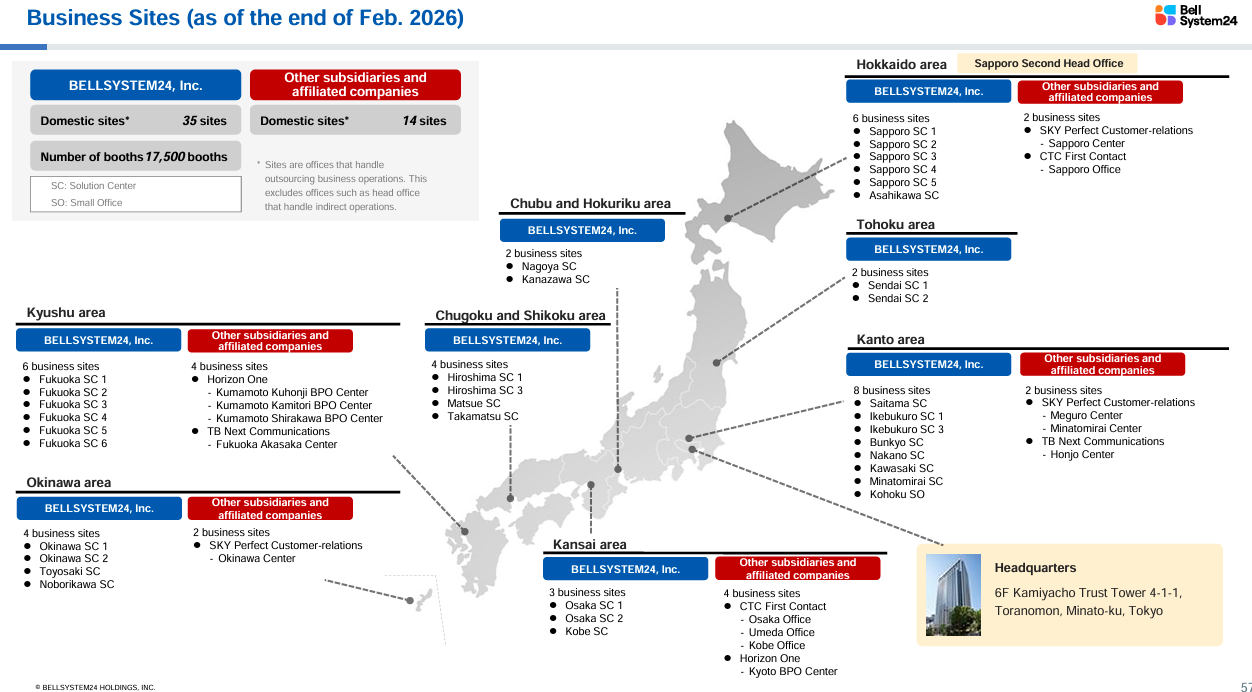
(From the company’s materials)
[1-3 ROE Analysis]
| FY 2/17 | FY 2/18 | FY 2/19 | FY 2/20 | FY 2/21 | FY 2/22 | FY 2/23 | FY 2/24 | FY 2/25 | FY 2/26 |
ROE (%) | 11.0 | 13.4 | 12.1 | 14.8 | 14.2 | 16.0 | 15.1 | 11.5 | 11.7 | 11.4 |
Net income margin (%) | 3.95 | 4.85 | 4.46 | 5.53 | 5.34 | 6.11 | 5.98 | 5.07 | 5.57 | 5.61 |
Total asset turnover (times) | 0.79 | 0.82 | 0.86 | 0.82 | 0.80 | 0.83 | 0.88 | 0.85 | 0.82 | 0.85 |
Leverage (x) | 3.56 | 3.37 | 3.16 | 3.25 | 3.34 | 3.13 | 2.88 | 2.69 | 2.56 | 2.39 |
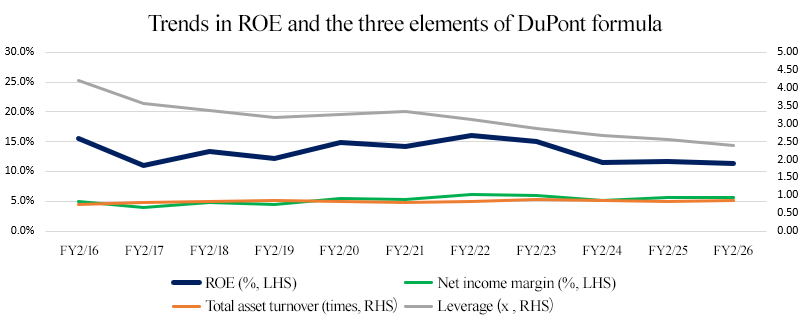
ROE exceeds 8%, which is considered as a value Japanese enterprises should target, but it has been at the 11% level over the past 3 fiscal years. Under the medium-term growth strategy and the Mid-Term Management Plan 2028, they plan to engage in the improvement in profitability mainly through the utilization of generative AI, so it seems that there is significant room for further improvement in ROE.
[1-4 ESG]
They actively engage in activities for solving social issues while considering their corporate philosophy, important issues, and ESG. Such activities are highly evaluated by external organizations.
*Excerpt from the reference material for briefing the financial results in the fiscal year ended February 2026
◎ First-time certification by the Ministry of Health, Labour and Welfare as an “Excellent Company in Occupational Safety and Health (White Mark)".
In May 2025, under the Ministry of Health, Labour and Welfare’s Excellent Occupational Safety and Health Enterprise Disclosure System, the company was certified for the first time as an Excellent Occupational Safety and Health Enterprise.
An Excellent Occupational Safety and Health Enterprise is a company certified by the Ministry of Health, Labour and Welfare for actively implementing measures to ensure workers’ safety and health, while maintaining or improving high standards of occupational safety and health. To receive this certification, companies must not only meet basic requirements, such as having no serious violations of occupational safety and health laws in the past three years, but also demonstrate proactive initiatives across a wide range of areas, including worker health maintenance or promotion, mental health measures, prevention of overwork, and safety management. In this certification process, the company was particularly recognized for its outstanding initiatives in managing long working hours, conducting activities in collaboration with the health insurance association, providing mental health training and seminars with external specialists, and establishing return-to-work rules and interviews after return to work.
◎ Recognized with the highest “Gold” rating for the seventh consecutive year in the “PRIDE Index 2025,” an evaluation index for LGBTQ+ initiatives in a workplace.
In November 2025, the company was recognized with the highest “Gold” rating for the seventh consecutive year in the “PRIDE Index 2025,” an evaluation index for LGBTQ+ initiatives in workplaces at companies and organizations, signifying that it met all certification criteria.
This fiscal year, as part of initiatives aimed at creating opportunities for internal dialogue and promoting understanding, the company held roundtable discussions involving young employees and ALLY members who actively support and advocate for LGBTQ+ individuals. It also organized opinion exchange meetings among the management, LGBTQ+ employees, and ALLY members to foster awareness throughout the organization. In addition to introducing an LGBTQ+ awareness program into new employee training, the company launched a new e-learning program, “D&I Training / LGBTQ+,” for all employees. These initiatives were highly evaluated, resulting in the company receiving the highest “Gold” certification.
◎ Recognized with a Four-Star rating in the “Nikkei Sustainable Comprehensive Survey: Smart Work Management Edition.”
In January 2026, the company was awarded a four-star rating in the “Nikkei Sustainable Comprehensive Survey: Smart Work Management Edition.”
This survey is intended for selecting leading companies that aim to trigger innovation, improve productivity, and maximize corporate value by effectively leveraging human resources and accelerating investment in personnel. Since 2017, the survey has been organized by Nikkei Inc., evaluating listed companies nationwide and major unlisted firms. Companies are rated on a five-star scale based on three elements: the utilization of human resources, the investment in human resources, and the utilization of technologies. The company received an ‘S’ rating for the utilization of human resources, and ‘A++’ ratings for the investment in human resources and the utilization of technologies.
◎ Recognized for the fifth consecutive year as the “Best Workplace,” the highest rating in the D&I certification program “D&I AWARD 2025.”
In January 2026, the company was recognized for the fifth consecutive year with the highest rating, “BEST WORKPLACE,” in the “D&I AWARD,” which is conducted by JobRainbow to evaluate corporate diversity and inclusion (D&I) initiatives.
The award is Japan’s largest certification program for evaluating corporate D&I initiatives, launched in 2021. It assesses the diversity and inclusion efforts of companies operating in Japan using a proprietary 100-item evaluation index called the “Diversity Score,” and grants certification in one of four ranks— “Standard,” “Beginner,” “Advance,” and “Best Workplace”—according to the score achieved.
To promote greater understanding of D&I-related topics such as LGBTQ+, people with disabilities, health-oriented management, working while raising children, and paternity leave, the company introduced an e-learning program titled “D&I Training” for all employees. In addition, the company’s group-wide initiatives were comprehensively recognized, including its proprietary “Bell Pride Month” activities featuring roundtable discussions involving the management and employees; “Colourful Meeting” roundtables between executives and employees focused on various D&I themes; participation by executives and employees in the “Rainbow Parade,” which opposes discrimination and prejudice against LGBTQ+ individuals and celebrates diversity in sexuality and gender; and participation in the “CHALLENGE COFFEE BARISTA” competition by employees with disabilities. These ongoing efforts contributed to the company being certified as the “Best Workplace” for the fifth consecutive year.
[1-5 Measures for realizing business administration conscious of capital cost and share price]
(Policies)
Considering that the business administration deeply conscious of capital cost and profitability is essential for achieving sustainable growth and improving medium/long-term corporate value, the company adopted ROE as one of management indicators, and aims to improve capital profitability by keeping ROE higher than cost of shareholders’ equity.
(Recognition of the current state)
◎ ROE
With the cost of shareholders’ equity in fiscal year 2025 being around 8%, the company maintains ROE that exceeds this cost (11.4% in the fiscal year ended February 2026).
The company aims to improve capital profitability by maintaining ROE at a level that is above the cost of shareholders’ equity.
◎ PBR
PBR was around 1.5 for fiscal year 2025, remaining above 1.0 in the past five fiscal years.
By making efforts to improve profitability and growth potential, they will aim to get higher valuations in the market and improve PBR.
◎ Cash allocation
Cash flow from operating activities in fiscal year 2025 was 9.9 billion yen. 4.4 billion yen was used for shareholder return, 1.2 billion yen for investment in business and facilities, and 5.6 billion yen for the repayment of interest-bearing liabilities.
The major points of cash allocation mentioned in the “Mid-Term Management Plan 2028,” which will be described later, are as follows.
・To keep Net DER sound. To keep the Net DER unchanged from the end of FY 2025 (0.56) until the end of FY 2028, by conducting investment as planned. For executing the investment plan, they will shift from the repayment of debt to new financing.
・They will invest a total of 24 billion yen in business and equipment in 3 years. They plan to invest 20 billion yen in M&A and business and 4 billion yen in equipment.
・They will keep payout ratio 50%.
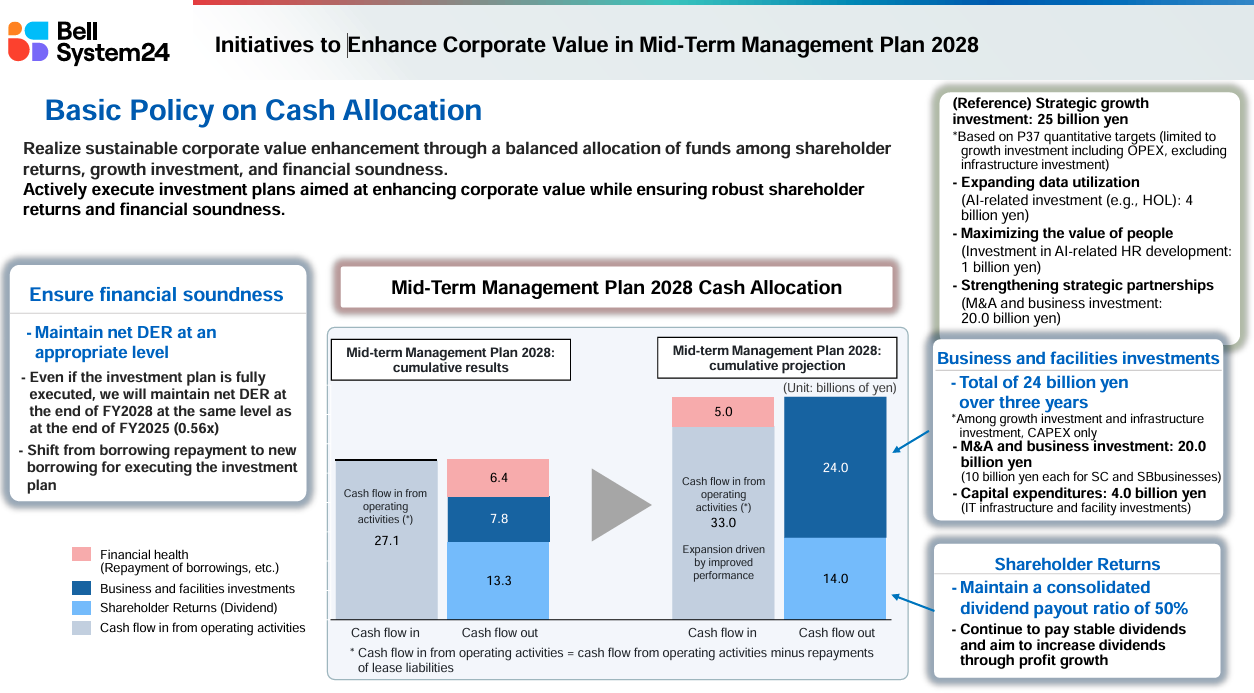
(From the company’s materials)
By allocating funds to shareholder return, investment for growth, and the improvement in the financial standing in a well-balanced manner, they will improve corporate value sustainably.
(Strategic policy and concrete measures)
By “sophisticating customer experience (CX)” and “expanding the service of undertaking business operations” as core policies in the “Mid-Term Management Plan 2028,” they strive to improve profitability, capital efficiency, and growth potential, and reduce the cost of shareholders’ equity. By “maintaining or improving ROE” and “raising PER,” they aim to improve PBR.
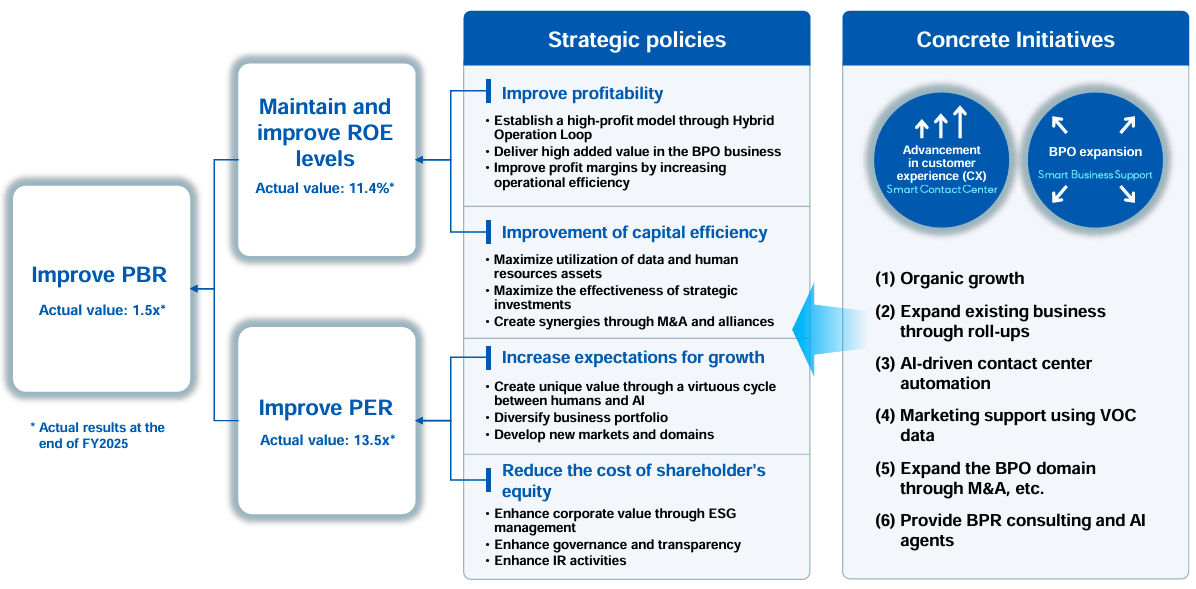
(From the company’s materials)
2. Fiscal Year ended February 2026 Earnings Results
[2-1 Consolidated Earnings]
| FY 2/25 | Ratio to sales | FY 2/26 | Ratio to sales | YoY | Compared with the forecast |
Sales revenue | 143,607 | 100.0% | 145,826 | 100.0% | +1.5% | -2.8% |
Gross profit | 25,412 | 17.7% | 27,517 | 18.9% | +8.3% | -2.4% |
SG&A expenses | 16,182 | 11.3% | 15,606 | 10.7% | -3.6% | -4.3% |
Operating income | 11,587 | 8.1% | 12,652 | 8.7% | +9.2% | +5.4% |
Income before Income Taxes | 11,232 | 7.8% | 12,290 | 8.4% | +9.4% | +4.5% |
Net income | 8,003 | 5.6% | 8,181 | 5.6% | +2.2% | +1.0% |
*Unit: million yen. Net income is profit attributable to owners of the parent.
Both sales and profit increased.
Sales revenue was 145.8 billion yen, up 1.5% year on year. Sales increased in both SC operations and SB operations.
Operating income was 12.6 billion yen, up 9.2% year on year. Gross profit grew 8.3% year on year, due to increased sales revenue, higher unit prices for client companies, cost reduction through the restructuring of operational sites and operational efficiency improvement. Gross profit margin rose 1.2 points year on year. On the other hand, due largely to the drop from expenses related to the restructuring of operational sites in the previous fiscal year, selling, general and administrative expenses decreased 3.6% year on year. The profit increase was also due to gains from the sale of part of the content business.
Sales revenue was slightly below the forecast, but operating income, income before income taxes, and net income exceeded expectations thanks to progress in cost reduction measures.
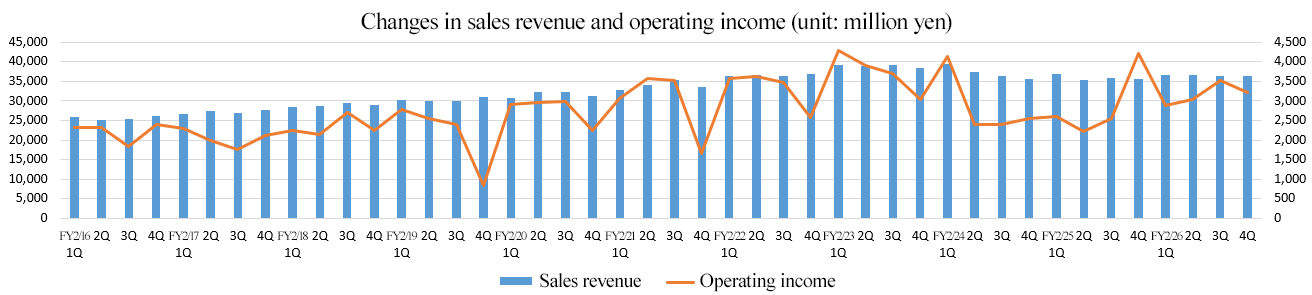
◎ Revenue Breakdown
| FY 2/25 | FY 2/26 | YoY | Compared with the forecast |
Sales revenue | 1436.1 | 1458.3 | +1.5% | -2.8% |
CRM Business | 1432 | 1455.6 | +1.6% | -2.6% |
SC Operations | 1231.8 | 1248.9 | +1.4% | -1.7% |
SB Services | 200.2 | 206.7 | +3.3% | -8.1% |
Other | 4.1 | 2.7 | -34.3% | -46.0% |
*Unit: 100 million yen. SC operations refer to smart contact center operations, and SB services refer to smart business support services.
◎ Smart Contact Center Operations
Sales grew. While transactions with telecommunication carriers and the public sector increased steadily, the operations related to two national elections contributed.
◎ Smart Business Support Services
Sales grew. While business operations related to human resources decreased, backyard operations for telecommunications carriers and business operations for personnel affairs and accounting in the consolidated subsidiary Horizon One increased steadily.
[2-2 Business Topics]
(1) Sales revenue in each industry
| FY 2/25 | FY 2/26 | YoY |
Service industry | 331 | 342 | +3.3% |
Transportation/communication | 296 | 306 | +3.4% |
Finance/insurance industry | 253 | 252 | -0.4% |
Wholesale/retail | 164 | 160 | -2.4% |
Manufacturing industry | 78 | 79 | +1.3% |
Other | 79 | 88 | +11.4% |
*Unit: 100 million yen. The sales revenue in each field indicates the sum of sales revenues from top 300 client companies of BELLSYSTEM24, Inc. (non-consolidated). The year-on-year percentage change is calculated by Investment Bridge based on the company’s data.
(Increase in sales)
Services: Although the introduction of personnel decreased from the previous fiscal year, Internet-related and public services continued to increase.
Transportation/communications: Although ISPs (Internet Service Providers) decreased, sales increased mainly among communication carriers.
Manufacturing: Sales increased thanks to the operations for national elections in the second and fourth quarters of this fiscal year, but the sales from other operations declined.
Othe Sales increased in new electric power service-related and real estate-related sectors.
(Decrease in sales)
Finance/Insurance: Large-scale spot transactions in the first quarter of the previous fiscal year decreased, but insurance-related transactions with mainly life and non-life insurance companies remained healthy. Credit card-related operations increased.
Wholesale and retail: The downward trend continued.
(2) ITOCHU Synergy
Sales grew 11.7% year on year. The sales from transactions with mainly telecommunications carriers and insurance companies increased, exceeding those in FY 2022.
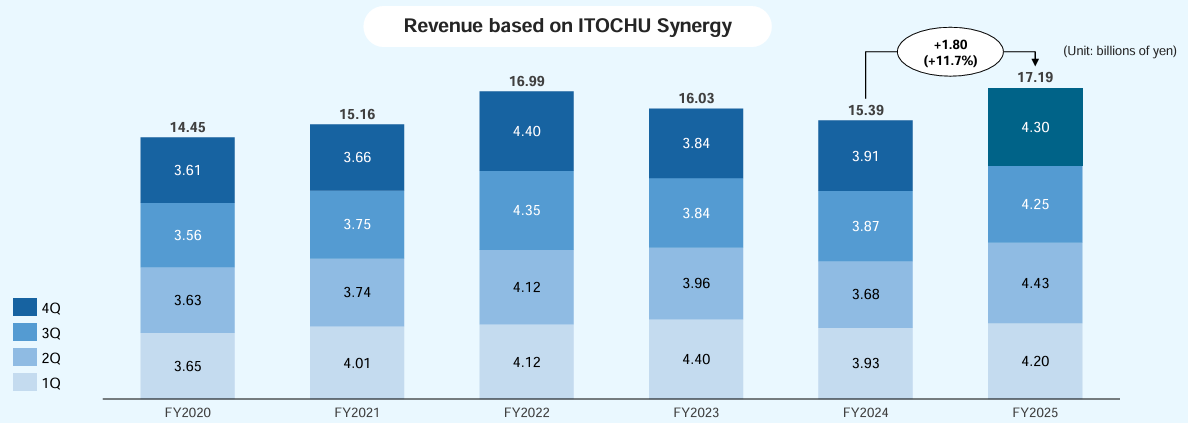
(From the company’s materials)
(3) Quarterly variations in the number of contact center booths, etc.
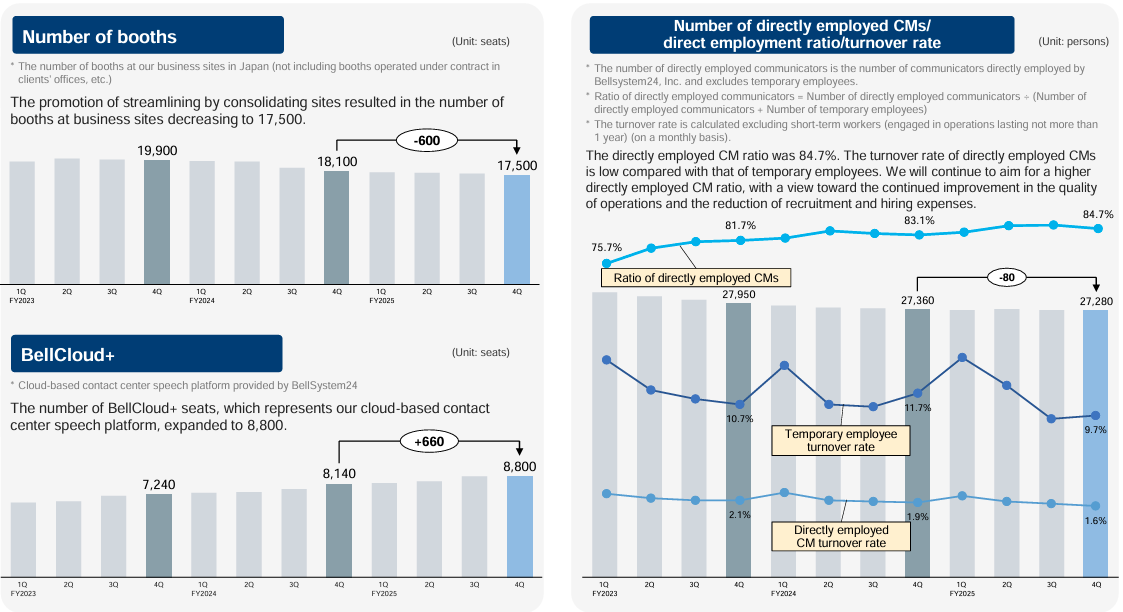
The company's strategic system, BellCloud+, a cloud-type contact center that serves as the base for DX utilizing voice data, equipped with functions necessary for contact center operations including voice recognition, emotion analysis, Chatbot, Voicebot, and remote work environments, saw a significant increase in the number of seats to 8,800, up 660 from the end of the previous fiscal year.
The company is promoting efficiency improvement by restructuring bases in response to the conclusion of COVID-related projects and the completion of large-scale projects. The number of booths at business sites has decreased by 600 from the end of the previous fiscal year to 17,500.
The retirement rate of directly employed communicators is lower than that of temporary workers, so they actively engage in recruitment in order to improve the quality of human capital further. As of the end of February 2026, the ratio of directly employed communicators was 84.7%.
(From the company’s materials)
[2-3 Financial condition and Cash Flow (CF)]
◎ Financial condition
| End of Feb. 2025 | End of Feb. 2026 | Increase/ decrease |
| End of Feb. 2025 | End of Feb. 2026 | Increase/ decrease |
Current assets | 28,042 | 29,717 | +1,675 | Current liabilities | 57,413 | 45,790 | -11,623 |
Cash and deposits | 6,992 | 7,194 | +202 | Trade debt | 5,634 | 5,820 | +186 |
Trade Receivables | 19,006 | 20,657 | +1,651 | Loans payable | 30,799 | 17,300 | -13,499 |
Noncurrent assets | 146,371 | 140,104 | -6,267 | Noncurrent liabilities | 46,163 | 49,249 | +3,086 |
Tangible assets | 31,563 | 25,556 | -6,007 | Long-term loans payable | 23,247 | 31,438 | +8,191 |
Goodwill | 94,651 | 94,669 | +18 | Total liabilities | 103,576 | 95,039 | -8,537 |
Total assets | 174,413 | 169,821 | -4,592 | Total capital | 70,837 | 74,782 | +3,945 |
|
|
|
| Equity capital(*) | 70,160 | 73,928 | +3,768 |
|
|
|
| Total loans payable | 54,046 | 48,738 | -5,308 |
*Unit: million yen. Equity capital is total equity attributable to owners of the parent.
Total assets decreased 4.5 billion yen from the end of the previous fiscal year due to decrease of tangible assets through the restructuring of business bases.
Total liabilities decreased 8.5 billion yen from the end of the previous fiscal year, as short and long-term loans payable shrank 5.3 billion yen. Total shareholders’ equity increased 3.9 billion yen from the end of the previous fiscal year due to an increase in retained earnings. Capital-to-asset ratio increased 3.3 points from the end of the previous term to 43.5%.
◎ Cash Flow
| FY 2/25 | FY 2/26 | Increase/ decrease |
Operating Cash Flow | 17,391 | 16,533 | -858 |
Investing Cash Flow | -3,693 | -571 | +3,122 |
Free Cash Flow | 13,698 | 15,962 | +2,264 |
Financing Cash Flow | -13,897 | -15,782 | -1,885 |
Cash and Equivalents at Term End | 6,992 | 7,194 | +202 |
*Unit: million yen.
The cash inflow from operating activities shrank from FY 2/2025 due to the increase in trade receivables, etc., but the expenditure for acquiring tangible fixed assets decreased, so the surplus of free cash flow expanded. The cash position remained almost unchanged.
[2-4 Topics]
(1) AI-related
①Launch of the “Hitotonari AI” Service: AI-Based Clarification of Customer Needs from Call Data
In April 2025, the company launched the ‘Hitotonari AI’ service, which uses AI to analyze the data on voices of customers (VOC), such as call records and chat logs, to clarify customer needs. The development of the service was initiated in response to the increasing difficulty in understanding customer needs following the enforcement of cookie regulations in 2023. The service integrates factual data such as purchase and behavioural records with unstructured data, including contact center interactions and sales meeting audio, under a customer ID. AI then analyzes the data to identify the reasons behind customer actions and predict future behaviours. Based on these insights, the system presents actionable recommendations that enable companies to promptly implement the most appropriate next steps for each customer, thereby supporting the expansion of loyal customers and improving customer lifetime value (LTV).
② Announcement of the next-generation contact center platform: the AI-powered CX platform ‘BellCloud+CX’
In March 2025, the company began offering “BellCloud+CX,” an AI-based cloud-based contact center platform, in collaboration with NICE Ltd., a global CX solutions provider, which has offered solutions to more than 25,000 companies across 150 countries. In addition to core features such as PBX, call recording, omnichannel support, and AI bots, BellCloud+CX incorporates advanced AI features, including speech recognition, conversation summarization, and multilingual translation. These functions enhance operator support and drive operational efficiency. In addition, the platform enables rapid contact center deployment using only a PC and the Internet, allowing organizations to start small and scale flexibly to large-scale operations as needed. It also provides customization to meet domestic operational requirements, along with operational consulting services, supporting optimal contact center management aligned with each company’s specific challenges and needs.
(2) Business Alliances
① Signed a business partnership agreement with AVILEN and Itochu Corporation to support the co-creation of AI agents
In December 2025, with a view to expanding its SB business, the company began offering comprehensive solutions ranging from business process reform to BPO, in partnership with AVILEN, a firm specialising in the bespoke development of AI agents and reskilling within the BPO sector, and Itochu Corporation. Currently, the company is promoting the automation of invoice processing operations at Nippon Access Co., Ltd., which handles food distribution for major convenience store chains and other clients. By combining Bell System 24’s “Business Process Reengineering (BPR) Consulting” and “Solution Operation Expertise” with AVILEN’s workforce of approximately 400 engineers and AI development capabilities, as well as the network of Itochu Group companies, they aim to contribute to solving client companies’ challenges through business process reform and the introduction of AI.
② Partnership with Alfresa Corporation to launch D-REACH, a contract-based information provision support service for pharmaceutical companies
In January 2026, the company signed a basic agreement with Alfresa Corporation to launch D-REACH, a contract-based information provision support service for pharmaceutical companies.
With face-to-face communication opportunities for medical representatives (MRs) decreasing due to restrictions on visits to healthcare facilities and reforms of doctors’ working practices, the two companies will combine their respective platforms and expertise to provide end-to-end support ranging from developing information provision plans tailored to doctors’ circumstances to delivering information via remote consultations. This contributes to improving productivity, optimizing costs, and enhancing the quality of information provided to pharmaceutical companies. The aim is to launch the full service in April 2027.
3. Fiscal Year ending February 2027 Earnings Forecasts
[3-1 Consolidated Earnings forecast]
| FY 2/26 | Ratio to sales | FY 2/27 Est. | Ratio to sales | YoY |
Sales revenue | 145,826 | 100.0% | 152,000 | 100.0% | +4.2% |
Gross profit | 27,517 | 18.9% | 29,000 | 19.1% | +5.4% |
SG&A expenses | 15,606 | 10.7% | 16,100 | 10.6% | +3.2% |
Operating income | 12,652 | 8.7% | 13,000 | 8.6% | +2.7% |
Income before Income Taxes | 12,290 | 8.4% | 12,600 | 8.3% | +2.5% |
Net income | 8,181 | 5.6% | 8,500 | 5.6% | +3.9% |
*Unit: million yen.
Sales and profit are forecast to increase.
Sales revenue is projected to be 152 billion yen, up 4.2% year on year. Both SC Operations and SB operations are expected to see an increase in sales. SB operations are forecast to see a double-digit revenue growth.
Operating income is projected to be 13 billion yen, up 2.7% year on year. Gross profit is expected to increase 5.4% year on year due to the effects of increased income from AI-related business (*HOL: described below), an increase in operational efficiency through ongoing efforts, and steadily passing on price increases to clients, although costs are significantly higher due to rising labor and other expenses caused by inflation. Gross profit margin is forecast to increase 0.2 points year on year. Selling, general, and administrative expenses are expected to increase 3.2% year on year due to the assumed increases in personnel expenses and costs for security-related measures against cyberattacks.
They plan to pay a dividend of 60.00 yen/share like in the previous fiscal year. The expected payout ratio is 52.5%. With a basic policy of maintaining the payout ratio at 50%, they aim to increase the dividend amount by growing profit.
[3-2 Revenue Breakdown]
| FY 2/26 | FY 2/27 Est. | YoY |
Sales revenue | 1,458.3 | 1,520.0 | +4.2% |
SC Operations | 1,251.6 | 1,290.0 | +3.1% |
SB Services | 206.7 | 230.0 | +11.3% |
*Unit: 100 million yen. SC operations refer to smart contact center operations, and SB services refer to smart business support services. Regarding other businesses, sales revenue declined due to the sale of some content businesses, so they were included in SC operations in FY 2/2027.
◎Smart Contact Center Operations
Sales are expected to grow. In addition to the meeting of demand for outsourcing due to the shortage of manpower, etc. and initiatives, such as M&A, the start of full-scale operations related to AI (Hybrid Operation Loop) will contribute.
◎Smart Business Support Services
Sales are projected to increase. In addition to the increase of operations for personnel affairs and accounting, the orders arising out of BPR consulting and new services, such as the utilization of AI based on the collaboration with AVILEN, will contribute.
4. Mid-Term Management Plan 2028
On April 8, 2026, the company announced its “Mid-Term Management Plan 2028” for the three-year period until the fiscal year ending February 2029.
【4-1 Review of the previous plan (Medium-Term Management Plan 2025)】
(1)Qualitative Aspects
In the area of “human resources,” in which they aim to maximize the activities of a total of 40,000 employees of the corporate group, the company began operating an AI-powered “job-matching recruitment model.” Furthermore, it produced good results such as improving reskilling support by developing career map systems and training programs, and acquiring various certifications through diversification. These initiatives also helped increase employee retention rates.
As part of its “standardization” efforts, the company announced the launch of “BellCloud+CX,” a contact center platform equipped with generative AI, and began development of “Hybrid Operation Loop (HOL),” a system designed to automate contact centers. In collaboration with THINKER Inc., it also began providing the “Hitotonari AI” service, which infers customer needs based on VOC data, reaching a milestone in the advancement of data utilization.
In the area of “co-creation,” which is aimed at pioneering new BPO domains through collaboration with external partners, the company launched a participation program for user companies, along with the Generative AI Co-Creation Lab. The company also expanded the business of Horizon One, a platform that offers BPO services in the accounting and HR sectors, and made efforts to expand into new domains through co-creation with partner companies in sectors such as local governments, primary industries, and healthcare. The company made progress in reducing its dependence on contact center operations.
(Quantitative aspects)
For the fiscal year ended February 2026, the company aimed to achieve “a sales revenue of 180 billion yen, an operating income of 16.5 billion yen, and an operating income margin of 9.2%.” The actual results were “a sales revenue of 145.8 billion yen, an operating income of 12.7 billion yen, and an operating income margin of 8.7%.”
This was mostly owing to the fact that M&A did not progress as planned, and conventional simple telephone support services were sluggish. On the other hand, next growth opportunities became evident, such as the progress of business base restructuring and the focus on generative AI.
【4-2 Mid-Term Management Plan 2028】
(1) Business Environment
With worsening labor shortages and skyrocketing labor expenses brought on by a shrinking working population and the lingering rise in costs due to foreign economic trends, exchange rate fluctuations, etc., the business environment surrounding the companies remains challenging. At the same time, rapid technological advancements, including generative AI and AI agents, are driving a swift transformation of industrial structures, and these innovations are expected to help address these challenges.
The outsourcing of business processes is indispensable for companies to focus their management resources on their core business to increase their competitiveness, and the market for business process outsourcing services is growing and diversifying. Nonetheless, the company believes there is a substantial market opportunity due to the low percentage of business process outsourcing in Japan.
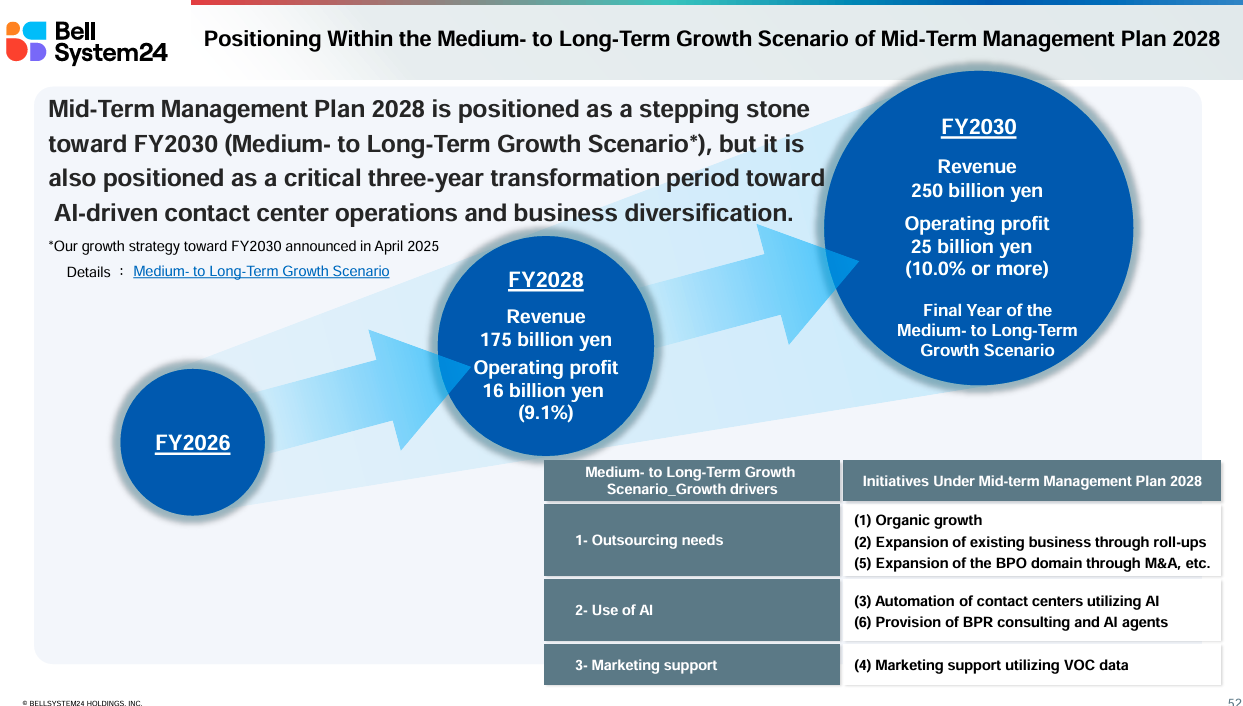
(2)Positioning the Mid-Term Management Plan 2028 in the Medium/Long-Term Growth Scenario
While the Mid-Term Management Plan 2028 serves as a checkpoint toward the fiscal year ending February 2031, as outlined in the Medium/Long-Term Growth Scenario (see Reference 1), the company positions these three years as a critical turning point for transitioning to AI-driven contact center operations and business diversification.
(From the company’s materials)
(1)Responsibilities and Philosophy of the Company
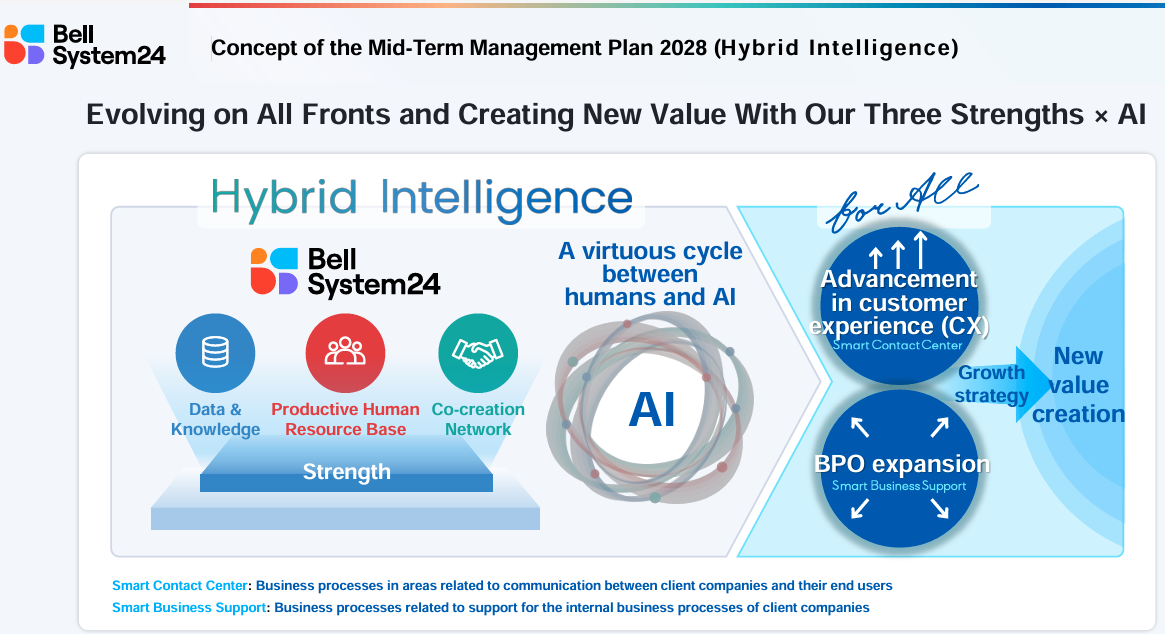
In order to meet the social needs in the AI era in this business environment, the company considers that their duty is to apply AI to its distinctive capabilities, that is, “Data & Knowledge,” “Base for Enabling Personnel to Flourish,” and “Co-creation Network.”
The company's Mid-Term Management Plan 2028 lists “CX Advancement” and “BPO Expansion” as growth initiatives under the statement “Evolving all businesses through a virtuous cycle of people and AI—Hybrid Intelligence for All,” and it is dedicated to creating new value.
(From the company’s materials)
(4)Three Key Initiatives to Promote Growth Strategies
Building on the company's distinctive capabilities, that is, “Data & Knowledge,” “Base for Enabling Personnel to Flourish,” and “Co-creation Network,” the company will promote three key initiatives: 1. Promoting Data Utilization, 2. Maximizing Human Value, and 3. Increasing Partners, with the aim of advancing “CX Advancement” and “BPO Expansion.”
①Promoting Data Utilization
The company will leverage its unparalleled assets, that is, 500 million dialogue records, the know-how to operate contact centers for over 40 years, and a track record of working with more than 1,500 companies, the company will transform specialized operational insights into knowledge data and use AI to evolve them into new business value.
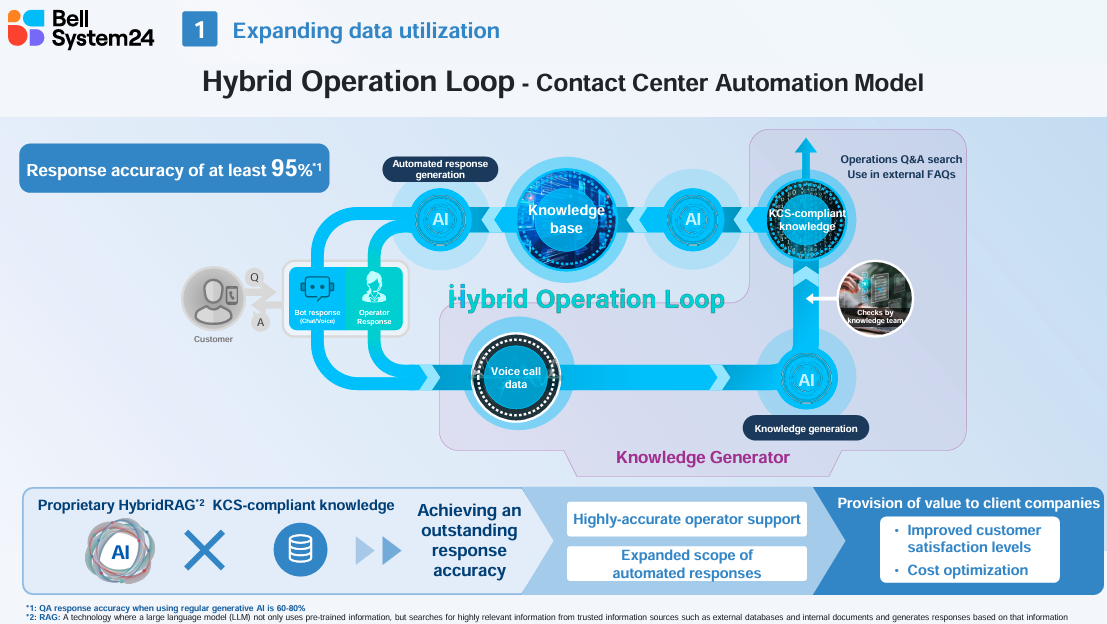
Key roles are played by the “Hybrid Operation Loop (HOL),” a contact center automation model, and the “AI-Collaborative BPO” model, which handles everything, including the adoption of AI, development, deployment, and operation.
◎ Overview of Hybrid Operation Loop (HOL)
This proprietary automation solution, developed by the company, incorporates generative AI specialized in automatically generating replies and knowledge, enabling the automatic creation of a knowledge base from call data.
In November 2025, the development of “Knowledge Generator” was completed as the first solution in a series that focuses on a specific part of the process. The “Knowledge Generator” is a proprietary technology that automatically generates highly accurate knowledge from call recording data in accordance with the “KCS (Knowledge Center Service),” the global standard for knowledge generation.
Prior to the provision of “Knowledge Generator” across the entire “Hybrid Operation Loop,” it has been incorporated into the company's knowledge management consulting services and made available to clients. Previously, compiling KCS-compliant knowledge from call recording data required a tremendous amount of time, but it has been substantially streamlined and expedited. “Knowledge Generator” has been tested in demonstration experiments with several companies, including major life insurance companies, to confirm its accuracy in anticipation of practical use.
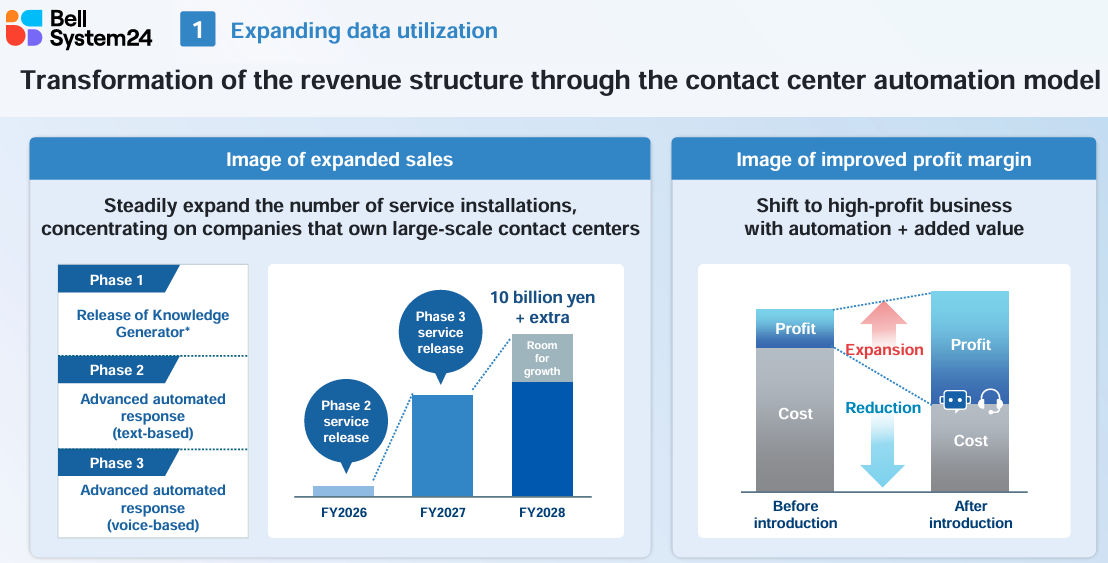
Following the release of “Knowledge Generator,” the company plans to release advanced text- and voice-based automated responses as its second and third releases, respectively. By steadily expanding the number of clients adopting their service, mainly companies with large-scale contact centers, the company is expected to earn sales of over 10 billion yen in the fiscal year ending February 2029. Furthermore, it expects to significantly improve profitability through automation and the addition of high value.
 |
 |
(From the company’s materials)
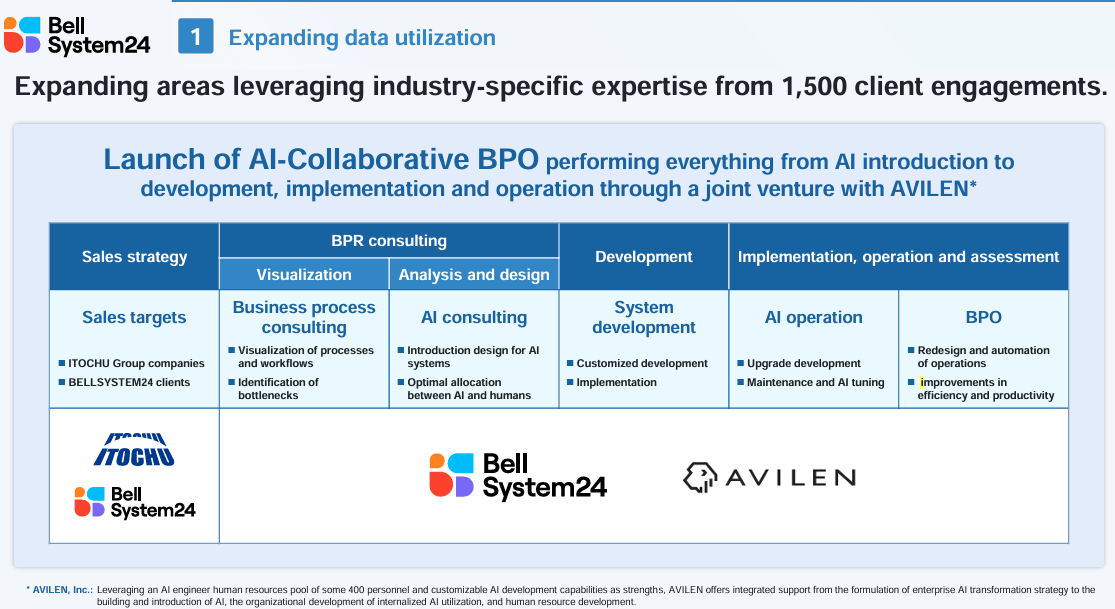
◎ Overview of AI-Collaborative BPO Model
In December 2025, BELLSYSTEM24, Inc., AVILEN, Inc., and Itochu Corporation entered into a business partnership agreement to not merely introduce AI solutions or provide partial support, but also offer optimal support tailored to the business process and challenges in each company. They started offering comprehensive solutions that include the custom development and implementation of AI agents, reskilling of human resources specializing in AI, and business process outsourcing (BPO).
This solution was developed in collaboration with companies that are considering adopting AI agents and generative AI. While paying close attention to on-the-ground challenges, experts in a variety of sectors, such as business process reform, AI utilization, and BPO collaborate to create a project system and implement the successful and efficient introduction of AI agents.
The company aims to achieve good results at both the executive and operational levels by combining BELLSYSTEM24’s knowledge and operation know-how of business process transformation consulting, AVILEN's strength of a human resource pool of approximately 400 engineers and AI development capabilities, and ITOCHU's network to support digital transformation of companies.
In March 2026, with the aim of further enhancing the benefits of the above business alliance, BELLSYSTEM24 and AVILEN established a joint venture, “BA Intelligence Inc.,” to build a BPO model incorporating AI agents for corporate back-office operations. By integrating BELLSYSTEM24’s “operation” capabilities with AVILEN’s “development” capabilities, the company supports the adoption of AI tailored to each client’s specific operational needs through a highly agile and cost-efficient “AI-Collaborative BPO” model.
The company aims to expand the scope of business process outsourcing services by leveraging the specialized business knowledge of each industry possessed by BELLSYSTEM24, which receives orders from more than 1,500 clients annually.
(From the company’s materials)
②Maximizing Human Value
The company aims to establish a system that brings out the potential of all employees to the maximum degree and expand high value-added services that are unique to human capabilities.
◎ Expanding high value-added services unique to human capabilities
The company will pursue creativity in areas in which only humans can excel, such as empathetic understanding of customers' emotions, advanced consulting, and making judgments in unfamiliar situations.
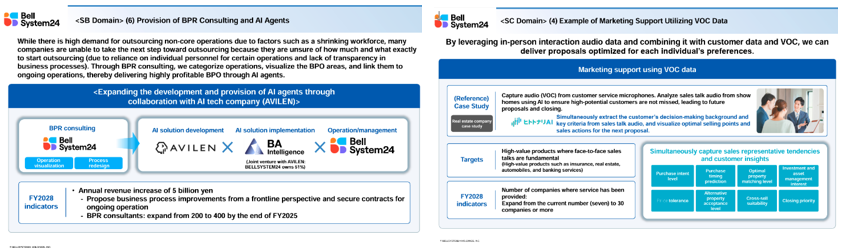
Specifically, the company will enhance its proposal capabilities through its proprietary business improvement methodology in BPR consulting. By the fiscal year ending February 2029, it plans to expand its BPR consulting team from the current approximately 200 members to 400.
Through AI cooperation, the company is also attempting to improve its marketing support capabilities. The company hopes to turn individualized client insights into revenue development by utilizing “Hitotonari AI,” an AI engine for understanding customers provided in collaboration with its subsidiary THINKER. It has set a target of installing Hitotonari AI in 30 companies by the fiscal year ending February 2029.
(From the company’s materials)
③Increasing Partners
In order to co-create new intellectual values, the company will strengthen and widen its network of alliances.
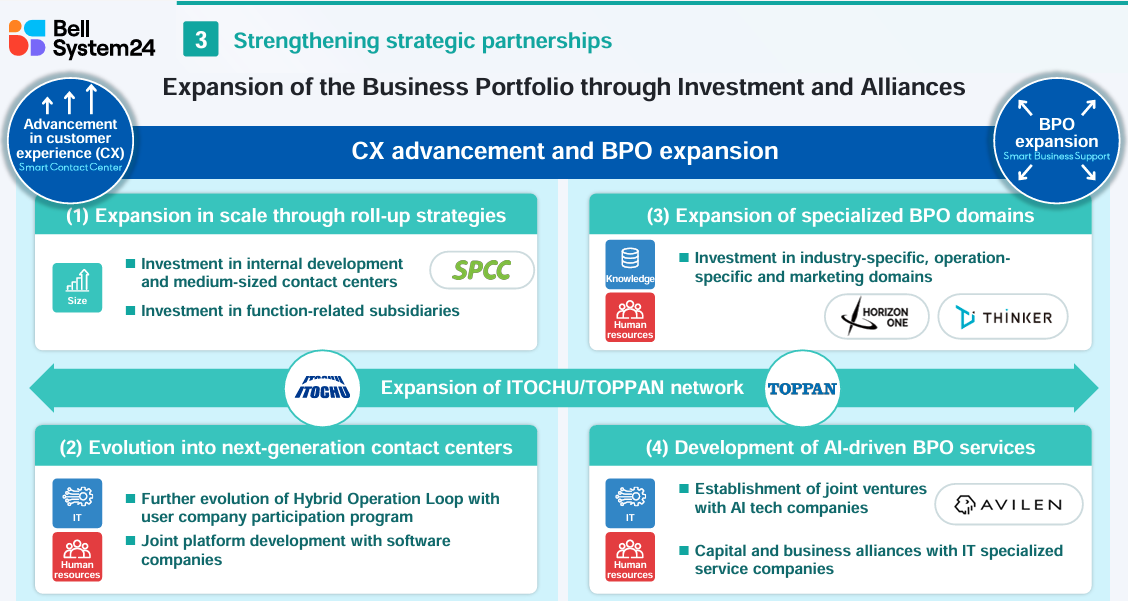
The company will promote “CX Advancement” and “BPO Expansion” through four key initiatives: 1. To expand the scale through the rollup strategy; 2. To evolve into a next-generation contact center; 3. To expand the specialized business process outsourcing area; and 4. To establish AI-powered business process outsourcing services.
(From the company’s materials)
Specific Measures
①To expand the scale through the rollup strategy
*The rollup strategy for in-house contact centers
The company will increase its investment in its in-house contact centers and work with client companies to rapidly enhance the automation and efficiency of contact centers, using the acquisition of SKY Perfect Customer-relations Corporation (SPCC) as a subsidiary as a model case.
*Investment in functional subsidiaries
By investing in functional subsidiaries of client companies that handle all group operations and introducing their processes, the company will develop CoE (*).
* CoE:An organization inside a company that, by integrating human resources and technologies with specialized knowledge in one location, fosters creativity and operational efficiency throughout the entire organization.
②To evolve into a next-generation contact center
The company will promote hands-on support across various industries to facilitate the adoption of generative AI in contact centers. It will further evolve its previously described “Hybrid Operation Loop (HOL),” a proprietary automation model for contact centers.
The company aims to achieve contact center automation across all industries by implementing and validating it at businesses in different sectors.
③To expand the specialized business process outsourcing area
*Investment in industry-specific business process outsourcing companies
By investing in industry-specific business process outsourcing companies, mainly in the construction, manufacturing/retail, and pharmaceutical/medical industries, the company aims to leverage their industry-specific expertise and networks to expand its BPO market share in each sector.
*M&A and establishment of JVs with companies specializing in specialized operations
The company plans to establish joint ventures like Horizon One Corporation (*) with companies specializing in specialized operations to expand its scale by providing comprehensive services ranging from strategy formulation to operations. It aims to acquire and leverage expertise in business transformation within back-office areas such as human resources, accounting, and general affairs.
* Horizon One Corporation:As a joint venture with Layers Consulting Co., Ltd., it undertakes business processes and offers various consulting services, and human resources support services in the fields of human resources development and accounting.
④To establish AI-powered services of undertaking business processes
As demonstrated by the AVILEN and CTC cases, the company will strengthen its system for development of automation and sophistication solutions through capital and business alliances with AI technology firms, thereby accelerating the development of knowledge-based services and expanding its customer base.
(5) Quantitative targets
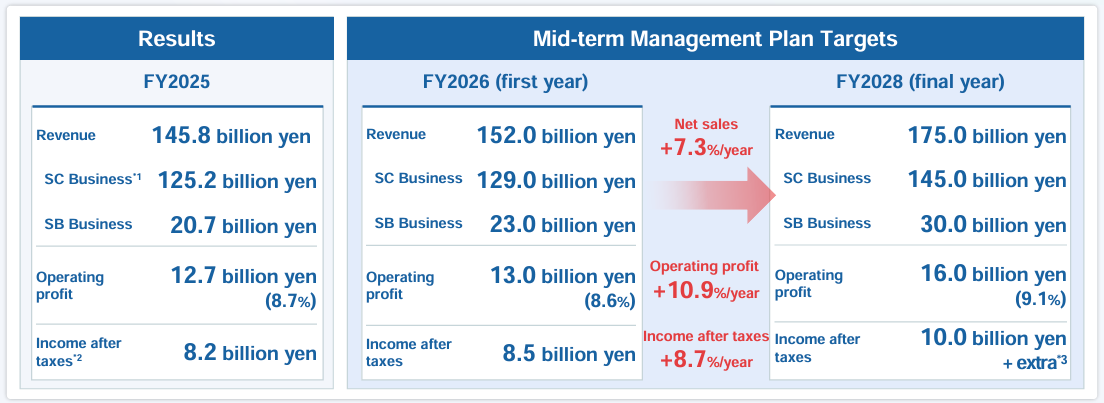
① Company-wide
The targets for the fiscal year ending February 2029 are “a sales revenue of 175 billion yen, an operating income of 16 billion yen, and an after-tax profit of 10 billion yen + extra.”
“+ extra” reflects the potential impact from the adoption of generative AI.
(From the company’s materials)
The company plans to allocate 25 billion yen to carry out the previously mentioned three key initiatives as part of its strategic investments for growth over the next three years: To promote data utilization (Investments related to generative AI), to maximize human value (Investment in human resources development), and to increase partners (Investment in M&A and business ventures).
The company aims for a dividend payout ratio of 50% as part of its shareholder return policy.
② Initiatives and Targets in SC and SB Business Areas
Initiatives and targets in SC and SB business areas are as follows:
◎ SC Business Areas
The sales revenue in the fiscal year ended in February 2026 was 125.2 billion yen. The company is aiming to increase it by 20 billion yen to 145 billion yen in the fiscal year ending February 2029.
The 20 billion yen increase is divided int (1) organic growth: 5 billion yen; (2) expansion of existing businesses through the rollup strategy: 5 billion yen; (3) AI-powered contact center automation; and (4) marketing support using VOC dat 10 billion yen.
Initiative | Specific Measures | Quantitative Targets: Fiscal year ending February 2029 |
(1)Organic growth | Implementing in-house contact center operations | ・Annual revenue growth of 5 billion yen ・Increase the number of client companies from the current approximately 1,700 to over 2,000 |
(2)Expansion of existing businesses through the rollup strategy | Expanding business scale through the rollup strategy (mass production of the SKY Perfect Customer-relations Corporation’s model) | ・Annual revenue growth of 5 billion yen ・Projected investment of 10 billion yen by the end of fiscal year 2028 |
(3)AI-powered contact center automation (On-Site implementation of the Hybrid Operation Loop) | The target companies are those with large-scale contact centers in big industries such as finance, telecommunications, and energy. By the end of 2026, they will develop knowledge from actual call records (STEP 1) (Knowledge Generator) and implement a feature (STEP 2) where AI provides operators with possible responses to customer inquiries. Automated dialogue response system (STEP3) will be introduced in the spring of 2027. | They aim to achieve a sales revenue of 10 billion yen, make their services adopted by 50-60 companies, and a gross profit margin approximately double that of conventional contact center operations.
Sales revenue may exceed the forecast if initiatives to automate contact centers using AI progress more than anticipated. The reduction of labor costs, which account for more than 80% of the total cost, will make a major contribution to the improvement of gross profit margin. The company's enormous efficiency improvement will entice clients to switch from competitors to the company in projects where work is shared with other outsourcees. |
(4)Marketing support using VOC data (Utilizing the “Hitotonari AI,” a customer understanding AI engine) | Target companies are those that use in-person sales meetings to handle expensive goods and services (including insurance, real estate, automobiles, and bank counters) | Expanding the number of companies using the service from the current seven to over thirty |
(The company's projections)
Although some have claimed that “the emergence of AI is a headwind for contact center operators,” the company sees it as a significant business opportunity because “there are limits to how far AI alone can respond to inquiries from end users based solely on information found on the Internet”; “by leveraging AI, contact centers are expected to continue to play central roles in responding to inquiries from end users”; and “with the exception of some advanced companies, many companies find it difficult to utilize AI on their own due to limitations on their technological and financial capabilities.”
The company aims to evolve from a conventional “outsourcee” to a corporate “strategic partner” by leveraging its ability to rapidly convert voice data into knowledge data using AI.
◎ SB Business Areas
The company's revenue for the fiscal year ended February 2026 was 20.7 billion yen. It aims to increase it by 10 billion yen to 30 billion yen for the fiscal year ending February 2029.
The 10 billion yen increase is divided int (1) expanding the business process outsourcing business area through M&A (5 billion yen); and (2) providing BPR consulting and AI agents (5 billion yen.)
Initiative | Specific Measures | Quantitative Targets: Fiscal year ending February 2029 |
(1)Expanding the BPO business area through M&A | ・Conducting M&A and establishing JVs in collaboration with industry-specific outsourcees, targeting sectors such as finance/insurance, telecommunications, construction, manufacturing, wholesale/retail, and pharmaceuticals/healthcare
・Collaborating with specialized outsourcees, such as those focused on HR/accounting, procurement, and sales support, to carry out M&A and JV establishments. | ・Annual revenue increase of 5 billion yen through M&A ・Plan to invest 10 billion yen by the end of fiscal year 2028 |
(2)Providing BPR consulting and AI agents | Expanding the development and provision of AI agents through partnership with AI tech company (AVILEN) | ・To increase annual revenue by 5 billion yen by securing orders for business process improvements from a frontline perspective and their continuous implementation. Increasing the number of BPR consultants from 200 at the end of fiscal 2025 to 400. |
(The company's projections)
The domestic BPO market, whose scale is expected to exceed 5 trillion yen, is expanding, driven by constraints in recruiting staff internally due to a severe labor shortage and the growing need to improve operational efficiency through digital technologies as DX accelerates. By focusing on industry-specific BPO, specialized BPO, and contact center-related BPO areas—excluding IT infrastructure—the company hopes to build its business through its own growth model, which is estimated to be worth 1.6 trillion yen at a 2.5% annual growth rate.
5. Conclusions
For the SC business that accounts for over 80% of sales revenue, they aim to increase sales by 20 billion yen to 145 billion yen between the fiscal year ended February 2026 and the fiscal year ending February 2029. The most important part in this initiative is the AI-based automation of contact centers. There are concerns that contact center operators can experience adversity due to the emergence of AI, but AI alone has limitations in responding to end users based solely on information available on the Internet. Many companies, excluding some advanced enterprises, face constraints in terms of technical capabilities and financial resources, and are unable to utilize AI on their own. It is anticipated that these companies will continue to outsource contact center operations and they view it as a major business opportunity.
Hybrid Operation Loop (HOL) they developed plays a key role here. This is equipped with technologies and systems for automatically producing a knowledge base from telephone response data with the generative AI specializing in the automatic production of replies and the generative AI specializing in the automatic production of knowledge. Phase 1 for HOL, that is, to develop a knowledge generator, was finished. As Phases 2 and 3, they plan to release advanced automated response based on text and advanced automated response based on voice, respectively. By steadily expanding the number of service users, mainly companies that own large-scale contact centers, they aim to achieve a sales revenue of 10 billion yen, have their service adopted by 50-60 companies, and make gross profit margin about two times higher than that of the conventional contact center operation. A significant improvement in profitability is expected due to not only scale expansion, but also automation and addition of high value. We would like to keep an eye on the advance of HOL, which is indispensable for the company to evolve from a conventional “outsourcee” into a “strategic partner.”
<Reference1: Medium- to Long-Term Growth Scenario>
The market environment surrounding the company is changing dramatically with the emergence and rapid evolution of generative AI, but the company has set forth the following medium/long-term growth scenario to ensure sustainable growth by leveraging its strengths and competitive advantages.
[1 Changes in the Business Environment and the Company’s Current Situation]
(1) Changes in the Business Environment
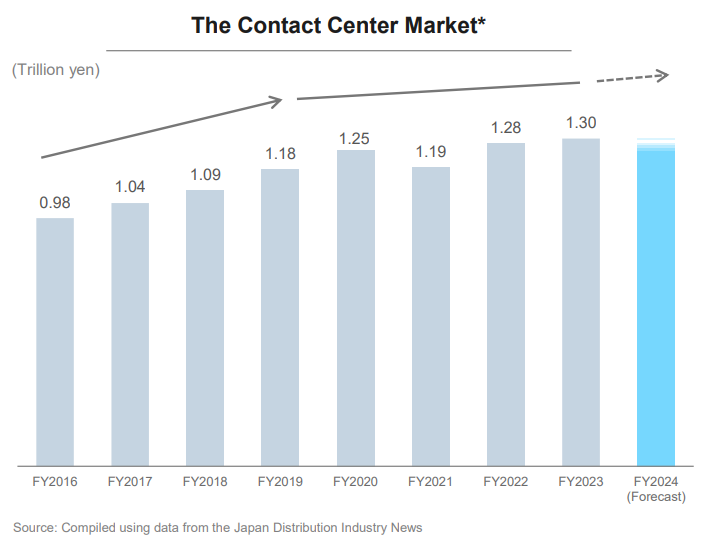
The market for contact centers has seen its CAGR (compound annual growth rate) drop from around 6% and remain around 2% from FY 2019.
(CAGR calculated by Investment Bridge based on the company’s reference material)
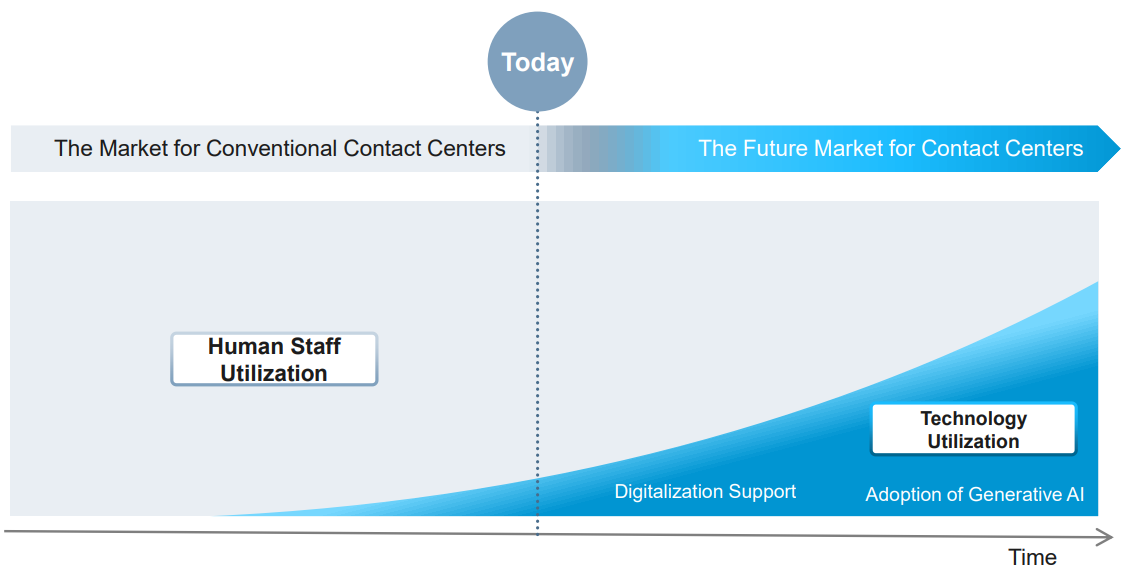
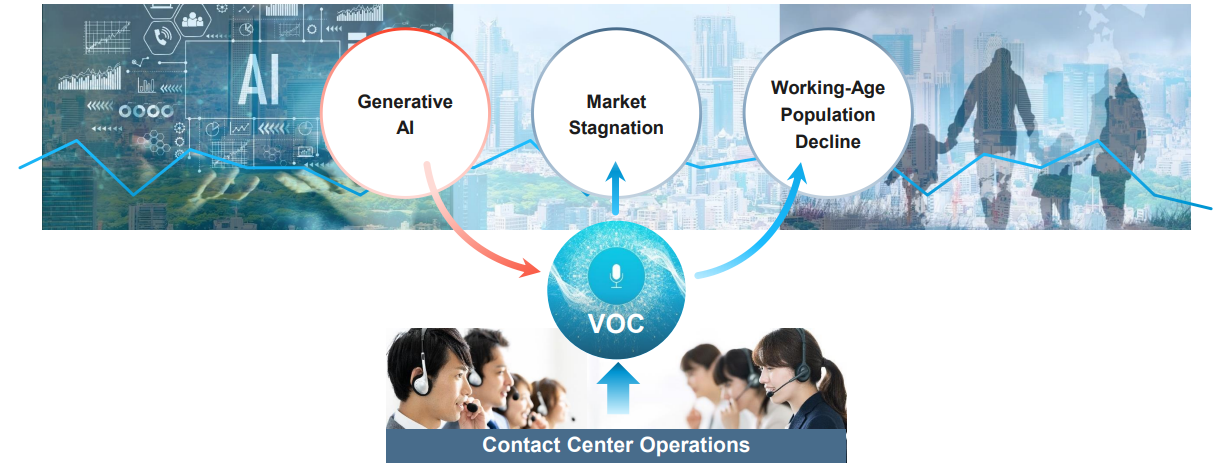
In the wake of the COVID-19 pandemic, digitization has accelerated, prompting a shift in contact centers from human-centric operations to technology-driven systems. As digital transformation and the adoption of AI continue to advance, conventional contact centers that rely primarily on human staff-operated telephone support are expected to face increasing challenges.
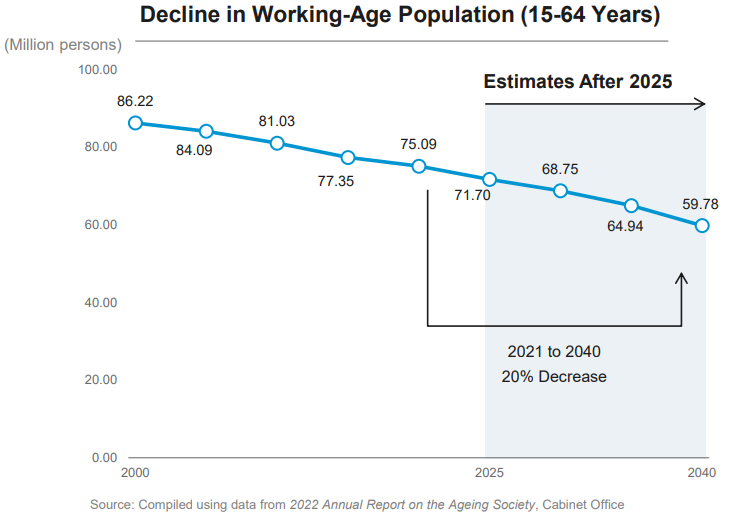
Moreover, Japan’s shrinking working-age population is intensifying the insufficiency of manpower in certain industries and contact center operators are likely to face growing difficulties in securing sufficient human resources in the future.
 |
 |
 |
(From the company’s reference material)
(2) Current Situation and Future Outlook of the Company
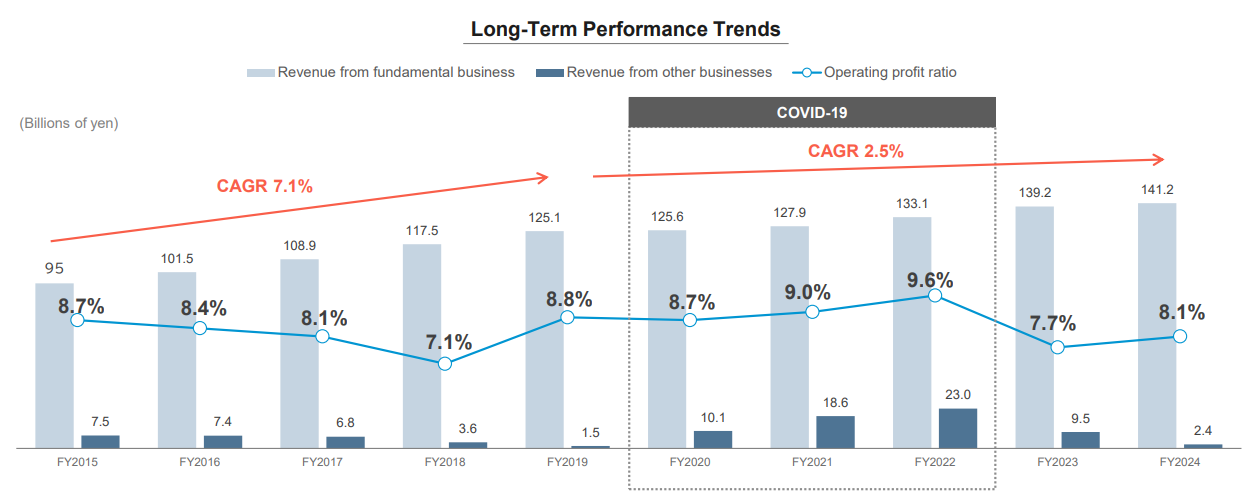
Amid these major changes in the business environment, the company’s growth rate has slowed since the COVID-19 pandemic, and since FY 2019, the average annual growth rate of sales revenue from basic operations, excluding operations related to national policies for COVID-19, has dropped to 2.5%, down from 7.1% before the COVID-19 pandemic.
Although operating income margin had been well above 8% since FY 2019, it fell to the 7% range in FY 2023, and the improvement in profit margin was limited in FY 2024 as well.
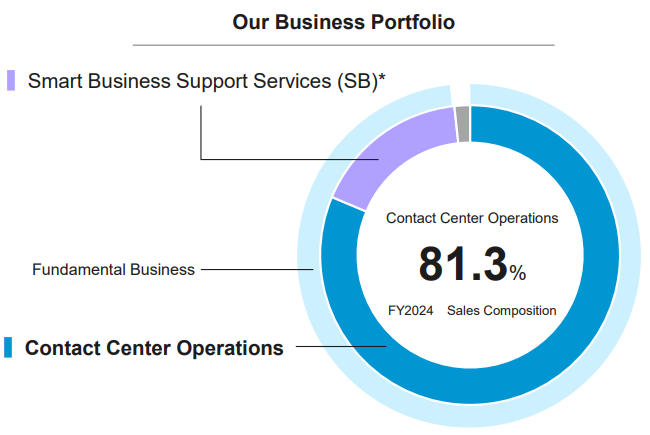
Contact center operations account for 80% of the company’s business portfolio, and the aforementioned stagnation in the contact center market is a concern for future growth.
Under these circumstances, the company aims to expand its business by utilizing generative AI and creating more added value through the use of VOC (Voice of Customer).
 |
 |
 |
(From the company’s materials)
[2 Policy for Responding to the Changing Business Environment]
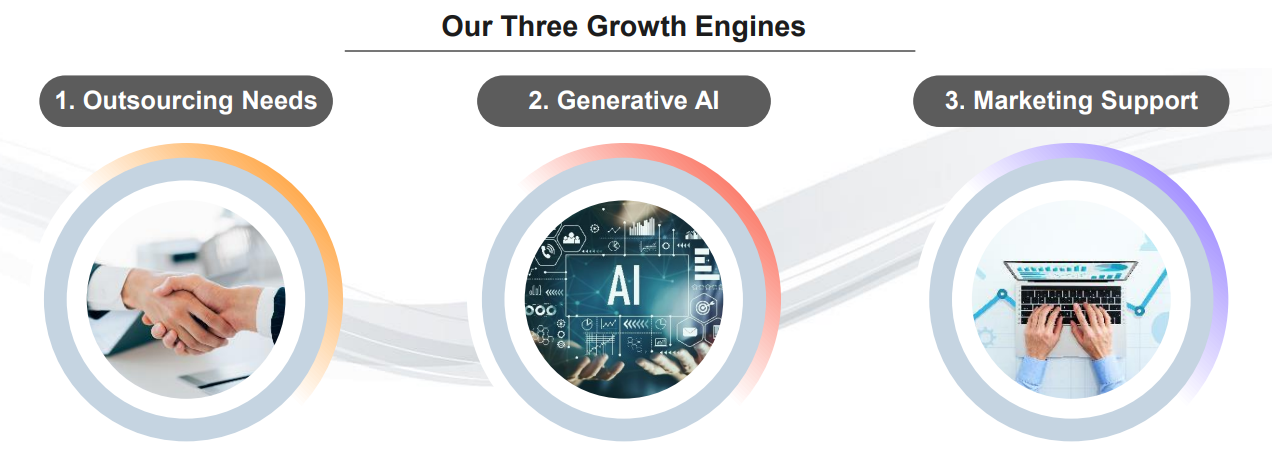
In the market environment mentioned above, the company has positioned “(1) Meeting outsourcing needs,” “(2) Utilizing generative AI,” and “(3) Marketing support” as three growth drivers. The company will pursue growth by leveraging its strengths in each of these drivers.
(From the company’s reference material)
(1) Meeting outsourcing needs
(Overview)
Companies that operate contact centers in-house will find it difficult to find personnel and will assign their limited staff to core operations. As a result, it will become more difficult for them to respond to inquiries about their company’s services and products, and it is expected that in-house contact center operations will be outsourced.
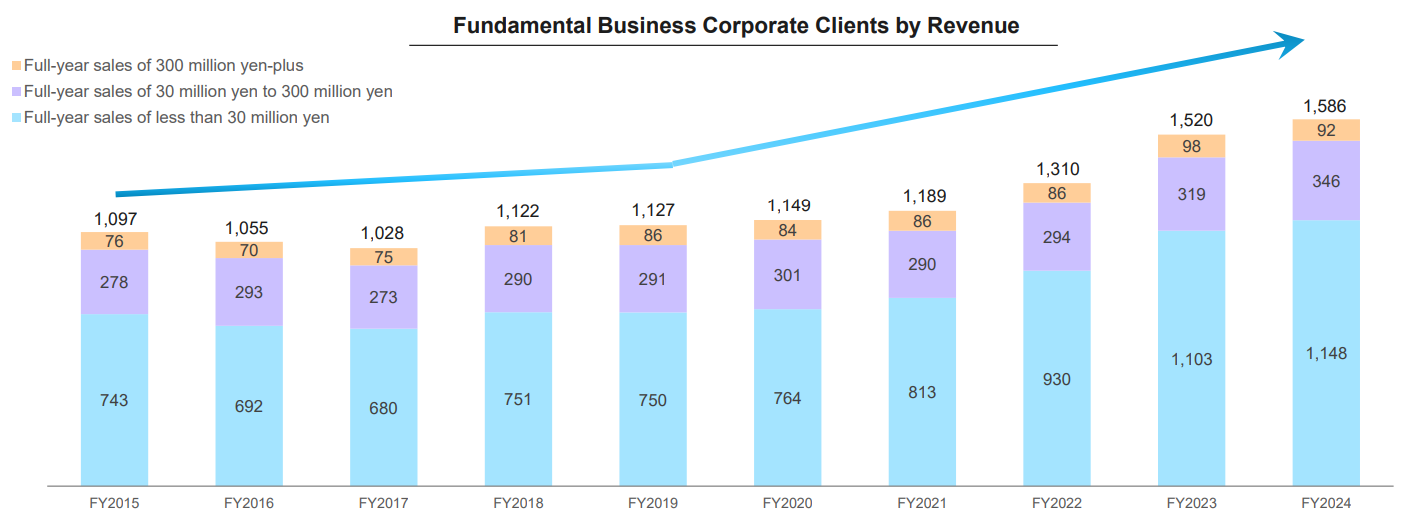
The need for outsourcing has already become apparent. The number of client companies for the company’s basic operations has expanded from 1,097 in FY 2015 to 1,586 in FY 2024. The increase is particularly noticeable in the middle and lower tiers in terms of transaction amount.
The company estimates the scale of the in-house contact center market to be 1.4 trillion yen.
(From the company’s reference material)
(The company’s strengths)
With a workforce of 30,000 operators, the company is well-positioned to accommodate future growth in the number of client companies. Over the 40 years since its establishment, it has accumulated extensive expertise in contact center operations across a wide range of industries and business sectors, enabling it to provide operational support irrespective of industry type.
A key strength of the company lies in its standardized methodology, which involves systematizing and documenting operational procedures to eliminate individual dependency and establishing a framework in which consistent performance can be achieved regardless of the personnel involved.
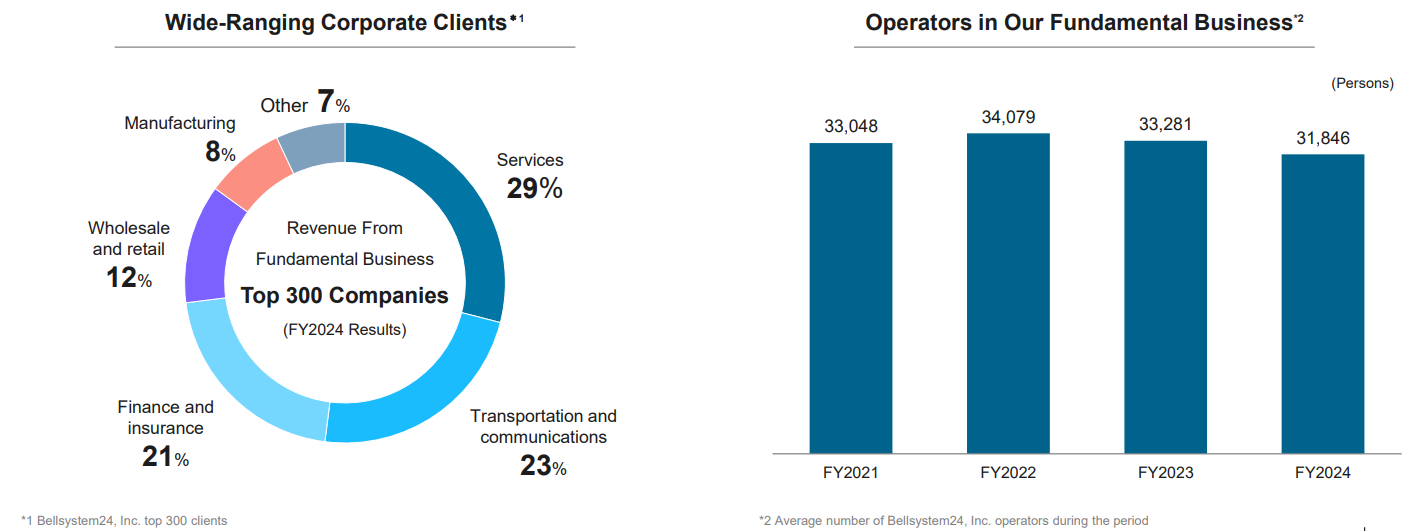
(From the company’s reference material)
(Targets and specific initiatives)
The company will aggressively pursue new projects, aiming to have 2,500 client companies by FY 2030.
Specific initiatives are as follows:
・ | Over the past four years, they have held over 130 webinars on the latest information and services, with a cumulative total of over 10,000 participants. They will continue to increase opportunities to disseminate information and raise corporate recognition. |
・ | In January 2025, the company acquired SKY Perfect Customer-relations Corporation (SPCC) as a subsidiary and will promote such equity carve-outs and roll-up strategies (continuously acquiring companies in the same industry) to acquire contact center outsourcers. |
・ | Utilizing the networks of major shareholders such as ITOCHU Corporation and TOPPAN Inc., as well as their group companies, the company will acquire contact center projects and clients for smart business support services (SB) from a wide range of industries and business types. |
・ | Utilizing the “standardized methodology,” the company will take on non-core operations such as accounting, human resources, and back office operations for client companies. By expanding operations for smart business support services (SB), in addition to contact center operations, the company will aim to expand the scale of transactions per client company through cross-selling and up-selling. |
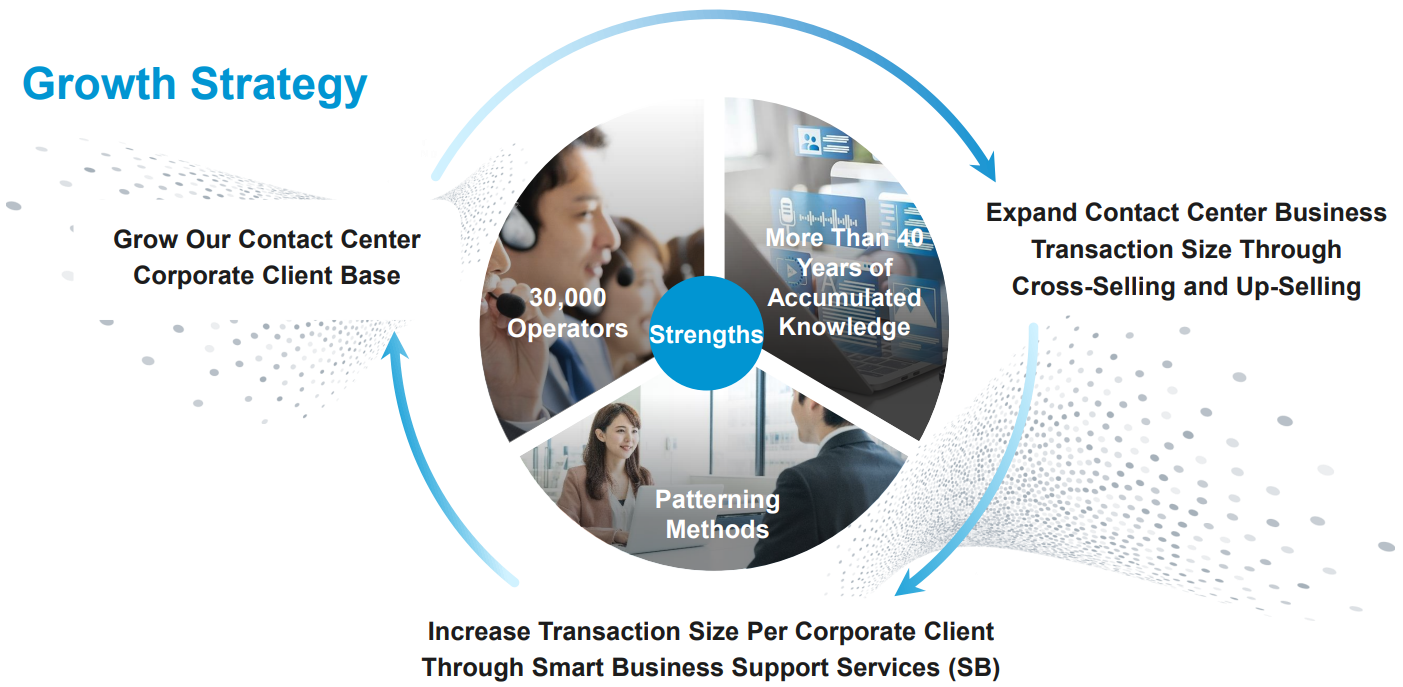
(From the company’s reference material)
(2) Utilizing Generative AI
(Overview)
In conventional contact center operations handled by human operators, although the operators are highly skilled, there are inherent limitations to their processing capacity, and the emergence of generative AI is often perceived as a threat.
In contrast, the company views generative AI not as a threat, but as a key enabler for realizing next-generation contact centers with dramatically enhanced processing capabilities.
The next-generation contact center envisioned by the company is one in which generative AI automatically handles inquiries, with human operators responding only to cases that cannot be addressed by AI.
Compared to conventional contact centers staffed by human operators, this model is expected to reduce operational costs. Furthermore, by capturing demand for outsourcing as previously mentioned and expanding the number of client companies, the company anticipates a significant increase in its profit areas and a substantial improvement in profit margin.
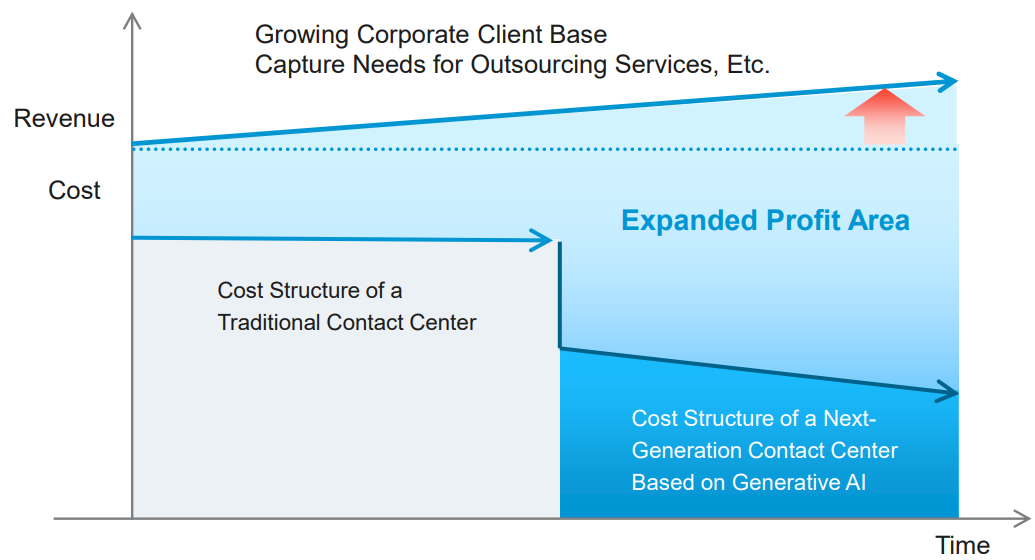
(From the company’s reference material)
(The company’s strengths)
However, building a next-generation contact center using generative AI requires more than simply adopting an advanced and capable AI solution. It also demands vast volumes of high-quality data tailored to the specific inquiries of individual client companies, rather than general knowledge.
The company has a wealth of insights derived from a massive amount of data (VOC), comprising 500 million annual calls handled by its 30,000 operators, and believes that this will add significant value to our client companies.
Extracting, collecting, and analyzing the real voices of users, many of whom pose vague or ambiguous inquiries, is a process that only highly skilled human operators can perform. Identifying root causes through these human interactions is essential to resolving issues and improving customer satisfaction, making it a core function of contact center operations.
Leveraging the vast call data, the company is capable of using the root cause analysis process as training data for generative AI, thereby constructing a high-precision, high-quality knowledge database.
(Targets and specific initiatives)
The company aims to realize a next-generation contact center powered by generative AI at an early stage.
A key process in achieving this goal is the transformation of operational knowledge into a “knowledge service” through the use of generative AI.
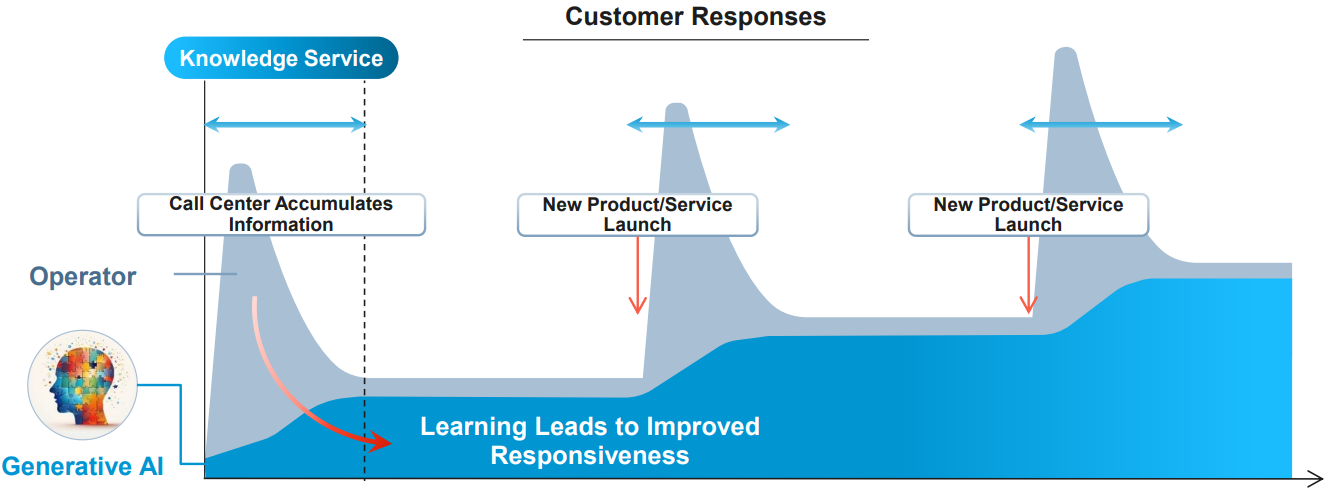
When launching new services or products, generative AI initially lacks sufficient pre-trained knowledge, making it difficult to respond accurately despite a surge in customer inquiries. To address this, the company is promoting the early development of its AI by rapidly and efficiently accumulating the necessary training data (knowledge) through interactions handled by its 30,000 operators. This initiative is referred to by the company as the “Knowledge Service.”
In the Knowledge Service model, human operator involvement accounts for a significant portion of the process during the initial implementation of generative AI. As AI training progresses, this reliance gradually decreases. However, with each launch of a new service or product, it becomes necessary to collect new knowledge once again. Early data collection and effective training of generative AI requires a large number of highly adaptable operators capable of responding flexibly to diverse inquiries. As such, the company’s Knowledge Service plays an essential role in the successful operation of contact centers powered by generative AI.
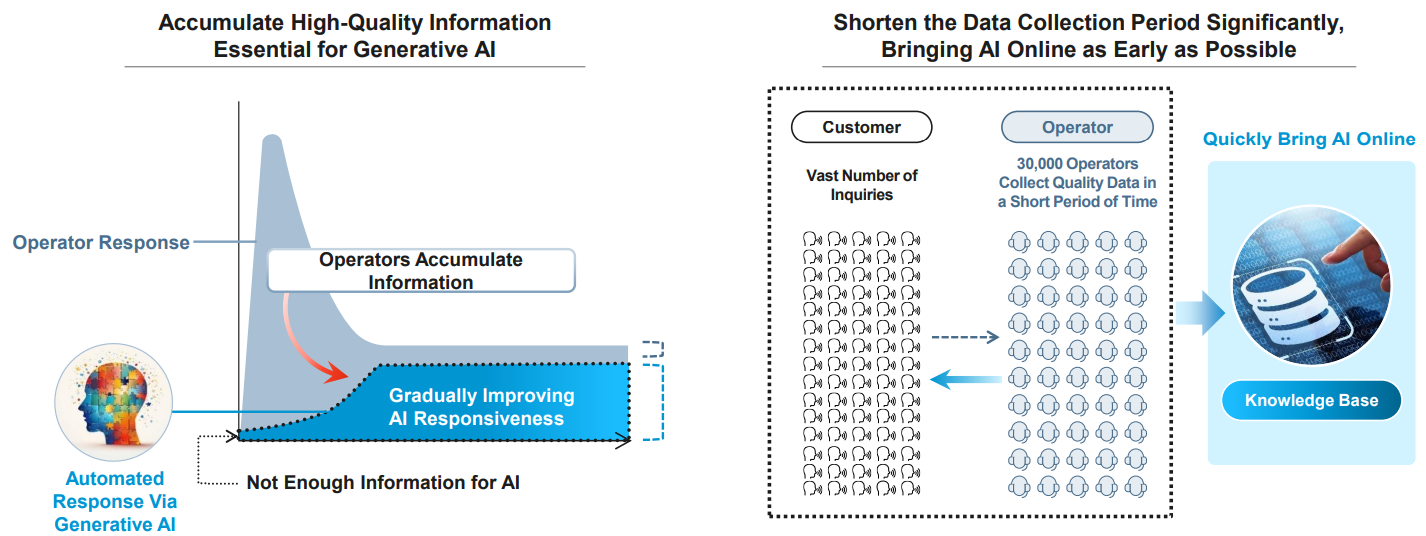 |
 |
(From the company’s materials)
The company is already undertaking a variety of initiatives to facilitate the introduction and utilization of generative AI.
* Launch of Generative AI Co-Creation Lab.
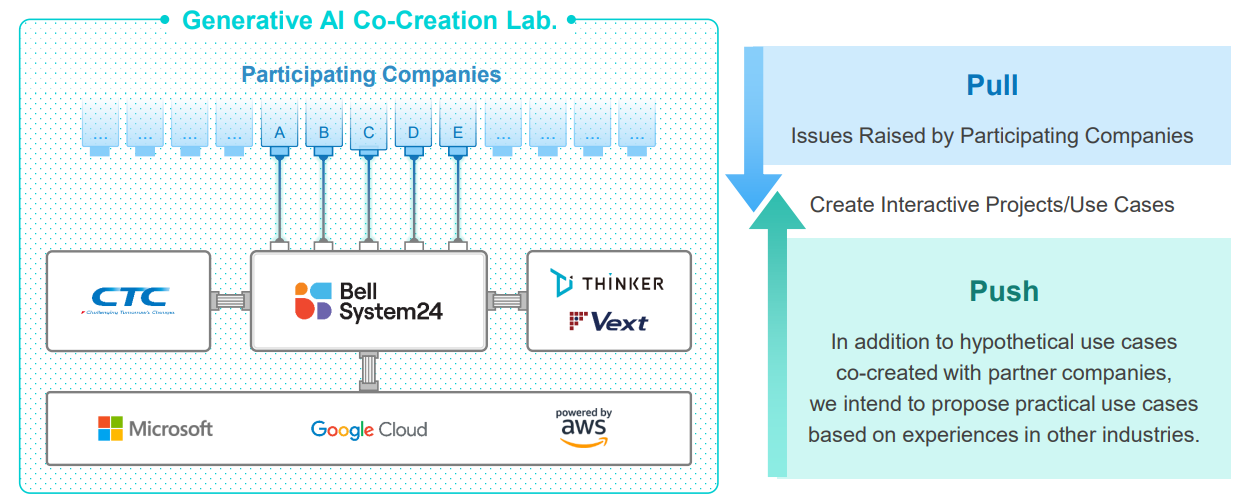
In June 2024, Bellsystem24 launched the “Generative AI Co-Creation Lab.,” which is a user company participation program, to share cases among participating companies, with the aim of building a hybrid contact center that combines “generative AI” and “humans.”
The program will operate contact centers using the AI technologies and expertise of companies such as ITOCHU Techno-Solutions Corporation, Microsoft Japan Co., Ltd., which is at the forefront of generative AI development, Google Cloud, Amazon Web Services Japan LLC (AWS), Thinker Inc., which provides support in the data marketing domain, and Vext Inc., which provides support in the natural language processing domain.
The company acts as a bridge between user companies and vendors, accelerating the development of generative AI use cases through a bidirectional approach that incorporates both pull and push-based strategies.
(From the company’s materials)
* Starting the development of “Hybrid Operation Loop” products
The company is developing a system to automate the knowledge updating process, which is a major challenge when introducing generative AI.
By creating a process that automatically generates a knowledge base from daily call data, the company aims to reduce the burden of knowledge management, which was previously done manually by operators, while improving efficiency. By the end of FY 2025, the company plans to use this knowledge to train generative AI for automated responses, building a next-generation contact center with automated replies for certain tasks.
* Training Knowledge Managers
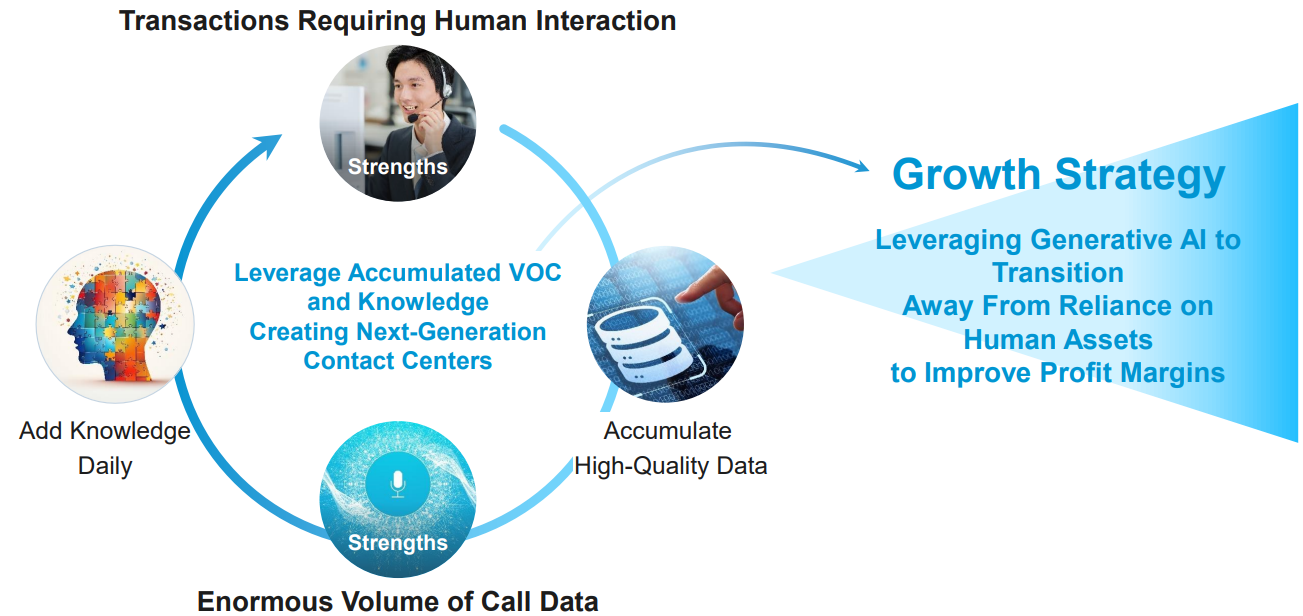
In the next-generation contact center, inquiry responses will shift to automated replies using generative AI. As a result, some operators will become knowledge managers, responsible for selecting the necessary knowledge for AI training and educating the AI. The company is committed to fully supporting the reskilling of employees to carry out knowledge manager’s duties.
The company plans to invest over 30 billion yen in generative AI-related technologies and human resources by FY 2030.
Additionally, in 2024, the company established a specialized department focused on the introduction and management of AI technologies, aimed at integrating engineers, operators, and knowledge managers. The company also plans to actively hire specialized AI talent, with a goal of increasing its team by about 100 AI consultants and engineers over the next three years, strengthening its capacity to implement generative AI.
(From the company’s reference material)
(3) Marketing Support
(Overview)
By leveraging the vast insights and VOC (Voice of the Customer) data collected at the next-generation contact center, the company aims to create new value.
Through automated collection of VOC data aligned with the goals of generative AI, the company will identify consumer needs and develop marketing support services that contribute to increasing client sales, such as in marketing and advertising. This will transform the contact center into a profit center.
(The company’s strengths)
The system will utilize an automated VOC data collection system and a large number of operators, who will evolve into knowledge managers, as part of the process of realizing the next-generation contact center.
(Targets and specific initiatives)
The company will carry out data analysis based on automatic collection of VOC, and provide new services to the marketing departments of client companies, leading to increased sales revenue.
*Case example
Istyle Inc., which operates “@cosme,” one of Japan’s largest comprehensive cosmetics information websites, receives marketing support services through its subsidiary, Thinker Inc.
Using generative AI, they automatically create customer personas from review data. By converting vast amounts of review data into quantitative information, such as customer interests and needs, they can compare issues and competitive advantages.
[3 Growth Strategy]
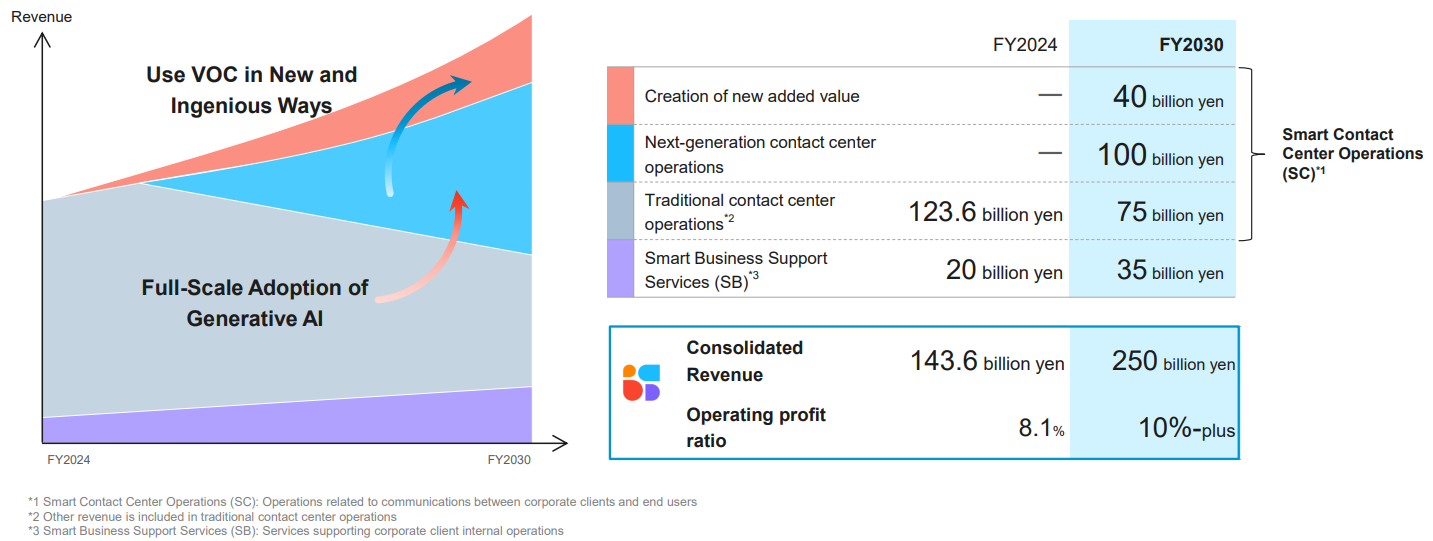
Leveraging these three growth drivers— “(1) Meeting outsourcing needs,” “(2) Utilizing generative AI,” and “(3) Marketing support”—the company aims to achieve 250 billion yen in revenue and an operating income margin of over 10% by FY 2030.
(From the company’s materials)
<Reference2: Regarding Corporate Governance>
◎ Organization type, and the composition of directors and auditors
Organization type | company with corporate auditors |
Directors | 8 directors, including 5 outside ones (including 3 independent executives) |
Auditors | 3 auditors, including 2 outside ones (including 1 independent executive) |
◎ Corporate Governance Report Updated on May 29, 2025
Basic Views
Our company is striving to enhance management efficiency and manage the company that ensures transparency and soundness based on the recognition that in order to maximize corporate value, it is indispensable to establish a good relationship with all stakeholders surrounding the company and the group companies (collectively referred to as the “Group”), including our shareholders, clients, business partners, and employees and gain their trust, and to achieve it, enhancement of corporate governance is one of the important management tasks.
<Reasons for Non-Compliance with the Principles of the Corporate Governance Code>
[Supplementary Principle 4-1-3 Appropriate supervision of succession plans for the CEO and other top executives]
Although our board of directors has not formulated any succession plan for the CEO and executive officer who concurrently serves as the president that is the highest managerial position, the board recognizes the importance of the roles that stakeholders expect the president to play.
The nominating committee exercises comprehensive judgment about such matters as whether candidates satisfy the criteria for selection of candidates for the president, which are specified in the criteria for the appointment and dismissal of directors, including the ability to make business decisions, courage as a corporate manager, multifaceted vision and foresight, and makes proposal to the board of directors.
<Disclosure Based on the Principles of the Corporate Governance Code (Excerpts)>
[Principle 1-4 Strategically held shares]
As a basic policy, when conducting any investment other than net investment, we discuss whether our group’s business will have synergetic effects through the business tie-up, information sharing, etc. with an invested company, and when reducing investment, we discuss whether there will be synergetic effects. Furthermore, on respective stock which does not have dividends or with sluggish performance, we examine whether we should keep holding or reduce their shares for capital efficiency improvement every year, by analyzing expected business performance and recoverability from the viewpoints of economic reasonability.
As for strategically held shares of listed companies, the Board of Directors discussed whether or not to keep holding the shares of a company (balance sheet amount 12 million yen) and decided to continuously hold it.
With regard to exercise of the voting rights for strategically held shares, our company basically makes comprehensive judgment for individual proposals about such matters as whether or not doing so will boost the corporate value and the shareholder return of the companies in which we invest for the medium- and long-term, and whether or not doing so will contribute to enhancing our corporate group’s value through maximization of synergy that is our company’s goal of investment.
[Supplementary Principle 2-4-1 Ensuring diversity in the promotion to core human resources]
(1) Ensuring diversity
Following our corporate philosophy (PURPOSE), our company respects the diversity in our employees and makes proactive efforts, including development of an environment that allows people with all attributes to work enthusiastically, establishment of a human resources system for realizing flexible workstyles, and provision of educational opportunities that support autonomous growth of our employees.
(2) Women
Our company has been taking proactive action for promoting active participation of women, and our efforts have gained recognition of outside organizations through various awards and certificates that we have received. We will continue our efforts, such as improvement of our workplace environment, provision of opportunities for broadening experience, and support for autonomous career development, and conduct activities aimed at building pipelines at each hierarchical level and increasing the ratio of female workers in various positions to raise the number of female workers who will be involved in business decision-making processes.
<<Target ratio of female workers in managerial positions: Database regarding Promotion of Women’s Participation and Advancement by the Ministry of Health, Labor and Welfare>>
Visit the following website concerning the general employer action plans pursuant to the Women’s Advancement Promotion La
https://positive-ryouritsu.mhlw.go.jp/positivedb/detail?id=11012
(3) Employment of Foreigners
Our company promotes employment of human resources from all over the world regardless of nationality, including from our overseas subsidiaries, and over 3,000 regular and non-regular employees with foreign nationalities are currently working at our company inside and outside Japan. While we are doing business mainly in Japan, we will promote human resources to managerial positions based not on their nationalities or genders, but on their abilities and business performance according to our business expansion overseas in the future.
(4) Employment of mid-career workers
Our company proactively employs mid-career workers (including workers whose employment status is changed from the contract employee to the regular employee) so as to secure work-ready human resources, and mid-career workers account for about 80% of all of our employees, playing active roles in every level and post. We will continuously endeavor to further expand diversity in our company through proactive mid-career employment.
[Supplementary principle 3-1-3 Initiatives on sustainability]
In the Basic Sustainability Promotion Policy, our company clearly states the identification of material issues, the resolution of social issues, and the role of the Board of Directors, and in the “Medium-Term Management Plan 2025” disclosed on April 12, 2023, our company discloses medium-term targets for "material issues," which are common for us and society, based on risks and profit opportunities, in addition to our corporate philosophy (PURPOSE) and important themes in our management strategy.
Regarding human capital, to ensure the company's sustainable growth, we will maximize employees’ work engagement by proactively investing in the people we work with and the environment to create a workplace that attracts professionals and is rewarding to work in. By improving the number and quality of our human capital, we aim to realize our corporate philosophy (PURPOSE) by establishing a cycle of improving the quality of our services, providing them to our clients, improving our earnings, and giving back to society. As performance indicators, we collect and analyze the ratios of female directors and female managers, investment in training for human resource development, and the number of rotations to refine our human investment measures, thereby striving for long-term and sustainable improvement of corporate value.
Regarding investment in intellectual property, our “Medium-Term Management Plan 2025” calls for deepening our CX (customer experience) operations, and it is making strategic investments in cutting-edge technologies such as AI.
We assume that risks and profit opportunities related to climate change will have a small impact on our business activities and profit and that the environmental impact of our business activities will also be small.
On the other hand, the issue of climate change is a common global challenge, and the company also regards it as one of its most important management issues. At the Board of Directors meeting held in April 2022, the company formulated and resolved specific targets for greenhouse gas (GHG) emission reduction rates for 2025, 2030, and 2040. In addition, these target values were recognized by “SBT Initiative” in January 2024. In addition to introducing renewable energies to our operational bases, we engage in initiatives for reducing greenhouse gases (GHG), such as installing solar power generation facilities.
In the future, the company will monitor the established targets, strengthen the governance structure related to the planning and implementation of each measure, and reflect the results in the medium- and long-term strategies and roadmaps as appropriate.
Sustainability-related initiatives are disclosed in our website.
https://www.bell24.co.jp/ja/csr/
[Principle 5-1 Policy for constructive dialogue with shareholders]
In order to achieve sustainable growth and improve mid/long-term corporate value, our company will conduct constructive dialogues with shareholders within an appropriate range and an appropriate method in accordance with the following policies.
(1) Executive officer in charge of IR (CFO) will be designated and said Executive officer (CFO) will manage all dialogues with shareholders.
(2) The IR division will be established under the supervision of Executive officer in charge of IR (CFO) and promote the appropriate exchange of information and organic cooperation among the management planning division, the accounting/financial division, and other related divisions.
(3) We will strive to enrich the dialogues with shareholders through results-briefing sessions held at the time of announcement of interim and full-year financial results, reports for shareholders, our website, etc. in addition to individual interviews.
(4) Shareholders’ opinions, etc. grasped through dialogues will be reported to the Executive officer in charge of IR (CFO) and relevant divisions and shared with the Board of Directors when necessary.
(5) In dialogues, we respect the fair disclosure rules, prohibit the acts of conveying information and encouraging transactions, and follow the regulations for preventing insider trading, which specify necessary measures for limiting the retransmission of insider information.
(6) We conduct surveys for identifying substantial shareholders.
(Situation of dialogues with shareholders)
Under the above “policy,” the IR section makes efforts to have dialogues with shareholders through various IR activities, including briefing sessions and individual interviews. In the fiscal year ended February 2025, we held IR interviews with a total of about 180 companies. In February 2025, we held a briefing session for individual investors, which was organized by an IR supporting company, to have dialogues with individual investors.
Recently, shareholders and investors have been showing a strong interest in the expansion of a new business foundation based on new technologies, including AI, and the growth of the outsourcing market due to the shrinkage of the working population. Accordingly, we have explained our advantages, initiatives for adopting new technologies, and the importance of investment in human capital. We have received requests for an explanation concerning the concrete direction and image of the medium-term management plan period and our future business from our shareholders and investors. In order to respond, we made additional explanations at the financial results briefing while disclosing “Medium- to Long-Term Growth Scenario,” an equity story looking ahead at 2030, and gained understanding from our shareholders and investors as a result.
Regarding "the development of a work environment where diverse human resources can work in diverse styles" on which we place the most importance among common material issues of our company and society, we disclose target indicators related to the ratio of female executives, the ratio of female managers, the ratio of employees with disabilities, and the ratio of employees who have taken childcare leave.
The opinions and requests from shareholders and investors we receive in dialogues are reported at meetings of the board of directors and regular meetings involving section chiefs, to be shared by the management and the IR section when necessary.
[Measures for realizing business administration conscious of capital cost and stock price]
(Policies and recognition of the status quo)
Considering that the business administration deeply conscious of capital cost and profitability is essential for achieving sustainable growth and improving medium/long-term corporate value, our company adopted ROE as one of management indicators, and aims to improve capital profitability by keeping ROE higher than cost of shareholders’ equity.
In capital and financial strategies, we are striving to improve corporate value, by allocating the cash inflow through business to shareholder return, investment for growth, and repayment of interest-bearing liabilities in a balanced way.
The cost of shareholders’ equity in the fiscal year ended February 2025 is considered to be around 8%, and ROE was higher than that (being 11.7% in the fiscal year ended February 2025 with the average in the past five fiscal years being 13.7%). PBR was around 1.3 as of the end of February 2025, remaining above 1.0 in the past five fiscal years as of the end of each fiscal year. By making efforts to improve profitability and growth potential, we will aim to get higher valuations in the market and improve PBR.
(Concrete measures)
We will implement the following measures for improving our corporate value continuously.
・Implementing and pursuing various measures with the objective of upgrading our services and expanding the business foundation by utilizing new technologies as a step toward boosting revenue and improving profit margin, in accordance with the “Medium- to Long-Term Growth Scenario.”
・ While striving to maintain financial soundness, we plan to actively invest over 15 billion yen for growth in three years from the fiscal year ended February 2024.
・ The basic policy is to achieve a consolidated payout ratio of 50%, and the expected dividend amount for the fiscal year ending February 2025 is 60 yen per share. We will strive to increase the dividend amount by expanding profit.
・ In order to improve medium/long-term corporate value, we added sustainability-related items (employees’ engagement score, the ratio of female managers, and climate change) to performance-linked indicators for stock-based remuneration for executives.
・ In order to receive higher valuations in the market, we will continue constructive dialogues with shareholders and investors, and further enrich opportunities for dialogues.
The “Medium-Term Management Plan 2025” and “Medium- to Long-Term Growth Scenario” are disclosed in our website.
“Medium-Term Management Plan 2025”
https://contents.xj-storage.jp/xcontents/AS07594/a27ed7b0/3735/4d24/94a6/74103b8e71b2/140120230412545930.pdf
“Medium- to Long-Term Growth Scenario”
https://contents.xj-storage.jp/xcontents/AS07594/a7e26954/d660/4148/84a1/6c6b213c3ce5/140120250409511440.pdf?_fsi=Kc8pSdTp
This report is not intended for soliciting or promoting investment activities or offering any advice on investment or the like, but for providing information only. The information included in this report was taken from sources considered reliable by our company. Our company will not guarantee the accuracy, integrity, or appropriateness of information or opinions in this report. Our company will not assume any responsibility for expenses, damages or the like arising out of the use of this report or information obtained from this report. All kinds of rights related to this report belong to Investment Bridge Co., Ltd. The contents, etc. of this report may be revised without notice. Please make an investment decision on your own judgment. Copyright(C) Investment Bridge Co., Ltd. All Rights Reserved. |
The back number of Bridge Reports (BELLSYSTEM24 Holdings, Inc.:6183) and contents of Bridge Salon (IR seminars) can be seen at www.bridge-salon.jp/