



Bridge Report:(6838)Tamagawa the 3Q of Fiscal Year ending October 2026

 President Toru Masuzawa | Tamagawa Holdings Co., Ltd. (6838) |
 |
Company Information
Market | Standard Market of TSE |
Industry | Electrical equipment |
President | Toru Masuzawa |
HQ Address | Shiba Nicho-me Building 11F, 2-28-8, Shiba, Minato-ku, Tokyo |
Year-end | October |
Homepage |
Stock Information
Share Price | Shares Outstanding (Term-end) | Total Market Cap | ROE Act. | Trading Unit | |
¥1,148 | 9,182,700 shares | ¥10,541 million | 5.3% | 100 shares | |
DPS Est. | Dividend Yield Est. | EPS Est. | PER Est. | BPS Act. | PBR Act. |
¥10.00 | 0.9% | ¥201.18 | 5.7x | ¥837.48 | 1.4x |
*The share price is the closing price on October 22. These were taken from the brief report on financial results in the third quarter of the fiscal year ending October 2026. ROE and BPS are the results in the previous fiscal year.
Earnings Trend
Fiscal Year | Sales revenue | Operating income (business income) | Pretax income (ordinary income) | Net income | EPS | DPS |
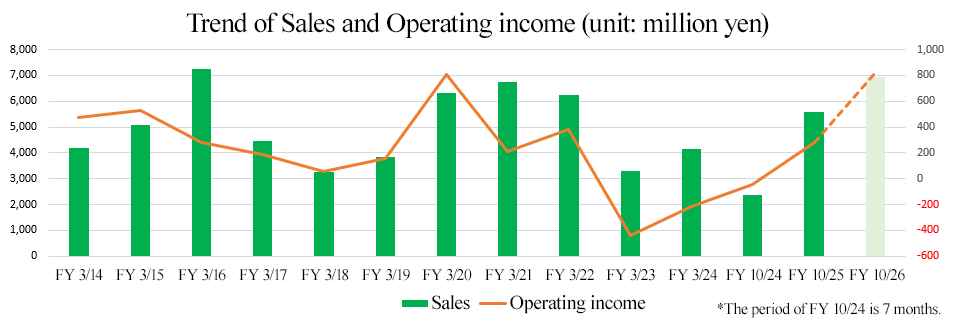
March 2023 Act. | 3,294 | -437 | -514 | -482 | -80.82 | 5.00 |
March 2024 Act. | 4,153 | -215 | -215 | -443 | -71.02 | 3.00 |
October 2024 Act. | 2,356 | -47 | -51 | -113 | -17.50 | 3.00 |
October 2025 Act. | 5,587 | 278 | 231 | 268 | 41.23 | 5.00 |
October 2026 Est. | 6,950 | 820 | - | 1,835 | 201.18 | 10.00 |
*Unit: million yen. The period of the fiscal year ended October 2024 was 7 months. The forecast was made by the company.
*From the fiscal year ending October 2026, IFRS has been applied arbitrarily. Operating income is calculated by subtracting the cost of sales and SGA from sales revenue. Business income is obtained by adding investment profit/loss on equity method to operating income and then subtracting profit/loss due to non-ordinary factors, but as of now, operating income is equal to business income. In the column for pretax income, ordinary income was indicated until the fiscal year ended October 2025. Net income means the net income attributable to owners of the parent company. For the net income forecast, the valuation profit of overseas shares held by overseas affiliates as of the end of July 2026 is included in financial income.
This report includes the outline and business performance trend of Tamagawa Holdings Co., Ltd. and the interview with the president.
Table of Contents
Key Points
1. Company Overview
2. Progress of the Medium-term Management Plan
3. 3Q of Fiscal Year ending October 2026 Earnings Results
4. Fiscal Year ending October 2026 Earnings Forecasts
5. Interview with the President
6. Conclusions
<Reference: Regarding Corporate Governance>
Key Points
- Subsidiaries of the holding company Tamagawa Holdings Co., Ltd. operate the Electronics and Telecommunications Equipment Business and the Renewable Energy Business. Based on the high-frequency and microwave technologies cultivated since its establishment, the Electronics and Telecommunications Equipment Business delivers products and systems to sectors such as government & public services, mobile communications, and factory automation (FA) & measurement. In the Renewable Energy Business, the company is expanding its scope of operations beyond the development, operation and sale of solar power plants and small-scale wind power plants to include electricity storage stations for grids and small-scale hydroelectric power generation in overseas markets.
- The five-year medium-term management plan, which set three main objectives: “to grow business performance,” “to enrich shareholder return,” and “to improve management indicators,” is ongoing and will end in the fiscal year ending October 2030. In the Electronics and Telecommunications Equipment Business, they have worked on the construction of the second factory of the headquarters and are establishing a structure for mass-producing products for governmental agencies. In addition, they aim to make a further leap forward by cultivating the Southeast Asian market based on the factory in Vietnam. In the Renewable Energy Business, they plan to further enhance their earning capability by launching the business of electricity storage stations for grids. Through these initiatives, they aim to achieve “sales of 11.1 billion yen, about two times larger than those in FY 10/25, an ordinary income of 1.3 billion yen, about six times larger than that in FY 10/25, a DPS of 20 yen (5 yen in FY 10/25), and an ROE of 10.2% (5.3% in FY 10/25)” in the fiscal year ending October 2030.
- For the fiscal year ending October 2026, sales revenue is expected to grow 24.4% year on year to 6,950 million yen and operating income is projected to rise 194.0% year on year to 820 million yen. The dividend amount will be 10.00 yen/share, two times that in the previous fiscal year. The expected dividend payout ratio is 5.0% of net income, which includes unrealized financial gains. In the Electronics and Telecommunications Equipment Business, the sales of products for “social infrastructure,” including products for governmental agencies, have grown significantly, as the related national budget increased and core products entered the mass production phase. The sales revenue forecast is in line with the forecast for the fiscal year ending October 2027 in the medium-term management plan. The operating income forecast exceeds the forecast for the fiscal year ending October 2028, indicating a favorable progress, so they are planning to revise the forecast announced at the time of release of financial results in the fiscal year ending October 2026, and announce the revised forecast. *From the first quarter of FY 10/26, IFRS has been applied. The year-on-year comparisons indicated herein mean the comparisons with the results in FY 10/25, for which the Japanese standards were applied, and they were calculated by Investment Bridge Co., Ltd.
- We interviewed Mr. Toru Masuzawa, who is the representative director and president of Tamagawa Holdings Co., Ltd., and Mr. Junichi Suzuki, who is the representative director and president of Tamagawa Electronics Co., Ltd. The president Suzuki said, “The high-frequency wireless communication technology, which is a strength of our company, can be utilized for not only new fields, including outer space, and the Japanese industry, but also overseas markets centered around Southeast Asia. Market cultivation in such domains would lead to further growth in the medium term, so you can hold expectations for that.” The president Masuzawa said, “While supporting social infrastructure such as telecommunications, defense and national security, and railways through the Electronics and Telecommunications Equipment Business, we shall also contribute to decarbonization and stable power supply through the Renewable Energy Business. We would appreciate your continued support.”
- Since the inauguration of its business, Tamagawa Holdings has been highly evaluated for its high-frequency analog technology and expanded its business by meeting mainly the demand from governmental agencies. Since their technology can be applied to digital technology, they have expanded their technological domain, including system integration combining various technologies. As the company employs a large number of excellent engineers, their high-frequency technology is the source of great competitiveness in the Electronics and Telecommunications Equipment Business as an “irreplaceable technology.”
- Another strength of the company is the stable customer base composed of mainly governmental agencies acquired through major manufacturers, which was established based on this technology. In the fields of railways, meteorology, artificial satellites, telecommunication infrastructure, etc., including projects for governmental agencies, not only the performance of products, but also long-lasting quality and reliability, technologies for meeting customers’ requests, and rigorous security specs are required. The company is highly evaluated for the track record of delivering products for many years and their high-frequency technology. The medium-term management plan, which is expected to be completed one or two years earlier than forecast, is projected to be revised. We would like to pay keen attention to what kinds of measures will be implemented and what kinds of numerical goals will be set.
1. Company Overview
As subsidiaries of the holding company Tamagawa Holdings Co., Ltd., Tamagawa Electronics Co., Ltd. operates the Electronics and Telecommunications Equipment Business, while Tamagawa Energy Co., Ltd. conducts the Renewable Energy Business. Based on the high-frequency and microwave technologies cultivated since its establishment, the Electronics and Telecommunications Equipment Business delivers products and systems to sectors such as government and public services, mobile communications, and factory automation & measurement. In the Renewable Energy Business, the company is expanding its scope of operations beyond the development, operation and sale of solar power plants and small-scale wind power plants to include electricity storage stations for grids and small-scale hydroelectric power generation in overseas markets.
[1-1 History]
In November 1968, Tamagawa Electronics Co., Ltd. was established in Ota-ku, Tokyo. The company commenced the development, manufacturing and sale of electronic components and high-frequency circuit elements for color television sets, which were rapidly gaining popularity at the time, including the manufacturing equipment required for these products. In 1970, the company was reorganized as a joint-stock company. It subsequently continued to expand its production facilities, establishing a business foundation as a manufacturer of electronic and telecommunications equipment with high-frequency radio technology at its core. In August 1999, the company’s shares were registered on the Japan Securities Dealers Association’s over-the-counter market.
In October 2007, the company changed its name to Tamagawa Holdings Co., Ltd. and acquired Tamagawa Electronics Co., Ltd. responsible for the Electronics and Telecommunications Equipment Business, thereby transitioning to a holding company structure. In 2009, it established Environmental Business Planning Office, and in September 2012, it founded GP Energy Co., Ltd. as a company specializing in the operation of solar power plants, thereby entering the Renewable Energy Business field. In 2013, the company established Tamagawa Solar Systems Co., Ltd. (now Tamagawa Energy Co., Ltd.) as a solar power system sales company, and has been developing renewable energy as its second core business domain. The company is also expanding overseas; in 2015, Tamagawa Electronics established TAMAGAWA ELECTRONICS VIETNAM CO., LTD. in Vietnam. In October 2025, the company relocated to a new factory in Hung Yen Province, Vietnam, and is working to expand its mass production capacity and strengthen its cost competitiveness. Following the Tokyo Stock Exchange’s market reorganization in April 2022, the company moved from JASDAQ (Standard) to the Tokyo Stock Exchange Standard Market.
[1-2 Corporate Philosophy]
(1) Corporate Philosophy
The company focuses on the three "Re's":
Corporate "Re"generation |
"Re"newable energy |
"Re"investment of generated cash |
"We view the current situation surrounding Japan as a significant opportunity. It means that by providing solutions that align with the times, we can make great leaps forward. If there are limitations in the traditional Japanese management approach, then through measures like M&A, we can revitalize companies and create more room for growth in Japanese businesses. For environmental and resource challenges, offering solutions like renewable energy can lead to substantial progress." (From the company’s website)
(2) Corporate Policy
We have adopted the principle of “For the Future of People and the Planet.” To realize a prosperous society while making effective use of the limited resources of the Earth, we aim to support society by combining different technologies and businesses such as electronics and communications technology with renewable energy.
Through the Electronics and Telecommunications Equipment Business, we support social infrastructure such as telecommunications, defense & security, and railways, and through the Renewable Energy Business, we contribute to decarbonization and a stable supply of electricity.
[1-3 Business Overview]
(1) Segments
The company operates two business segments: the “Electronics and Telecommunications Equipment Business” and the “Renewable Energy Business.”
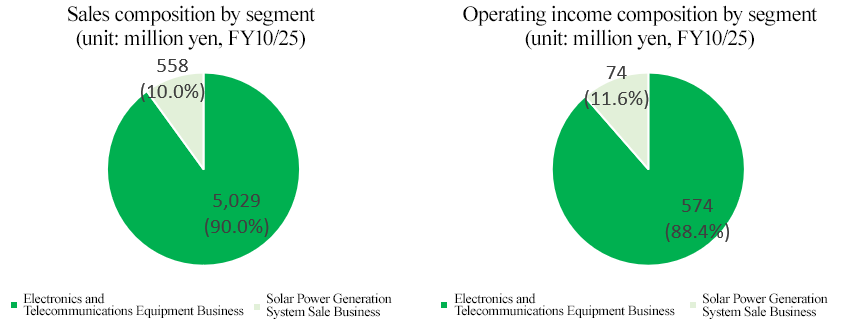
① Electronics and Telecommunications Equipment Business
With Tamagawa Electronics Co., Ltd. at its core, they specialize in the development, manufacturing, and sales of a diverse range of electronic and telecommunications equipment leveraging high-frequency and microwave technologies.
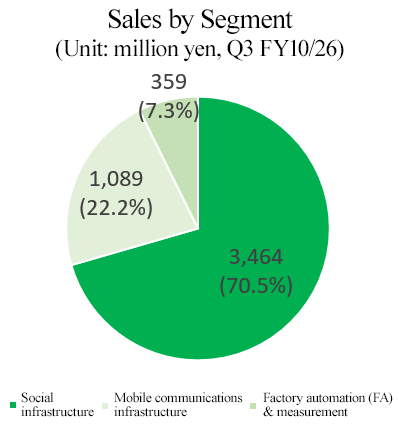
This business covers the three main domains: social infrastructure, mobile communications infrastructure, and factory automation (FA) & measurement.
 |
 |
(Source: The company’s material. The graph was prepared by Investment Bridge based on the material of the company.)
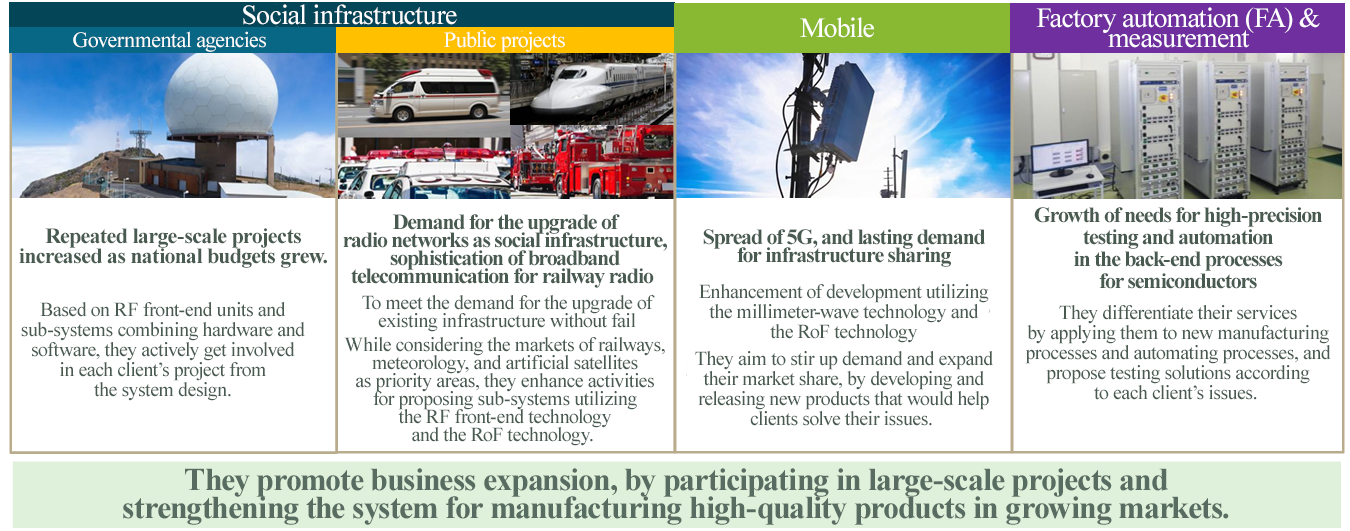
◎ Overview of Each Domain
“Social Infrastructure Domain”
In addition to projects for governmental agencies, the company supplies products and systems for railway radio, meteorology, and satellite-related applications for public projects. It places particular emphasis on RF front-end units and subsystems that integrate hardware and software, and is pursuing a proposal-based business model that goes beyond merely supplying components to actively participating in each customer’s system design phase.
“Mobile Communication Infrastructure Domain”
The company supplies products for 4G and 5G communications equipment and infrastructure sharing. Aiming for next-generation communication standards, it is also engaged in product development utilizing microwave technology and RoF (Radio over Fiber) technology. By leveraging its new factory in Vietnam, the company has established a mass production system that balances high quality with low costs, and aims to expand its business in the ASEAN market in addition to the Japanese market.
“FA & Measurement Field”
The company offers semiconductor reliability testing equipment and other products. Recognizing the growing demand for high-precision testing and automation in the semiconductor back-end process, it is applying the high-frequency technology it has cultivated in the telecommunications sector to the semiconductor manufacturing equipment market.
◎ Key Initiatives
*Initiatives for the Government Office Market
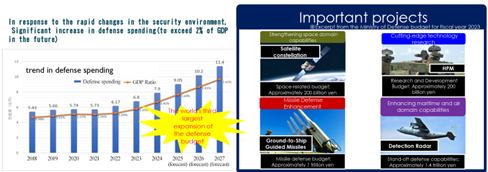
The company identifies the government office market as a key area that will drive future growth. Against the backdrop of the changing security environment, defense spending has increased significantly; as a result, budgets related to the space domain in addition to the land, sea, and air domains are expanding, generating new business opportunities for the company.
Specific target areas include the space sector (such as satellite constellations), the enhancement of missile defense capabilities (such as land-to-ship guided missiles), the improvement of capabilities in the maritime and air domains (such as detection radar), and research into cutting-edge technologies, including high-power microwave (HPM).
The company plans to leverage the high-frequency and microwave-related technologies it has cultivated over many years to expand its participation in key projects for governmental agencies.
*Expansion of drone surveillance business
One of the new initiatives in the public project sector is the drone surveillance business.
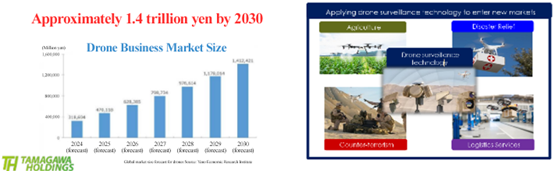
According to the company’s materials, the scale of the global market for industrial drones is projected to expand to approximately 1.4 trillion yen in 2030. Furthermore, the range of drone applications is rapidly expanding, and demand for technologies to monitor and detect drones is expected to grow accordingly.
The company is developing a drone surveillance unit and plans to first expand into the domestic market, followed by expanding into the global market. In the future, the company envisions applying its drone surveillance technology to a wide range of fields including antiterrorism, agriculture, disaster relief, and logistics services.
 |
 |
(Taken from the company's materials)
* Launch of satellite business
The satellite business, too, is included in a new growing area.
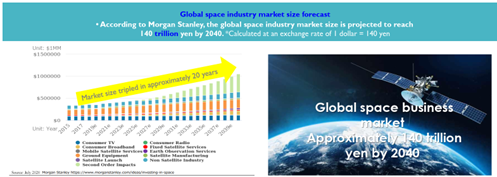
The company has jointly developed X-band transceivers for small satellite systems with a major electronics manufacturer, and based on this track record, it plans to launch a satellite business, which is expected to create a significant market in the future. According to the company’s materials, based on Morgan Stanley’s projections, the scale of the global space market is expected to reach approximately 140 trillion yen by 2040. This market is highly compatible with the company’s core strengths in high-frequency and microwave technologies, and its efforts to expand existing technologies into this new growing market are gaining attention.
* Meeting demand related to disaster prevention and transportation infrastructure against the backdrop of national resilience building
Demand is also expected to grow over the medium to long term for public projects outside the government, defense, and space sectors.
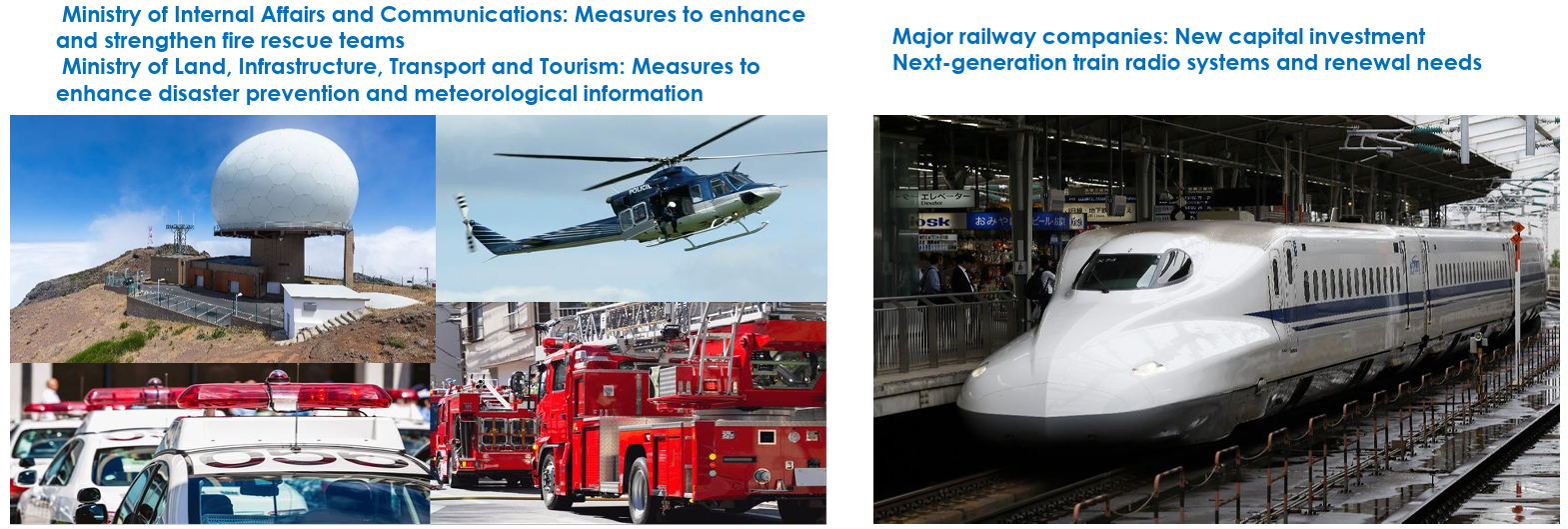
The “First Medium-Term Plan for Increasing National Resilience” will begin in the fiscal year 2026, with approximately 20 trillion yen allocated to address the aging of infrastructure and advance disaster prevention and mitigation measures. Business opportunities include the Ministry of Internal Affairs and Communications’ efforts to expand and strengthen Fire and Disaster Rescue Teams, as well as the Ministry of Land, Infrastructure, Transport and Tourism’s initiatives to enhance disaster prevention and meteorological information. In addition, investment by major railway companies in next-generation train radio systems and demand for the upgrade of existing equipment are also anticipated.
The company aims to leverage its long-standing expertise in radar, radio, and communications technologies to expand into the social infrastructure sector and capitalize on the demand generated by national resilience initiatives.
 |
 |
(Taken from the company's materials)
* Expansion of the Infrastructure Sharing Market and Beyond 5G and 6G
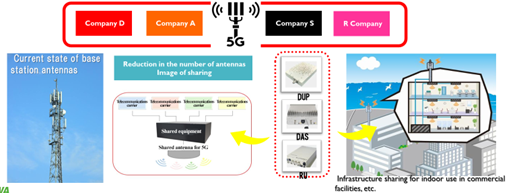
In the mobile equipment sector, the company is working to expand its share in the market of equipment and passive components for infrastructure sharing, where telecommunications operators jointly use base station equipment and other facilities.
Particularly in indoor communication environments such as commercial facilities, infrastructure sharing, where multiple telecommunications operators share equipment such as antennas, is expected to become more widespread. The company plans to capitalize on the demand for mobile communication-related equipment, including distributed antenna systems (DAS), radio units (RU), and distributed units (DUP), primarily for 5G, to meet the needs in this market.
In terms of production, the company aims to secure profits by leveraging its Vietnamese factory to reduce costs while maintaining a high level of reliability. Looking ahead to next-generation mobile communications, “Beyond 5G and 6G,” the company is also engaged in industry-academia joint research on microwave technology, thereby preparing not only for current 5G-related demand, but also adapting to future communication technologies.
* Initiatives in the Field of FA and Measurement
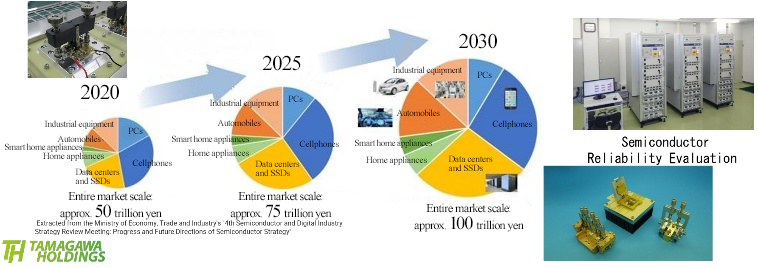
In the FA and measurement field, the focus will be on the semiconductor manufacturing equipment market, with the goal of expanding its share in the market of burn-in test equipment (*).
In Japan, investment in the domestic production of advanced semiconductors is on the rise, and demand for related manufacturing and testing equipment is increasing. Leveraging its core microwave technology, the company offers burn-in test equipment used to evaluate semiconductor reliability.
Going forward, in addition to proposal-giving activities that leverage the company's track record of successful deliveries, the company will promote its technical capabilities through public relations activities to expand its share in the market of burn-in test equipment. In the semiconductor market, which differs from the government and telecommunications infrastructure sectors, the company aims to utilize its high-frequency and microwave technologies to seize revenue-earning opportunities and diversify its business portfolio.
*Burn-in test equipment: A reliability testing system that subjects semiconductors and electronic components to stress conditions such as high temperatures and high voltages to artificially accelerate the occurrence of initial defects and eliminate defective products.
 |
 |
(Taken from the company's materials)
Mass Production at the Vietnamese Factory, Enhancement of Cost Competitiveness, and Expansion into ASEAN Countries
The company is actively expanding its overseas operations, focusing on Vietnam.
Tamagawa Electronics Vietnam, a subsidiary serving as the company’s production base in Vietnam established in April 2015, relocated and expanded the facility in October 2025 and began operations at the new factory. To meet the growing demand for mass-produced products, the company is expanding production space and upgrading facilities. Through these efforts, the company is strengthening its production system that balances low costs with high quality, aiming to enhance price competitiveness and improve supply stability.
The Vietnamese factory is positioned not only as a production base for products destined for the Japanese market, but also as a hub for expanding into the ASEAN market; the company is currently working to expand its sales channels in Vietnam and Indonesia.
In August 2023, Tamagawa Electronics Vietnam was selected as one of the “Top 20 Vietnamese Companies of 2023” by the Organizing Committee of the Ministry of Science and Technology, a Vietnamese government agency. Additionally, in December 2024, the company was selected as one of the top 12 companies in the “10th National Strong Brand Awards” program organized by the Vietnam Institute of Quality Management. In the “10th National Strong Brand Awards Program,” only two out of 2,394 Japanese companies operating in Vietnam were selected, including Tamagawa Electronics Vietnam. This recognition reflects the high regard in which the company’s activities in Vietnam are held, particularly regarding the quality of its products and services and its contributions in the area of human resources management. The company believes that this will not only lead to further enhancement of its brand value and market competitiveness, but also provide a competitive edge in its sales activities within Vietnam.
In Indonesia, a huge economic powerhouse with a population of 270 million, the company conducts sales activities through local distributors. As an archipelagic nation, there is significant potential for the development of wireless access, and the company plans to capitalize on this demand by leveraging its strengths in communications technology.
(2) Renewable Energy Business
Centered around Tamagawa Energy Co., Ltd., the company is engaged in the development and operation of solar power plants and small-scale wind power plants; the sale of generated electricity; the development and sale of power plants based on customer needs; after-sale management and maintenance services; and consulting services related to the expansion of Renewable Energy Businesses. The company owns small-scale wind power plants in Hokkaido and the Tohoku region, as well as solar power plants in Nagano, Ibaraki, and Yamanashi prefectures, and other locations.
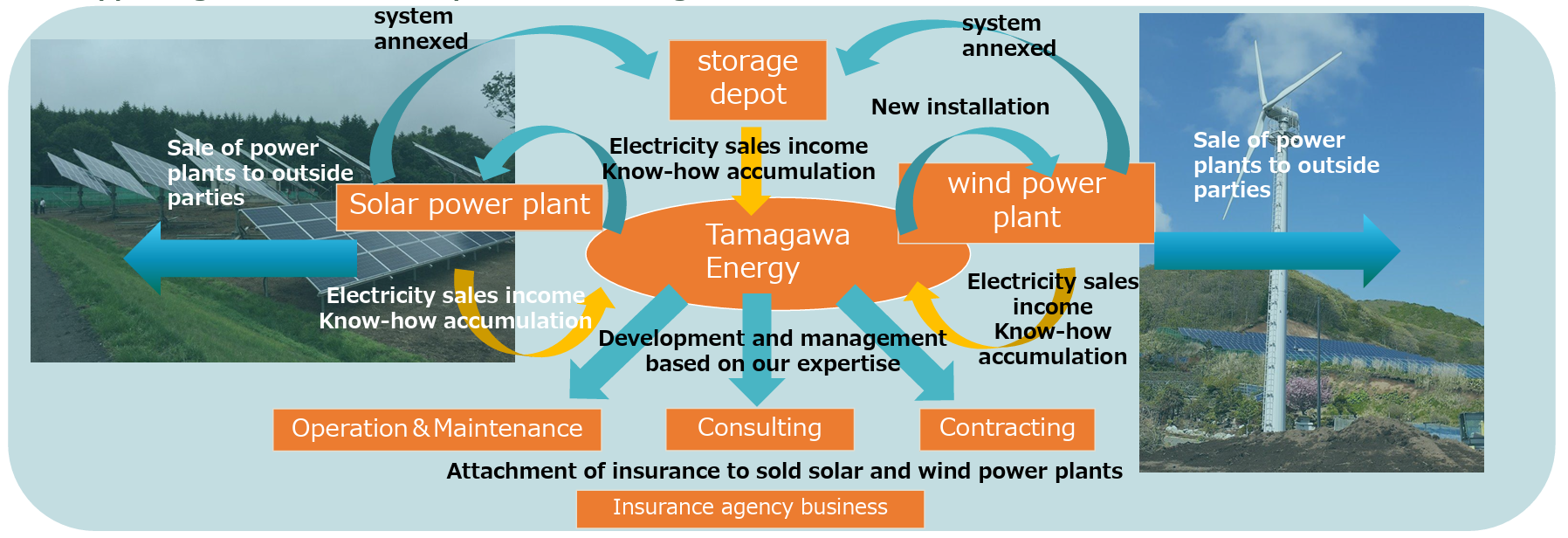
(Taken from the company's materials)
With regard to renewable energy, the Japanese government has made achieving “carbon neutrality by 2050” an international commitment. It is essential to expand the renewable energy market using solar, wind, and other sources while restarting and constructing new nuclear power plants.
As mentioned earlier, the company’s group is engaged in the development and operation of solar power plants and small-scale wind power plants, as well as the sale of the electricity they generate; however, in recent years, it has been focusing on the business of electricity storage stations for grids as a new growing area.
Storage batteries for grids are large-scale storage batteries directly connected to the power grid, such as power plants operated by electric power companies. These batteries can store and discharge electricity generated from renewable energy sources as well as electricity purchased from the electricity market.
To ensure the stable operation of the power grid, electricity consumption (on the demand side) must be balanced with the output from power generators (on the supply side); if this balance is disrupted, grid frequency may rise or fall, significantly increasing the risk of widespread power outages (blackouts). In recent years, power generation with renewable energy has increased as part of efforts to combat climate change. However, since solar and wind power generation is highly dependent on weather conditions, making power supply more unstable. Consequently, batteries for grids are becoming increasingly important not only for balancing power during the peak of demand, but also for instantaneous adjustments to the supply and demand of electricity.
The company views the role of balancing electricity supply and demand, which is becoming increasingly important as renewable energy is adopted further, as a business opportunity and is proceeding with the development and acquisition of electricity storage stations for grids.
The electricity storage station for grids in Miyama City, Fukuoka, which completed its grid connection in July 2026, was acquired in August. The company aims to begin operations in the supply-demand adjustment market as soon as possible, after necessary reviews. In addition, the company is proceeding with the acquisition of an electricity storage station for grids in Iga City, Mie Prefecture, which is scheduled to be connected to the grid in September 2027. While the company will primarily handle acquisitions and operations in house, it will sell business sites for which there are no longer a usage plan and power generation rights to other companies.
By accumulating know-how and expertise for the development of electricity storage stations for grids, the company intends to diversify its revenue sources by not only installing and operating its own facilities, but also providing construction contracting services and management expertise for other companies' projects.
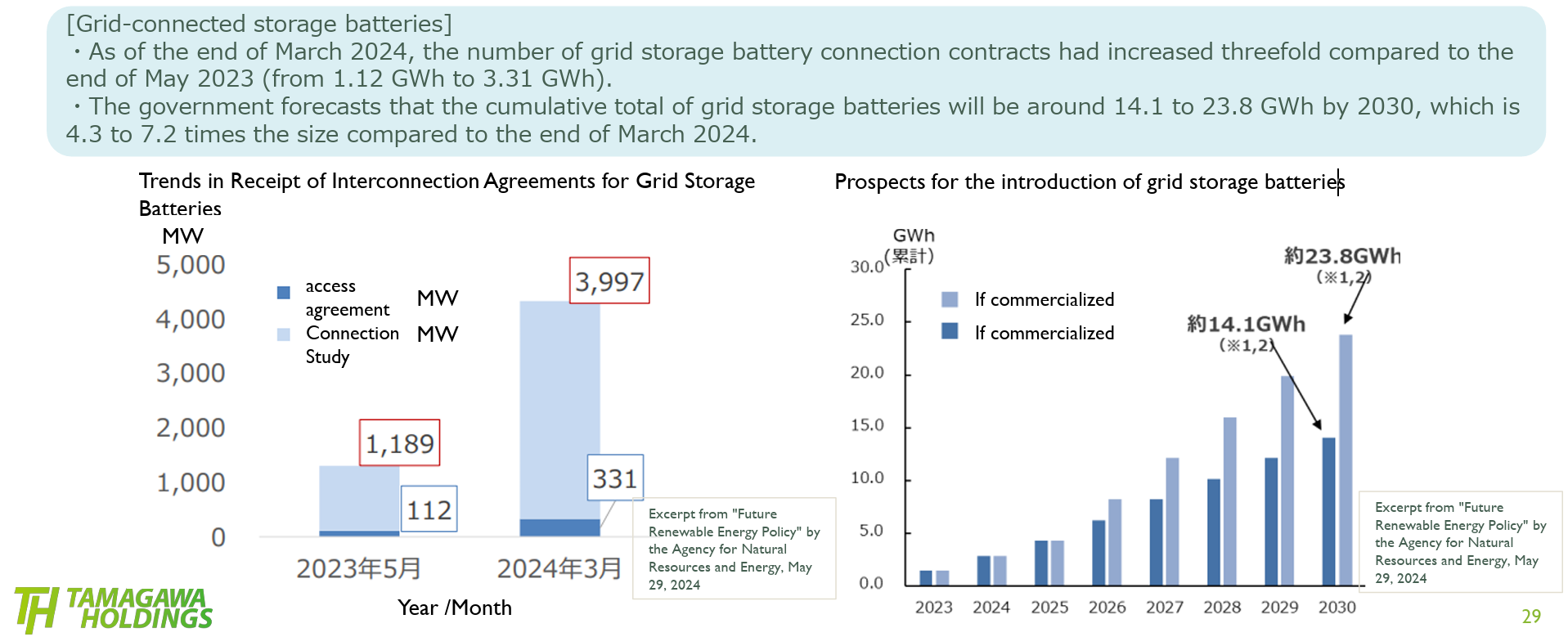 |
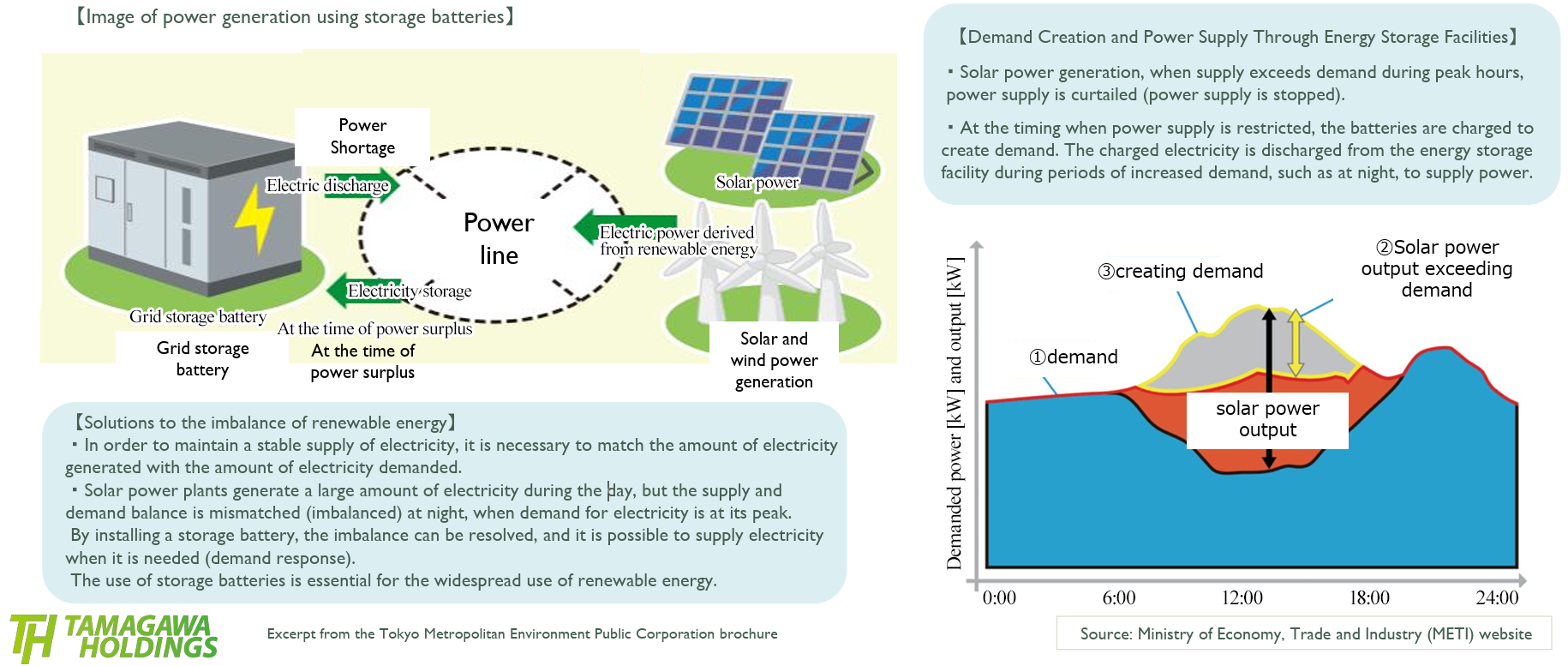 |
(Taken from the company's materials)
In addition, the company is expanding its business areas by participating in joint projects such as a small-scale hydroelectric power plant on the island of Flores in Indonesia. By leveraging the expertise accumulated through previous power plant development projects, the company is working to stabilize its revenue base and mitigate business risks through diversification of power sources. While the overall business is still small in scale and currently in an investment phase requiring careful risk assessment, the company aims to develop it into a second pillar of its business under the “Three ‘Re’s” outlined in its corporate philosophy.
③ Investment Business
In July 2022, the company acquired shares in Addvalue, a company listed on the Singapore Exchange (SGX), through its consolidated subsidiary in Singapore, THEG PTE LTD.
Addvalue engages in satellite communication systems and software-defined radio, among other areas, and operates in the space & aviation, defense, IoT, and maritime communications sectors. By combining the high-frequency radio technology that Tamagawa Electronics has accumulated over many years with Addvalue’s technology and expertise in satellite communications and other fields, the companies aim to expand their business by leveraging respective strengths.
The current number of shares held is approximately 125 million, and their voting rights account for 3.4%. Following the transition to IFRS, the valuation difference on held shares has been recognized as financial income beginning with the fiscal year ending October 2026.
*Financial income recorded in the summary of financial results for the third quarter of the fiscal year ending October 2026 amounted to 1,581 million yen.
In addition, as of the end of the third quarter of the fiscal year ending October 2026, the market value stood at approximately 2.8 billion yen, accounting for about 17% of the company’s total assets of approximately 16.4 billion yen. The company plans to expand this segment further as part of its investment business.
Maybank Research Pte. Ltd., a Singapore-based firm specializing in financial research and analysis, has assigned a “BUY” rating to Addvalue with a 12-month target price of 0.34 Singapore dollars per share (according to an analyst’s report dated September 4, 2026).
Applying Maybank Research’s target price of 0.34 Singapore dollars mechanically, the reference valuation would be approximately 5.27 billion yen. This represents an increase of approximately 3.02 billion yen compared to the approximately 2.25 billion yen as of the end of July 2026, and an increase of approximately 2.40 billion yen compared to the approximately 2.87 billion yen as of September 24, 2026.
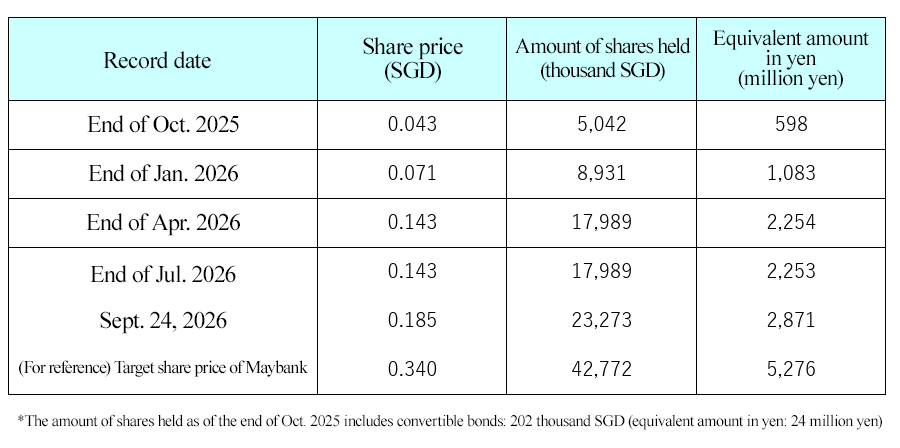
(From the company’s press release)
*Please note that this is an assessment by a third-party analyst and does not constitute a stock price forecast by Tamagawa Holdings or Addvalue. Tamagawa Holdings presents this target stock price as one reference information; however, it does not guarantee that Addvalue’s stock price will reach this level or rise in the future.
*For information on Addvalue’s most recent business developments, please refer to “Summary of Third-Quarter Financial Results for the Fiscal Year Ending October 2026 [3-4 Topics].”
[1-4 Key Points (Features, Competitive Advantages, etc.)]
The company possesses the following notable features and competitive advantages.
(1) High-frequency and microwave technologies accumulated over approximately 60 years
The greatest strength lies in the high-frequency and microwave technologies Tamagawa Electronics Co., Ltd. has accumulated over many years. High-frequency technology is required not only in the communications sector, such as mobile phones, but also in a wide range of fields, including radar, railway radio, meteorology, satellites, and semiconductor testing equipment. Since its founding, the company has earned a strong reputation for its high-frequency analog technology and has expanded its business primarily through demand from governmental agencies. In addition, because the company is capable of applying their expertise to digital technologies such as optical transmission, digital signal processing, and FPGAs, it has broadened its technical scope to include system integration that combines various technologies. Furthermore, in addition to expanding its technical scope, the company has implemented the latest production management systems and established global production capabilities, enabling it to comprehensively address customer needs in terms of quality, cost, and delivery (QCD).
The company employs many talented engineers, and its high-frequency technology serves as an “irreplaceable technology” that is the source of its strong competitive advantage in the Electronics and Telecommunications Equipment Business.
(2) Expansion of Business Areas Through Continuous Research and Development
When the company was founded in 1968, its core products were palm-sized RF passive components such as coaxial fixed attenuators, variable attenuators, and terminators. The company subsequently expanded its scope to include O/E and E/O converters such as microwave amplifiers, active RF components, and integrated modules such as oscillators for broadcasting equipment. Furthermore, the company has expanded to handle subsystems such as optical SCMs for train radio communications and semiconductor test equipment for satellites.
In recent years, by integrating technologies such as high-frequency wireless communications, optical conversion and transmission, and digital control and software, the company has expanded its scope to include large-scale public infrastructure systems, such as RF units for weather radar, high-speed optical communication control units, and LLRF devices for linear accelerators at synchrotron radiation facilities.
In fact, through continuous research and development, the company has advanced its technology from “palm-sized components to systems spanning 150 meters” and from “factory floors to outer space.” Looking ahead, the company aims to achieve further growth as a system supplier supporting public infrastructure, targeting markets including Beyond 5G & 6G, satellite communications, and drone surveillance.
To further strengthen its competitiveness, the company is actively engaged in open innovation with academia and research institutions, with the following achievements demonstrated.
Press Release | Overview |
Released on June 25, 2025 “World’s First Equipment for High-Speed Data Communication Experiments Utilizing Terahertz Waves Between Aircraft and Ground Experiment Stations” | The Japan Aerospace Exploration Agency (JAXA) and Waseda University have successfully conducted an experiment in high-speed data communication between an aircraft and a ground station using terahertz waves. This marks the world’s first successful high-speed, high-capacity data communication using terahertz-band radio waves between an aircraft in high-speed flight and a ground experiment station. A terahertz-band frequency converter designed and manufactured by Tamagawa Electronics was used in this experiment. |
Released on May 20, 2024 “Notice of Attendance at the Ceremony Commemorating the Start of Operations of NanoTerasu”
| The company designed and manufactured the “Low-Power RF Circuit and Beam Monitor Circuit System for the Linear Accelerator of the Next-Generation Synchrotron Radiation Facility (NanoTerasu*)” and delivered it at the end of March 2023 to the “NanoTerasu” facility, which was constructed on the campus of Tohoku University. The company's RF technology received high recognition. NanoTerasu began operations in April 2024.
*NanoTerrace is a gigantic microscope with light source performance 100 times that of existing soft X-ray synchrotron radiation facilities in Japan (one billion times the brightness of the sun), capable of visualizing the functions of materials at the nanoscale. It is expected to be utilized in various fields, including drug discovery, medical technology, energy conservation, environmental preservation, and food safety. Going forward, the operation of this facility is expected to promote joint research between industry and academia and drive innovative breakthroughs. |
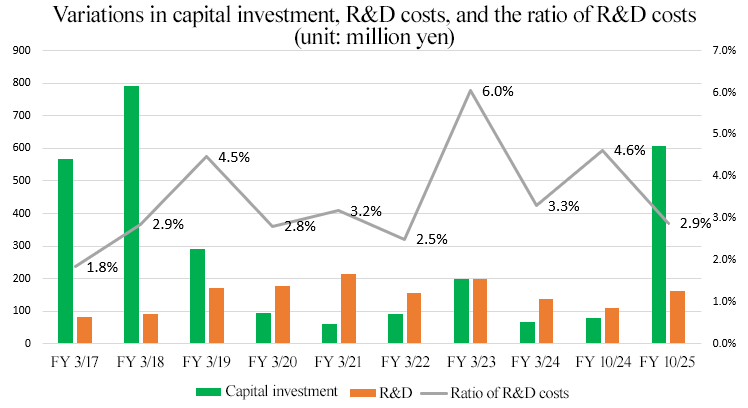
Research and development expenses for each fiscal period range from 100 million to 200 million yen. Although no specific target ratio relative to net sales has been established, the company continues to invest in promising areas under a certain framework.
(3) A stable customer base centered on governmental agencies and social infrastructure sectors
In the Electronics and Telecommunications Equipment Business, the company focuses on key markets such as government agency projects, railways, meteorology, satellites, and telecommunications infrastructure. These fields require not only high product performance, but also long-term quality and reliability, technical capabilities to meet customer requirements, and high security standards. The company has built a stable customer base by earning strong recognition for its long track record of successful deliveries and its advanced high-frequency technology.
(4) Improved Profitability by Transitioning from Development to Mass Production
As the most notable recent development, the Electronics and Telecommunications Equipment Business saw certain large-scale projects transitioning from the development phase to the mass production phase.
In the Electronics and Telecommunications Equipment Business, development costs and labor expenses tend to be incurred upfront during the research and development and prototyping stages; however, once a developed product enters the mass production phase, increased sales volumes are expected to drive improved profitability. For products for governmental agencies, the company has begun gradually transitioning from the “development phase” to the “mass production phase,” and the start of mass production for its flagship products is driving recent performance growth. The company aims to establish a full-scale mass production system with the start of full-scale operations at its second factory at the headquarters in March 2028.
In the cumulative third quarter of the fiscal year ending October 2026, the Electronics and Telecommunications Equipment Business saw a significant improvement in profitability due to mass production, in addition to the optimization of sales prices and enhanced production efficiency.
[1-5 ROE analysis]
| FY 3/19 | FY 3/20 | FY 3/21 | FY 3/22 | FY 3/23 | FY 3/24 | FY 10/24 | FY 10/25 |
ROE | 3.9 | 11.7 | 1.9 | 2.8 | -9.3 | -9.0 | -2.4 | 5.3 |
Net income margin | 3.347 | 6.939 | 1.338 | 2.384 | -14.654 | -10.673 | -4.825 | 4.808 |
Total asset turnover | 0.370 | 0.667 | 0.757 | 0.745 | 0.388 | 0.456 | 0.243 | 0.529 |
Leverage | 3.157 | 2.526 | 1.914 | 1.582 | 1.631 | 1.845 | 2.032 | 2.083 |
*Units: %, times, times. The period of FY 10/24 was 7 months.
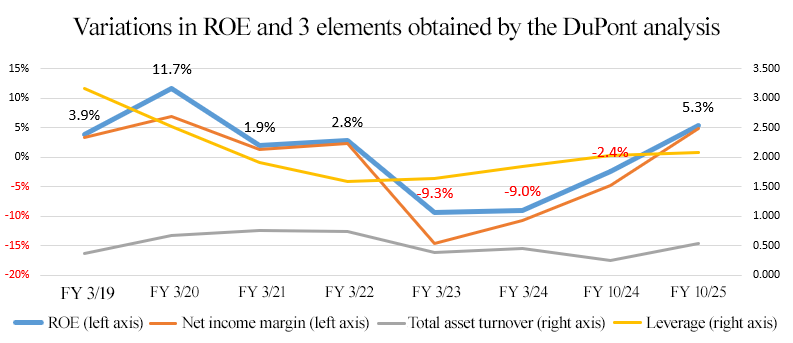
In the fiscal year ended October 2025, ROE turned positive, but it is still 5.3%, falling below 8%, which is generally required of Japanese enterprises.
In the medium-term management plan, they set the target ROE in the fiscal year ending October 2030 at 10.2%, so profitability is expected to improve significantly.
[1-6 Shareholder return]
The basic dividend policy is to pay dividends stably and continuously, and according to the medium-term management plan announced in December 2025, they plan to return profit to shareholders actively while keeping payout ratio 20%. The target dividend amount for the fiscal year ending October 2030 is 20.00 yen/share.
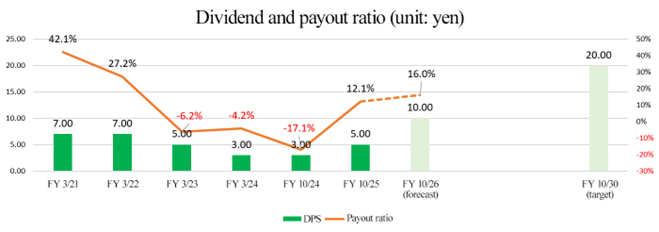
*When the payout ratio in FY 10/26 is calculated from the latest dividend forecast: 10.0 yen/share, the ratio of dividends to net income after tax, including financial income (unrealized gain that is the gain on valuation of shares in Addvalue) is around 5%, but in the above graph, only operating income was recognized as realized gain, and it was multiplied by the effective tax rate to obtain a payout ratio of around 16%.
2. Progress of the Medium-term Management Plan
The five-year medium-term management plan, which was announced in December 2025 and will end in the fiscal year ending October 2030, is underway.
[2-1 Background of the formulation of the plan]
-Toward a new growth stage after the start of mass production and the enhancement of production capacity
Tamagawa Holdings Co., Ltd. considers that the business of each subsidiary is in a growth trend. Accordingly, they plan to actively conduct investment for growth to make a leap forward in the future, such as the construction of the second factory of the headquarters in the Electronics and Telecommunications Equipment Business and the launch of the business of electricity storage stations for grids in the Renewable Energy Business, while defining the period until the fiscal year ending October 2028 as a “period for establishing a structure.”
As the background of the formulation of the plan, there was a change in the business environment surrounding the core Electronics and Telecommunications Equipment Business. They expect that demand for their products will remain for a long period of time, as they receive many business inquiries from governmental agencies, ordered products they developed have entered the mass production phase, and national budgets for defense are growing due to the global increase in awareness of the issue of defense.
In terms of production, they will manufacture high-quality products for mobile devices at low cost, by utilizing a new Vietnamese factory, which was completed in September 2025. In Japan, they consider that it is necessary to expand their production capacity in order to meet the increased demand for products for governmental agencies, so they plan to start the operation of the second factory of the headquarters in the fiscal year ending October 2029.
In the Renewable Energy Business, they will launch the business of electricity storage stations for grids, which are considered indispensable for distributing renewable energy, to enhance their earning capability.
From the fiscal year ending October 2029, which is considered as an “investment recoupment period,” they aim to enter a new growth stage as an outcome of the above investment.
[2-2 Three pillars of the medium-term plan]
-To pursue “the growth of business performance,” “the enrichment of shareholder return,” and “the improvement of management indicators”
They uphold “the growth of business performance,” “the enrichment of shareholder return,” and “the improvement of management indicators” as three pillars.
Growth of business performance | Plan for FY 10/30 Sales are expected to increase about two times from FY 10/25 to 11.1 billion yen. Ordinary income is forecast to rise about six times from FY 10/25 to 1.3 billion yen.
Start of mass production of products for governmental agencies and the cultivation of the Southeast Asian market in the Electronics and Telecommunications Equipment Business. Profit margin will rise significantly thanks to the mass production of core products and the operation of the factory in Vietnam. Launch of the business of electricity storage stations for grids in the Renewable Energy Business |
Enrichment of shareholder return | Plan for FY 10/30 To increase dividend per share (DPS) to 20 yen (5 yen in FY 10/25)
They will reflect profit growth in shareholder return. They will actively return profit to shareholders while keeping payout ratio around 20%. |
Improvement of management indicators | Plan for FY 10/30 ROE: 10.2% (5.3% in FY 10/25)
They will raise capital efficiency by allocating funds procured with share acquisition rights to profitable businesses. In the future, they plan to use WACC and ROIC as well as ROE as important management indicators. |
[2-3 Initiatives in each business]
(1) Electronics and Telecommunications Equipment Business
-They aim to achieve sales of 10 billion yen and an ordinary income of 1.5 billion yen through mass production in Japan and overseas business operation.
① Overview
Regarding products for social infrastructure in Japan, they aim to increase sales by 2 billion yen from the fiscal year ended October 2025 to 7 billion yen, as the products for governmental agencies, which account for over 50% of sales, entered the mass production phase. By March 2028, they will start operating the second factory of the headquarters on a full-scale basis and establish a mass production structure in Japan.
Overseas sales, too, are expected to grow considerably. They plan to increase the sales of products for overseas social infrastructure from 55 million yen in the fiscal year ended October 2025 to 3 billion yen by the fiscal year ending October 2030. In Vietnam, they received commendation from the national government, so their popularity increased, and they receive an increasing number of inquiries about products for telecommunication infrastructure. They will also cultivate sales channels by utilizing local distributors in Indonesia, which has a population of 270 million people.
In terms of profit, they aim to improve profit margin by shifting from development to mass production inside the country and starting full-scale low-cost manufacturing of high-quality products at the Vietnamese factory.
② Primary measures for the Electronics and Telecommunications Equipment Business
-Growth based on the system business and the device business
Their five business domains are “governmental agencies,” “public infrastructure,” “factory automation & measurement,” “mobile devices,” and “global business.”
In the system business, which is focused on governmental agencies, public infrastructure, and factory automation & measurement, they handle aeronautical/railway/fire radios, front-end units for radar systems, burn-in equipment for semiconductors, etc.
In the device business, which is focused on mobile devices and global business, they handle infrastructure sharing devices, RF-related units for 4G and 5G, etc.
They will proceed with short-term and medium/long-term growth strategies while keeping a good balance between the highly valued added system business and the mass-produced device business.
(2) Renewable Energy Business
-To develop the business of electricity storage stations for grids as a new revenue source, to earn sales of 1.1 billion yen and an ordinary income of 100 million yen
① Overview
They consider the business of electricity storage stations for grids as a new growth driver, while they have been selling electricity generated by solar panels and small wind power plants. They started development in the fiscal year ended October 2025, and plan to make them contribute to the income from sale of electricity from the fiscal year ending October 2027.
They will continue to construct and sell solar power plants according to customer needs and sell candidate land and rights for development of electricity storage stations for grids. As the business of electricity storage stations for grids, which has a high profit margin, will be included in revenue sources, ordinary income is expected to exceed 100 million yen from the fiscal year ending October 2028.
② Primary measures for the Renewable Energy Business
For diversifying the revenue sources of the Renewable Energy Business, they will take the three primary measures: “to increase the revenue from sale of electricity,” “the sale of power generation equipment,” and “consulting and undertaking of construction work (upgrading solar panels, etc.).”
◎ To increase the revenue from sale of electricity
As renewable energy will be adopted further, the function to adjust the demand and supply of electric power will become important. Accordingly, they will launch the business of electricity storage stations for grids.
◎ Development and sale of power generation equipment to meet clients’ requests
Expecting that more enterprises will need to own renewable energy power plants for achieving carbon neutrality by 2050, they will promote the sale of land and rights for construction of power generation facilities, in addition to the construction and sale of solar power generation equipment to meet the requests from clients.
◎ To upgrade existing solar power plants
As the feed-in tariff (FIT) period will end, they aim to meet new demand for construction work, such as the upgrade to highly efficient solar panels to enhance the power generation capacity and the attachment of storage batteries for grids.
[2-4 Investment plan]
-From the “period for establishing a structure” to the “investment recoupment period”
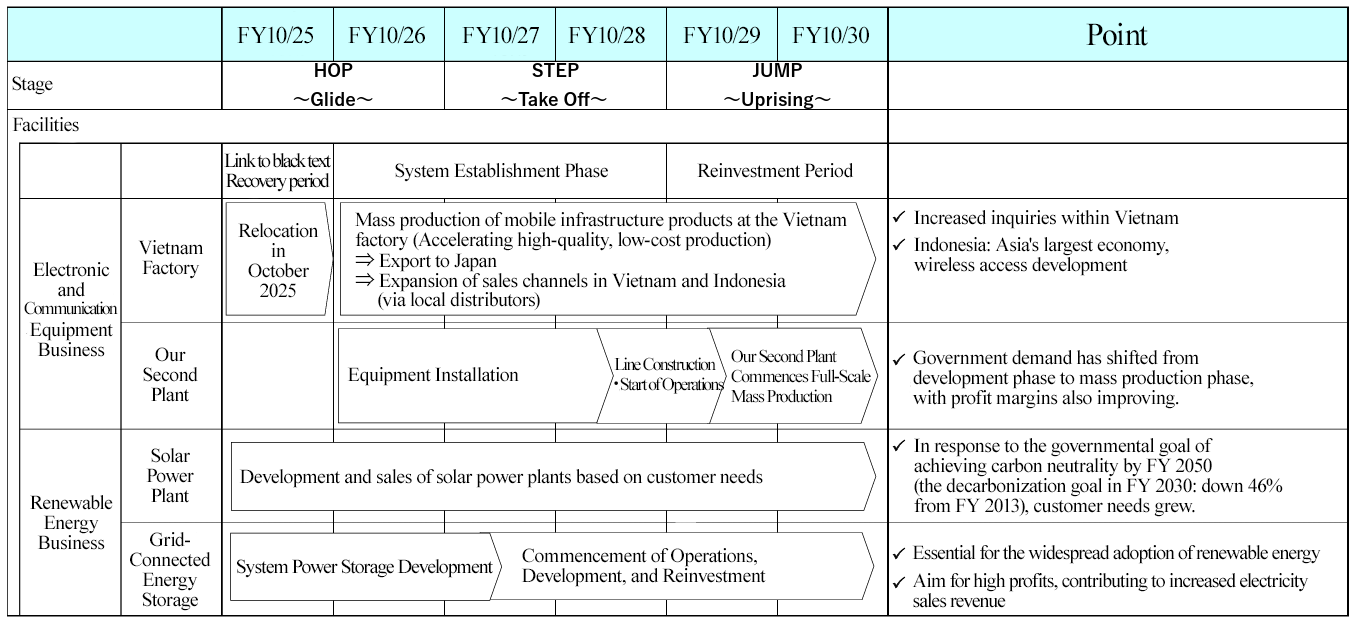
The period of the medium-term plan is divided into the three two-year stages: “HOP (Glide) from FY 10/25 to FY 10/26,” “STEP (Take Off) from FY 10/27 to FY 10/28,” and “JUMP (Uprising) from FY 10/29 to FY 10/30.” These stages are positioned as the period for recovering consolidated profit, the period for establishing a structure, and the investment recoupment period, respectively.
(1) Electronics and Telecommunications Equipment Business
At the Vietnamese factory, they will establish a structure for manufacturing high-quality products for infrastructure for mobile devices at low cost. In addition to the export to Japan, they will expand sales channels in Vietnam and Indonesia.
In Japan, they will construct the second factory of the headquarters, as core products for meeting the demand from governmental agencies will proceed from the development phase to the mass-production phase. They plan to start full-scale operation and establish a mass production structure in March 2028, in which the installation of equipment is scheduled to be completed. Profit margin is expected to rise significantly.
(2) Renewable Energy Business
While continuing the development and sale of solar power plants according to customer needs, they will develop electricity storage stations for grids. After the start of operation, they will invest revenues in another project, to keep expanding their business.
(Taken from the reference material of the company)
[2-5 Numerical plan]
(1) Initial plan
*The numerical forecasts in their document “Medium-term management plan of Tamagawa Holdings; December 4, 2025” were included. Then, they disclosed the brief report on the financial results in FY 10/25 on December 15, 2025 and the material for explaining the financial results in FY 10/25 on January 30, 2026, so there are differences in numerical values in FY 10/25. The corrected values in the annual forecast for FY 10/26 will be included and described in “(2) Progress of the numerical plan” below.
-They aim to grow profit exceeding the sales growth.
① Group-wide performance
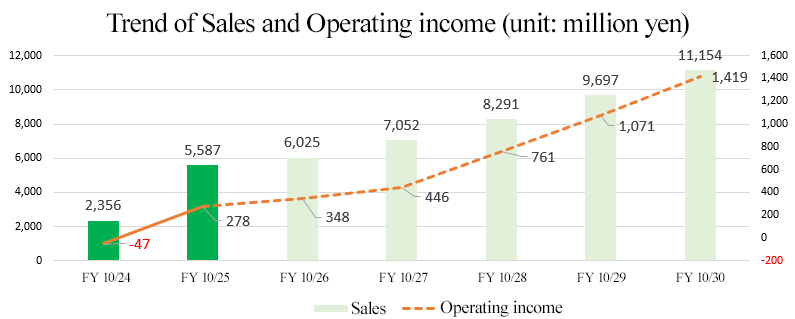
For the fiscal year ending October 2030, it is forecast that “sales will be 11,154 million yen, operating income will be 1,419 million yen, ordinary income will be 1,321 million yen, and net income will be 925 million yen.” The improvement in profit margin is noteworthy. Operating income margin is expected to rise from 5.0% in the fiscal year ended October 2025 to 12.7% in the fiscal year ending October 2030.
| FY 10/24 | FY 10/25 | FY 10/26 | FY 10/27 | FY 10/28 | FY 10/29 | FY 10/30 |
Sales | 2,356 | 5,587 | 6,025 | 7,052 | 8,291 | 9,697 | 11,154 |
Operating income | -47 | 278 | 348 | 446 | 761 | 1,071 | 1,419 |
Operating income margin | - | 5.0% | 5.8% | 6.3% | 9.2% | 11.0% | 12.7% |
Ordinary income | -51 | 231 | 273 | 352 | 667 | 976 | 1,321 |
Net income | -113 | 268 | 191 | 246 | 467 | 683 | 925 |
ROE | -2.4 | 5.3 | 2.7 | 3.4 | 6.1 | 8.2 | 10.2 |
*Units: million yen and %. Taken from “the medium-term management plan of Tamagawa Holdings; December 4, 2025” of the company. The figures from FY 10/26 are forecasts.
|
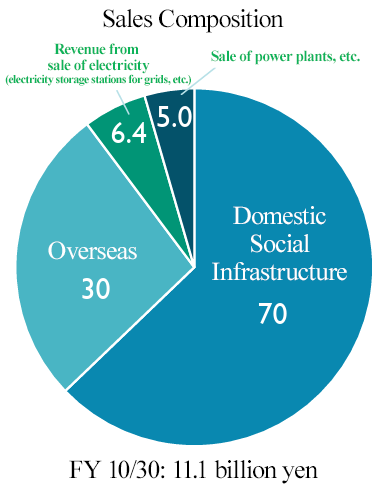 |
Out of sales of 11.1 billion yen in the fiscal year ending October 2030, social infrastructure in Japan accounts for 7 billion yen and social infrastructure outside Japan makes up 3 billion yen.
In the Renewable Energy Business, they are forecast to earn sales of around 1 billion yen by selling electricity with electricity storage stations for grids, which are highly profitable, selling solar power plants, and so on.
② Trend in each segment
◎ Electronics and Telecommunications Equipment Business
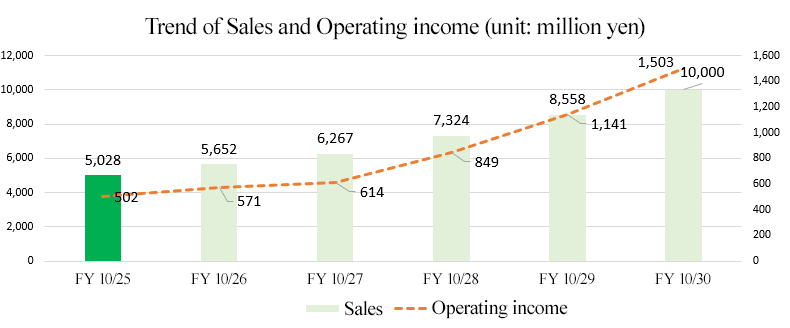
The operating income of Tamagawa Electronics is forecast to increase about three times from 502 million yen in the fiscal year ended October 2025 to 1,503 million yen in the fiscal year ending October 2030. In the medium-term management plan, it is important to raise profitability while increasing sales, by manufacturing products for governmental agencies, utilizing the factory in Vietnam, etc.
| FY 10/25 | FY 10/26 | FY 10/27 | FY 10/28 | FY 10/29 | FY 10/30 |
Sales | 5,028 | 5,652 | 6,267 | 7,324 | 8,558 | 10,000 |
Social infrastructure in Japan | 4,973 | 5,484 | 5,542 | 6,024 | 6,748 | 7,000 |
Social infrastructure outside Japan | 55 | 168 | 725 | 1,300 | 1,810 | 3,000 |
Operating income | 502 | 571 | 614 | 849 | 1,141 | 1,503 |
Operating income margin | 10.0% | 10.1% | 9.8% | 11.6% | 13.3% | 15.0% |
*Units: million yen and %. Taken from “Medium-term management plan of Tamagawa Holdings; Dec. 4, 2025” of the company. The figures from FY 10/26 are forecasts.
③ Renewable Energy Business
They started developing electricity storage stations for grids in the fiscal year ended October 2025, and their operation will start in the fiscal year ending October 2027, and the posting of revenue from sale of electricity will begin. The sales of power generation equipment, too, will grow, as they will construct and sell solar power plants according to the needs of clients and sell candidate land and rights for development of electricity storage stations for grids.
In terms of profit, ordinary income is expected to exceed 100 million yen from the fiscal year ending October 2028, thanks to the operation of electricity storage stations for grids, which have a high profit margin.
| FY 10/25 | FY 10/26 | FY 10/27 | FY 10/28 | FY 10/29 | FY 10/30 |
Sales | 559 | 625 | 785 | 967 | 1,139 | 1,154 |
Revenue from sale of electricity | 330 | 335 | 438 | 671 | 660 | 646 |
Sale of power generation equipment | 133 | 236 | 293 | 242 | 304 | 323 |
Other | 96 | 54 | 54 | 54 | 175 | 185 |
Operating income | 74 | 78 | 112 | 192 | 210 | 196 |
Operating income margin | 13.2% | 12.5% | 14.3% | 19.9% | 18.4% | 17.0% |
Ordinary income | 26 | 23 | 38 | 118 | 135 | 118 |
*Units: million yen and %. Taken from “Medium-term management plan of Tamagawa Holdings; Dec. 4, 2025” of the company. The figures from FY 10/26 are forecasts. “Other” is the sum of sales from consulting, construction work, operation & maintenance, and insurance.
(2) Progress of the numerical plan
-Growth exceeding the forecast, followed by the revision to the medium-term plan
As the core products in the Electronics and Telecommunications Equipment Business entered the mass production phase, both sales revenue and operating income were health in the fiscal year ending October 2026, which is the initial fiscal year of the medium-term management plan. On June 15, 2026, they revised the earnings forecast upwardly for the second time in the current fiscal year.
| FY 10/25 | FY 10/26 (Initial plan) | FY 10/26 (Revision 1) | FY 10/26 (Revision 2) | FY 10/27 | FY 10/28 | FY 10/29 | FY 10/30 |
Sales | 5,587 | 6,270 | 6,620 | 6,950 | 7,052 | 8,291 | 9,697 | 11,154 |
Electronic/ telecommunication devices | 5,029 | 5,645 | 5,995 | 6,325 | 6,267 | 7,324 | 8,558 | 10,000 |
Renewable energy | 558 | 625 | 625 | 625 | 785 | 967 | 1,139 | 1,154 |
Operating income | 278 | 369 | 560 | 820 | 446 | 761 | 1,071 | 1,419 |
Operating income margin | 5.0% | 5.8% | 8.5% | 11.7% | 6.3% | 9.2% | 11.0% | 12.7% |
*Units: million yen and %. Taken from the brief report on the financial results in FY 10/25 and “the reference material for explaining the financial results in the third quarter of FY 10/26; Sep. 14, 2026” of the company. The initial plan for FY 10/26 was announced on December 15, 2025, its first revision was announced on February 19, 2026, and its second revision was announced on June 15, 2026.
① Sales revenue
In the fiscal year ending October 2026, sales revenue is expected to grow 24.4% year on year (calculated by Investment Bridge) to 6,950 million yen, up 10.8% from the initial forecast. This is at the same level as the forecast for the fiscal year ending October 2027, so it has become more likely that they will achieve the target sales revenue one year earlier than expected.
The sales revenue of the Electronics and Telecommunications Equipment Business is expected to grow 25.8% year on year, up 12.0% from the initial forecast, exceeding the forecast for the fiscal year ending October 2027.
② Operating income
The operating income in the cumulative third quarter of the fiscal year ending October 2026 was 928 million yen, exceeding the upwardly revised annual forecast: 820 million yen, which exceeds not only the forecast for the fiscal year ending October 2027, but also the forecast for the fiscal year ending October 2028: 761 million yen. Operating income margin was 11.7%, exceeding the forecast for the fiscal year ending October 2029: 11.0%.
Like this, sales and profit are growing healthily, exceeding the forecast, so they are planning to revise the forecast at the time of announcement of the financial results in the fiscal year ending October 2026.
3. 3Q of Fiscal Year ending October 2026 Earnings Results
[3-1 Outline of business performance]
| 3Q of FY 10/25 (cumulative) | Ratio to sales revenue | 3Q of FY 10/26 (cumulative) | Ratio to sales revenue | YoY |
Sales revenue | 3,904 | 100.0% | 5,302 | 100.0% | +35.8% |
Gross profit | 1,178 | 30.2% | 2,153 | 40.6% | +82.7% |
SGA | 1,010 | 25.9% | 1,217 | 23.0% | +20.5% |
Operating income | 167 | 4.3% | 928 | 17.5% | +453.7% |
Pretax income | 222 | 5.7% | 2,452 | 46.2% | - |
Quarterly income | 163 | 4.2% | 1,950 | 36.8% | - |
*Unit: million yen. IFRS has been applied since the first quarter of FY 10/26. The figures in the cumulative third quarter of FY 10/25 are indicated in accordance with IFRS. Quarterly net income means the quarterly net income attributable to owners of the parent company.
Sales and profit grew significantly.
Sales revenue grew 35.8% year on year to 5,302 million yen, thanks to the Electronics and Telecommunications Equipment Business.
Operating income rose 453.7% year on year to 928 million yen. Gross profit increased at a rate that significantly exceeds the sales growth rate, and gross profit margin improved 10.4 points. SGA, including personnel expenses, augmented, but it was offset, and profit grew considerably.
[3-2 Trend in each segment]
Sales revenue | 3Q of FY 10/25 (cumulative) | Ratio to total sales revenue | 3Q of FY 10/26 (cumulative) | Ratio to total sales revenue | YoY |
Electronics and Telecommunications Equipment Business | 3,489 | 89.4% | 4,912 | 92.7% | +40.8% |
Renewable Energy Business | 414 | 10.6% | 389 | 7.3% | -6.2% |
Total sales revenue | 3,904 | 100.0% | 5,302 | 100.0% | +35.8% |
Profit | 3Q of FY 10/25 (cumulative) | Profit margin | 3Q of FY 10/26 (cumulative) | Profit margin | YoY |
Electronics and Telecommunications Equipment Business | 372 | 10.7% | 1,173 | 23.9% | +215.1% |
Renewable Energy Business | 70 | 17.0% | 88 | 22.8% | +26.1% |
Adjustment | -275 | - | -333 | - | - |
Total profit | 167 | 4.3% | 928 | 17.5% | +453.7% |
*Unit: million yen. IFRS has been applied since the first quarter of FY 10/26. The figures in the cumulative third quarter of FY 10/25 are indicated in accordance with IFRS. Sales mean the sales to external clients. The adjustment means group-wide expenses that do not belong to any segments to be reported.
(1) Electronics and Telecommunications Equipment Business
Sales and profit grew significantly.
The sales of products for “social infrastructure,” including governmental agencies, grew considerably, as related national budgets increased and large-scale projects entered the mass production phase. The annual sales forecast has been revised upwardly to 6.3 billion yen, up 12% from the initial forecast.
The profit in this segment exceeded the forecast, as they rationalized selling prices and improved production efficiency in response to the augmentation of material costs and personnel expenses, securing a stable profitability level. As they strengthened the manufacturing structure through capital investment and personnel development, the capability of responding to the growth of demand and profit margin improved.
(Topics)
・Large-scale projects for upgrading radar sites progressed steadily, and they proceeded with the establishment of a structure for mass-producing new RF modules on a full-scale basis, developing a base for dealing with increased orders.
・They proceeded with the trial production and inspection of next-generation wireless systems for trains, and promoted initiatives for entering new business fields by utilizing their high-frequency and microwave technologies.
・They aim to receive more orders by meeting the demand for 4G/5G telecommunication infrastructure and infrastructure sharing and strengthening their production system based on the Vietnamese factory.
・Order backlog remains large, as large-scale projects for governmental agencies and projects for telecommunication infrastructure increased. They will lead to the expansion of sales from the next fiscal year.
*Breakdown of sales revenue and amount of orders received in the Electronics and Telecommunications Equipment Business
| 3Q of FY 10/25 (cumulative) | Ratio to sales revenue | 3Q of FY 10/26 (cumulative) | Ratio to sales revenue | YoY |
Social infrastructure | 2,112 | 60.5% | 3,464 | 70.5% | +64.0% |
Mobile communication infrastructure | 933 | 26.7% | 1,089 | 22.2% | +16.7% |
FA and measurement | 444 | 12.7% | 359 | 7.3% | -19.1% |
Total | 3,489 | 100.0% | 4,912 | 100.0% | +40.8% |
Amount of orders received | 4,249 | - | 5,083 | - | +19.6% |
*Unit: million yen. IFRS has been applied since the first quarter of FY 10/26. The figures in the cumulative third quarter of FY 10/25, too, follow the IFRS.
(2) Renewable Energy Business
Sales declined, but profit grew.
The solar power plants and small-sized wind power plants they hold kept selling electricity in a healthy manner. For the same period of the previous year, construction projects were taken into account due to the postponement of posting, so sales declined year on year, but business performance is healthy as a whole. In response to order placement by clients, they are preparing for the development and sale of solar power plants without the feed-in tariff (FIT) system, which are expected to contribute to sales revenue and profit.
(Topics)
[Wind and solar power plants]
・They continued the development and maintenance of solar power plants and small-sized wind power plants. The sale of electricity, including the electricity generated by existing power plants, is healthy.
・The ordered development and sale of solar power plants is expected to start contributing to sales revenue and profit in the second half of the current fiscal year.
[Electricity storage stations for grids]
・In the fiscal year ended October 2025, they purchased land for business use and the right to generate electric power for the purpose of constructing electricity storage stations for grids. They plan to commercialize them with the electricity storage station for grids (Iga City, Mie Prefecture), which is scheduled to be connected to the utility grid in September 2027.
・They will keep selling the land for business use for electricity storage stations for grids and the right to generate electric power they have no plan to use to other companies.
・The electricity storage station for grids in Miyama City, Fukuoka Prefecture was connected to the utility grid in July 2026, and acquired by the company in August. After necessary reviews, they aim to start the operation in the supply-demand adjustment market as soon as possible.
[3-3 Financial standing]
◎ Primary balance sheet
| End of Oct. 2025 | End of Jul. 2026 | Increase/ decrease |
| End of Oct. 2025 | End of Jul. 2026 | Increase/ decrease |
Current assets | 6,186 | 8,486 | +2,300 | Current liabilities | 2,478 | 2,930 | +452 |
Cash, etc. | 1,221 | 4,747 | +3,526 | Accounts payable, etc. | 793 | 712 | -81 |
Accounts receivable, etc. | 2,021 | 746 | -1,275 | Debt | 908 | 1,233 | +325 |
Inventory assets | 2,752 | 2,738 | -14 | Non-current liabilities | 3,710 | 4,020 | +310 |
Non-current assets | 5,501 | 7,969 | +2,468 | Debt | 3,032 | 3,078 | +46 |
Tangible fixed assets | 3,774 | 4,646 | +872 | Total liabilities | 6,188 | 6,951 | +762 |
Other financial assets | 839 | 2,477 | +1,638 | Total equity | 5,499 | 9,505 | +4,006 |
Total assets | 11,687 | 16,456 | +4,769 | Total liabilities and equity | 11,687 | 16,456 | +4,769 |
*Unit: million yen. IFRS has been applied since FY 10/26. The figures as of the end of October 2025 are indicated in accordance with the IFRS. “Cash, etc.” mean cash and cash equivalents, “Accounts receivable, etc.” mean operating receivables and other receivables, and “Accounts payable, etc.” mean operating payables and other payables. Each figure was calculated in units of thousand yen with reference to the brief report on financial results of the company and indicated after rounding it off to the million. Debt includes lease obligations.
Total assets increased 4.7 billion yen from the end of the previous fiscal year to 16.4 billion yen, due to the growth of cash and deposits, etc. Total liabilities augmented 700 million yen from the end of the previous fiscal year to 6.9 billion yen, due to the increase in debt, etc. Total equity increased 4 billion yen from the end of the previous fiscal year to 9.5 billion yen, due to the increase in retained earnings, etc.
Equity ratio (the ratio of equity attributable to owners of the parent company) rose 10.7 points from the end of the previous fiscal year to 57.8%.
[3-4 Topics]
(1) Progress of business of Addvalue Technologies Ltd. and the estimated value of shares held by the company for reference
In September 2026, Tamagawa Holdings announced the news release titled “Progress of business of Addvalue Technologies Ltd. and the estimated value of shares held by the company for reference.”
The overview is as follows.
① Recent major business developments
◎ Establishment of a framework to be provided to the U.S. government based on the cooperation with Viasat
In August 2026, Addvalue announced that its subsidiary named Addvalue Solutions Pte. Ltd. would cooperate with Viasat, Inc., which is a satellite communication provider in the U.S. Based on this cooperation, they established a framework for offering the intersatellite data relay service “IDRS” of Addvalue via the managed service “HaloNet” of Viasat. This cooperation helps incorporate the technology of Addvalue into Viasat’s infrastructure for services for the U.S. government. Namely, concrete sales and operation structures for offering the IDRS technologies to clients in the U.S. government have been manifested.
◎ Plan of spinning off Addvalue Solutions and listing it on a U.S. market
Addvalue plans to make the business group led by Addvalue Solutions Pte. Ltd., which engages in the IDRS business, listed on NASDAQ or New York Stock Exchange (NYSE) after spinning off it. At the extraordinary meeting of shareholders held on September 24, 2026, they received shareholders’ approval for the listing plan and the possibility that the indirect equity of Addval will dilute by up to 30% due to the listing, so they think that there is a high possibility that this plan will actually progress.
They also recognize the possibility that the market evaluation of the IDRS business as an independent company, the procurement of funds for growth, and the presence in the U.S. space-related market will improve, if it is listed on a U.S. market.
② Target share price set by Maybank Research
Maybank Research Pte. Ltd., which is a firm specializing in financial surveys and research and headquartered in Singapore, concluded in an analyst’s report dated September 4, 2026 that shares in Addvalue should be bought and the 12-month target share price is 0.34 Singapore dollars (SGD) per share.
*This is not the share price forecast by Tamagawa Holdings or Addvalue, but the evaluation by a third-party analyst. Tamagawa Holdings introduces the target share price as a piece of reference information, and does not guarantee that the share price of Addvalue will reach said price or rise in the future.
③ Shareholding status of the Tamagawa Holdings Group and the estimated value for reference
The Tamagawa Holdings Group holds about 125 million shares in Addvalue, which account for about 3.44% of outstanding shares. If the target share price set by Maybank Research (0.34 Singapore dollars) is applied mechanically, the estimated value for reference will be around 5.27 billion yen, up around 3.02 billion yen from around 2.25 billion yen as of the end of July 2026 and up around 2.4 billion yen from around 2.87 billion yen as of September 24, 2026.
(Taken from the news release of the company)
(2) Completion of exercise of share acquisition rights
The exercise of all of the 15th, 16th, and 17th share acquisition rights was finished in the third quarter, so they procured around 1.2 billion yen as planned. They plan to allocate the procured fund to the construction of the second factory of the headquarters of Tamagawa Electronics and the development of electricity storage stations for grids.
4. Fiscal Year ending October 2026 Earnings Forecasts
[4-1 Earnings forecast]
| FY 10/25 | Rato to sales revenue | FY 10/26 (forecast) | Ratio to sales revenue | YoY | Progress rate |
Sales revenue | 5,587 | 100.0% | 6,950 | 100.0% | +24.4% | 76.3% |
Operating income | 278 | 5.0% | 820 | 11.7% | +194.0% | 113.2% |
Net income | 268 | 4.8% | 1,835 | 26.4% | +583.0% | 106.3% |
*Unit: million yen. IFRS has been applied since the first quarter of FY 10/26. The Japanese standards were applied for FY 10/25. The forecast was made by the company. The year on year comparison and the progress rate were calculated by Investment Bridge.
The earnings forecast has been left unchanged. Sales and profit are expected to grow considerably.
Sales revenue is expected to grow 24.4% year on year to 6,950 million yen and operating income is projected to rise 194.0% year on year to 820 million yen. In the Electronics and Telecommunications Equipment Business, the sales of products for “social infrastructure,” including those for governmental agencies, are growing considerably, as related national budgets are increasing and core products have entered the mass production phase. They plan to pay a dividend of 10.00 yen/share, two times larger than that in the previous fiscal year*. Business performance has been healthy until the third quarter, and profit has already exceeded the annual forecast, but considering the possibility of postponement of posting of sales from some large-scale projects, they have left the earnings forecast unchanged.
* The payout ratio of after-tax net income, including financial revenue (unrealized profit from shares in Addvalue) is around 5%, but the payout ratio of realized profit is 20%. See “1. Company Overview [1-6 Shareholder Return].”
[4-2 Key initiatives]
(1) Electronics and Telecommunications Equipment Business
They will make continuous efforts to receive large-scale orders steadily and deal with mass production in the social infrastructure business, including those for governmental agencies.
In the field of mobile communication infrastructure, they aim to expand their market share.
In order to improve production capacity and improve profitability, they will further utilize the Vietnamese factory and conduct business activities while assuming the difficulty in procuring raw materials due to the Middle East situation.
In order to improve personnel and make them competitive early, they will concentrate on the recruitment of mid-career workers who can work on actual tasks upon employment and the training of employees fresh out of college and young engineers to make them competitive early.
(2) Renewable Energy Business
They will actively carry out investment activities. While utilizing loans from banks, they concentrate on the early monetization of electricity storage stations for grids, which are expected to achieve an internal rate of return (IRR) of 10% or higher.
5. Interview with Presidents
We interviewed Mr. Toru Masuzawa, Representative Director and President of Tamagawa Holdings Co., Ltd., and Junichi Suzuki, Representative Director and President of Tamagawa Electronics Co., Ltd.
About the competitive advantage of the corporate group
(President Suzuki)
The greatest forte of Tamagawa Electronics is the high-frequency analog technology we have developed for many years. Our high-frequency analog technology has been highly regarded ever since the inauguration of business, and we have expanded our business range mainly for meeting the demand for products for governmental agencies. As our high technological competence also allows for expansion into digital technology fields such as optical transmission, digital signal processing and FPGA, there have been increasingly more cases of clients placing orders believing that “Tamagawa Electronics can handle technologies across various fields.” While the number of engineers specializing in the high-frequency analog technology is limited, we have many excellent human resources at our company, and our high-frequency analog technology presents a powerful competitive advantage as an “irreplaceable technology.”
(President Masuzawa)
70% of Tamagawa Electronics’ sales come from social infrastructure, including defense, railways, meteorology, satellites and telecommunication infrastructure, as well as products for governmental agencies.
As you know, not only product quality, but also long-lasting quality and reliability and technological capability for meeting the clients’ demands are required in these fields. In addition, high security requirements are demanded especially in defense and national security fields, which have been growing increasingly important in recent years. We have received very favorable reviews from customers in these fields, and I regard that as a significant strength of our corporate group.
As the demand is growing against the backdrop of an increase in a national budget for defense and national security-related fields, I cannot reveal the details, but mainstay products have entered the phase of full mass production and are projected to significantly drive future growth.
Moreover, we issued share acquisition rights for the 15th, 16th and 17th time in December 2025. All these rights have been exercised by May 2026, and we have thus managed to procure funds of 1.2 billion yen according to the initial plan.
The funds procured this time will be used for investment in future growth, allocated mainly to the construction of the second factory of the headquarters of Tamagawa Electronics and the development of electricity storage stations for grids, in addition to the enhancement of our financial foundations, and our corporate group will make joint efforts to complete the medium-term management plan.
Regarding the Renewable Energy Business
(President Masuzawa)
The business is still in a growing phase, accounting for only about 10% of both sales and profit of our company, but we are steadily cultivating it while considering investment risks.
With regard to renewable energy, the Japanese government is upholding “the achievement of carbon neutrality by 2050” as an international commitment. In addition, expansion of the renewable energy market, such as the usage of solar and wind power, is a necessary challenge stated in the 7th Energy Strategic Plan, alongside the restart of operations at nuclear power plants, and construction of new nuclear power plants.
Our corporate group has been focusing on the expansion of the business of electricity storage stations for grids, in order to further expand the renewable energy market.
While the amount of power generated by renewable energy is increasing, the amount of electricity generated by solar and wind power is easily affected by weather conditions, and the power supply is thus prone to instability. As a result, storage batteries for grids are growing increasingly important not only for the power supply adjustment at the peak of demand, but also for instant adjustment of electricity supply and demand. We are expecting significant growth in the medium/long term from electricity storage stations for grids, indispensable for the adjustment of electricity supply and demand, in step with expansion in the usage of renewable energy.
Regarding challenges toward medium-term growth
(President Suzuki)
As I mentioned a while ago, the greatest forte of our company is the high-frequency analog technology, but in order to keep surviving the severe competition, we must constantly work toward further refinement, not remaining content with our current position. One thing we must work on in order to achieve that is enhancing our human resources and organizational capability, and strengthening technologies and production bases that will support continuous growth. As a step toward the elevation of our technological capabilities, we shall engage even more proactively in open innovation with external partners such as universities and research institutes, and strive for accumulation of technologies.
(President Masuzawa)
With regard to human resources, it is necessary to not only recruit talent, but also arrange the environment for excellent personnel already working at our company to further exert their capabilities. We intend to consider and implement various measures, including the utilization of the capital market.
Message toward shareholders and investors
(President Suzuki)
Our company currently holds a large market share in the domain of devices for governmental agencies owing to high-frequency wireless communications. These technologies can be utilized to expand into new fields such as outer space, and not only in Japan, but also overseas, mainly Southeast Asia. We shall aim for further growth in the medium term through market cultivation in such domains, so you can hold expectations for that.
(President Masuzawa)
We have been making a steady progress with regard to the ongoing mid-term management plan.
We are forecasting a sales revenue of 6,950 million in the current fiscal year, which will end in October 2026, which is a level stated as a target for the fiscal year ending October 2027 in the medium-term management plan. We can thus expect the achievement of the target a year earlier than planned.
As for operating income, the result in the cumulative third quarter of the fiscal year ending 2026 has already reached 928 million yen, exceeding the upwardly revised forecast for the full fiscal year, which is 820 million yen. In addition, the forecast for the full fiscal year, which is 820 million yen, surpasses not only the target for the fiscal year ending October 2027, but also the target for the fiscal year ending October 2028, which was 761 million yen. Seeing how extremely well the company is performing at this point, we are considering the disclosure of a revision to the medium-term management plan at the announcement of financial results planned for December.
While supporting social infrastructure such as telecommunications, defense and national security, and railways through the Electronics and Telecommunications Equipment Business, we shall also contribute to decarbonization and stable power supply through the Renewable Energy Business. We would appreciate your continued support.
6. Conclusions
Since the inauguration of its business, Tamagawa Holdings has been highly evaluated for its high-frequency analog technology and expanded its business by meeting mainly the demand from governmental agencies. Since their technology can be applied to digital technology, they have expanded their technological domain, including system integration combining various technologies. As the company employs a large number of excellent engineers, their high-frequency technology is the source of great competitiveness in the Electronics and Telecommunications Equipment Business as an “irreplaceable technology.” Another strength of the company is the stable customer base composed of mainly governmental agencies, which was established based on this technology. In the fields of railways, meteorology, artificial satellites, telecommunication infrastructure, etc., including projects for governmental agencies, not only the performance of products, but also long-lasting quality and reliability, technologies for meeting customers’ requests, and rigorous security specs are required. The company is highly evaluated for the track record of delivering products for many years and their high-frequency technology. The medium-term management plan, which is expected to be completed one or two years earlier than forecast, is projected to be revised. We would like to pay keen attention to what kinds of measures will be implemented and what kinds of numerical goals will be set.
<Reference: Regarding Corporate Governance>
◎ Organization type, and the composition of directors and auditors
Organization type | Company with auditors |
Directors | 9 directors including 2 outside directors (including 2 independent executives) |
Auditors | 4 auditors including 2 outside auditors (including 2 independent executives) |
◎ Corporate Governance Report
Last update date: February 13, 2026
<Basic policy>
Our company recognizes that in order to improve corporate value, it is important to improve flexibility by making decisions more swiftly, increase the soundness of business administration, enhance the business overseeing function, and comply with laws and regulations.
Under this policy, we apply a system for fair and transpiration operation to the selection of directors, the determination of remuneration, management supervision, etc.
<Reasons for Non-compliance with the Principles of the Corporate Governance Code (Excerpts)>
[Supplementary Principle 1-2-3]
Our company recognizes that a general meeting of shareholders provides our company and shareholders with an opportunity to exchange constructive opinions. Since we changed the account closing month to October in the fiscal year ended October 2024, we hold a general meeting of shareholders in late January, and enable shareholders to electronically exercise their voting rights, so that their intentions are reflected appropriately. Accordingly, we think that there are no practical issues.
[Supplementary Principle 1-2-4]
Our company adopted a platform for electronic exercise of voting rights, for enabling the electronic exercise of voting rights, but we do not translate convocation notices into English for overseas investors. Considering the fact that shareholders of our company include overseas investors, we will think of disclosing the English version of the summary of convocation notices.
<Disclosure Based on the Principles of the Corporate Governance Code (Excerpts)>
[Principle 1-4 Strategically held shares]
1. Shareholding policy, methods for evaluating the rationality of shareholding, and discussions on whether it is appropriate to hold shares in individual companies
Regarding our shareholding policy, discussions on the rationality of shareholding, etc., the board of directors holds discussions at the time of acquisition, to clarify the purpose in acquisition and expected effects of shareholding and then make a resolution on whether or not to acquire shares. The progress of shareholding is regularly reported at meetings of the board of directors.
Regarding the appropriateness of strategically holding shares, we grasp the market value and the financial standing of the issuing company, consider the market situation and the relationship with business partners, and scrutinize the appropriateness of the purpose in shareholding, the balance between benefits, risk, and capital cost for shareholding, etc., and then review the appropriateness of shareholding regularly at meetings of the board of directors.
2. Exercise of voting rights
Regarding the voting rights of strategically held shares, we consider the agenda items and the details thereof written in the convocation notice for a general meeting of shareholders with reference to the management policy, accounting strategy, and management plan of the issuing company, social situations, etc. and then exercise the voting rights appropriately.
[Supplementary Principle 2-4-1]
Female employees account for 60% of managers in our company. The ratio of female employees, including that at management posts of subsidiaries, is kept constant. We will discuss measurable goals regarding the ratio of female managers in the entire corporate group.
Regarding the promotion of non-Japanese employees as core personnel, our second-tier subsidiary in Vietnam promotes non-Japanese employees to management posts, from the viewpoint of local business operation.
Regarding the policy for developing an in-house environment, we have established systems for childcare leave and maternity leave, but the development of other environments and personnel development will be discussed from now on.
[Supplementary Principle 3-1-3]
Our corporate policy “For the Future of People and the Planet” is in line with Sustainable Development Goals set by the United Nations in 2015.
It is necessary to combine various technologies in order to lead an affluent life while effectively utilizing limited resources of the Earth. Our company has engaged in the Renewable Energy Business since 2006 and the Electronics and Telecommunications Equipment Business for half a century since 1968.
Our company will keep contributing to the attainment of SDGs through business activities.
Concrete measures are disclosed below.
Initiatives for SDGs (https://www.tmex.co.jp/sustainability/sdgs.html)
In addition, the reference material for our session for explaining financial results describes our management strategy, measures for acquiring technologies for completing the strategy, and so on in detail.
Furthermore, Tamagawa Electronics Co., Ltd., which is a subsidiary, trains engineering staff for the purpose of improving their technical skills as professionals, and utilize subscription-type training services.
[Principle 5-1 Policy for constructive dialogues with shareholders]
If we receive a request for a dialogue (meeting) from a shareholder or an investor, we will basically discuss its purpose sufficiently and deal with it in a reasonable range.
In order to promote constructive dialogues with shareholders, the management planning department, which is in charge of IR, handles IR information in cooperation with related departments.
If an investor wants to interview us for gathering information, the management planning department, which is in charge of IR, will deal with it. In the case of interviews regarding the business domain of a subsidiary, our executive in charge of the subsidiary will participate in the interview.
This report is not intended for soliciting or promoting investment activities or offering any advice on investment or the like, but for providing information only. The information included in this report was taken from sources considered reliable by our company. Our company will not guarantee the accuracy, integrity, or appropriateness of information or opinions in this report. Our company will not assume any responsibility for expenses, damages or the like arising out of the use of this report or information obtained from this report. All kinds of rights related to this report belong to Investment Bridge Co., Ltd. The contents, etc. of this report may be revised without notice. Please make an investment decision on your own judgment. Copyright(C) Investment Bridge Co., Ltd. All Rights Reserved. |