



Bridge Report:(7604)UMENOHANA GROUP the Interim Period of Fiscal Year ending April 2026

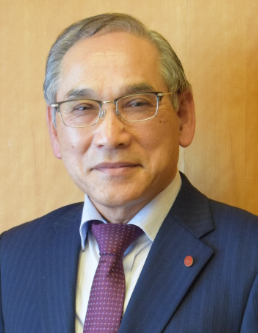 Chairperson and CEO Yuji Honda | UMENOHANA GROUP CO., LTD. |
 |
Company Information
Market | TSE Standard Market |
Industry | Retail |
Representative | The chairperson and CEO Yuji Honda and the president and COO Takahiro Onizuka |
HQ Address | 146 Tenjin-machi, Kurume-shi, Fukuoka Prefecture |
Year-end | April |
Homepage |
Stock Information
Share Price | Shares Outstanding | Total Market Cap | ROE (Act.) | Trading Unit | |
¥850 | 9,029,200 shares | ¥7,674 million | - | 100 shares | |
DPS (Est.) | Dividend Yield (Est.) | EPS (Est.) | PER (Est.) | BPS (Act.) | PBR (Act.) |
¥10.0 | 1.2% | ¥54.74 | 15.5x | ¥114.48 | 7.4x |
*The share price is the closing price on February 6. BPS and ROE are actual results from the previous fiscal year. Each figure is based on the financial results of the second quarter of the fiscal year ending April 2026.
Earning trends
Fiscal Year | Net Sales | Operating Income | Ordinary Income | Net Income | EPS | DPS |
April 2022 | 22,591 | -1,630 | -1,792 | 217 | 19.58 | 0.0 |
April 2023 | 27,456 | 89 | 14 | -440 | - | 5.0 |
April 2024 | 29,816 | 819 | 739 | 1,020 | 117.30 | 10.0 |
April 2025 | 29,440 | 550 | 388 | -383 | - | 10.0 |
April 2026 (Est.) | 29,713 | 778 | 538 | 485 | 54.74 | 10.0 |
*Forecast figures are those of the company. Unit: million yen, yen.
This report includes the overview of the earnings results of Umenohana Co., Ltd. in the interim period of the fiscal year ending April 2026.
Table of Contents
Key Points
1. Company Overview
2. Interim Period of Fiscal Year ending April 2026 Earnings Results
3. Fiscal Year ending April 2026 Earnings Forecasts
4. Conclusions
<Reference: Regarding corporate governance>
Key Points
- Under the theme of fusion of food and culture, Umenohana operates the Restaurant Business, the To-go Meal Business, and the External Sales Business. In the Restaurant Business, they operate restaurants, such as “Umenohana, a restaurant specializing in yuba (soy milk skin) and tofu,” “Kanishige,” a restaurant specializing in crab dishes,” “Sushihan, a Japanese-cuisine restaurant,” “Sakana ga Ichiban (Fish is the best option),” and “Shabushabu Koubai, a restaurant serving mainly lightly boiled beef from Japanese brown cattle grown in Kumamoto.” Since 2025, they have been opening restaurants outside Japan. In the To-go Meal Business, they operate “Koichian,” a store of rolled sushi, Inarizushi, etc., and “Umenohana,” a store of Japanese delicatessen and boxed meals. In the External Sales Business, they sell products of the Umenohana and Koichian brands through mail order and sell deep-fried oysters and other products to the Restaurant Business. In 1999, Umenohana became an over-the-counter company registered in Japan Securities Dealers Association. In 2002, the company got listed on the second section of Tokyo Stock Exchange. In April 2022, the company got listed on the Standard Market. In May 2025, the corporate name was changed to “UMENOHANA GROUP.” They are diversifying their restaurants.
- In the fiscal year ended April 2025, sales grew 1.4% year on year to 14,056 million yen. The average spending per customer at existing restaurants increased 3.9%, showing a healthy performance. The number of restaurants declined, but sales grew. In the restaurant industry, customer visits increased thanks to the recovery of demand from foreign visitors to Japan. In the food product field, the demand for visiting a store was healthy, thanks to seasonal events and the increase of visitors to Japan. Such a rebound was seen also in the delicatessen field, thanks to the growth of demand for outdoor amusement and needs for home food. Operating loss was 126 million yen (a loss of 133 million yen in the same period of the previous year). The loss shrank, as the ratio of SG&A expenses decreased thanks to the price revision and the improvement in the revenue structure after the remodeling or closure of unprofitable restaurants in the previous fiscal year. Sales were in line with the company’s forecast, and all kinds of profits fell below the forecast. They will pay an interim dividend of 5.00 yen/share as initially forecast.
- The annual earnings forecast has been left unchanged. For the fiscal year ending April 2026, sales are expected to rise 0.9% year on year to 29,713 million yen and operating income is projected to increase 41.4% year on year to 778 million yen. There remains the risk of economic downturn due to the U.S. trade policy, and the prices of ingredients and the costs of utilities keep increasing in Japan. In addition, the outlook will remain uncertain, due to the shortage of manpower, etc. Under these circumstances, they will raise wages while considering the rise in commodity prices, revise selling prices and improve productivity to adapt to the virtuous cycle of wage improvement. They will concentrate on the improvement in productivity and revenues of the Central Kitchen. The year-end dividend has not been revised, and they plan to pay 5.00 yen/share like in the previous fiscal year.
- In the interim period, operating loss shrank slightly, but all kinds of profits fell below the forecast significantly. The performance of the Restaurant Business and the To-go Meal Business, which are the mainstay, is not bad, as they reflected the skyrocketing of raw material prices in prices. It seems that the unprofitability of oysters hinders their business. It can be said that they need to improve profitability from the second half of the fiscal year. In the Restaurant Business, average spending per customer increased although the number of customers was stagnant. In the second half, business performance is expected to improve significantly from the end of winter, which saw a sluggish performance. They hope to catch up. Since the end of the COVID-19 pandemic, their performance has recovered rapidly and they have strengthened their initiatives for new business models. In the overseas business, they have opened restaurants in Thailand and Vietnam, and it is likely that they will conduct full-scale business operation outside Japan. “Umenohana” has a stable customer base, and their business is expected to grow by reeling in new customers.
1. Company Overview
Under the theme of fusion of food and culture, Umenohana operates the Restaurant Business, the To-go Meal Business, and the External Sales Business. In the Restaurant Business, they operate restaurants, such as “Umenohana, a restaurant specializing in yuba (soy milk skin) and tofu,” “Kanishige,” a restaurant specializing in crab dishes,” “Sushihan, a Japanese-cuisine restaurant,” “Sakana ga Ichiban (Fish is the best option),” and “Shabushabu Koubai, a restaurant serving mainly lightly boiled beef from Japanese brown cattle grown in Kumamoto.” Since 2025, they have been opening restaurants outside Japan. In the To-go Meal Business, they operate “Koichian,” a store of rolled sushi, Inarizushi, etc., and “Umenohana,” a store of Japanese delicatessen and boxed meals. In the External Sales Business, they sell products of the Umenohana and Koichian brands through mail order and sell deep-fried oysters and other products to the Restaurant Business.
Their management philosophy is “be grateful to people and things,” which used to be the motto of the late founder Shigetoshi Umeno.
The company was registered under the Japan Securities Dealers Association in 1999 and listed on the 2nd Section of TSE in 2002. In April 2022, the company got listed on the Standard Market of TSE. In May 2025, the corporate name was changed to “UMENOHANA GROUP.” They are diversifying their restaurants.
[1-1 History]
In 1976, Mr. Shigetoshi Umeno founded “Kanishige,” a restaurant specializing in crab dishes. After establishing the company, he served as President until 2018, expanding the business. Mr. Honda, who currently serves as chairperson and CEO, took over presidency in 2018.
Year and month | Event |
October 1979 | Founded Kanishige Limited in Saga City, Saga Prefecture, to operate dining facilities |
April 1986 | Opened the first “Umenohana, a restaurant specializing in yuba (soy milk skin) and tofu” in Kurume City, Fukuoka Prefecture (Kurume Restaurant) |
January 1990 | Founded UME CORPORATION Co., Ltd. in Kurume City, Fukuoka Prefecture |
July 1990 | UME CORPORATION Co., Ltd. absorbed Kanishige Limited. |
December 1992 | Newly established Kurume Central Kitchen in Kurume City, Fukuoka Prefecture. |
March 1996 | A building for the headquarters was acquired in and relocated to Kurume City, Fukuoka Prefecture. |
October 1997 | Renamed from UME CORPORATION Co., Ltd. to UMENOHANA Co., Ltd. |
April 1999 | The company’s stock was registered under the Japan Securities Dealers Association. |
June 2002 | Listed on the 2nd Section of TSE |
September 2003 | Founded UMENOHANA (THAILAND) CO., LTD in Bangkok, Thailand. |
September 2004 | Founded West Japan UMENOHANA Co., Ltd. and East Japan UMENOHANA Co., Ltd. through an incorporation-type demerger, taking over restaurant operation (Integrated in October 2008 due to organizational restructuring, changing the company name to Service Co., Ltd.) |
November 2004 | Founded UMENOHANA plus Limited in Kurume City, Fukuoka Prefecture (changed to UMENOHANA plus Co., Ltd. in October 2008). |
October 2007 | Turned Koichian Co., Ltd. into a subsidiary through share acquisition. |
November 2012 | Concluded a capital and business alliance agreement with H2O Retailing Corp. |
October 2014 | Turned Koichian Co., Ltd. into a wholly-owned subsidiary through share exchange. |
October 2016 | Turned Maruhira Shoten Co., Ltd. into a wholly-owned subsidiary through share acquisition. |
November 2016 | Concluded a memorandum on a capital and business alliance with Fujio Food System Co., Ltd. (the present name: FUJIO FOOD GROUP INC.). |
April 2017 | Turned Sushihan Co., Ltd. into a wholly-owned subsidiary through share acquisition. |
August 2018 | Newly established Kyoto Central Kitchen in Ide, Tsuzuki-gun, Kyoto Prefecture. |
December 2018 | Started closing accounts in April instead of September from the fiscal year ending April 2019. |
February 2019 | Established Sankyo UMENOHANA Co., Ltd. (which turned into a subsidiary) through a merger with the Agricultural Cooperative Association Kosei Farm (headquartered in Aso City, Kumamoto Prefecture). |
May 2019 | Turned TERAKEN Co., Ltd. into a subsidiary through share acquisition. |
January 2021 | Founded Plum Cooperative Union. |
May 2021 | Founded UMENOHANA Service Kyushu Co., Ltd. through an incorporation-type demerger, in which UMENOHANA Service West Japan Co., Ltd. was the splitting company. |
April 2022 | Got listed on the Standard Market of TSE in step with revisions to the TSE market classification. |
May 2022 | Performed an absorption-type merger in which Koichian Co., Ltd. was the surviving company and UMENOHANA plus Co., Ltd. was the absorbed company, and changed the company name to Koichian Plus Co., Ltd. |
March 2023 | Terminated the capital and business alliance agreement with H2O Retailing Corp. |
May 2025 | Renamed to “UMENOHANA GROUP.” |
October 2025 | Umenohana Vietnam Co., Ltd. started their Restaurant Business. |
[1-2 Business structure]
≪Central Kitchens≫
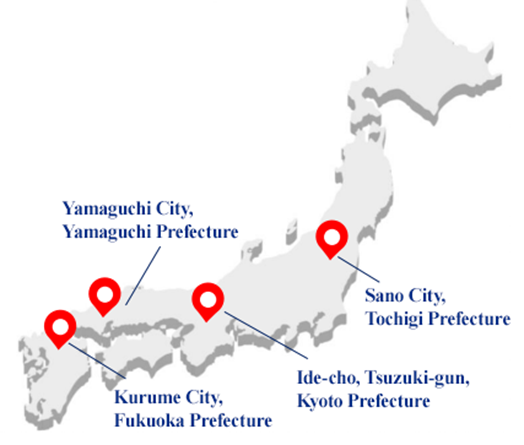
The Central Kitchen produces a total of 1,000 or more items, such as ingredients for “Umenohana” and “Koichian.” They achieved unchanging delicious taste and a stable supply.
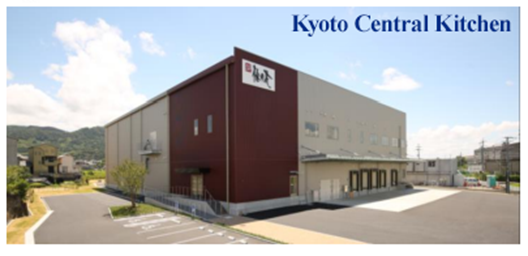 | Delivering “safe, secure and delicious taste” throughout Japan
|
(Taken from the reference material of the company)
Ingredients produced at Central Kitchens are shipped out on the day of production and delivered to respective restaurants and stores preserving the freshness and flavor. As ingredients are made into final dishes at restaurants/stores, unchanging delicious food is served to customers at any time.
Delicate ingredients such as yuba (soy milk skin) are made entirely by hand without the use of machines. The exquisite taste is created by the experience and intuition of experts. Even when expert cooks are not available, it is possible to provide products with a high level of technical expertise. Automated equipment has been installed to maintain stable production and quality. Tasks that require meticulousness are handled by employees.
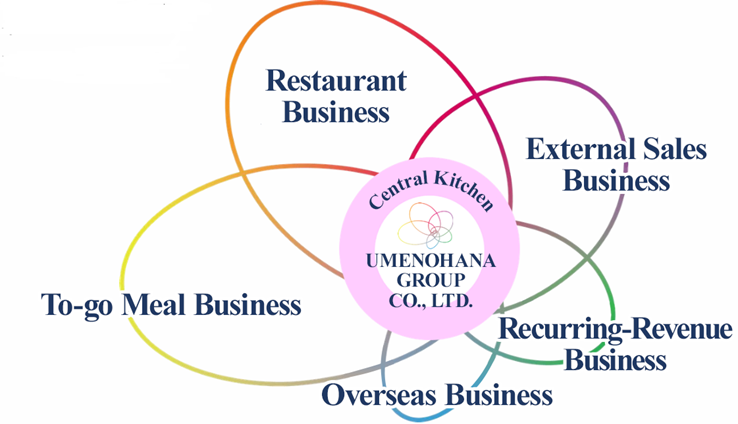
In recent years, the company has been strengthening its group strategy. In May 2025, the company changed its trade name to “UMENOHANA GROUP.” Despite these changes, the Central Kitchen remains at the core of the business.
The company operates five businesses: Restaurant Business, To-go Meal Business, External Sales Business, Recurring-Revenue Business, and Overseas Business.
"Five Businesses" of UMENOHANA GROUP
(Taken from the reference material of the company)
[1-3 Business description]
≪Restaurant Business≫
UMENOHANA Service Co., Ltd. (a consolidated subsidiary) operates dining facilities, mainly “Umenohana, a restaurant specializing in yuba (soy milk skin) and tofu,” Sushihan Co., Ltd. (a consolidated subsidiary) manages “Sushihan, a Japanese-cuisine restaurant,” TERAKEN Co., Ltd. (a consolidated subsidiary) runs dining facilities, mainly “Sakura Suisan, a Japanese-style pub serving seafood dishes,” and Sankyo UMENOHANA Co., Ltd. (a consolidated subsidiary) is responsible for the operation of “Shabushabu Koubai, a restaurant serving mainly lightly boiled beef from Japanese brown cattle grown in Kumamoto.” The company supplies ingredients, equipment, etc. and provides guidance concerning management, services for undertaking accounting paperwork, etc. to these subsidiaries.
The features of each dining style offered by the corporate group in the Restaurant Business is as follows.
Dining style | Features |
Umenohana, a restaurant specializing in yuba (soy milk skin) and tofu | High-quality, meticulously cooked meals centered on tofu and yuba, designed to create “memorable moments” through unwavering commitment to exceptional food, ambience, and heartfelt services. |
Kanishige, a restaurant specializing in crab dishes | Offering high-quality, meticulously prepared meals, mainly crab dishes, and a relaxing time to spend with important persons on special occasions. |
Creative Chinese Cuisine Restaurant – CHINA Umenohana | Serving creative Chinese dishes made with tofu and yuba. Customers of all ages can spend a peaceful time here. |
Sushihan, a Japanese-cuisine restaurant | With operations rooted in each local region, it offers Japanese dishes utilizing ingredients that appeal to everyone from children to the elderly in a relaxed atmosphere. |
Sakana ga Ichiban (Fish is the best option) | Sakura Suisan has changed its business model. With their lively customer services and atmosphere, customers can fully enjoy a wide variety of fresh seasonal fish prepared using the fish-killing method to maintain freshness, at reasonable prices. |
Shabushabu Koubai, a restaurant serving mainly lightly boiled beef from Japanese brown cattle grown in Kumamoto | Customers can enjoy traditional Japanese meat dishes in a luxurious space with rare beef from Japanese brown cattle grown in Kumamoto and an exceptional dining atmosphere. |
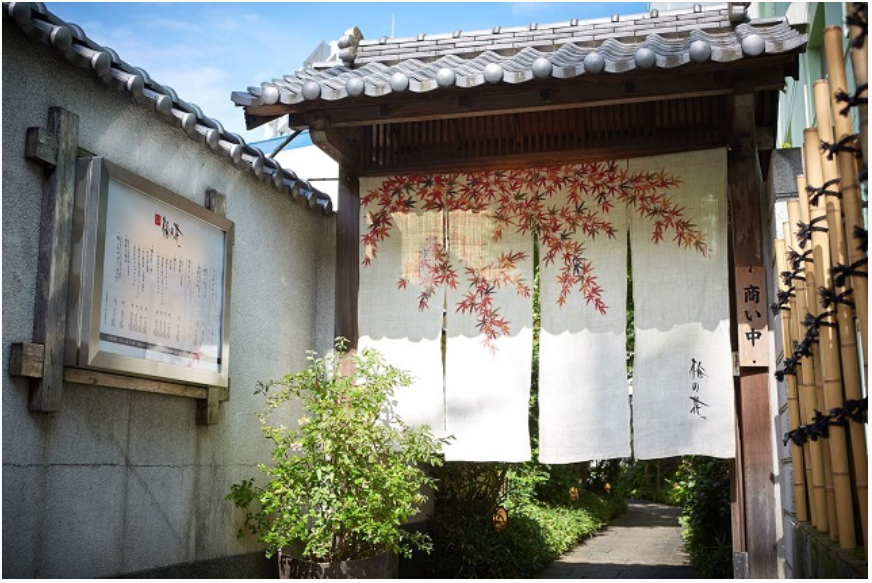
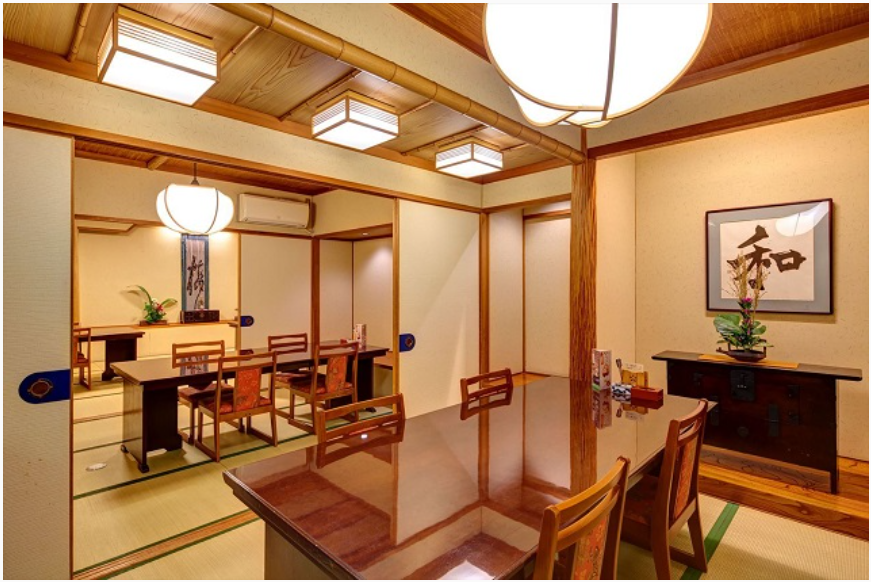
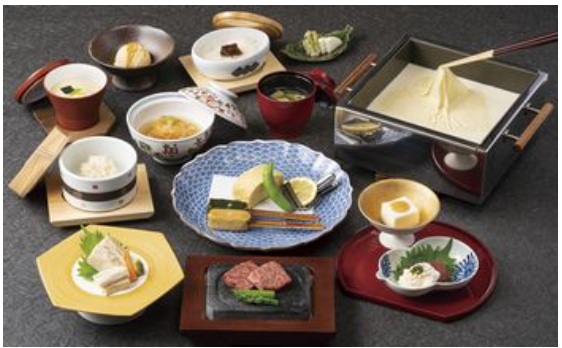
“Umenohana, a restaurant specializing in yuba (soy milk skin) and tofu” – Kurume Restaurant | ||
 |
 |
 |
(Taken from the company website)
The group’s mainstay “Umenohana, a restaurant specializing in yuba (soy milk skin) and tofu” offers “memorable moments” through unwavering commitment to exceptional food, ambience, and heartfelt services. It offers meticulously cooked high-quality meals focused on tofu and yuba. Customers are welcomed with sincere hospitality tailored to each individual in a comfortable setting where they can lose track of time.
In addition, with the aim of further expanding the business, the company has opened "Creative Chinese Cuisine Restaurant – CHINA Umenohana" and “Seasonal Kamameshi – Hanakoume.” Furthermore, the company has acquired Sushi Han, which operates “Sushihan, a Japanese-cuisine restaurant,” and Teraken, which operates "Sakura Suisan, a Japanese-style pub serving seafood dishes," through M&A. "Sakura Suisan, a Japanese-style pub serving seafood dishes" has changed its business model to “Sakana ga Ichiban” (Fish is the best option) and is proceeding with renovation. As a new business model, the high-end restaurant “Shabushabu Koubai, a restaurant serving mainly lightly boiled beef from Japanese brown cattle grown in Kumamoto” was opened in GINZA SIX in March 2020 and in Tokyo Solamachi in March 2025. It has gained popularity among foreign visitors to Japan.
In addition, the company operates multiple restaurants, including “Meixiang,” which serves Chinese cuisine that stimulates all five senses; “Seasonal kamameshi - Hanakoume”; “Chaseika,” which serves rice porridge made with yuba; “Umenohana-no-teishoku-ya Umemame,” and “Shoku no Tsumugi,” which serves meals and café dishes based on handmade tofu, yuba, and soy milk.

(Taken from the reference material of the company)
≪To-go Meal Business≫
Koichian Plus Co., Ltd. (a consolidated subsidiary) operates stores of mainly the “Koichian” and “Umenohana” brands. The company supplies ingredients, equipment, etc. and provides guidance concerning management, services for undertaking accounting paperwork, etc. to this subsidiary.
It all began with the desire to let people enjoy the deliciousness of restaurants effortlessly at home. Established in Osaka in 1977 and joined the Umenohana Group in 2007, Koichian offers seasonal delicacies and events with traditional Japanese dishes, boxed meals, rolled sushi, Inarizushi, and rice balls. Brands of to-go meals are available at department stores, etc., across Japan. In addition, suburban stores also operate “Oshitori” and “Hotaru.”
In April 2025, a new business model, “Umenohana KITCHEN,” was opened.
The features of each major brand offered by the corporate group in the To-go Meal Business is as follows.
Brand | Features |
Koichian | Offering products that reflect the tradition and seasonality of Kamigata sushi, as well as a playful creativity, bringing “colorful moments” to everyday dining. With traditional Kamigata sushi as a base, the restaurant offers a variety of playful sushi rolls incorporating seasonal flavors and trends that are available to enjoy effortlessly at home anytime. |
Umenohana | “Umenohana, a restaurant specializing in yuba (soy milk skin) and tofu,” is famous for its “tofu shumai” and “deep-fried yuba” dishes, which feature the flavors of Umenohana, as well as offering boxed meals and side dishes that are gentle to the soul and body using plenty of "soybean ingredients" such as tofu and yuba. |
Umenohana KITCHEN | Opened in April 2025 as a new business model The Umenohana brand offers a wide selection of prepared foods and boxed meals, while the Koichian brand offers rice balls and sushi, as well as a wide selection of popular desserts. These products are offered at reasonable prices and sizes. |
≪External Sales Business≫
Umenohana is strongly associated with the image of a restaurant-based dining business. However, the company is also focusing on the To-go Meal Business centered on the store operation in department stores and is also making efforts to develop an External Sales Business as its third pillar. The company plans to share customer feedback expressing happiness in being able to enjoy the flavors of Umenohana and Koichian at the local supermarkets.
Services are provided in the following formats
Service Format | Features | |
Online Specialty Store Ume Asobi | High-quality, carefully cooked dishes made mainly from tofu and yuba can be ordered online. It offers a chance to enjoy “special moments” at home. With the small set called “Chotto Zutsu Set,” customers can enjoy all six of the delicious flavors that represent the pride of “Umenohana, a restaurant specializing in yuba (soy milk skin) and tofu.” |
 Scan it |
External Sales | The company sells a variety of products to supermarkets and restaurant operators as new sales channels. In addition to the stable, standard flavors produced by the Central Kitchen, the company develops and sells products that meet customer needs. Commercial food ingredients such as deep-fried oysters are used by restaurant operators. | |
Bento Honpo [Home Delivery] | The company delivers “Umenohana” boxed meals for special occasions and important meetings. Operating across four regions: Kyoto, Nara & Shiga; Osaka & Hyogo; Tokai; and Fukuoka & Saga. | |
≪Recurring-Revenue Business≫
Services provided by Reise Co., Ltd. The Umenohana Group is working to make effective use of its land and buildings, aiming to stabilize revenue. A rental property that includes storage rooms and monthly parking lots was built on the site of the former Osaka Central Kitchen, and the company started a leasing business with its own property in Osaka City.
In February 2025, the company started leasing its own properties in Osaka City as offices.
Plans to begin initiatives aimed at effective utilization of 11 properties owned in Osaka and Hyogo Prefectures and diversification of revenue streams. Since all properties are located near railway stations, construction of rental apartments with attached stores is planned for some properties, with the aim of starting work.
≪Overseas Business≫
The company aims to develop various business models, including " Umenohana, a restaurant specializing in yuba (soy milk skin) and tofu," by opening restaurants mainly in Asian countries overseas.
“UMENOHANA(THAILAND)CO., LTD.,” a subsidiary established in 2003, runs “Wa-Umenohana” UMENOHANA Solaria Restaurant in Thailand, and opened the second restaurant “Ginza Shabushabu Koubai” in September 2025.
In August 2025, they established a local corporation in Vietnam and started the operation of “KUROGE WAGYU NOBU” (renamed “UME” in April 2026).
From the fiscal year ending May 2026 onward, the company aims to expand its multi-restaurant operations in Thailand and Vietnam and make new market entries in Southeast Asia, including Indonesia and the Philippines.
The overseas business has just begun.
[1-4 Sustainability]
―Together with producers ― Delivering a safe and secure delicious taste together with producers
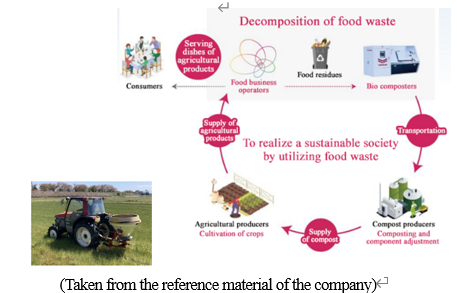
Reduction of annual amount of waste from food residues at Central Kitchen by 100% As an initiative for the expansion of coexistence and co-prosperity with producers and to address environmental issues, annual waste reduction is implemented. At the Central Kitchens in Kurume, Kyoto, and Sano, 273 tons of food residue have been reduced to zero. Currently, some restaurants have begun implementing this initiative. | Contract farming of “Yumepirika soybeans” Umenohana has contracted with seven farms in the Sorachi and Tokachi Districts in Hokkaido to produce “Yumepirika soybeans,” which are indispensable for making tofu, a specialty of Umenohana. The company has been purchasing all produce since 2010, also striving for stable procurement of ingredients.
 (Taken from the reference material of the company) “Yukipirika soybeans” are characteristic in having a higher isoflavone content in comparison with other soybeans. Rare soybean variety grown in small amounts as it is difficult to cultivate. |
 |
―Support for Refugees in Myanmar―
“The Flower of a Dream Association” was established in 2014. The company and its employees contribute to the sound development of international communities by conducting support activities with business partners through charity golf events.
The aim is to contribute to the development of children who will lead the future by conducting activities to raise public awareness and promote the smooth operation of school management and school meal programs for children in developing countries who are unable to receive school education or eat school meals.
―Provision of food to volunteer-run children’s cafeterias―
The Umenohana Group has provided boxed meals, etc., from its retail stores and food products from the Central Kitchen to the NPO Children's Cafeteria.
―Support for areas affected by natural disasters―
The company provided food to evacuation shelters during the torrential rain disaster in Kurume City, Fukuoka Prefecture, for 11 days in July 2023.
―Consideration of the environment―
The company is working to reduce greenhouse gas emissions. The materials used for deliveries from the logistics center to restaurants/stores were changed from dry ice and polystyrene foam to recyclable containers and reusable high-performance ice packs, thereby reducing the annual amount of dry ice used. Kyoto Central Kitchen is equipped with solar panels to reduce greenhouse gas emissions.
Plum Cooperative Union
The company founded “Plum Cooperative Union (a non-consolidated subsidiary)” with the objective of launching the business of “Joint Acceptance of Foreign Technical Interns” and engaging in the businesses of “Support for Specified Skilled Foreign Worker” and “Employment Placement.” 26 companies are union members (6 companies from UMENOHANA Group and 20 other companies).
(1)Foreign technical intern acceptance program conducted for union members
(2)Employment placement services related to joint acceptance programs for foreign technical interns
(3)Employment placement services for foreign nationals with specified skills
2. Interim Period of Fiscal Year ending April 2026 Earnings Results
[2-1 Consolidated Earnings Results]
| FY 4/25 Interim | Ratio to sales | FY 4/26 Interim | Ratio to sales | YoY | The company’s forecast | Compared to forecast |
Sales | 13,855 | 100.0% | 14,056 | 100.0% | +1.4% | 14,023 | +0.2% |
Gross profit | 9,057 | 65.4% | 9,046 | 64.4% | -0.1% | - | - |
SG&A expenses | 9,190 | 66.3% | 9,173 | 65.3% | -0.2% | - | - |
Operating income | -133 | - | -126 | - | - | 19 | - |
Ordinary income | -223 | - | -252 | - | - | -101 | - |
Interim net income | -166 | - | -202 | - | - | 188 | - |
*Unit: million yen.
Sales increased 1.4%, and an operating loss remained flat, so each performance fell below the company’s forecast.
Sales grew 1.4% year on year to 14,056 million yen. The average spending per customer at existing restaurants increased 3.9%, showing a healthy performance. The number of restaurants declined, but sales grew. In the restaurant industry, customer visits increased thanks to the recovery of demand from foreign visitors to Japan. In the food product field, the demand for visiting a store was healthy, thanks to seasonal events and the increase of visitors to Japan. Such a rebound was seen also in the delicatessen field, thanks to the growth of demand for outdoor amusement and needs for home food.
Operating loss was 126 million yen (a loss of 133 million yen in the same period of the previous year). As commodity prices rose, gross profit margin decreased year on year from 65.4% to 64.4%. The loss shrank, as the ratio of SG&A expenses decreased thanks to the price revision and the improvement in the revenue structure after the remodeling or closure of unprofitable restaurants in the previous fiscal year. Ordinary loss was 252 million yen (a loss of 223 million yen in the previous fiscal year) as interest paid rose, and net loss was 202 million yen (a loss of 166 million yen in the previous fiscal year). Sales were in line with the company’s forecast, and all kinds of profits fell below the forecast.
They will pay an interim dividend of 5.00 yen/share as initially forecast.
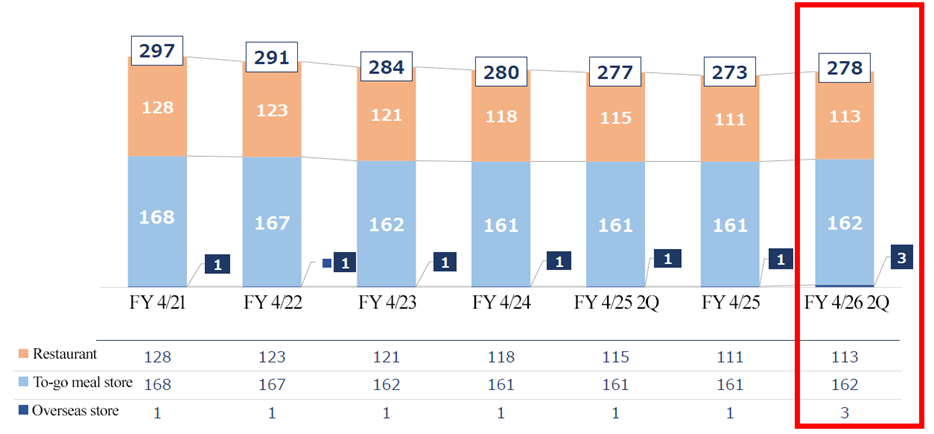
Changes in the number of stores
(Taken from the reference material of the company)
[2-2 Sales and operating income in each segment]
| FY 4/25 Interim | Composition Ratio | FY 4/26 Interim | Composition Ratio | YoY |
Sales |
|
|
|
|
|
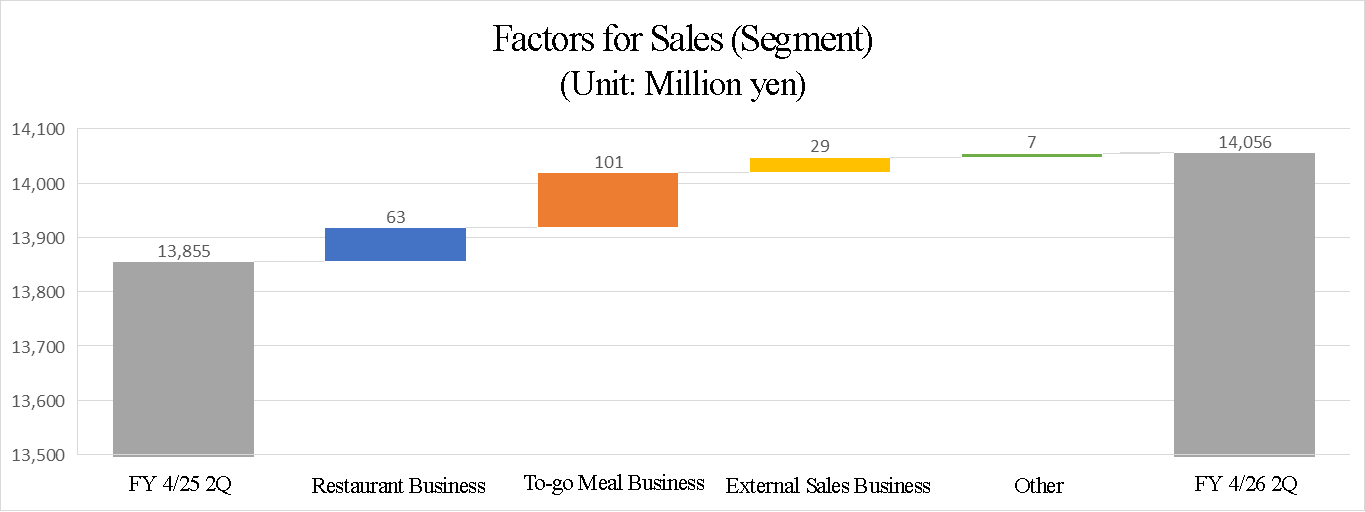
Restaurant Business | 7,938 | 57.3% | 8,001 | 56.9% | +0.8% |
To-go Meal Business | 4,941 | 35.7% | 5,042 | 35.9% | +2.1% |
External Sales Business | 958 | 6.9% | 987 | 7.0% | +3.0% |
Other | 17 | 0.1% | 24 | 0.2% | +37.9% |
Total | 13,855 | 100.0% | 14,056 | 100.0% | +1.4% |
Profit in each segment |
|
|
|
|
|
Restaurant Business | 186 | 2.4% | 298 | 3.7% | +59.5% |
To-go Meal Business | 294 | 6.0% | 236 | 4.7% | -19.8% |
External Sales Business | -140 | - | -167 | - | - |
Other/adjustment | -474 | - | -493 | - | - |
Total | -133 | - | -126 | - | - |
*Unit: million yen. The composition ratio of profit in each segment means profit margin.
* Restaurant Business
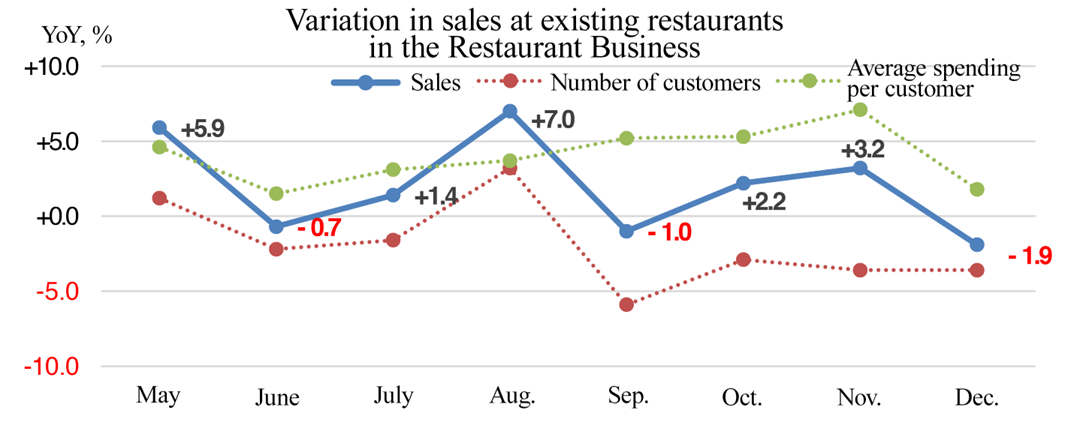
Sales increased 0.8% year on year to 8,001 million yen and operating income increased 59.5% year on year to 298 million yen.
They continue digital sales promotion utilizing social media and the public app “Umeno App,” to popularize the brand further. In addition, they revised prices and restaurant menus and shifted to in-restaurant processing, etc. in response to the skyrocketing of prices of rice and ingredients and the augmentation of personnel costs due to the revision to minimum wages. By managing personnel costs and other costs thoroughly, they strive to improve revenues. Regarding “Umenohana, a restaurant specializing in tofu and yuba (soy milk skin) and tofu,” the sales of lunch and kaiseki (traditional multi-course Japanese dinner) dishes increased from the previous year, thanks to the time-limited menus including seasonal ingredients and campaigns for app subscribers. In addition, they sold expensive boxed meals on Respect-for-Senior-Citizens Day and accepted the reservations for “Osechi (New Year dishes)” as “return gifts for donations to local governments for taking a tax deduction.” In “Sushihan, a Japanese-cuisine restaurant,” they revised prices of dishes in the regular menu and the lunch menu in September, to improve profitability. Regarding “Tamatsukuri Restaurant of Seasonal Sushi and Tempura Sushihan Iki,” which was opened after renovation in March 2025, the number of customers and the average spending per customer increased from the previous year. For “Seafood Restaurant Sakura Suisan,” they strengthened the management of personnel expenses and other costs and closed unprofitable restaurants in the previous fiscal year, so performance improved significantly. For “Shabushabu Koubai, a restaurant serving mainly lightly boiled beef from Japanese brown cattle grown in Kumamoto,” customers from outside Japan increased thanks to the measures targeted at wealthy people and foreign visitors to Japan and multi-language promotion.
They opened “Jizo Yokocho Restaurant of Chinese Cuisine Meishan” in June 2025 and “Kuzuha Mall Restaurant of Umenohana-no-teishoku-ya Umemame” in October 2025.
*To-go Meal Business
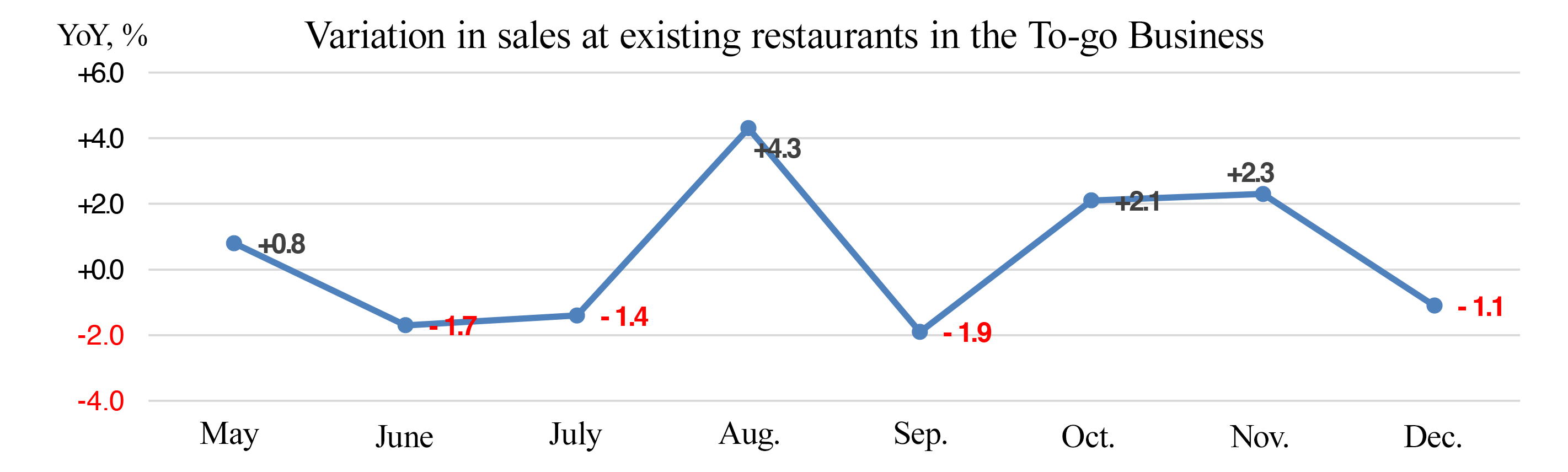
Sales increased 2,1% year on year to 5,042 million yen and operating income decreased 19.8% year on year to 236 million yen.
In the Umenohana business, seasonal products and the new product “two-tiered boxed meal” sold well. In the Koichian business, sales grew thanks to the favorable sales of event-related products. In addition, average spending per customer rose as they revised prices in response to the skyrocketing of prices of rice and ingredients. On the other hand, the number of customers dropped from the previous year, and they are striving to motivate customers to visit a restaurant by adopting digital stamp collection cards, strengthening the linkage with “Umeno App,” and improving the system for attending to customers. Profit declined, as the costs for ingredients and materials increased more significantly than assumed.
They opened “Kusatsu-Kintetsu Restaurant of Umenohana” in May 2025, and opened “Ikebukuro-Seibu Restaurant of Umenohana” and “Ikebukuro-Seibu Restaurant of Koichian” after renovation in September. In “Higashi-Osaka-Kintetsu Restaurant of Koichian,” a booth where some products were replaced with the products of the Umenohana brand was established.
*External Sales Business
Sales increased 3.0% year on year to 987 million yen, and they posted an operating loss of 167 million yen (an operating loss of 140 million yen in the previous fiscal year).
They enhanced the effort to give proposals to existing business partners and proposed products to enterprises that belong to the co-prosperity association of the Umenohana Group. In addition, they engaged in the expansion of sales channels for the core product “tofu dumplings,” sushi, boxed meals, etc. via exhibitions and other events. Sales grew as daily stocked products sold well. Also, for the mail order business, their sales promotion activities, including factory tours, email newsletters, and app distribution, were effective. In terms of profit, loss augmented as the price revision produced some effects later than assumed due to the procedures and personnel expenses increased through the strengthening of the external sales system.
[2-3 Financial Condition]
◎ Balance Sheet Summary
| April 2025 | October 2025 | Increase/ Decrease |
| April 2025 | October 2025 | Increase/ Decrease |
Current assets | 6,845 | 6,321 | -523 | Current liabilities | 9,230 | 10,103 | +873 |
Cash and deposits | 2,076 | 1,841 | -235 | Trade payables | 673 | 636 | -37 |
Trade receivable | 1,632 | 1,654 | +22 | Short-term interest-bearing debt | 6,223 | 7,362 | +1,138 |
Inventories | 2,115 | 1,775 | -339 | Noncurrent liabilities | 11,894 | 10,739 | -1,155 |
Noncurrent assets | 16,105 | 16,130 | +24 | Long-term interest-bearing debt | 10,357 | 9,198 | -1,159 |
Property, plant and equipment | 13,077 | 12,971 | -105 | Total liabilities | 21,125 | 20,842 | -282 |
Intangible assets | 180 | 159 | -21 | Net assets | 1,826 | 1,609 | -216 |
Investments and other assets | 2,848 | 2,999 | +150 | Total retained earnings | -564 | -767 | -202 |
Total assets | 22,951 | 22,451 | -499 | Total liabilities and net assets | 22,951 | 22,451 | -499 |
*Unit: million yen. Short-term debts include current portion of long-term debts.
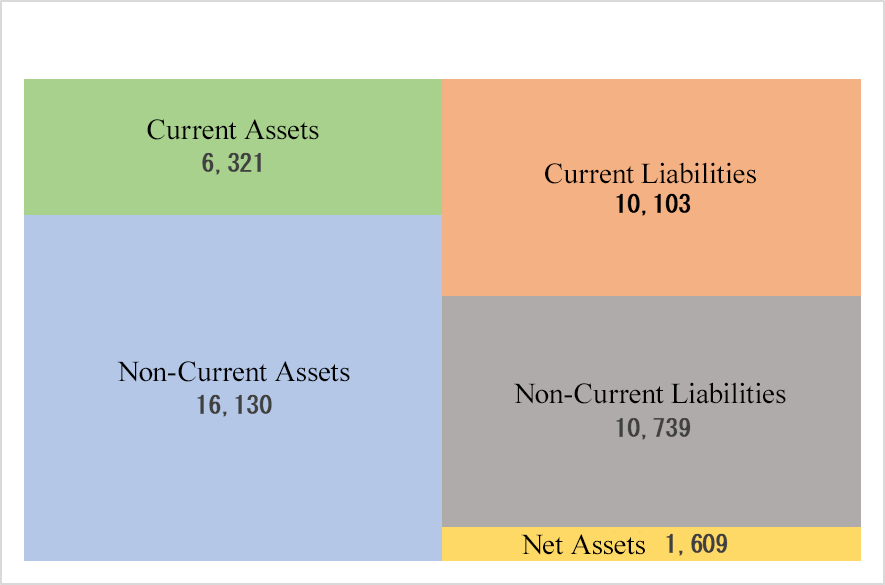
The total assets as of the end of the interim period of the fiscal year ended April 2026 stood at 22,451 million yen, down 499 million yen from the end of the previous fiscal year, due to the decrease of cash and deposits.
Total liabilities decreased 282 million yen from the end of the previous fiscal year to 20,842 million yen, due to a reduction in provisions.
Net assets decreased 216 million yen from the end of the previous fiscal year to 1,609 million yen, due to the posting of an interim net loss and so on.
Capital-to-asset ratio dropped from 8.0% at the end of the previous fiscal year to 7.2%.
3. Fiscal Year ending April 2026 Earnings Forecasts
[3-1 Earnings Forecasts]
| FY 4/25 | Ratio to sales | FY 4/26 (Est.) | Ratio to sales | YoY |
Sales | 29,440 | 100.0% | 29,713 | 100.0% | +0.9% |
Operating income | 550 | 1.9% | 778 | 2.6% | +41.4% |
Ordinary income | 388 | 1.3% | 538 | 1.8% | +38.4% |
Net income | -383 | - | 485 | 1.6% | - |
*Unit: million yen.
Projecting sales to increase 0.9% year on year and profit to grow 41.4% year on year for the fiscal year ending April 2026
The annual earnings forecast has been left unchanged. For the fiscal year ending April 2026, sales are expected to rise 0.9% year on year to 29,713 million yen and operating income is projected to increase 41.4% year on year to 778 million yen.
There remains the risk of economic downturn due to the U.S. trade policy, and the prices of ingredients and the costs of utilities keep increasing, such as the rise in rice prices due to the rice shortage in Japan. In addition, the outlook will remain uncertain, due to the shortage of manpower, etc. Under these circumstances, they will raise wages while considering the rise in commodity prices, revise selling prices and improve productivity to adapt to the virtuous cycle of wage improvement. They will enhance the sale of in-house products to clients outside the corporate group, and concentrate on the improvement in productivity and revenues of the Central Kitchen. In addition, they will pursue the coexistence and coprosperity with producers, and continuously engage in social and environmental issues.
The year-end dividend has not been revised, and they plan to pay 5.00 yen/share, for a total of 10.00 yen/share per year like in the previous fiscal year.
[3-2 Situation and initiatives in FY 4/26]
(1) Promotion of three priority projects
① Smart CK project
They will review and select their products to be produced, rationalize working hours, streamline factory operation, and improve costs.
Out of 1,452 products, 577 products are subject to this project. They determined policies for 308 products out of them, and carried out some measures for 290 products as of the end of December (discontinuing the production of 216 products, outsourcing the production of 14 products, changing the production process for 26 products, and shifting to in-store production for 27 products).
They reduced working hours by 41,038 hours and expenses by 4,295,000 yen. Up until now, they have dealt with 84 out 326 products.
② Web media products
They will distribute information on Umenohana Group via social media, and share information on customers among groups, to improve popularity and the capacity to attract customers.
The number of Instagram followers for the entire Umenohana Group grew around 1.5 times from March 2025. The number of subscribers to the official app “Umeno App” exceeded 300,000.
③ Workstyle reform project
They will streamline tasks that depend on individual skills and many manual tasks and save labor by utilizing technologies, including AI, for curtailing personnel expenses and coping with the shortage of manpower.
They adopted AI and RPA, to reduce working hours and sophisticate management operations.
(2) To open more casual restaurants to curb investment
In the first half of the current fiscal year, they opened 2 restaurants in the Restaurant Business, 1 shop in the To-go Meal Business, and 2 restaurants in the overseas business. As of the end of the interim period, they owned 113 restaurants in the Restaurant Business, 162 shops in the To-go Meal Business, and 3 restaurants in the overseas business, having a total of 278 restaurants/shops.
In the second half, they opened the two shops “Umeda-Hanshin Shop of Umenohana-Shizuku” and “Omiya-Ecute Shop of Umenohana” in the To-go Meal Business in November.
In February 2026, they renovated “Ebista-Nishinomiya Shop of Shoku-no-tsumugi Cafe” into “Ebista-Nishinomiya Restaurant of Umenohana-no-teishoku-ya Umemame” and opened it in the Restaurant Business.
In March, they plan to open “Aeon Mall Tsudanuma South Restaurant of Sakana ga Ichiban (Fish is the best option)” and “Kumamoto Amu Plaza Shop of Umenohana Koichian” in the To-go Meal Business.
(3) Progress in the second half
・ At the end of winter in the previous fiscal year, performance was sluggish due to the bad weather, so the recovery from that period can be expected in the second half of this fiscal year.
・ As the prices of ingredients, etc. are rising, but it is said that rice price will decrease from the fourth quarter.
[3-3 Shareholders’ benefits]
They have adopted a new shareholder benefit program.
This will be applied to shareholders listed or registered in the shareholder register as of October 2026 or later.
<Shareholder’s certificate>
・Can be used at restaurants of the Umenohana Group.
・Discount rate varies according to restaurant type.
・Can be used limitlessly during the effective period.
<Coupon>
・Can be used at restaurants of the Umenohana Group.
・Distributed twice a year (after the right allotment in April and October)
Existing shareholders
Regarding the shareholders who hold 100 or more shares listed or registered in the shareholder register on or before April 30, 2026, the shareholder’s certificate for a 20% discount of the shareholders who keep holding 100 or more shares with the same shareholder number will remain valid and the shareholders who hold 500 or more shares will receive coupons.
Number of shares held | Shareholders’ benefits | Month of right allotment |
100 to 499 | A shareholder’s certificate for a 20% discount | April and October |
500 to 999 | A shareholder’s certificate for a 20% discount Two 1000-yen coupons (4,000 yen per year) | |
1,000 or more | A shareholder’s certificate for a 20% discount Five 1000-yen coupons (10,000 yen per year) |
New shareholders
The shareholders listed or registered in the shareholder register on or after May 1, 2026 will receive the following benefits.
Number of shares held | Shareholders’ benefits | Month of right allotment |
100 to 199 | A shareholder’s certificate for a 10% discount | April and October |
200 to 499 | A shareholder’s certificate for a 20% discount | |
500 to 999 | A shareholder’s certificate for a 20% discount Two 1000-yen coupons (4,000 yen per year) | |
1,000 or more | A shareholder’s certificate for a 20% discount Five 1000-yen coupons (10,000 yen per year) |
4. Conclusions
In the interim period, operating loss shrank slightly, but all kinds of profits fell below the forecast significantly. The performance of the Restaurant Business and the To-go Meal Business, which are the mainstay, is not bad, as they reflected the skyrocketing of raw material prices in prices. It seems that the unprofitability of oysters hinders their business. It can be said that they need to improve profitability from the second half of the fiscal year.
In the Restaurant Business, average spending per customer increased although the number of customers was stagnant. In the second half, business performance is expected to improve significantly from the end of winter, which saw a sluggish performance. They hope to catch up.
Since the end of the COVID-19 pandemic, their performance has recovered rapidly and they have strengthened their initiatives for new business models. In the overseas business, they have opened restaurants in Thailand and Vietnam, and it is likely that they will conduct full-scale business operation outside Japan. “Umenohana” has a stable customer base, and their business is expected to grow by reeling in new customers. It is projected to contribute to the improvement in utilization rate and efficiency of the Central Kitchen.
From now on, it seems that they need to improve their financial standing, which degraded during the COVID-19 pandemic. Capital-to-asset ratio remains 7.2%, so they hope to raise it to 20% by steadily increasing profit. Then, they are expected to enhance shareholder return by increasing the dividend amount, etc.
They have enriched shareholders’ benefits and enhanced initiatives for promoting a rise in share price. In addition to their business performance, we would like to pay attention to the announcement of “their measure for realizing business administration conscious of capital cost and share price,” “a medium-term plan,” etc.
<Reference: Regarding corporate governance>
◎ Organization type, and the composition of directors and audit and supervisory committee
Organization type | Company with audit and supervisory committee |
Directors | 11 directors, including 4 external ones |
Audit and supervisory committee | 4 members, including 3 external ones |
◎ Corporate Governance Report (Last Update: August 15, 2025)
Basic Views
Based on the following basic policy and our corporate philosophy of “Be grateful to people and things,” we aim to ensure sound and transparent management, respond promptly to changes in the business environment, and realize mutual prosperity with local communities and business partners by improving corporate value through social contributions and sustainable growth, satisfying shareholders, customers, and the employees. We believe that this is the base for corporate governance.
<Basic Policy>
(1) Ensuring shareholders’ rights and equality
(2) Appropriate collaboration with stakeholders other than shareholders
(3) Ensuring transparency through appropriate information disclosure
(4) Ensuring transparency through separation of management and supervision
(5) Active dialogue with shareholders
<Reasons for Non-compliance with the Principles of the Corporate Governance Code (Excerpts)>
[Supplementary Principle 4-1 (ii) Making best efforts to achieve the medium-term management plan, taking measures if the plan is not achieved, and reflecting them in the next plan]
Recognizing that management strategies and management plans are a commitment to shareholders, the Board of Directors will do their best to achieve the plan. Should the company fail to deliver on its medium-term management plan, the reasons underlying the failure of achievement as well as the company’s actions will be fully analyzed, and disclosing the results of such analysis to the shareholders will be considered accordingly, while the analytic findings will be reflected in a plan for the ensuing years.
<Disclosure Based on Principles of the Corporate Governance Code (Excerpts)>
[Principle 1-4 Strategically Held Shares]
Basic Policy on Strategically Held Shares
We hold shares in companies that we have determined are suitable for investment after taking into consideration the benefits to be derived from the maintenance and development of business relationships.
Basic Policy for Verification
The Board of Directors annually reviews the appropriateness of holding strategically held shares.
Taking into consideration the maintenance of relationships with business partners and business benefits of holding the shares, we determine whether there is any significance to holding the shares and decide whether to continue holding them or dispose of them.
Basic Policy on Exercise of Voting Rights
Regarding the exercise of voting rights for strategically held shares, we will carefully examine the content of each proposal and decide whether to support or oppose it after comprehensively considering factors such as whether it contributes to improving shareholder value and whether it will impede business relations with our company.
[Principle 3-1 Enhancement of information disclosure]
In addition to appropriate disclosure in accordance with laws and regulations, we disseminate information on the following matters from the perspective of ensuring the transparency and fairness of our decision-making and realizing effective corporate governance.
(i) Our corporate philosophy is disclosed on our website as a message from the founder.
https://www.umenohana.co.jp/company/message.html
Management strategies and management plans will be prepared and disclosed in the future.
(ii) Basic Views and Policies Regarding Corporate Governance
Please refer to “1. Basic Views” in this report.
(iii) Policies and Procedures for Determining the Compensation of Directors and Audit & Supervisory Committee Members
The basic policy for determining the compensation of directors (excluding audit and supervisory committee members) is to aim for the sustainable improvement of corporate value and to set an appropriate level taking into consideration factors such as position, responsibilities and years of service, and to make a comprehensive decision while taking into consideration the standards of other companies and employee salaries. The compensation for directors (excluding audit and supervisory committee members) consists solely of monthly fixed monetary compensation, which accounts for all of their individual compensation. The Representative Director and President is entrusted with the determination of the specific details of individual compensation based on a resolution of the Board of Directors, and as a measure to ensure that the Representative Director and President exercises his/her authority appropriately, the Representative Director and President seeks the opinion of the Audit and Supervisory Committee on a draft that is prepared within the framework of the compensation limit resolved at the general meeting of shareholders, and makes an appropriate decision while taking into consideration the opinion. Going forward, we will consider adopting stock-based compensation linked to business performance.
In addition, compensation for directors (members of the Audit and Supervisory Committee) is determined through discussions by the Audit and Supervisory Committee within the scope of the applicable compensation limits.
(iv) Policies and Procedures for the Board of Director’s Appointment and Dismissal of Senior Management Personnel and Nomination of Candidates for Directors
In accordance with the “Director Appointment Policy,” the Board of Directors deliberates on the appointment and dismissal of directors based on the opinions of the Audit and Supervisory Committee after comprehensively reviewing the skills required by the company, such as character, insight, and business and professional experience which are suited for the execution and supervision of management, through an exchange of opinions at Board of Directors meetings, including outside directors, and submits the results to the General Meeting of Shareholders.
In the event that a director candidate does not meet the required qualifications or ability to perform the duties of a director, or in the event that there is a suspicion of wrongful conduct or a material fact in violation of laws, regulations or the Articles of Incorporation, the Board of Directors shall deliberate on the matter.
(v) Explanation of the individual appointment and dismissal of the senior management personnel and the nomination of candidates for Directors by the Board of Directors based on (iv) above
An explanation of the appointment and nomination of individual candidates for Directors appointed by the Board of Directors is included in the reference documents of the Convocation Notice for the General Meeting of Shareholders.
[Supplementary Principle 3-1 (iii) Sustainability]
Our company established a “sustainability committee” for the purpose of systematically promoting the initiatives and activities for sustainability. The committee is chaired by the representative director, president and COO. The following basic policies for sustainability will be reflected in the business policies, purposes, and goals of the entire Umenohana Group, and we will meet social needs by conducting sustainability-oriented business administration.
1. Basic policies
(1) Our corporate group engages in corporate activities for solving environmental and social issues and contributes to the development of a sustainable society.
(2) We conduct activities for solving the issues with the earth environment, while being aware of corporate responsibilities in a broad range of fields.
(3) We foster virtuous ethics and behave with common sense, while being aware of being a good corporate citizen.
(4) We promote faithful, transparent corporate activities in accordance with laws, regulations, and fair commercial customs.
Our company is committed to the following sustainability initiatives.
1. Consideration of global environmental issues
①Reducing energy consumption by joint delivery with other companies
②Introducing solar power generation, switching to LED lighting, and power control
③Reducing the number of deliveries and changing delivery materials to recyclable containers and switching from dry ice to high-performance refrigerants
④Commercializing soy pulp and recycling residues
⑤Reducing plastic use (using paper straws and wooden spoons), recycling waste oil, and conserving resources by reducing printed materials
2. Respect for human rights
①Eliminating discrimination based on gender and nationality by promoting women to managerial positions and actively hiring foreign workers
3. Fair and appropriate treatment of employees and consideration for their health and working environment
①Improving the working environment by conducting DX and reviewing and improving operations
4. Fair and appropriate transactions with business partners
①Compliance with relevant laws and regulations such as the Subcontract Act and the Unfair Competition Prevention Act
5. Crisis management for natural disasters
①Business continuity through decentralization of Central Kitchens
3. Human capital
Regarding investment in human capital, we allocate resources appropriately according to our management strategies and issues and disclose the number of employees in each department and subsidiary in our financial statements. Regarding investment in intellectual property, we are considering revamping our entire business system, including the core business system, in order to improve productivity and increase contact points with customers.
[Principle 5-1 Policy on constructive dialogue with shareholders]
Our IR activities are based on the principle of providing timely, transparent, accurate and consistent information to shareholders, whether positive or negative.
The Corporate Planning Office, centered on the President and Representative Director, is in charge of IR activities based on this basic stance, and collects and compiles information necessary for IR activities from each business and administrative division. In addition, when we receive requests for dialogue (interviews) from shareholders, we will respond with sincerity within reasonable limits and share information such as requests obtained from shareholders through dialogue.
[IR activities]
・ Annual general meeting of shareholders: once a year
・ Financial results announcement: twice a year
・ Tasting events and factory tours open only to shareholders: Approximately six times a year (which varies)
・ Dissemination of information via the company’s website: As needed
This report is not intended for soliciting or promoting investment activities or offering any advice on investment or the like, but for providing information only. The information included in this report was taken from sources considered reliable by our company. Our company will not guarantee the accuracy, integrity, or appropriateness of information or opinions in this report. Our company will not assume any responsibility for expenses, damages or the like arising out of the use of this report or information obtained from this report. All kinds of rights related to this report belong to Investment Bridge Co., Ltd. The contents, etc. of this report may be revised without notice. Please make an investment decision on your own judgment. Copyright(C) Investment Bridge Co., Ltd. All Rights Reserved. |