



Bridge Report:(8130)Sangetsu the Fiscal Year ended March 2026

 Yasumasa Kondo, President | Sangetsu Corporation (8130) |
 |
Company Information
Market | TSE Prime Market, NSE Premier Market |
Industry | Wholesale (Commerce) |
Executive Director and President Executive officer | Yasumasa Kondo |
HQ Address | 1-4-1 Habashita, Nishi-ku, Nagoya-shi, Aichi-ken |
Year-end | End of March |
URL |
Stock Information
Share Price | Shares Outstanding | Total market cap | ROE Act. | Trading Unit | |
¥2,950 | 59,200,000 shares | ¥174,640 million | 12.5% | 100 shares | |
DPS Est. | Dividend yield Est. | EPS Est. | PER Est. | BPS Act. | PBR Act. |
¥155.00 | 5.3% | ¥229.62 | 12.8x | ¥2,067.46 | 1.4x |
*The share price is the closing price on June 26. Each figure is from the financial results for the fiscal year ended March 2026.
Earnings Trend
Fiscal Year | Net Sales | Operating Income | Ordinary Income | Net Income | EPS | DPS |
March 2023 Act. | 176,022 | 20,280 | 20,690 | 14,005 | 238.71 | 105.00 |
March 2024 Act. | 189,859 | 19,103 | 19,695 | 14,291 | 243.44 | 140.00 |
March 2025 Act. | 200,378 | 18,140 | 18,572 | 12,550 | 213.60 | 150.00 |
March 2026 Act. | 206,441 | 19,408 | 20,152 | 14,642 | 249.08 | 155.00 |
March 2027 Est. | 213,000 | 19,000 | 19,200 | 13,500 | 229.62 | 155.00 |
*Unit: million yen, yen. Estimates are those of the company. Net income is profit attributable to owners of the parent. Hereinafter the same shall apply. The changes in prices of energy and raw materials due to the growing tension in the Middle East and the growth of geopolitical risks and their impact on the supply chain have been excluded in this earnings forecast, because it was difficult to conduct rational estimation as of May 2026. In FY 3/26, provisional accounting for business combination was carried out, and it is reflected in the figures in FY 3/25.
This Bridge Report presents earnings results for the fiscal year ended March 2026 of Sangetsu Corporation, the outline of the Medium-term Management Plan 2029, and interview with President Kondo.
Table of Contents
Key Points
1. Company Overview
2. Fiscal Year ended March 2026 Earnings Results
3. Fiscal Year ending March 2027 Earnings Forecasts
4. Medium-term Management Plan 2029
5. Interview with President Kondo
6. Conclusions
<Reference: Regarding Corporate Governance>
Key Points
- In the fiscal year ended March 2026, sales grew 3.0% year on year to 206.4 billion yen, hitting a record high. In the domestic interior segment, sales quantities decreased due to the sluggish domestic demand, the fire accident at a factory of a major supplier, etc., but sales grew thanks to price revisions, etc. Sales increased also in the domestic exterior and overseas segments. Operating income rose 7.0% year on year to 19.4 billion yen. In the domestic interior segment, operating income increased, as the effect of the fire accident at the supplier’s factory and the cost augmentation were offset by the price revisions, the increase of sale of high value-added products, and the expansion of revenues of group companies. The domestic exterior segment, too, saw a profit growth, and the deficit in the overseas segment shrank. Both sales and profit were in line with the forecast announced in November 2025.
- For the fiscal year ending March 2027, sales are expected to grow and profit is projected to decline. In detail, sales are expected to grow 3.2% year on year to 213 billion yen and operating income is projected to decline 2.1% year on year to 19 billion yen. Due to the skyrocketing of construction costs, etc., it is forecast that new construction will be stagnant in both the residential and non-residential sectors, and they will receive a healthy number of orders for remodeling and renovation. This forecast includes the augmentation of raw material procurement costs, logistics costs, etc., the rise in SG&A expenses, including personnel expenses, and the investment in growth strategies. The annual dividend amount is scheduled to be 155.00 yen/share, unchanged from the previous fiscal year. The expected payout ratio is 67.5%. Meanwhile, this forecast does not include the soaring of energy prices due to the tense Middle East situation and the increase of geopolitical risks, the difficulty in procuring raw materials caused by the disturbance of supply chains, or uncertainties about the rise in raw material prices, etc., because it was difficult to rationally estimate these effects as of May 2026 (The effect of the price revision conducted on July 1, 2026 was not taken into account, either). If it becomes necessary to revise the earnings forecast, they will announce it immediately.
- They announced the “Medium-term Management Plan 2029” for the 4 years ending in the fiscal year ending March 2030. Upholding the slogans "Transformation, Challenge and the Driving of Innovation" they will keep enhancing the interior business as a growth driver and establish a more robust revenue base by diversifying products and cooperating with partner enterprises. They will also accelerate the growth of the overseas business in North America and Asia, by selling mainly interior products. Considering the comprehensive space and exterior businesses as the fields where they will apply the strengths of the interior business, they will grow them steadily as promising businesses in the medium/long term while maximizing their synergetic effects. For the fiscal year ending March 2030, they aim to achieve “sales of 250 billion yen, an operating income of 25 billion yen, and an ROE of 14.0%.”
- We interviewed President Kondo about the issues he considers when formulating and announcing the “Medium-term Management Plan 2029,” the points of the new medium-term plan, his message toward shareholders and investors, and so on. He said, “In accordance with the previous medium-term plan, our company launched a comprehensive space business with the aim of transforming into a space creation company, but we found that it would take more time to have the new business contribute to overall revenues than initially assumed, due to the differences in business model. In addition, the ‘Medium-term Management Plan 2029’ describes strategies for growing the interior, comprehensive space, and exterior businesses by reconsidering our core business and taking advantage of its strengths, in order to grow sustainably and dramatically. The interior business is our revenue base, but the domestic market will shrink in volume inevitably, so we cannot rest on our laurels. We will seek business opportunities in the non-residential, remodeling, and renovation markets and related fields, and pursue growth by utilizing our competitive advantage, which is the core of our company. To do so, it is indispensable to conduct investment in M&A and others for growth, but we will also return profit to shareholders responsibly, to achieve both and live up to the expectations of shareholders and investors, so I hope that you will keep supporting our company.”
- For their business, it is difficult to significantly increase sales and profit in an organic manner in a short period of time, but through active investment for growth, they aim to achieve “sales of 250 billion yen, an operating income of 25 billion yen and an ROE of 14%” in the fiscal year ending March 2030, four years from now.
- In some companies, a path toward growth that should be pursued by companies is unclear, because they focus on shareholder return excessively in order to improve PBR. Meanwhile, Sangetsu plans to invest 45-55 billion yen for corporate growth, exceeding the fund for shareholder return: 35-45 billion yen. We would like to pay attention to the progress of their investment for growth.
1. Company Overview
Sangetsu Corporation is the largest among all Japanese trading companies specializing in wallcoverings, flooring materials, curtains and other interior decorating products. Being a trading firm, the company also operates as a “fabless company” that plans and develops interior decorating products except for some products. Sangetsu boasts of a business model that is able to produce stable earnings and top market share in its main product realms.
As of the end of March 2026, the group is composed of eleven companies including “Sangetsu Okinawa Corporation,” which sells interior merchandise in the Okinawa area, “Sangetsu Vosne Corporation,” a distributor specializing in curtains “Sungreen Co., Ltd.,” a dedicated distributor of exterior products, “GOODRICH GLOBAL LIMITED,” the company responsible for business in China and Hong Kong, “KOROSEAL INTERIOR PRODUCTS HOLDINGS, INC.,” the United States company conducting sales of wallcovering materials for non-residential applications, “Goodrich Global Holdings Pte., Ltd.,” the company selling interior merchandise in Southeast Asia, “D’Perception Pte Ltd.,” which designs spaces and offers comprehensive construction services in Southeast Asia, mainly Singapore, “Fairtone Co., Ltd.,” which seeks to grow orders on the back of enhanced installation capabilities, Japan’s largest manufacturer of vinyl wallcovering, “CREANATE Inc,” “Kurosukikaku, Corporation” which is a leading delivery firm in the Kyushu area, and “SDS Co., Ltd.,” which is a logistics company.
[1-1 Corporate History]
Sangetsu was founded in 1849 under the original name of “Sangetsudo” to sell various traditional Japanese interior decorating products including scrolls, wall scrolls, folding screens, sliding doors, partitioning screens, and other products made of cloth and paper. Sangetsu Corporation was incorporated in 1953 by the founding family. From the latter half of the 1970s onwards, the business was expanded into Tokyo, Osaka, Fukuoka and other parts of Japan. In 1980, Sangetsu was listed on the Second Section of the Nagoya Stock Exchange, and later in 1996 its shares were also listed on the First Section of the Tokyo Stock Exchange. Currently, Sangetsu is expanding its operations into overseas markets and has established itself as a large total interior decorating product provider.
In April 2022, through the restructuring of stock markets, the company got listed on the Prime Market of Tokyo Stock Exchange and the Premier Market of Nagoya Stock Exchange.
[1-2 Corporate Identity]
In January 2024, they set up new corporate philosophies: “Purpose,” the supreme concept, “Dream,” a vision to realize based on the purpose, “Belief,” a belief as an enterprise for realizing the purpose, and “Way,” employees’ stance with the aim of creating social value as an enterprise.
Furthermore, when formulating the “Medium-term Management Plan 2029” for the four years ending in the fiscal year ending March 2030 in May 2026, they defined their corporate credo as “integrity” and their ideal state as "Shaping Culture from interiors through Materials and Design".
Regarding the corporate credo, they incorporated the original credo “integrity,” which was set up when determining their corporate philosophy in 2024, into their corporate philosophy “belief of putting importance on things,” but since the business startup in 1849, “integrity” has been the DNA and identity of Sangetsu for connecting all employees and stakeholders, and this is their original concept they should go back to. Remembering it, they decided to uphold the corporate credo “integrity.”
Corporate Philosophy of Sangetsu Group
Purpose: meanings of existence | To create a space filled with peace of mind and hope, together with everyone |
Dream: Vision to realize | A world where anyone can talk about tomorrow’s dream |
Belief: Belief to cherish | The sincerity of each enterprise would become power to change our society. |
Way: our stance | Freedom & fairness, ego & co-creation, and change & a leap forward |
Corporate credo | Integrity |
Ideal corporate state | Shaping Culture from interiors through Materials and Design |
[1-3 Market Environment]
◎ Overview
The market environment for the main wallcoverings and flooring materials is strongly influenced by trends in the Japanese construction market. The domestic interior market is projected to decline in the long term, due to the decreases in new housing starts and area caused by the shrinkage of the population and changes in family composition.
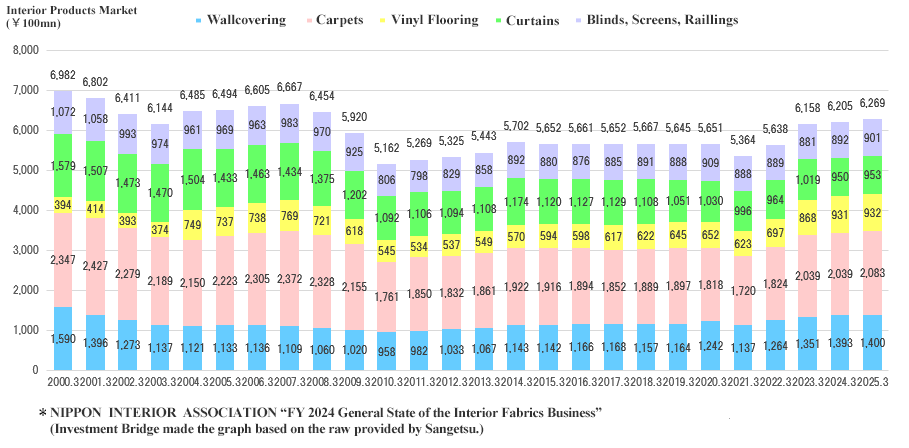
(Source: the company)
At the same time, the graph below shows the correlation between sales of Sangetsu relative to sales of the domestic interior market and new housing starts (Ministry of Land, Infrastructure, Transport, and Tourism data). The company’s sales and trends in the domestic interior market have been largely linked to the number of new housing starts, but following the collapse of Lehman Brothers, while the overall market and the number of new housing starts have remained at low levels, the company’s sales have been at record highs continuously until March 2020. In the fiscal year ended March 2021, sales dropped for the first time in 11 fiscal years, due to the COVID-19, but sales grew in the fiscal year ended March 2022. Since the fiscal year ended March 2023, they had high a record high for 4 consecutive fiscal years until the fiscal year ended March 2026.
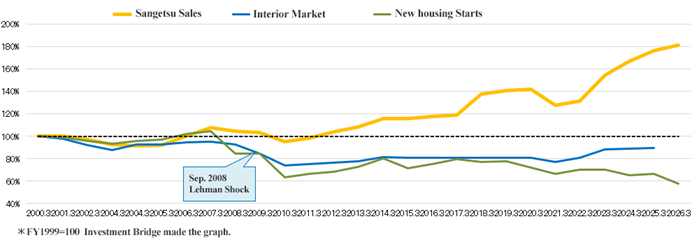
This is because they have developed new products, reformed logistics systems, enriched construction and manufacturing functions, and so on to brush up each function and improve their capability of proposing solutions, and then invested in the cultivation of the non-housing market other than private housing, and revised prices as a top enterprise in this industry.
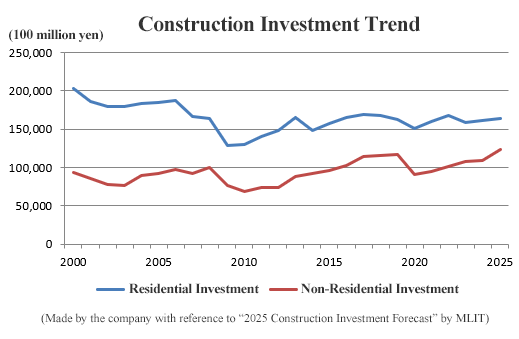
According to “2025 Construction Investment Forecast” announced by the Ministry of Land, Infrastructure, Transport and Tourism, the investment in private housing construction remains flat, but the investment in private non-residential construction is expected to increase 12.9% year on year in FY 2025, showing a slightly bright outlook.
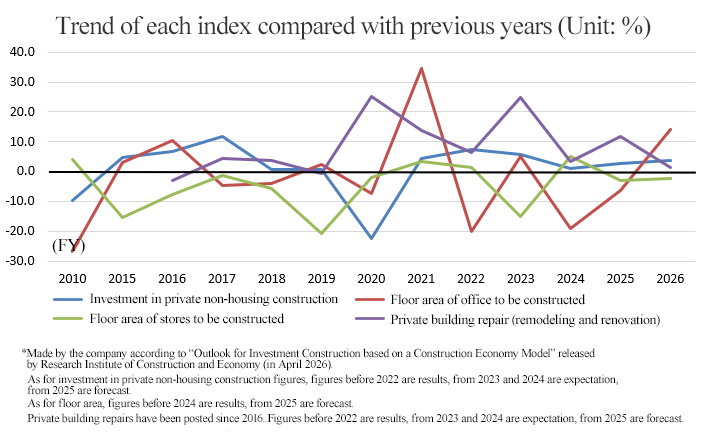
According to “Outlook for investment in construction based on a construction economy model” released by Research Institute of Construction and Economy on April 13, 2026, nominal private investment in non-housing construction increased steadily through fiscal year 2017, then dropped considerably by 22.2% in fiscal year 2020 due to the COVID-19 pandemic, but is expected to recover gradually after that. In fiscal year 2026, it is projected to reach 11.7 trillion yen, slightly exceeding the pre-pandemic level of 11.6 trillion yen recorded in fiscal year 2019. The floor area of offices and stores whose construction have been started and private building repairs (renovations and repairs) are described as follows.
Floor areas of facilities to be constructed
*Offices“The demand for convenient locations and highly functional buildings is high due to the trend of return to the urban center and advantages for recruitment, but the total floor area of new offices whose construction has started has not increased year on year, so it is projected to decline year on year in FY 2025. A large number of offices are forecast to be supplied in 2028 and 2029, so a year-on-year growth is expected in FY 2026.”
*Stores
They said, “There is a stance of actively investing in construction, but the number of stores opened in large-scale retailers and total store area are decreasing. Expecting that this trend will continue, we forecast that the total floor area of new stores whose construction has started will decline slightly year on year in both FY 2025 and FY 2026.”
Private building repair (remodeling and renovation)
According to the “survey on the remodeling and renovation of buildings conducted by the Ministry of Land, Infrastructure, Transport and Tourism,” healthy performance is expected as “the number of orders for renovation and repair increased 24.7% year on year in the third quarter of fiscal year 2025. In the residential field, steady investment can be expected through the shift from rebuilding plans to large-scale remodeling or renovation. In addition, in the non-residential sector, it is expected to increase year on year in FY 2025, as it is projected that the upward trends of mainly capital investment for DX, GX, and supply chain fortification will last and healthy investment will be continued. In FY 2026, too, the high level is projected to be maintained, but it is projected to decline slightly year on year.”
Like this, private investment in non-housing construction is projected to be healthy, after the decline due to the COVID-19 pandemic. There is steady demand for renovations in the non-residential market, so Sangetsu is trying to capture demand mainly through the corporate sales division.
◎ Competitors
In addition to Sangetsu, there are seven publicly traded competitors that operate in the interior decorating market.
Stock Code | Company | Net Sales | YY Change of Net Sales | Operating Income | YY Change of Operating Income | Operating Income Margin | Total Market Cap | PER | PBR | ROE |
3501 | SUMINOE | 106,000 | +1.2% | 2,200 | -26.7% | 2.1% | 16,255 | 35.1 | 0.9 | 2.1% |
4206 | Aica Kogyo Co., Ltd. | 280,000 | +11.2% | 31,000 | +6.4% | 11.1% | 235,959 | 11.9 | 1.2 | 10.2% |
4224 | LONSEAL Corporation | 22,500 | +1.8% | 1,400 | +4.2% | 6.2% | 9,037 | 8.6 | 0.5 | 5.3% |
5956 | TOSO COMPANY, LIMITED | 23,500 | +1.1% | 850 | -11.0% | 3.6% | 5,560 | 8.8 | 0.3 | 4.4% |
7971 | TOLI Corp. | 112,000 | -0.3% | 4,100 | -19.6% | 3.7% | 36,799 | 10.2 | 0.7 | 8.9% |
7989 | TACHIKAWA CORPORATION | 43,500 | +2.1% | 4,500 | +2.0% | 10.3% | 50,559 | 14.9 | 0.9 | 5.9% |
8130 | Sangetsu Corporation | 213,000 | +3.2% | 19,000 | -2.1% | 8.9% | 171,028 | 12.6 | 1.4 | 12.5% |
9827 | Lilycolor Co., Ltd. | 36,800 | +8.4% | 1,000 | +24.9% | 2.7% | 7,356 | 10.7 | 0.9 | 6.4% |
*Unit: million yen, times. Estimates are from those of the respective companies this term. Total market capitalization, PER and PBR are based upon the closing share price of each stock on June 12, 2026. The number of outstanding shares of each company that was used for calculation includes the number of treasury shares, and was taken from the latest brief report on financial results of each company, like EPS and BPS. ROE is based on the previous fiscal year.
[1-4 Business Description]
The main businesses include planning, development, and sales of wallcoverings, flooring materials, curtains, upholstery and other interior products. Although Sangetsu is fabless except for some products, it is not a typical trading firm as most of the products it sells are planned, designed and developed in-house and is also engaged in the comprehensive space business, in which they design and construct spaces. In addition, Sangetsu also provides domestic exterior products through its group companies. The overseas interior business and the overseas comprehensive space business (limited to Southeast Asia) are operated by four group companies located in the U.S., Singapore, and China/Hong Kong.
The company is using three business segments: "Domestic Interior," "Domestic Exterior," and "Overseas" Segments.
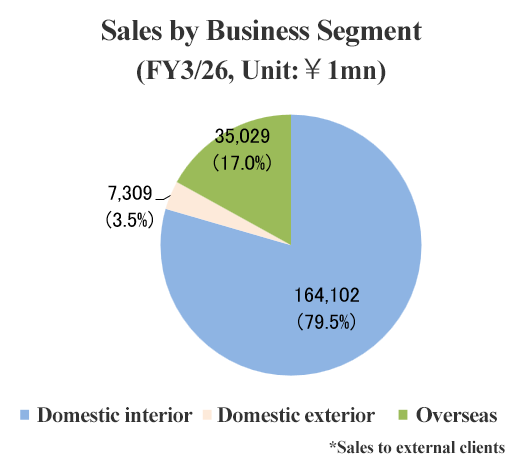
① “Domestic Interior Segment”
<Domestic Interior Business>
◎ Main Products
Wallcoverings | Sangetsu’s main product, used in a wide range of residential and non-residential applications. High functionality products have become popular in recent years that are resistant to staining, odor absorbing, and scratch resistant. The product lineup also includes antivirus wallcovering. Also, “Accent Wall” a wallcovering with colorful designs being used to decorate one full wall or a part of a wall in homes, adds an appeal to the living space, and is increasingly adopted in general residences and rental residences. |
Cushion Vinyl Sheet | Sheet formed flooring materials that are commonly used in apartments and condominiums. They boast of wood grain, stone, and a wide range of other motif designs and have functionality and cushioning properties for use in a wide range of applications. |
Vinyl Sheets | Sheet formed flooring materials used in commercial applications including medical and welfare institutions, and educational institutions. This product boasts of high levels of safety and hygiene, and is designed to reduce maintenance costs, thanks to the excellent maintenance properties, such as the unnecessity of waxing. It also has been designed with the environment in mind and helps to reduce the environmental burden. |
PVC Tiles | Tile formed PVC flooring which has a wide range of applications, is used in commercial facilities, educational institutions, detached houses and apartments. One feature is its high design, in which the materials used as motifs such as wood and stone are expressed through high-tech printing technology and precise embossing. |
Carpets | Textile flooring materials used in a wide range of applications including ryokans (i.e. Japanese inns), hotels, residential and commercial facilities. Manufactured with variety of designs and high functionality. It also proposes original designs to each property. |
Carpet Tiles | Tile-like carpets used for mainly offices, hotels, commercial and educational facilities, etc. whose dominant size is 50 cm square. It excels in its feature of easy installation and superior maintenance. |
Curtains | All of the curtains sold by Sangetsu are custom made and boast of the ability to create unique designs and custom sizes of curtains to match room decorations in which they are used. In addition to highly fashionable designs and heavy materials, mirror-like insulating characteristic lace curtains, which make it difficult to see inside from the outside and reduce the amount of heat transferred into the rooms, have also become popular. |
Sangetsu boasts a diverse product lineup with about 12,000 different products in total
There are about 4,300 different wallcovering products alone. Sample books are updated approximately every 3 years (those for curtains are updated every 3-4 years), with an existing product replacement rate for wallcoverings of 30% to 40%. Disposal of outdated products leads to producing wastes, but because keeping a sample book up-to-date is necessary to enhance customer satisfaction, the company has maintained a balance between efficiency and freshness through the company’s energetic engagement and long-cultivated know-how.
◎ Sales Structure
In addition to the headquarters located in Nagoya, Sangetsu maintains 10 regional offices, and about 23 sales offices throughout Japan, with 8 of these sales offices also hosting showrooms as important sales offices. Sangetsu also maintains “PARCs Sangetsu Group Creative Hub (PARCs)” in Hibiya, Chiyoda-ku, Tokyo, as a new base for value creation.
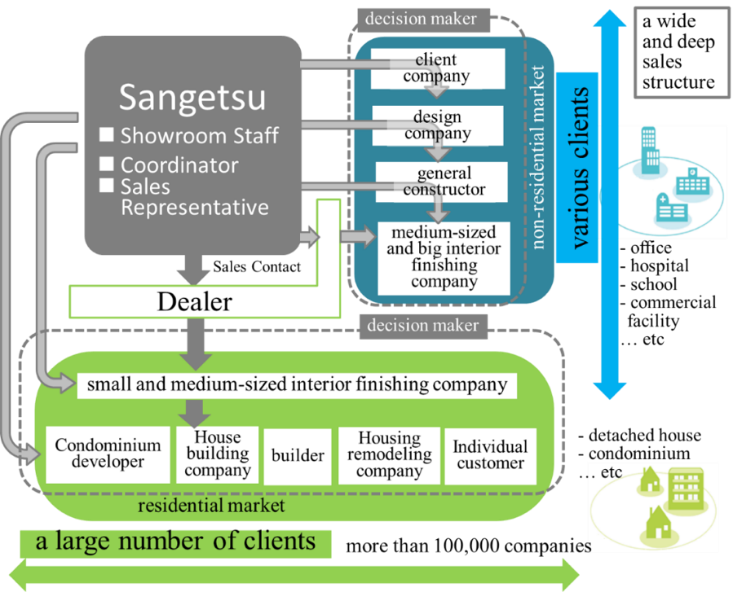
The interior finishing process (figure shown above) includes the final delivery of products, booking of sales, and receipt of cash. The main customers are interior construction companies and interior and building material shops that are serviced through dealers. Furthermore, public relations and advertising for products at the start of the process are also very important.
By the time the residence or building is completed, a large number of players such as the client (facility owner), architect office, design office, subcontractor, residential manufacturer, etc. are involved, and the interior is finally selected from design and function. In many cases, decision making starts upstream.
Therefore, Sangetsu conducts public relations and advertising for its products through its sample books, showrooms, and others. In addition to these “passive” sales activities, Sangetsu also conducts “proactive” sales of its products through its 700 sales staff (Sangetsu only) which belongs to its corporate sales division, etc. to provide and gather information, and propose products to clients. Sangetsu's main sales efforts are conducted through agents (some sell directly), so the number of customers is not known, but the total number of customers is estimated to amount to several tens of thousands nationwide.
◎ Distribution Structure/Delivery System
With the aim of streamlining logistics, they are developing a logistics system. They have established two “flagship logistics centers,” which store stocks for each region and to backup broader areas, and seven “regional logistics centers,” which store stocks for each region.
Most products are normally stocked at the company’s distribution centers in Tokyo, Nagoya, Osaka and Fukuoka, with the number of products shipped from these centers surpassing 60,000 per day, and the out-of-stock ratio is 1% in average. Sangetsu seldom asks their clients for backordering because the out-of-stocks are covered by surrounding distribution centers immediately. Sangetsu’s nationwide distribution network makes “Just-in-Time” provision of products to match the interior construction schedules of its clients possible. Products are sourced from a wide range of about 270 supplier companies.
As for delivery, the company is improving its own delivery system, to cope with the increase of logistics costs.
Following the establishment of a local delivery system in Tohoku, they are establishing local delivery systems one after another throughout Japan, while developing networks for delivering heavy objects and supplies to construction sites. In September 2022, the company acquired Kurosukikaku, Corporation, which delivers products throughout Kyushu. In April 2025, they acquired SDS Co., Ltd., a logistics company that has been entrusted by Sangetsu with shipment and delivery since before, as a group company, to improve the delivery service mainly in the Honshu (main island).
<Domestic Comprehensive Space Business>
In April 2025, they established the comprehensive space business division in the business department, integrating the functions for space design, management of design and construction, and marketing for comprehensive space projects. In addition, it oversees the group company Fairtone Co., Ltd. Based on these capabilities of designing the entire space, managing construction, and finishing its interior, it aims to strengthen comprehensive construction skills and construction management capabilities, including corporate soft power, such as abilities to design spaces, come up with new ideas, make concepts, give proposals, and give consultation services, as well as woodworking, lighting, and electricity, to create and provide optimal spaces for clients.
The interior business and the comprehensive space business have totally different business models, so they decided to operate and manage them separately in the same segment.
② “Domestic Exterior Segment”
Sungreen Co., Ltd., which was turned into a group company in 2005, sells and constructs doors, fences, terraces and other exterior products within Japan. The company will concentrate on the expansion of its business area in the Tokyo Metropolitan Area and the improvement of its capability of proposing interior and exterior spaces together and so on.
③ “Overseas Segment”
<Overseas Interior Business>
This segment is centered on KOROSEAL INTERIOR PRODUCTS HOLDINGS, INC. in North American, Goodrich Global Holdings Pte., Ltd. in Southeast Asia, and GOODRICH GLOBAL LIMITED in China/Hong Kong.
<Overseas Comprehensive Space Business >
D’Perception Pte Ltd operates space design and general construction businesses in Southeast Asia, mainly Singapore.
Like in Japan, the interior business and the comprehensive space business have totally different business models, so they decided to operate and manage them separately in the same segment.
[1-5 Shareholder Returns]
They basically pursue stable dividends, and aim to increase the dividend amount while targeting a payout ratio of 60% or higher with the lower limit of DPS being 155 yen. When determining the dividend amount, they set a target payout ratio to increase profit while living up to the expectations of shareholders for a “stable dividend increase.”
They also consider the acquisition of treasury shares when necessary, while taking into account the market environment, capital efficiency, investment for growth, etc.
[1-6 ROE Analysis]
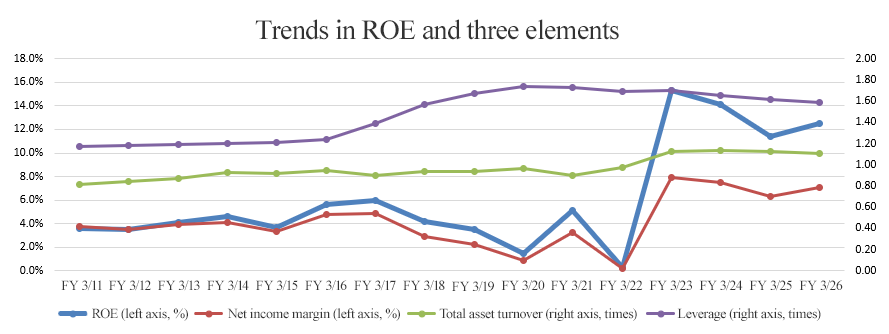
| FY 3/18 | FY 3/19 | FY 3/20 | FY 3/21 | FY 3/22 | FY 3/23 | FY 3/24 | FY 3/25 | FY 3/26 |
ROE (%) | 4.2 | 3.5 | 1.5 | 5.1 | 0.3 | 15.3 | 14.1 | 11.4 | 12.5 |
Net income margin (%) | 2.89 | 2.23 | 0.89 | 3.29 | 0.19 | 7.96 | 7.53 | 6.26 | 7.09 |
Total asset turnover [times] | 0.91 | 0.94 | 0.96 | 0.90 | 1.01 | 1.13 | 1.13 | 1.13 | 1.11 |
Leverage [times] | 1.60 | 1.67 | 1.74 | 1.73 | 1.69 | 1.70 | 1.66 | 1.61 | 1.59 |
*Net income margin = Net income attributable to owners of the parent ÷ Net sales
Total asset turnover = Net sales ÷ (Total assets as of the end of the previous fiscal year + Average of total assets as of the fiscal year under review)
Leverage = (Total assets as of the end of the previous fiscal year + Average of total assets as of the fiscal year under review) ÷ (Equity capital as of the end of the previous fiscal year + Average of equity capital as of the end of the fiscal year under review)
Since the fiscal year ended March 2023, ROE has been in double digits, exceeding 8%, which is the minimum level required of Japanese enterprises. It also exceeds the cost of shareholders’ equity recognized by the company (6-8%). In the “Medium-term Management Plan 2029,” they aim to achieve an ROE of 14% in the fiscal year ending March 2030.
[1-7 Competitive Advantage]
Since its founding in 1849, the Sangetsu Group has built more than 170 years of operating history and established itself as a pioneer in Japan’s interior industry. Over this period, it has developed an integrated value chain encompassing product planning and development, logistics, and sales, enabling end-to-end control of its business operations.
Leveraging its strengths in “outstanding product competitiveness supported by originality, design, functionality, quality, and stable supply,” “a resilient supply chain,” “a nationwide, finely tuned sales network,” and “a strong commitment to addressing social issues,” the Sangetsu Group is reinforcing its solution-driven business model, based on four core functions: materials, design, logistics, and construction.
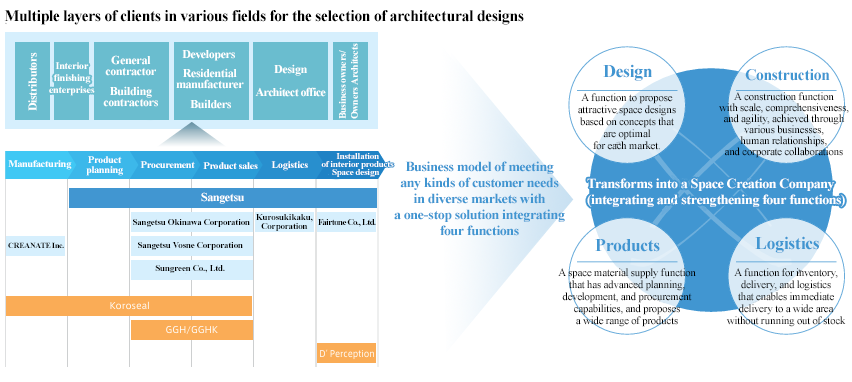
(Taken from the integrated report “SANGETSU REPORT 2025”)
The overview of the four functions is as follows.
(1) Materials (Products)
① Product Planning and Development
The Sangetsu Group entered the wallcovering business at a time when the concept of interior design had not yet become widespread in Japan. Since then, it has played a pioneering role in creating both a market and demand domestically, expanding its business by leveraging strong, market-responsive product planning and development capabilities. While they develop products based on customer and market needs to supply new out-of-the-box products, they increase personnel for product design, collaborate with external and overseas designers, and have about 12,000 kinds of products in stock. As they enhance the development of core products, including wallcoverings, flooring materials, and fabrics, the sales of strategic products, such as REATEC (adhesive decorative films), glass films, carpet tiles, PVC tiles, and upholstery, are steadily growing, as they concentrate on these products while expecting growth.
② Manufacturing and procurement
The interior and exterior products, which are used at the final stage of construction, require advanced design for making each space colorful and a stable, swift supply system, with which products hardly go out of stock. In order to stably supply diverse products which our company handles, it is indispensable to have relationships with around 270 suppliers in the interior business and around 150 suppliers in the exterior business. In order to cement the cooperation with suppliers, they are optimizing supply chain management (SCM) for developing a sustainable, stable supply system. Regarding wallcoverings, which are their core products, they are striving to secure the capability of supplying them and streamlining business operations by cementing the cooperation with the group company CREANATE Inc., a leading wallpaper maker in Japan, and establishing an integrated system for manufacturing and sale. In order to realize both stable supply and diverse product development, they are improving the level of quality control. They stably supply products trusted by customers, by establishing a dedicated division to improve quality design and assessment precision in product development and establishing a high quality control system in cooperation with suppliers.
< Major resources, etc. (FY 2025)>
Product design professionals 90 members |
Suppliers Domestic interior segment: approx. 270 companies Domestic exterior segment: approx. 150 companies |
Largest wallcovering manufacturing facility in Japan (CREANATE) |
State-of-the-art wallcovering manufacturing equipment (Koroseal) |
(2) Spatial designs
As societal change accelerates and values continue to diversify, the importance of spatial design for satisfying diverse needs is rising year by year. To address this trend, the Sangetsu Group is strengthening its ability to deliver comprehensive spatial design solutions that extend beyond conventional product proposals. In addition to coordinating interior materials such as wallcoverings, flooring materials, and fabrics, the Sangetsu Group provides holistic solutions covering design, construction, and exterior elements, to contribute to solving social issues. To offer high-quality solutions, the Sangetsu Group is reinforcing its capabilities in spatial design, architectural planning, and construction. By proactively recruiting specialize talent and training personnel, they have established design teams capable of responding flexibly across a wide spectrum of domains, ranging from residential to non-residential projects, new construction to renovation, and interior to exterior spaces.
<Major resources, etc. (FY 2025)>
Space design professionals (for designing and constructing spaces): about 105 employees |
(3) Logistics
In the domestic interior segment, the company ships approx. 60,000 products and 40,000 samples per day. The systems for quickly shipping and delivering products around Japan without fail contribute significantly to the flexible response to changes in deadlines for interior finishing and smooth discussions on interior designs and specifications.
As logistics bases, the company has established two flagship logistics centers (LCs), which function to back up inventory in each region and serve as an inventory base in each area, and 7 local LCs, which serve as an inventory base in each area. The Sangetsu Group is advancing the establishment of a supply chain management center to further improve company-wide inventory efficiency.
To deal with social issues, such as the shortage of workers and the aging population, and establish a comfortable working environment for women, they pursue thoroughgoing automation and labor saving, and apply them to logistics centers around Japan. For delivery systems, they are enriching the in-house last-mile delivery service “Service Crew-bin” as a measure for brushing up the capability of proposing solutions. They make efforts to improve the level of their delivery service, by increasing staff considerably, expanding the area where they can deliver products, redeveloping a system for transportation between bases, and streamlining operations by integrating existing delivery services. They further recruit and train logistics workers, improve organizational strengths by thoroughly conducting appropriate labor management and appointing safety control staff in the administration division, enhance logistics functions, and concentrate on initiatives for improving the quality of delivery and safety.
< Major resources, etc. (FY 2025)>
Logistics personnel and contractors responsible for warehouse operations: approx. 1,000 people |
Flagship/regional LCs: 9 locations |
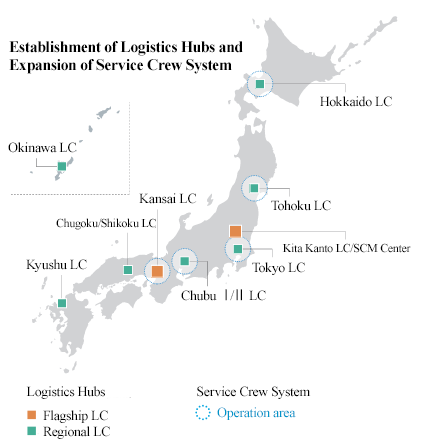
(Taken from the integrated report “SANGETSU REPORT 2025” of Sangetsu)
(4) Interior finishing
Interior finishing is an essential means for embodying a design, but the shortage of manpower in the construction industry is a serious challenge. It is conducted by a contractor, a subcontractor, or a second-tier subcontractor. The company had been conducting it as a second-tier subcontractor (assisting interior decorators). In the medium-term management plan “Next Stage Plan G” announced in 2014, the company aimed to improve its installation capability as a priority measure and has positioned it as an important function of the company group. In cooperation with Fairtone Co., Ltd., which conducts interior finishing and joined the Sangetsu Group in 2017, they strive to improve the interior finishing function in the entire corporate group. In order to hone not only the capability of interior finishing, which has been conducted by mainly the company, but also comprehensive construction skills for embodying an entire space from the viewpoint of business owners, they are increasing engineers in charge of price estimation, procurement, and construction supervision, while establishing bases for safety control and dealing with legal regulations and strengthening the capabilities of designing products and proposing solutions.
<Major resources, (FY 2025)>
First and second-class architects: 40 people |
Building operation and management engineers: 112 people |
2. Fiscal Year ended March 2026 Earnings Results
[2-1 Earnings Results]
| FY 3/25 | Ratio to sales | FY 3/26 | Ratio to sales | YoY | Ratio to forecast |
Net Sales | 200,378 | 100.0% | 206,441 | 100.0% | +3.0% | -1.7% |
Gross profit | 62,373 | 31.1% | 64,729 | 31.4% | +3.8% | -1.6% |
SGA | 44,232 | 22.1% | 45,321 | 22.0% | +2.5% | -3.2% |
Operating Income | 18,140 | 9.1% | 19,408 | 9.4% | +7.0% | +2.1% |
Ordinary Income | 18,572 | 9.3% | 20,152 | 9.8% | +8.5% | +3.3% |
Net Income | 12,550 | 6.3% | 14,642 | 7.1% | +16.7% | +12.6% |
*Unit: million yen. Net income is profit attributable to owners of the parent. In the fiscal year ended March 2026, provisional accounting for business combination was carried out, and it is reflected in the figures in the fiscal year ended March 2025.
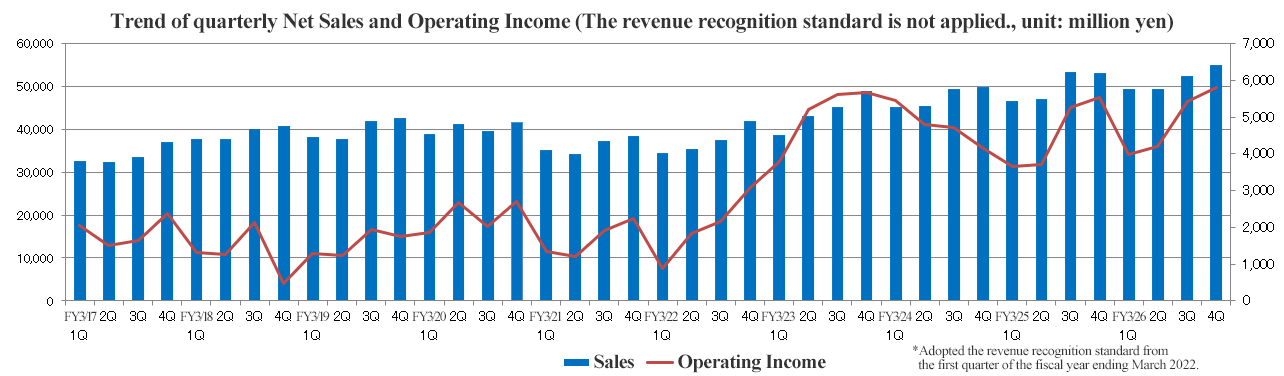
Increased in both sales and profit with sales reached record highs.
Sales grew 3.0% year on year to 206.4 billion yen, hitting a record high. In the domestic interior segment, sales quantities decreased due to the fire accident at a factory of a supplier, etc., but sales grew thanks to price revisions, etc. Sales increased also in the domestic exterior and overseas segments. Operating income rose 7.0% year on year to 19.4 billion yen. In the domestic interior segment, the effect of the fire accident at a factory of a supplier and the augmentation of costs were offset by the price revision effect, the increase of sale of strategic products in each unit for meeting market needs, and the improvement in performance of group companies. The domestic exterior segment, too, saw a profit growth, and the deficit in the overseas segment shrank. Both sales and profit were in line with the forecast.
*The financial results until the fiscal year ended March 2026 are indicated with the strategic product category in the Medium-term Management Plan [BX 2025].
[2-2 Business Segment Trends]
| FY 3/25 | FY 3/26 | YoY | Ratio to forecast |
Net Sales |
|
|
|
|
Domestic Interior Segment | 163,986 | 164,106 | +0.1% | -1.1% |
Wallcovering Unit | 78,644 | 79,949 | +1.7% | - |
Flooring Materials Unit | 57,377 | 55,614 | -3.1% | - |
Fabrics Unit | 9,609 | 10,125 | +5.4% | - |
Construction and others | 18,354 | 18,417 | +0.3% | - |
Domestic Exterior Segment | 6,611 | 7,310 | +10.6% | +0.8% |
Overseas Segment | 29,794 | 35,029 | +17.6% | -4.7% |
Adjustments | -13 | -5 | - | - |
Total | 200,378 | 206,441 | +3.0% | -1.7% |
Operating Income |
|
|
|
|
Domestic Interior Segment | 18,940 | 19,333 | +2.1% | +2.6% |
Domestic Exterior Segment | 17 | 118 | +586.7% | +136.3% |
Overseas Segment | -820 | -46 | - | - |
Adjustments | 2 | 3 | - | - |
Total | 18,140 | 19,408 | +7.0% | +2.1% |
*Unit: million yen.
① Domestic Interior Segment
Sales and profit grew year on year. Sales quantities declined, due to the sluggish domestic demand, the constraints on supply caused by the fire accident at a factory of a supplier, etc., but sales were unchanged year on year, thanks to the price revision, the improvement in their product portfolio, the improvement in performance of group companies, etc. Profit increased thanks to the price revision, the advance of the capability of proposing solutions through the enhanced linkage between functions, the improvement in performance of group companies, and SG&A expenses control. Sales slightly fell below the forecast, but profit was in line with the forecast.
(Products)
They concentrated on the expansion of the lineup of products that meet market needs, such as eco-friendliness and labor saving, and help solve social issues. In the fourth quarter (Jan. to Mar.), they published “INNO PANEL®,” a sample book of new building materials for significantly shorting construction periods, and decided to deal in the products of BOLON, a Swedish flooring material maker, which boasts the strong brand power in the global high-end market, in Japan. They plan to start releasing such products one after another in FY 2026, enhancing their product lineup. The wallcovering “ELEMENTUM™” received the “iF Design Award 2026.” They received this award for the third consecutive year and a total of five times. Their product design and quality have been highly evaluated in this market and this industry.
The sales of “strategic products,” for which there is room for share expansion and the market is expected to grow, such as REATEC (adhesive decorative films), glass films, carpet tiles, PVC tiles, and upholstery, increased 6.8% year on year to 44.5 billion yen, showing a continuous growth. They now account for one fourth of sales of the domestic interior segment.
(Supply chain management)
They are enhancing and streamlining the logistics functions, which play a central role. While costs are augmenting due to the constraints in the logistics field, they are promoting group-wide measures, including the cementing of cooperation between sections, the fortification of the management base of logistics companies in the Sangetsu Group, and the improvement in productivity through labor-saving equipment, with the aim of improving their competitiveness with advanced supply chain management.
(Manufacturing)
The group company CREANATE Inc., which is one of the largest makers of wallcoverings in Japan, started the operation of a new factory in Hiroshima Prefecture in October 2025. They strive to reinforce their supply chain and strengthen their stable supply system by establishing a production structure with two bases in eastern Japan and one base in western Japan and installing cutting-edge equipment with a high manufacturing efficiency.
(Comprehensive space business)
They aim to offer unique value while inducing synergy among the function to coordinate interior products, the sales network of the interior business, the customer base, etc. While sales, including the sales of the group company Fairtone Co., Ltd., grew steadily, it is recognized that they need to improve profitability.
② Domestic Exterior Segment
Sales grew and profit rose significantly year on year.
Like in the domestic interior segment, the business environment remains harsh, as housing starts decreased. Business performance keeps improving, due to the revisions to selling prices of exterior products, the increase of orders for non-residential properties in the Tokai region, which is a main market, the sales growth in the Kanto region, where they are strengthening their footholds, and so on. Sales were almost in line with the forecast. Profit exceeded the forecast significantly.
③ Overseas Segment
Sales grew year on year, and deficit shrank.
The financial results of overseas affiliated companies in the period from January to December 2025 have been included in the financial results in the fiscal year ended March 2026.
Profit/loss improved considerably, thanks to the favorable performance in North America and the improvement in management of the interior business in Southeast Asia, China, and Hong Kong, but fell below the forecast, due to the posting of temporary expenses for design and construction in Singapore.
In both China and Hong Kong, the establishment of the base for generating profit has progressed, as they have proceeded with structural reform, including the reshuffling of executives. They will clarify their strategies and directions further, and discuss a roadmap for growth.
< Overseas Interior Business>
◎ North America (The U.S. and Canada)
Sales and profit grew year on year, as marketing strategies turned out to be effective while they improved their internal systems, including the management base and business infrastructure.
◎ Southeast Asia
Their annual results were in the black, because their business performance improved as structural reform, including the refurbishment of their management structure, progressed and they implemented appropriate sales measures in each country.
◎ China and Hong Kong
The business environment remains harsh as consumer confidence has declined due to the stagnation of the real estate market and the worsening of the employment environment, but deficit shrank, as they refurbished and downsized their management structure and selected the targets of allocation of managerial resources, including the implementation of strategies for each market and each client.
<Overseas Comprehensive Space Business>
Regarding D’Perception, a company that operates design and construction businesses in Southeast Asia and became a group company in July 2024, it contributed to the sales growth in the entire overseas segment, but an operating loss was posted, due to the decline in profitability caused by the delay in completion of large-scale properties, the emergence of additional temporary costs, etc.
[2-3 Financial standing]
◎ Main BS
| End of Mar.25 | End of Mar.26 | Increase/ Decrease |
| End of Mar.25 | End of Mar.26 | Increase/ Decrease |
Current Assets | 117,011 | 118,020 | +1,009 | Current Liabilities | 58,276 | 45,011 | -13,265 |
Cash, Equivalents | 33,727 | 35,414 | +1,687 | Payables | 33,612 | 28,523 | -5,089 |
Receivables | 58,878 | 58,916 | +38 | Short-Term Debt | 9,607 | 920 | -8,687 |
Marketable Securities | 300 | 300 | 0 | Noncurrent Liabilities | 11,836 | 21,635 | +9,799 |
Inventories | 22,433 | 21,812 | -621 | Long-Term Debt | 3,177 | 13,611 | +10,434 |
Noncurrent Assets | 66,912 | 70,886 | +3,974 | Total Liabilities | 70,113 | 66,647 | -3,466 |
Tangible Assets | 41,665 | 42,300 | +635 | Net Assets | 113,810 | 122,259 | +8,449 |
Intangible Assets | 4,354 | 4,961 | +607 | Retained earnings | 74,538 | 80,216 | +5,678 |
Investments, Others | 20,892 | 23,624 | +2,732 | Treasury Stock | -698 | -663 | +35 |
Total Assets | 183,923 | 188,907 | +4,984 | Total Liabilities, Net Assets | 183,923 | 188,907 | +4,984 |
|
|
|
| Capital Adequacy Ratio | 61.4% | 64.3% | +2.9pt |
*Unit: million yen. Accounts receivable is the sum of notes and accounts receivable-trade, contract assets, and electronically recorded monetary claims. Accounts payable is the sum of notes and accounts receivable-trade, contract liabilities, and electronically recorded liabilities. Debt includes lease obligations.
Total assets increased 4.9 billion yen from the end of the previous fiscal year to 188.9 billion yen, as cash & deposits and investment securities, etc. increased.
Total liabilities decreased 3.4 billion yen from the end of the previous fiscal year to 66.6 billion yen, due to a reduction in accounts payable.
Net assets grew 8.4 billion yen from the end of the previous fiscal year to 122.2 billion yen, due to an increase in retained earnings, etc. As a result, capital-to-asset increased 2.9 points from the end of the previous term to 64.3%. Interest-bearing debt increased 1.7 billion yen from the end of the previous term to 14.5 billion yen.
[2-4 Topics]
◎ Initiatives for sustainability
① The environment
They promote appropriate information disclosure, while implementing measures for reducing environmental burdens from the viewpoints of carbon neutrality, the circular economy, and harmony with nature. As a result, their continuous efforts to reduce GHG emissions, the advance of information disclosure recommended by TCFD, the improvement in transparency of lumber procurement, goal setting, etc. have been highly evaluated, so they have received the score B in the climate change section and the score B- in the forest section from the international non-profit organization CDP.
② Human capital
They are developing an environment where diverse personnel, which serve as a management base, can flourish. Under the policies of “mental and physical health improvement,” “enrichment of life,” and “development of a comfortable working environment,” they implemented diverse initiatives, and were certified as “Excellent Corporation in Health-oriented Business Administration 2026” by Japan Health Council. They were certified for the 7th consecutive year and a total of 8 times.
③ Social engagement
They decided to participate in Hokkaido University’s COI-NEXT “Co-creation base for mental and physical life design.” This project is aimed at realizing a society in which children and youngsters of the next generation can lead a happy life in their own ways with others.
3. Fiscal Year ending March 2027 Earnings Forecasts
[3-1 Earnings Forecasts]
| FY 3/26 | Ratio to sales | FY 3/27 (Est.) | Ratio to sales | YoY |
Net Sales | 206,441 | 100.0% | 213,000 | 100.0% | +3.2% |
Gross profit | 64,729 | 31.4% | 66,300 | 31.1% | +2.4% |
SGA | 45,321 | 22.0% | 47,300 | 22.2% | +4.4% |
Operating Income | 19,408 | 9.4% | 19,000 | 8.9% | -2.1% |
Ordinary Income | 20,152 | 9.8% | 19,200 | 9.0% | -4.7% |
Net Income | 14,642 | 7.1% | 13,500 | 6.3% | -7.8% |
*Unit: million yen.
Without taking into account uncertainties, it is forecast that sales will grow and profit will decline.
Sales are expected to grow 3.2% year on year to 213 billion yen and operating income is projected to decline 2.1% year on year to 19 billion yen.
It is projected that the global economy will grow gently, but there will remain uncertainties over the supply chain due to the U.S. trade policy, geopolitical risks, etc. Due to the skyrocketing of construction costs, etc., it is forecast that new construction will be stagnant in both the residential and non-residential sectors, and they will receive a healthy number of orders for remodeling and renovation. The constraints on supply due to the fire accident at a factory of a supplier in the fiscal year ended March 2026 mostly disappeared, but the augmentation of costs for raw material procurement, logistics, etc., the increase in SG&A expenses, including personnel expenses, and the investment in growth strategies have been taken into account in their plan. To cope with the augmentation of costs, they announced in April 2026 that they would revise the prices of their products on July 1, 2026, but it has not been taken into account in the earnings forecast.
Regarding the annual dividend, they initially planned to pay 155.00 yen/share like in the previous fiscal year. The expected payout ratio is 67.5%.
Meanwhile, this forecast does not include the soaring of energy prices due to the tense Middle East situation and the increase of geopolitical risks, the difficulty in procuring raw materials caused by the disturbance of supply chains, or uncertainties about the rise in raw material prices, etc., because it was difficult to rationally estimate these effects at this time. We may revise the earnings forecasts once a reasonable calculation becomes possible.
[3-2 Business Segment Trends]
| FY 3/26 | FY 3/27 (Est.) | YoY |
Net Sales |
|
|
|
Domestic Interior Segment | 164,106 | 169,500 | +3.3% |
Domestic Exterior Segment | 7,310 | 7,300 | -0.1% |
Overseas Segment | 35,029 | 36,200 | +3.3% |
Adjustment | -5 | - | - |
Total | 206,441 | 213,000 | +3.2% |
Operating Income |
|
|
|
Domestic Interior Segment | 19,333 | 18,200 | -5.9% |
Domestic Exterior Segment | 118 | 100 | -15.4% |
Overseas Segment | -46 | 700 | - |
Adjustment | 3 | - | - |
Total | 19,408 | 19,000 | -2.1% |
*Unit: million yen.
For the domestic interior segment, it is forecast that sales will grow and profit will decline. For the domestic exterior segment, it is projected that sales and profit will decrease.
For the overseas segment, sales are expected to grow, and the business is forecast to move into the black.
4. Medium-term management plan 2029
In May 2026, they announced the “Medium-term Management Plan 2029” for the four years ending in the fiscal year ended March 2030.
[4-1 Background of the formulation]
Sangetsu announced its long-term vision [DESIGN 2030] in 2020, pursued “the transformation from an interior finishing enterprise into a space creation enterprise” as an ideal corporate state, and engaged in the expansion of its business domain and the sophistication of value they provide. In the Medium-term Management Plan [BX 2025], which was announced in 2023, they evolved the ability to give proposals and enriched the business base by strengthening human capital and digital capital. Over the past 3 years, the interior business, which is the mainstay, has grown steadily, and outside Japan, revenues improved somewhat, while the growth speed of the overseas, comprehensive space, and exterior businesses did not reach the initially assumed one, because there were issues attributable to respective characteristics.
Regarding the external environment surrounding the company, new value creation opportunities are increasing due to the diversification of values for daily life, the sophistication of social issues, technological advance, and the potential of the overseas market, while there are worsening constraints, such as the shrinkage of the domestic market and the shortage of manpower. Recognizing such environment, they formulated the “Medium-term Management Plan 2029.” They decided to go back to the core business of the company and implement growth strategies taking advantage of the strengths of the core business.
[4-2 Ideal corporate state, etc.]
They defined their ideal corporate state, corporate credo, and slogan.
(1) Ideal corporate state
They defined their corporate vision as "Shaping Culture from interiors through Materials and Design."
In addition to the rich lineup of interior products, their core lies in “comprehensive interior design,” in which they propose solutions while integrating material procurement, design, distribution, and construction processes. Based on this strength, they have enriched the sensibility and lives of people, by offering new value to spaces. Going forward, they will stimulate the sensibility of people through spaces in addition to products, and help realize diverse ways of living, by evolving their core business.
(2) Corporate credo
They started upholding “Integrity” again as their corporate credo. They incorporated the original corporate credo “integrity,” which was set up when determining their corporate philosophy in 2024, into their corporate philosophy, but since the business startup in 1849, “integrity” has been the DNA and identity of Sangetsu for connecting all employees and stakeholders, and this is their original concept they should go back to. Remembering it, they decided to uphold the corporate credo “integrity” in parallel with the start of the “Medium-term Management Plan 2029,” so that all employees would follow their beliefs while having sincerity and a sense of ethics.
(3) Slogan
They started upholding "Transformation, Challenge and the Driving of Innovation".
They will keep enhancing the interior business as the major growth driver, and establish a more robust revenue base by expanding the range of products and cooperating with partner enterprises. Outside Japan, too, they will accelerate the growth of their business centered around the interior business in North America and Asia. They will grow the comprehensive space and exterior businesses steadily as medium/long-term growing businesses while applying the strengths of the interior business to them and maximizing synergy. Outside Japan, too, they will accelerate the growth of their business centered around the interior business in North America and Asia. They will grow the comprehensive space and exterior businesses steadily as medium/long-term growing businesses while applying the strengths of the interior business to them and maximizing synergy.
[4-3 Review of the previous Medium-term Management Plan [BX 2025]]
The results were reviewed for each item.
① Overall business performance
While the domestic business environment is becoming harsher, sales hit a record high, but fell below the forecast. On the other hand, operating income and net income achieved the forecast.
② Trend of each segment
Domestic interior segment | It maintained a steady profitability as their core business, and sales did not reach the revised forecast, but profit achieved the forecast.
*Interior business Under the business environment, including the stagnation of domestic demand, the continuous rise in costs, and the shortage of artisans, it showed a steady profitability as the core business.
*Comprehensive space business As they fortified the business base by increasing personnel (recruiting 48 experienced workers between FY 2023 and FY 2025), sales gradually increased, but it did not contribute to profitability. |
Domestic exterior segment | Sales fell below the revised forecast, but profit reached the forecast. They invested in human resources and established new marketing bases for expanding their business scale and domain, but they did not contribute to profitability. |
Overseas segment | Sales fell below the revised forecast somewhat. Loss shrank, but this business did not move into the black as they aimed.
*Overseas interior business It improved steadily, as a significant growth was seen in North America, a profit was recorded in Southeast Asia, and deficit shrank in China and Hong Kong.
*Overseas comprehensive space business In July 2024, they acquired a Singaporean company as a group company, but business results did not reach the forecast. |
③ Shareholder return
As of the end of March 2026, equity capital stood at 121.5 billion yen, exceeding the target range “95 to 105 billion yen.”
For the fiscal year ended March 2026, they paid 155 yen/share per year, under the shareholder return policy of aiming to increase the dividend amount stably with the lower limit being 130 yen. They did not acquire treasury shares.
④ Cash allocation
While they increased the dividend amount based on their stable cash generating capacity, equity capital expanded, decreasing capital profitability. In the “Medium-term Management Plan 2029,” they will rebuild their capital composition according to the growth of their “earning capacity.”
[4-4 Business environment and internal issues]
Each is recognized as follows.
(1) Business environment
While there are some issues, including the shrinkage of the domestic market, the serious structural gap between demand for and supply of workers, the rise in interest rates, the inflation, the growth of geopolitical risks, and the destabilization of the supply chain due to the yen depreciation, they consider that there are growth opportunities thanks to the diversification of market needs and social issues, the growth of overseas markets, the rapid advance of AI, the execution of sustainable business administration, etc.
(2) Internal issues
While “their revenues are mostly from the domestic interior business” and “they have not yet developed a new business as the next revenue source after interior products,” they consider that the most important mission is to establish a business model and a business portfolio.
They will also “improve the abilities to develop innovative materials and products (production function),” “improve the profitability in the comprehensive space and domestic exterior businesses,” and “develop their corporate brand.”
In order to achieve growth, it is indispensable to establish business infrastructure by “improving the efficiency of business operation and productivity,” “utilizing data resources,” “developing personnel who strategically make decisions, promote transformation, and exert leadership,” and “producing managerial staff and global personnel.”
[4-5 “Medium-term Management Plan 2029” (FY 3/27 to FY 3/30)-Transformation, endeavors, and to trigger innovation]
(1) Positioning
Four years for completing the long-term vision [DESIGN 2030]. Since President Kondo was appointed as president two years ago, he has conveyed the message “Transformation, endeavors, and to trigger innovation” to employees, and this message was adopted as a slogan in the new medium-term management plan.
They will pursue transformation, endeavors, and to trigger innovation, and increase profit steadily by exerting the comprehensive capability of the Sangetsu group to the maximum degree.
(2) Direction
By going back to “comprehensive interior business,” which is the mainstay of the Sangetsu group, they will further fortify the base for the interior business and achieve a dramatic growth of the overseas business. In parallel, they will grow the comprehensive space and exterior businesses, seek and create next-generation businesses, and aim to brush up their earning capacity. For paying the way for growth, they will proactively consider strategic M&A as an important option in addition to organic growth. They will also concentrate on the strengthening of human capital and digital capital.
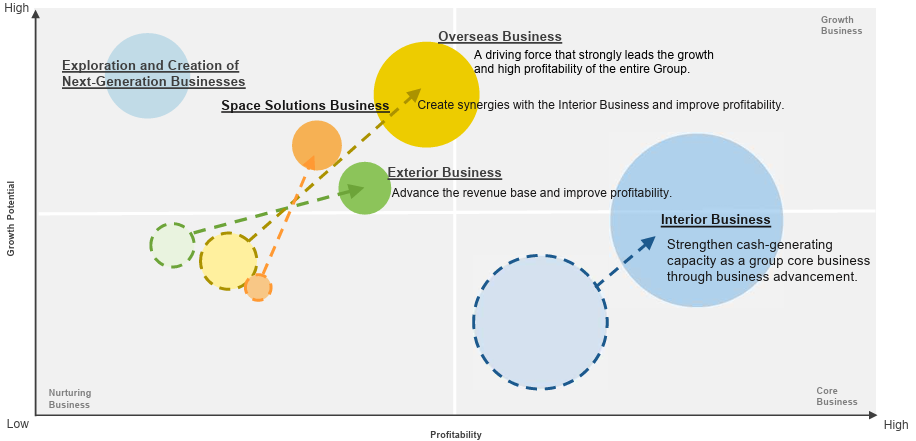
(Source: the company)
(3) Business strategies
① Domestic interior segment/Interior business
They laid out the five strategies: “to improve their position in growing markets,” “to optimize their product mix,” “to optimize their supply chain,” “to hone their manufacturing capacity,” and “to improve their corporate brand.”
By sophisticating their business and enhancing their ability to generate cash, they will accentuate the characteristics as the core business.
◎ To improve their position in growing markets
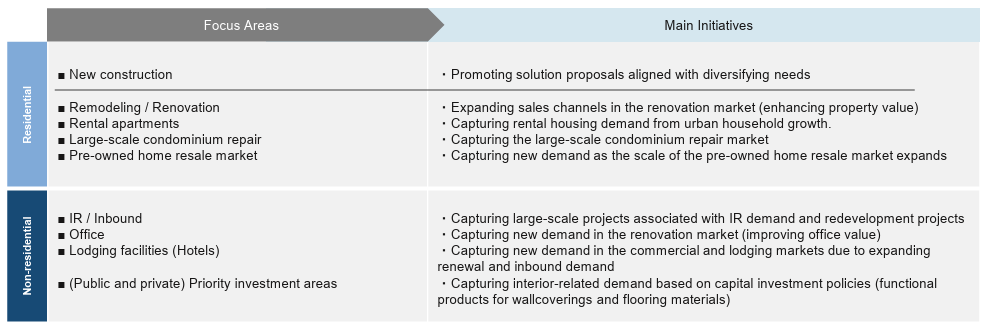
While the growth of the domestic construction market is limited, they concentrate on the markets and fields where new growth potential would emerge in urban areas and local areas. They consider that the non-residential, remodeling, and renovation markets remain promising.
By grasping the needs in each market or field and strengthening their capability of proposing solutions, they will enhance their competitive advantages and aim to improve their presence.
For remodeling and renovation, products for new construction cannot always be used due to installability, so they consider that the development of products for remodeling and renovation would lead to the improvement in the capability of proposing solutions.
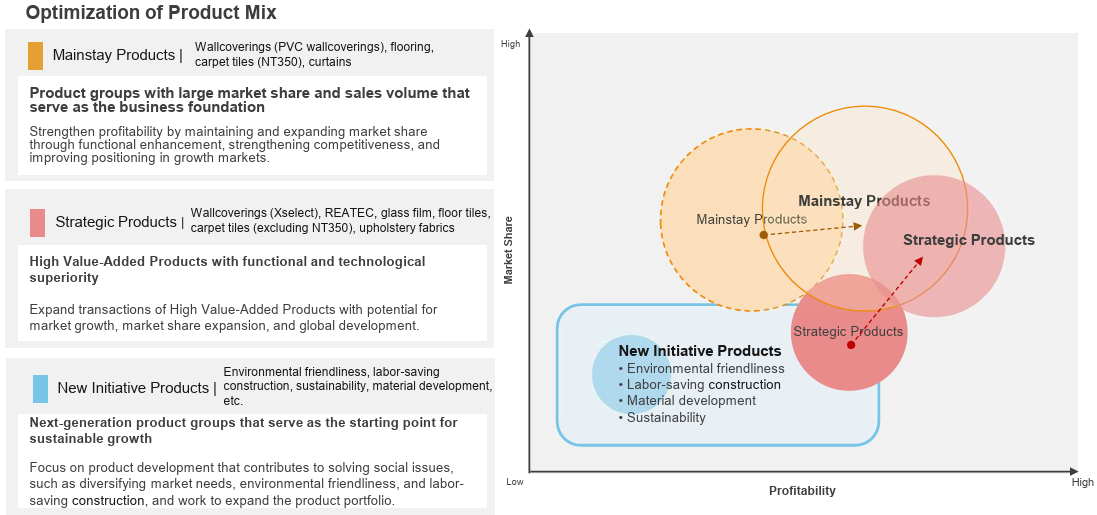
◎ Optimization of the product mix
They will strive to optimize their portfolio by reclassifying their products into “core products,” “strategic products,” and “innovative products.”
In the interior field, clients demand solutions for responding to market needs and social issues swiftly and accurately based on the approach of the development of products/services based on market needs rather than the approach of the development of products/services based on the technologies and internal resources of each company, which has been mainstream so far.
By cementing the cooperation in manufacturing and sale between the product management department, which is in charge of the planning and development of products, and the business department in charge of marketing, and establish a product portfolio that can be applied to overseas markets where they aim to grow their business significantly.
Regarding “strategic products,” they are planning to release REATEC and glass films as advantageous products in overseas markets.
 |
 |
(Source: the company)
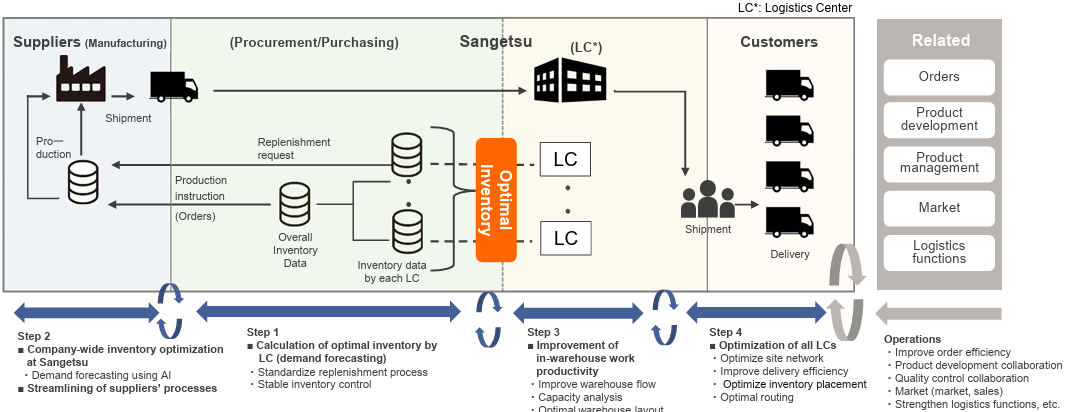
◎ Optimization of the supply chain
By sophisticating supply chain management (SCM), they will strive to maximize their competitive advantages and cash flows. In detail, they will strive to clear inventory through appropriate inventory control, to generate cash, and strategically control their capacity (resources), to maximize investment efficiency in the supply chain.
Some outcomes were seen in the period of the previous medium-term management plan, so they will keep strengthening the supply chain.
(Source: the company)
◎ Enhancement of the manufacturing capacity
They will reinforce all functions related to manufacturing, including R&D, design, development of materials and products, and quality control.
Through the linkage between functions, they will improve their competitiveness and proposing capability as a brand maker.
◎Improvement in their corporate brand
They will enhance promotional measures, in order to improve their corporate brand and popularity as “an enterprise that creates cultures from interior products based on materials and designs.”
② Domestic interior segment/comprehensive space business
In order to improve profitability, which is an issue, they will strive to establish a customer base, brush up their capability of proposing solutions, and beef up the functions as a comprehensive interior business operator.
To do so, they enhance marketing activities through synergy with the interior business by utilizing the finely-tuned nationwide sales network of Sangetsu, establish a customer base targeting the office market, the hotel market, and local markets where synergy with the interior business can be expected, and propose comprehensive solutions as the Sangetsu group.
Regarding products, they will enhance the capability of procuring not only wallcoverings, flooring materials, and fabrics, but also other products that constitute spaces, to raise the customer satisfaction level.
They aim to improve their competitiveness and profitability by boosting the marketing, designing, and installing functions and establishing a seamless project management system.
Its business model is totally different from that of the interior business, so they employed advanced specialists as executive officers on April 1, 2026. They will engage in the establishment of a more effective business system.
③ Domestic exterior segment/exterior business
In the period of the previous medium-term management plan, they failed to achieve the assumed growth.
This is because the strategic cooperation between Sangetsu and Sungreen was not effective.
In April 2025, the management structure of Sungreen was refurbished, and they will “hone the capability of proposing solutions through the linkage between functions,” “plan and develop original products,” “strengthen logistics and construction functions,” and “invest for growth” while Sangetsu will support them.
Originally, Sungreen has been a wholesaler without product development or planning functions, so it is indispensable to accelerate the cooperation with partner enterprises to expand their market share, plan and develop products that would help meet social needs and solve social issues by involving all companies of the Sangetsu group, and improve competitive advantages by increasing original products and differentiating their products.
④ Overseas segment/overseas interior and comprehensive space businesses
The initiatives in each region, mainly North America, which is a major market, and each business are as follows.
◎ Overseas interior business
North America | ~Acceleration of growth~ They will make efforts to strengthen the wallpaper production and sale business and launch the business of manufacturing sound-deadening materials, wooden panels, fabrics, etc., which are related to their current business and have a significant growth potential, to accelerate growth further. |
China and Hong Kong | ~To reestablish their business base and secure revenues~ They will redevelop their business base, select and concentrate on profitable markets and domains, and develop core products, to improve profitability. |
Southeast Asia | ~Shift to a growth track~ They will consolidate their revenue bases in Singapore, Malaysia, Thailand, and Vietnam, concentrate managerial resources onto the markets and domains on which they should focus, and execute the shift to a growth track. |
◎ Overseas comprehensive space businesses
Southeast Asia | ~Fortification of the revenue base~ D’Perception will switch from business administration relying on the leadership of the CEO to organization-driven business administration, and establish a horizontal organization and a steady revenue base. |
(4) Financial strategies
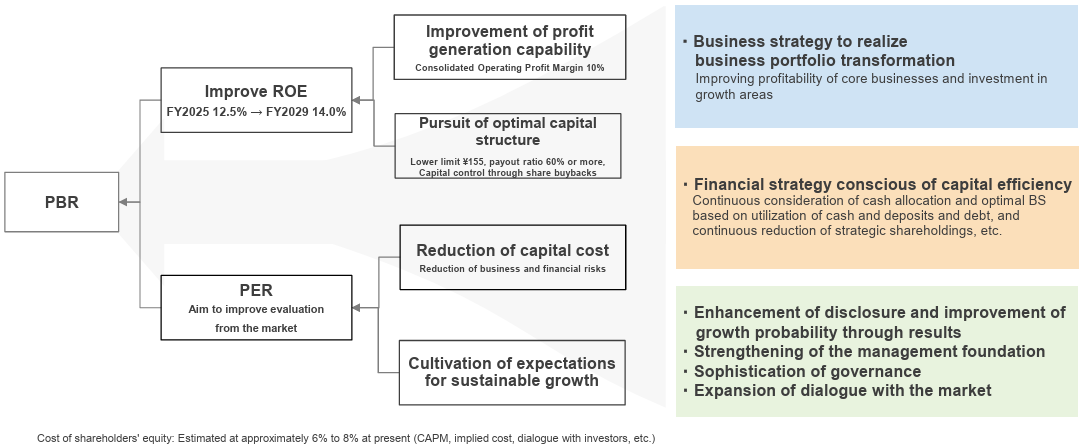
① Measures for realizing business administration conscious of capital cost and stock price
They will increase revenues through the reform of their business portfolio, optimize capital through financial strategies, and reduce capital cost through the fortification of the management base. The company recognizes that cost of shareholders’ equity is 6-8%, and by generating return exceeding that stably, they aim to improve PBR sustainably.
*ROE
They will increase ROE from 12.5% in the final fiscal year (ended March 2026) of the previous medium-term management plan to 14.0% in the final fiscal year (ending March 2030) of the “Medium-term Management Plan 2029.”
*Consolidated operating income margin
They aim to increase it to 10% by brushing up the earning capability through business strategies.
*Shareholder return
In order to pursue an optimal capital composition, they will raise the lower limit of annual dividend to 155 yen/share, return profit to shareholders while targeting a payout ratio of 60% or higher, acquire treasury shares when necessary, and flexibly carry out capital control.
*PER
They will make efforts to curtail capital cost and foster the expectations toward sustainable growth.
② Cash allocation
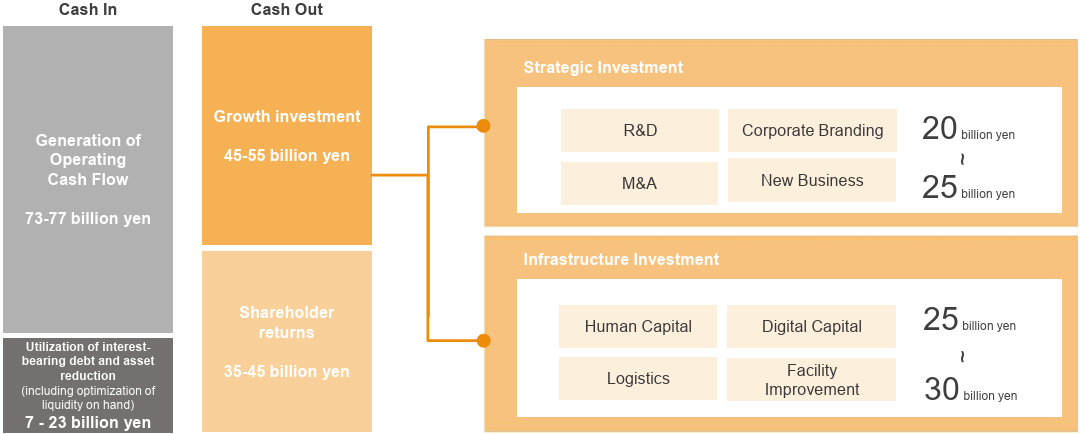
They will make efforts to achieve investment for growth and capital optimization. Through flexible fund allocation, they will realize the investment for growth that will help generate profit in the medium/long term and an optimal capital composition for achieving an ROE of 14%. Considering capital efficiency, investment for growth, etc., they think of flexibly returning additional profit to shareholders, including the acquisition of treasury shares. They plan to allocate 45-55 billion yen to investment for growth and 35-45 billion yen to shareholder return.
 |
 |
(Source: the company)
③ Investment policy
They will invest in the three fields: “R&D,” “corporate brand development,” and “M&A and new businesses.”
R&D | ・They are planning to establish an R&D base for enhancing the development of new materials and products. ・To cement the alliances with partner enterprises |
Corporate brand development | To enhance marketing and promotional functions, to diffuse their ideal corporate state “an enterprise that creates a culture from interior products based on materials and designs.” |
M&A and new businesses | ・To enrich the product portfolio in the interior business ・To consider business opportunities in the fields related to the interior business and arising out of industry restructuring ・To expand their business domain and scale in overseas markets, including North America |
④ Shareholder return policy
They basically pursue stable dividends, and aim to increase the dividend amount while targeting a payout ratio of 60% or higher with the lower limit of annual dividend amount being 155 yen/share. When discussing the shareholder return policy, they set up a policy of linking it with a profit growth with payout ratio, while living up to the expectations of shareholders for a “stable dividend increase.”
They also consider the acquisition of treasury shares when necessary, while taking into account the market environment, capital efficiency, investment for growth, etc.
(5) Management base
① Human capital
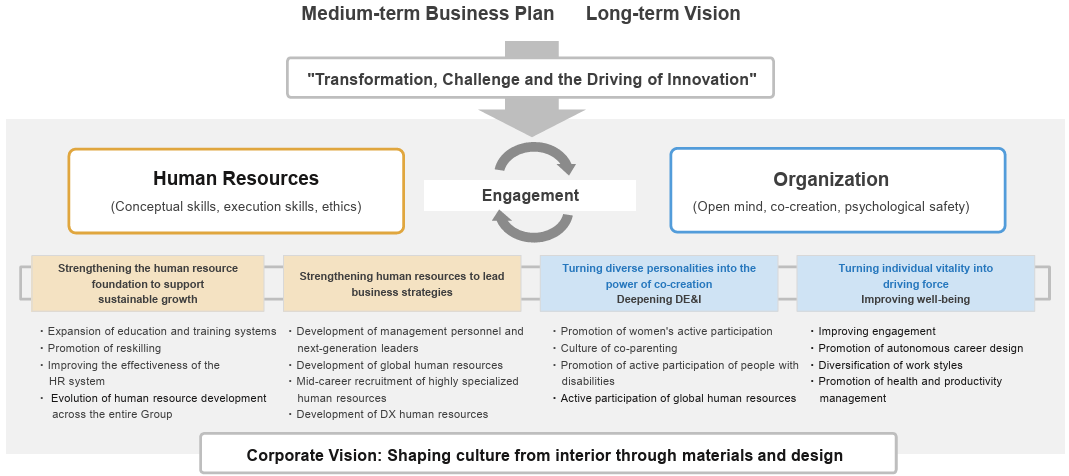
In order to realize or accelerate the themes: "Transformation, Challenge and the Driving of Innovation" they will implement human resources measures linked with management strategies and reinforce the personnel base of the Sangetsu group.
In the previous medium-term management plan, they increased employees in preparation for the next exponential growth, but in the current medium-term management plan, they will concentrate on the improvement of each employee’s abilities and skills rather than the increase of employees. They will develop and increase personnel who possess abilities to make concepts and take action and a sense of ethics, and can make strategic decisions, promote transformation, and exert leadership. In order to motivate employees, they will steadily develop a corporate culture and a working environment.
② Digital capital
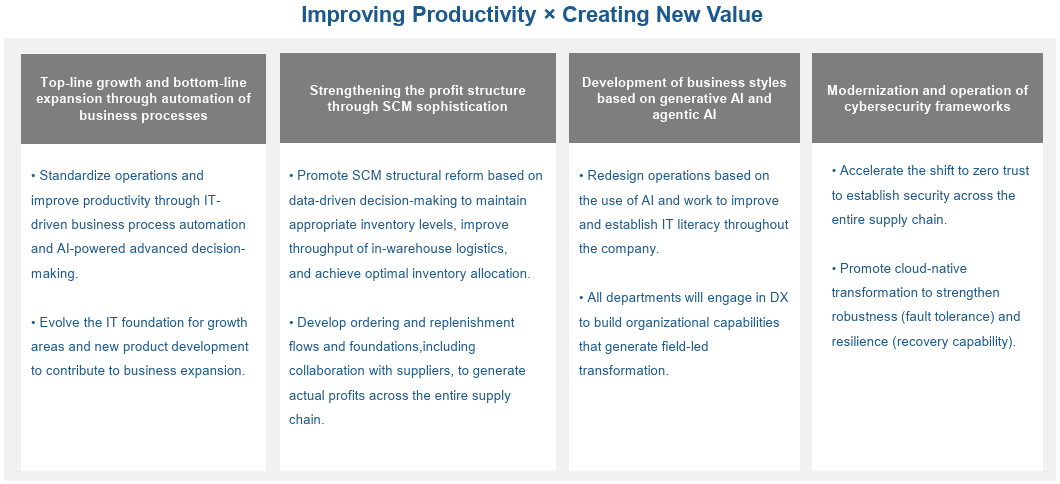
They will evolve digital capital into strategic capital for maximizing their earning capacity and capital efficiency, and execute data-driven business administration by utilizing accumulated digital capital. In order to enhance absolute competitiveness, they will promote digital transformation (DX) for creating reliable financial value.
 |
 |
(Source: the company)
③ Consolidated management
Sangetsu has increased the number of group companies through M&A over the past 10 years, and as of now, the number of employees of Sangetsu is around 1,300 and the number of employees of the Sangetsu group exceeds 3,000. They expanded their business domain in a short period of time, but it is necessary to enhance employees’ feeling of belonging to the Sangetsu group and aligning the vectors of all employees, in order to achieve a sustainable growth. Accordingly, it is considered that the importance of consolidated management has grown further.
They will enhance and accelerate personnel development in the entire Sangetsu group, to expand their business scale and domain.
④ Sustainability
While fulfilling corporate social responsibilities and conducting sound business administration, they will keep contributing to the realization of a sustainable society through corporate activities.
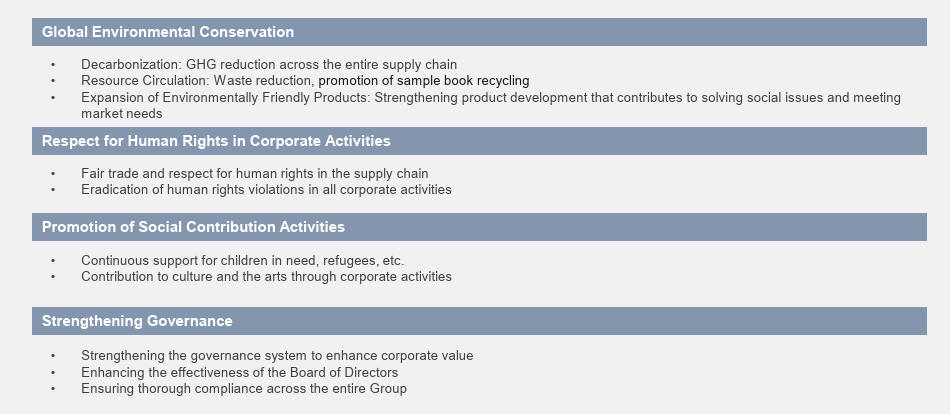
In detail, they will set goals in each of the 4 main items: “conservation of the earth environment,” “respect for human rights in corporate activities,” “promotion of social contribution activities,” and “tightening of corporate governance” and aim to achieve the goals.
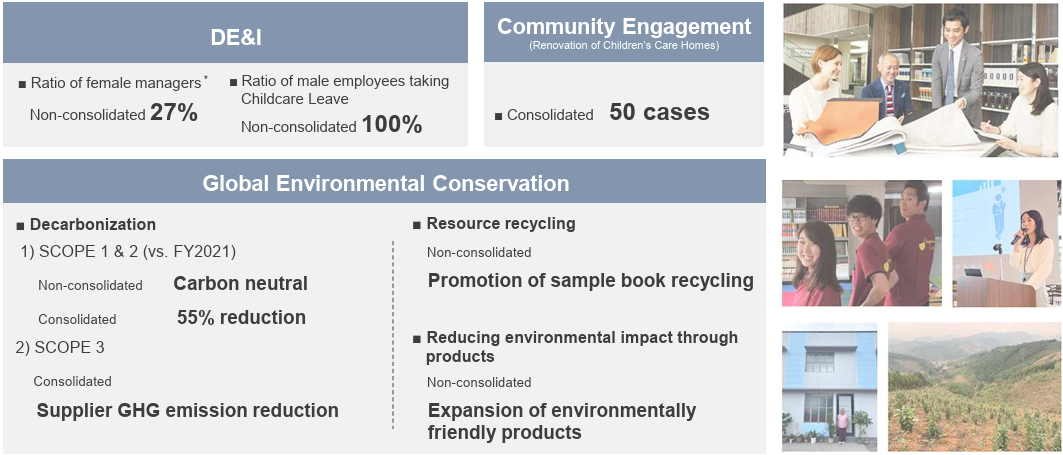
Regarding the conservation of the earth environment, they engage in the reduction of environmental burdens through decarbonization, recycling of resources, and products.
Regarding diversity, they will foster a corporate culture in which all of diverse employees of the Sangetsu group, including mid-career workers, full-time employees who joined the Sangetsu group as new graduates, and non-Japanese personnel, can flourish.
 |
 |
(Source: the company)
(6) Management indicators
They set the goal of achieving “sales of 250 billion yen, an operating income of 25 billion yen, and an ROE of 14%” in the fiscal year ending March 2030.
◎ Group-wide performance
| FY 3/26 (Results) | FY 3/30 (Plan) | CAGR |
Net Sales | 2,064.4 | 2,500.0 | +4.9% |
Operating Income | 194.0 | 250.0 | +6.6% |
Net Income | 146.4 | 170.0 | +3.8% |
ROE | 12.5% | 14.0% | - |
ROIC | 13.7% | 11.0% | - |
Unit: 100 million yen. The CAGR was calculated by Investment Bridge.
◎ Performance in each segment
| FY 3/26 (Results) | FY 3/30 (Plan) | CAGR |
Net Sales |
|
|
|
Domestic Interior | 1,641.0 | 1,880.0 | +3.4% |
Domestic Exterior | 73.1 | 78.0 | +1.6% |
Overseas | 350.2 | 542.0 | +11.5% |
Total | 2,064.4 | 2,500.0 | +4.9% |
Operating Income |
|
|
|
Domestic Interior | 193.3 | 215.0 | +2.7% |
Domestic Exterior | 1.1 | 5.0 | +46.0% |
Overseas | -0.4 | 30.0 | - |
Total | 194.0 | 250.0 | +6.6% |
Unit: 100 million yen. The CAGR of sales was taken from the reference material of the company. The CAGR of operating income was calculated by Investment Bridge.
◎ Breakdown of the overseas business
| FY 3/26 (Results) | FY 3/30 (Plan) | CAGR |
Net Sales |
|
|
|
North America | 225.6 | 394.0 | +15.0% |
Southeast Asia (Interior Business) | 43.1 | 63.8 | +10.3% |
China and Hong Kong | 8.8 | 13.2 | +10.7% |
Southeast Asia (Comprehensive Space Business) | 73.1 | 72.0 | -0.4% |
Operating Income |
|
|
|
North America | 8.6 | 30.0 | +36.7% |
Southeast Asia (Interior Business) | 0.6 | 3.0 | +49.5% |
China and Hong Kong | -2.2 | 0.5 | - |
Southeast Asia (Comprehensive Space Business) | -2.6 | 2.6 | - |
Unit: 100 million yen. The CAGR was calculated by Investment Bridge.
5. Interview with President Kondo
We interviewed President Kondo about the issues he considers when formulating and announcing the “Medium-term Management Plan 2029,” the points of the new medium-term plan, his message toward shareholders and investors, and so on.
Q: In this interview, we would like to ask about the newly formulated and announced “Medium-term Management Plan 2029.”
Seeing “TOP MESSAGE” at the beginning of the explanatory material of the “Medium-term Management Plan 2029,” we think that you were aware of some problems and issues when formulating this medium-term plan. Could you talk about them?
In the long-term vision [DESIGN 2030], our company pursued the transformation from an interior finishing enterprise into a space creation enterprise, and in the previous medium-term plan “BX 2025,” we aimed to realize business transformation to accelerate that.
Since I was appointed as representative director, president, and executive officer in April 2024, I have made efforts to grasp our company’s issues and potential in detail for achieving an ideal corporate state while tackling various managerial issues. Then, I concluded that under this policy, it would be difficult to achieve growth at the initially assumed speed and expand revenues.
The interior business, which is the mainstay, grew steadily, and while revenue improvement progressed also outside Japan, we conducted investment, including the allocation of specialized personnel to the comprehensive space businesses, which would drive the transformation into a space creation enterprise, but it did not contribute to revenues. In the exterior business, too, we strove to expand business scale and domain, but profitability has not grown. Both businesses have issues attributable to respective characteristics. In particular, the business model of the comprehensive space businesses is totally different from that of the interior business, so it is necessary to redevelop its business base.
Based on this review, our company will go back to the core of our business and implement growth strategies by leveraging its strengths, in order to achieve a sustainable dramatic growth. Defining our ideal state as "Shaping Culture from interiors through Materials and Design, "we will keep strengthening the interior business as a growth driver and establish a more robust revenue base. Outside Japan, they will accelerate the growth of their business, mainly the interior business, in North America and Asia. Regarding the comprehensive space and exterior businesses, they will steadily grow them as businesses for medium/long-term growth while applying the strengths of interior products to them. The “Medium-term Management Plan 2029” has been formulated this time based on such judgment and policies.
Q: In “TOP MESSAGE,” you mentioned that your company decided to uphold the corporate credo “Integrity” again. Could you explain your aspirations and thoughts?
Since I joined the company in December 2022, I have been strongly feeling the integrity of employees and the trust of stakeholders based on the integrity. Our company originally upheld “integrity” as a corporate credo. When formulating the corporate philosophy two years ago, it was incorporated into the “belief of putting importance on things: the integrity of enterprises drives a change in society,” but recognizing that “integrity” is our important trait that connects all employees and stakeholders, the origin we should go back to, and our fundamental value, we decided to uphold the corporate credo “Integrity” again.
Q: Next, we would like to ask about the direction, initiatives, etc. in the “Medium-term Management Plan 2029.”
Firstly, let us ask about the domestic interior business/interior business. You mentioned five business strategies. Could you talk about their important points?
*Improvement in the position in growing markets
While sales quantities in the domestic construction market will decrease gradually, some markets will certainly grow and new markets will emerge. By utilizing our nationwide sales network, we will enhance the access to market needs and social issues, and then improve our position in growing markets.
One of them is remodeling/renovation.
For remodeling and renovation, products for new construction cannot always be used due to installability, so they consider that the development of products for remodeling and renovation would lead to the improvement in the capability of proposing solutions.
*Optimization of the product mix
The key is the development of innovative products as well as the rise in profitability of existing major products with a large market share and strategic products with high added value.
For innovative products, we are currently focusing on the increase of eco-friendly products and the development of labor-saving products for helping solve the social issue of the shortage of manpower.
The recently released “INNO PANEL” is a new wallcovering material composed of plasterboard and wallpaper, where wallpaper is already attached to plasterboard when it is shipped from a factory. This is intended for solving the industrial issue of the shortage of workers, by building walls in a short period of time and reducing the burdens of on-site work.
*Optimization of the supply chain
Supply chain management (SCM) is important to all industries and all enterprises. SCM is a very significant element for enhancing competitiveness and improving the top line, especially for enterprises that deal in a wide array of products like our company.
Our company proceeds with Steps 1 to 4 stepwise at the same time. Step 1 is to optimize inventory at logistics centers, and Step 2 is to rationalize inventory throughout Sangetsu and rectify the processes of suppliers. We have worked on Step 3, which is to improve profitability of operations in warehouses and optimize the layouts in warehouses. After that, we plan to work on the final Step 4, which is aimed at optimizing the operations at all logistics centers and realizing optimal routing. Then, we plan to rationalize the entire supply chain in this industry, including those outside the Sangetsu group such as suppliers and clients.
Specialists invited in January 2024 will serve as executive officers, and proceed with processes as scheduled.
We strongly feel that employees have become aware of the importance of enhancement of supply chain management, so we would like to accelerate it further in the coming four years.
Q: We think that only your company can invest in SCM on this scale in this industry, so we would like to expect that your competitive advantage will increase further.
Next, let us ask about the comprehensive space businesses. We feel that your monetization method in this business is vague. How do you expand sales and profit?
In order to expand our business domain, we decided to enter the design and construction fields related to interior products, and launched a comprehensive space businesses. Its business model is totally different from that of the interior business, and there are already many enterprises that possess sufficient experience and knowledge of design and construction, advanced technologies, and a robust customer base, so our company cannot compete with them immediately on an equal footing. However, it is obvious that this is an important business constituting our comprehensive interior business, utilizing the advantages of our interior business, such as our portfolio of products for creating spaces and our nationwide customer base. In April 2026, we appointed talent from general contractors as executive officers, and are proceeding with infrastructure development and business sophistication under their supervision.
In detail, we will utilize our nationwide sales network, which is our primary strength, target collaborative projects with local general contractors and markets of offices and hotels where we can exert our strengths, and establish a customer base. In addition, we need to secure competitiveness in construction so that our business of proposing spaces will become true added value. Accordingly, we are proceeding with the establishment of a seamless project management system covering planning and construction, while enhancing the functions of not only marketing and design, but also construction. Our company will further evolve our “comprehensive interior business,” which is the mainstay, develop and sophisticate the base for the comprehensive space businesses, and induce strong synergy with the interior business, to grow it into a business with the capability of earning steadily.
Q: How do you plan to operate the exterior business?
Sungreen, which operates the exterior business in our corporate group, mainly procures and wholesales products of other companies’ brands, so in order to differentiate our products and improve profitability, it is necessary to improve the functions of planning and developing products. Accordingly, we will strive to increase original products by utilizing Sangetsu’s capabilities of planning and developing products, and accelerate the cooperation with makers, which are partner enterprises. In addition, we plan to conduct investment for growth to strengthen the logistics and construction functions and restructure the industry, while discerning the possibility of this business. Accordingly, we will strive to increase original products by utilizing Sangetsu’s capabilities of planning and developing products, and accelerate the cooperation with makers, which are partner enterprises. In addition, we plan to conduct investment for growth to strengthen the logistics and construction functions and restructure the industry, while discerning the possibility of this business.
Q: Next, we will ask about the overseas business. The performance of the overseas business varies according to region. How do you operate your business in each region?
Outside Japan, our revenues are improving steadily mainly in North America. Although the degree of revenue improvement varies among regions, we are at the stage of accelerating growth strategies in most regions, and we consider the overseas business as a growth driver in the period of the new medium-term plan.
In North America, we have been increasing revenues by enhancing the competitiveness of in-house manufacturing and sale of PVC wallcoverings, and from now on, we will strive to expand our market share in Japan and actively release promising products, such as sound-deadening materials, wooden panels, and fabrics. The management of Koroseal considers not only organic growth opportunities, but also inorganic ones, and our company would like to promote close communication, to support growth strategies.
The business environments in China and Hong Kong remain harsh, but profit/loss is improving through the downsizing of organizations, thorough profitability management, etc. Competition is fierce in this market, but there are still many business opportunities due to the market size, the diversity of needs, drastic changes, etc., so we will discern target markets and make efforts to establish a stable revenue base.
In Southeast Asia, the redevelopment of the base for the interior business, including its organizational structure, has been almost completed. Going forward, we will clarify our strategies and direction, and work on the improvement in our earning capacity. On the other hand, in the comprehensive space businesses, it has been two years since that company joined our corporate group, but they are still restructuring their organization, including the decision making process. We plan to establish a stable business base as soon as possible.
Q: Lastly, please give your message toward shareholders and investors.
The base for our interior business, which is the mainstay, is firm, and there are sufficient chances to grow further also outside Japan. On the other hand, its business model was established in the 1970s and the 1980s, and most of revenues come from the interior business in Japan. We think this imposes a significant latent risk.
Without resting our laurels, it is essential to raise our sensibility to market needs and social issues, seek or create new products or businesses that would generate revenues in the future, and accelerate them and other growth strategies. To do so, we will actively execute growth strategies, including M&A.
In parallel, we will return profit to shareholders responsibly, to realize both business growth and shareholder return, and live up to the expectations of shareholders and investors, so we would appreciate your continued support.
6. Conclusions
For their business, it is difficult to significantly increase sales and profit in an organic manner in a short period of time, but through active investment for growth, they aim to achieve “sales of 250 billion yen, an operating income of 25 billion yen and an ROE of 14%” in FY 3/30, four years from now. In some companies, a path toward growth that should be pursued by companies is unclear, because they focus on shareholder return excessively in order to improve PBR. Meanwhile, Sangetsu plans to invest 45-55 billion yen for corporate growth, exceeding the fund for shareholder return: 35-45 billion yen. We would like to pay attention to the progress of their investment for growth.
<Reference: Regarding Corporate Governance>
◎ Organization type and the composition of directors
Organization type | Company with audit and supervisory committee |
Directors | 7 directors (including 4 Outside Directors) |
Audit and supervisory committee member | 5 members (including 4 Outside Directors) *Within the Board of Directors |
◎ Corporate Governance Report
Last update date: June 25, 2026
<Basic Concept>
We aim to foster good relationships with all stakeholders to improve our corporate value and grow sustainably.
To attain these goals, we consider that it is essential to improve our corporate governance based on the transparency, swiftness, and efficiency of business administration.
Our company has been reorganizing to a company with an audit committee, with the aim of strengthening the auditing and supervising functions of the board of directors, by having outside directors join the management.
Under this governance system, we will make efforts to further improve our corporate value.
<Reason for Non-Compliance with the Principles of the Corporate Governance Code>
Our company follows all principles of the Corporate Governance Code.
<Disclosures Based on the Principle of the Corporate Governance Code (excerpts)>
Principles | Disclosure contents |
Principle 1-4 So-called strategically held shares | 1. Policy on strategically held shares and details of the review of the appropriateness of shareholding They determine shares to be strategically held in the medium/long-term, after comprehensively discussing whether new relationships should be fostered or whether the relationships with business partners should be cemented. With regard to holding shares, each year we will check the associated cost and returns, and if it is determined that holding the shares has no strategic value in the medium-and long-term, we will sell the shares, and conduct operations based on that decision. The Board of Directors’ decision and a disclosure of the shares we decide to continue holding will appear in the “Shareholding status” column of the securities report.In addition, if a company whose shares are strategically held by our company offers to sell shares of our company, we will not conduct any activities that would hinder said sale.2. Attitude toward exercise of voting rightsWe will keep an open dialogue and communicate through various channels, while respecting the management policies of companies that we invest in. We will make a comprehensive judgment based on company’s stance on shareholder returns and improving corporate value in the medium-to long-term, their corporate governance policies, and CSR activities. We will also separately examine whether holding the shares of the company is constructive to our goals and whether it will lead to improving the corporate value of the company we invest in. |
| [Principle 2-4 Ensuring Diversity, including Active Participation of Women] Supplementary Principle 2-4-1 Ensuring diversity in promotion to core human resources | (1) Our attitude toward ensuring diversityPursuing the Sangetsu Group Human Rights Policy and the Sangetsu Group Basic Policy on Diversity, our company fosters a corporate culture that continues taking on challenges and innovating and enriches programs and systems by considering the individuality of each one of our employees as diversity regardless of gender, age, nationality, race, religion, disability, gender identity, sexual orientation, etc.(2) Our voluntary and measurable goals for ensuring diversity, and our current progress of ensuring diversity - Promotion of women to managerial positions The percentage of female full-time employees in our company is increasing year by year, which is currently 38.5%, thanks to our efforts to create a workplace environment in which our employees can work comfortably regardless of gender, such as enrichment of the work-life balance support system. In addition, the ratio of female leaders (the section chief class) is 43.1%, and the ratio of female managers, including managers for supporting decision-making processes, is 24.2%. In order to support women in flourishing, we support career development for female employees and their superiors, conduct training for improving supporting skills, and hold health seminars for supporting women in flourishing. In the “Medium-term Management Plan 2029,” they uphold a goal of increasing the ratio of female line managers to 27% by 2030, and its variation over the past 5 years has been disclosed via our website. In the Medium-term Management Plan [BX 2025], the ratio of female managers, including managers for supporting decision-making processes, was used as an indicator, but from the “Medium-term Management Plan 2029,” we use the ratio of line managers. (https://www.sangetsu.co.jp/company/sustainability/social/divercity_policy.html) - Promotion of career hires to managerial positionsWe have employed career workers proactively since 2016 in order to secure human resources with expertise in such fields as management, information systems, and design. Three of our nine executive officers are career hires. We actively promote career hiring as well as in-house training of specialized and professional personnel, and hire several people for management positions every year. In addition, personnel hired for non-managerial positions are promoted to managerial positions in a fair manner like other full-time employees. We offer our career hires training and in-company communication after employment in order to help them get used to working in our company and actively participate in our business operations. - Promotion of foreign nationals to managerial positionsThe Sangetsu Group began to employ foreign nationals in 2015 when the Sangetsu Group started the overseas business. We will promote foreign nationals to managerial positions equally, regardless of nationality, based on their capabilities and business performance. In our group companies engaging in the overseas business, foreign nationals account for about 40% of the employees in the positions of officers that play the central roles in the business. (3) Our policies on human resources development for ensuring diversity, policies on internal environment development, and their progressConsidering diversity management, which leads new perspectives and ideas brought by different backgrounds, sensibilities, and senses of values to enriched creativity, as the core of our business management, we are making efforts in this regard as an important policy toward sustainable growth while handling diversifying market demand. The goals for diversity & inclusion are to employ more people with disabilities, support female employees in the promotion to managerial posts, and encourage male employees to take childcare leave. Other efforts of our company include improvement of the rate of paid holidays taken by our employees, reduction in long working hours, and approaches related to LGBTQ+. |
Supplementary Principle 3-1-3 | - Our initiatives toward sustainability Our long-term vision, [DESIGN 2030], includes 10 of the 17 goals of the SDGs as our corporate group’s objectives. In addition, in the “Medium-term Management Plan 2029,” we described measures for conserving the earth environment, respecting the human rights in corporate activities, promoting social contribution activities, and tightening corporate governance for sustainability, and set goals for the fiscal year ending March 2030. Then, we will implement initiatives for realizing a sustainable society through corporate activities while fulfilling our social responsibilities and carrying out healthy business administration. - Investment in human capitalOur company aims to run a personnel system that respects the diversity, personality, and individuality of our employees and allows each of them to demonstrate their abilities to the fullest extent as the leading role in business management, and we disclose information on the relevant systems on our website.(https://www.sangetsu.co.jp/company/sustainability/social/divercity_policy.html) Investments in human capital include employee training, skills development, the increase of employee work engagement, and the creation of a comfortable working environment, all of which we are proactively implementing. In particular, in the Medium-term Management Plan [BX 2025], the strengthening of human capital was included as one of major initiatives, and we planned to invest 700 million yen in 3 years, and have engaged in the expansion and sophistication of human capital and supported employees in flourishing. In the Medium-term Management Plan 2029, too, we will enrich education and training of employees, conduct engagement surveys, revise our human resources systems, improve treatment, and so on, to support employees in flourishing. Furthermore, we have followed our health and productivity management policy “For employees to work enthusiastically so that they can work and live healthily,” and have been committed to maintaining and building up our employees’ health by ensuring a safe, healthy, comfortable, and friendly workplace environment in which our employees can work with vigor and enriching programs and systems aimed at promoting their physical and mental health. We disclose information related to these activities on our website. (https://www.sangetsu.co.jp/company/sustainability/social/health_management.html) - Investment in intellectual propertyUnder our long-term vision, [DESIGN 2030], we have made "design management" the basis of our management, aiming to enhance brand value and transform our business through design. In order to realize design management, we are promoting to strengthen our ability to propose product and space designs through greater recruitment and training of design personnel. The legal affairs department, which was established in July 2023, is strengthening its function to handle intellectual property in addition to the function to deal with legal affairs, and aims to improve brand value by creating, protecting, and utilizing intellectual property rights. Additionally, the company offers appropriate rewards for employees’ inventions in accordance with in-house regulations on the handling of employees’ inventions, thereby promoting the creation of intellectual property. - Impact of climate change on our business activities Risks and opportunities from climate change are described in the financial statements issued in June 2026. In addition, on pages 46-51 of the Integrated Report issued in October 2025, we provide a summary of the environmental impact of our business activities regarding natural capital. The report describes our efforts to reduce the burden on the environment in our business activities and supply chain as a whole. On our website, we use many graphs and tables to explain our "Climate Change Perspective and Key Issues". https://www.sangetsu.co.jp/company/sustainability/environment/climatechange.html Furthermore, we agree with the TCFD in October 2021, and disclose the four TCFD disclosure elements (Strategy, Governance, Risk Management, and Indicators and Targets) on our website. Risk management is explained in a table on the "Risks and Opportunities from Climate Change" section of the website. https://www.sangetsu.co.jp/company/sustainability/environment/risk.html Additionally, in fiscal year 2022, the Risk Management Committee, chaired by the president, established a "Climate Change Risk Subcommittee" to review and re-examine the identification and handling of risks and opportunities through a more organized management system to address and monitor such issues. From now on, we will conduct scenario analysis, grasp financial impact, and improve the quality and quantity of information we disclose. |
Principle 5-1 Policy on constructive communication with shareholders | In order to achieve sustainable growth and improve corporate value in the medium/long term, our company puts importance on constructive dialogues with shareholders and investors and promotes IR activities under the following basic policy.
1. Manager and staff in charge of dialogues with shareholders The president manages dialogues with shareholders (IR activities), and interviews are dealt with by the president, executives in charge, or the management strategy office according to requests and themes. In addition, the president will hold direct dialogues with overseas investors, and meetings between overseas directors and institutional investors will be held when necessary.
2. Organic cooperation with related sections in our company In order to promote swift, rational dialogues, we established the publicity & IR section in the management strategy office as a dedicated organization. Centering around this section, the finance & accounting section, the management planning section, etc. cooperate in offering helpful information.
3. Enrichment of dialogue means and information disclosure other than individual interviews In addition to direct dialogues, we conduct the following measures, to promote the understanding about our management strategies and business progress. ・For institutional investors: We hold events, such as logistics center tours, in addition to sessions for briefing results and management strategies. ・For individual investors (shareholders): We hold a session for introducing our company (which is attended by all directors, including outside directors, and others) at our showroom, and participate in IR events. ・Enrichment of information disclosure: We issue an integrated report every year, proactively disclose the explanatory material and video for respective events, such as results briefing sessions and general meetings of shareholders through our website, and also release their English versions when necessary.
4. Feedback of shareholders’ opinions, etc. to the management The opinions and requests from shareholders and investors received through dialogues are reported by the publicity and IR section to the board of directors and the major management council, and used for improving our business administration. In addition, they are shared with the manager of each business section, to design concrete measures for enriching information disclosure and improving corporate value.
5. Management of insider information For dialogues, we manage unannounced important facts (insider information) thoroughly and make efforts to secure fairness in information disclosure to shareholders in accordance with the “regulations for managing insider transactions, etc.” |
[Measures for realizing business administration conscious of capital cost and stock price] *The English version disclosed *Last updated on May 27, 2026 | In order to achieve sustainable growth and improve medium/long-term corporate value, we have partially revised the “long-term vision,” whose last fiscal year is the fiscal year ending March 2030, and formulated the “Medium-term Management Plan 2029,” and are promoting management strategies based on them. In this plan, we set the following quantitative goals, and aim to maximize corporate value by conducting “business administration conscious of capital cost and stock price” based on our business and financial strategies.
(Major quantitative goals for FY 3/30) ・Consolidated sales: 250 billion yen ・Consolidated operating income: 25 billion yen ・Consolidated net income: 17 billion yen ・ROE: 14% ・ROIC: 11%
For details, see the material for the “Medium-term Management Plan 2029” (business strategy: pp.22-29, financial strategy: pp.30-33) in our website. [URL]https://www.sangetsu.co.jp/company/ir/management/medium_term_plan.html |