



Bridge Report:(3916)Digital Information Technologies the Fiscal Year Ended June 2026

 President Satoshi Ichikawa | Digital Information Technologies Corporation (3916) |
 |
Company Information
Exchange | TSE Prime Market |
Industry | Information and Communications |
President | Satoshi Ichikawa |
HQ Address | FORECAST Sakurabashi, 4-5-4 Hatchobori, Chuo-ku, Tokyo |
Year-end | End of June |
Homepage |
Stock Information
Share Price | Number of shares issued | Total Market Cap | ROE (Actual) | ROA (Actual) | |
¥950 | 31,003,640 shares | ¥29,453 million | 24.4% | 26.1% | |
DPS (Est.) | Dividend Yield (Est.) | EPS (Est.) | PER (Est.) | BPS (Actual) | PBR (Times) |
¥42.00 | 4.4% | ¥74.33 | 12.8x | ¥307.38 | 3.1x |
*The share price is the closing price on September 2. The figures were taken from the brief report on financial results in the fiscal year ended June 2026.
Consolidated Earnings
Fiscal Year | Net Sales | Operating Income | Ordinary Income | Net Income | EPS (yen) | DPS (yen) |
Jun. 2023 (Actual) | 18,149 | 2,039 | 2,059 | 1,447 | 47.59 | 18.00 |
Jun. 2024 (Actual) | 19,888 | 2,424 | 2,409 | 1,686 | 56.42 | 23.00 |
Jun. 2025 (Actual) | 24,159 | 3,013 | 3,027 | 2,178 | 73.69 | 36.00 |
Jun. 2026 (Actual) | 25,546 | 3,053 | 3,076 | 2,092 | 71.06 | 37.50 |
Jun. 2027 (Forecast) | 26,700 | 3,200 | 3,200 | 2,190 | 74.33 | 42.00 |
*Unit: million yen. The forecast is from the company. Net income is net income attributable to shareholders of the parent company. Hereinafter the same will apply. A 1-for-2 stock split was implemented on January 1, 2026. EPS and DPS are retroactively adjusted values. Regarding the dividends for the fiscal year ended June 2026, the total dividend amount per year is indicated as “-” because of the stock split. The total dividend amount 42.00 yen/share for the fiscal year ending June 2027 is composed of a common dividend of 39.50 yen/share and a commemorative dividend of 2.50 yen/share for the 45th anniversary of establishment.
This Bridge Report introduces the earnings results for the fiscal year ended June 2026, the earnings forecasts for the fiscal year ending June 2027, and other information of Digital Information Technologies Corporation.
Table of Contents
Key Points
1. Company Overview
2. Fiscal Year Ended June 2026 Earnings Results
3. Fiscal Year Ending June 2027 Earnings Forecasts
4. Moving the Model for Coexistence with AI into the Implementation Phase
5. Progress on the Medium-Term Management Plan and the Vision for 2030
6. Message from President Ichikawa
7. Conclusions
<Reference: Regarding Corporate Governance>
Key Points
- In the fiscal year ended June 2026, sales grew 5.7% year on year to 25,546 million yen. While the outlook for the Embedded Solutions Unit was uncertain due to the U.S. trade policy and the revision to the investment policies of automobile makers, they steadily met the healthy corporate demand for IT investment. Operating income rose 1.3% year on year to 3,053 million yen. Thanks to the sales growth, gross profit increased 4.5% year on year. SG&A expenses augmented due to the investment in AI and strategic product development for business growth, but it was offset, and they secured a profit growth. Amid the harsh business environment, each section and each company strove to grow earnings, so sales and profit increased for the 16th consecutive fiscal year. Sales fell below the forecast slightly, but profit was almost in line with the forecast.
- For the fiscal year ending June 2027, sales are expected to grow 4.5% year on year to 26.7 billion yen and operating income is projected to rise 4.8% year on year to 3.2 billion yen. The business environment related to in-vehicle devices is severe, but they aim to increase sales and profit for the 17th consecutive fiscal year, by meeting the firm demand for DX in the non-in-vehicle device-related field without fail. They will proceed to the phase of adopting a “model for coexistence with AI,” which is considered as a growth leverage. They will reinforce the base for medium/long-term growth, by continuously investing in the use of generative AI and the development of strategic products. They plan to pay dividends totaling 42.00 yen/share, up 4.50 yen/share from the previous fiscal year on a post-split basis (a common dividend of 39.50 yen/share and a commemorative dividend of 2.50 yen/share for the 45th anniversary of establishment). The expected payout ratio is 57.4%.
- The rapid evolution of AI and its penetration into various kinds of fields have produced significant effects on their business, too. It is obvious that the demand for generic skills for coding, etc. is declining, but there is rapidly growing demand for talent who possess the profound knowledge of the industry and business operations and the ability to utilize AI. Under these circumstances, the company will redevelop their business while assuming the utilization of AI, and concentrate on the acceleration of monetization as a hands-on AI/DX integrator while taking advantage of their strengths in four priority fields: “AI-driven development,” “a data utilization base,” “assurance and verification of quality,” and “security technology.”
- We requested President Ichikawa to give a message toward shareholders and investors. He said, “While we have experienced sluggish growth in both sales and profit over the past few years, causing concern among our shareholders and investors, we are restructuring our business while assuming the utilization of AI and aim to return to a growth path as a hands-on AI/DX integrator while leveraging our strengths. As our group's strength lies in our ability to adapt to change, this also represents an opportunity to further enhance our presence. We would appreciate your continued support from a medium- to long-term perspective.”
- They mentioned “the shift of their business models (adding high value) through AI-driven development and utilization of generative AI” as one of priority strategies for adopting a model for coexistence with AI. As primary measures, they enumerated “the sharing of successful models and know-how for AI-driven development that have been demonstrated in the primary department with other departments,” “automation of operations in the IT infrastructure field,” “hands-on support for the streamlining of business operations through the digitalization and sharing of on-site workers’ knowledge with AI,” and “utilization of AI for embedded development processes with high security requirements.” These measures have already produced some effects. When they gave an explanation about these measures to an institutional investor at a one-on-one meeting, the investor commented that there have been no companies that gave such concrete explanation like DIT, although they have often heard about “AI-driven development” and “productivity improvement.” Their business environment remains severe, but we would like to pay attention to the progress of return to a high growth track through the cultivation of the non-in-vehicle device field, the adoption of a model for coexistence with AI, the market cultivation with “RezOT,” a security measure for IoT, etc.
1. Company Overview
Digital Information Technologies Corporation is an independent information service company. Its sales are mostly from the undertaking of the development of business systems, embedded devices, etc. for clients mainly in the fields of finance, communications, etc. The company concentrates on the expansion of its products based on its original technologies, including "WebARGUS," a website security solution, and "xoBlos," an Excel work innovation platform. The company has a variety of characteristics, such as "multifaceted, diverse information technologies" and "organizational strategies of partial and total optimizations."
1-1 Corporate History
The late Norikazu Ichikawa (former Director and Chairperson), who obtained programming qualifications while he was working at Nippon Telegraph and Telephone Public Corporation, discovered a new world of computers and was attracted to its future potential. He awakened his spirit of challenge, decided to leave the company, and become independent.
In 1996, he was appointed president of Toyo Computer System, Inc. as the successor to one of his acquaintances. He expanded its business area starting from business system development, and then computer sales business (current: system sales business), embedded product development validation business and operation support businesses turning Toyo Computer System Inc. into a multifaceted and diverse IT company. In 2002, he established Toyo IT Holdings Corporation, which is the predecessor of current Digital Information Technologies Corporation, by separating several companies under the same group and establishing subsidiaries with 100% ownership. In 2006, he integrated four subsidiaries into one company and renamed it to the current company name. In addition, in January 2011, he established DIT America, LLC in Kansas, U.S.A. Digital Information Technologies Corporation was listed on JASDAQ of Tokyo Stock Exchange (TSE) in June 2015, listed on the second section of TSE in May 2016 and listed on the first section of TSE in March 2017. In July 2018, Mr. Satoshi Ichikawa, who used to be Representative Director and Senior Managing Officer, took up the office of Representative Director and President to rejuvenate the management structure under the business environment where change is accelerating and make a system to enable prompt decision-making.
In April 2022, the company was listed on the Prime Market of TSE, through the restructuring of the stock market.
1-2 Corporate Philosophy, etc.
 |
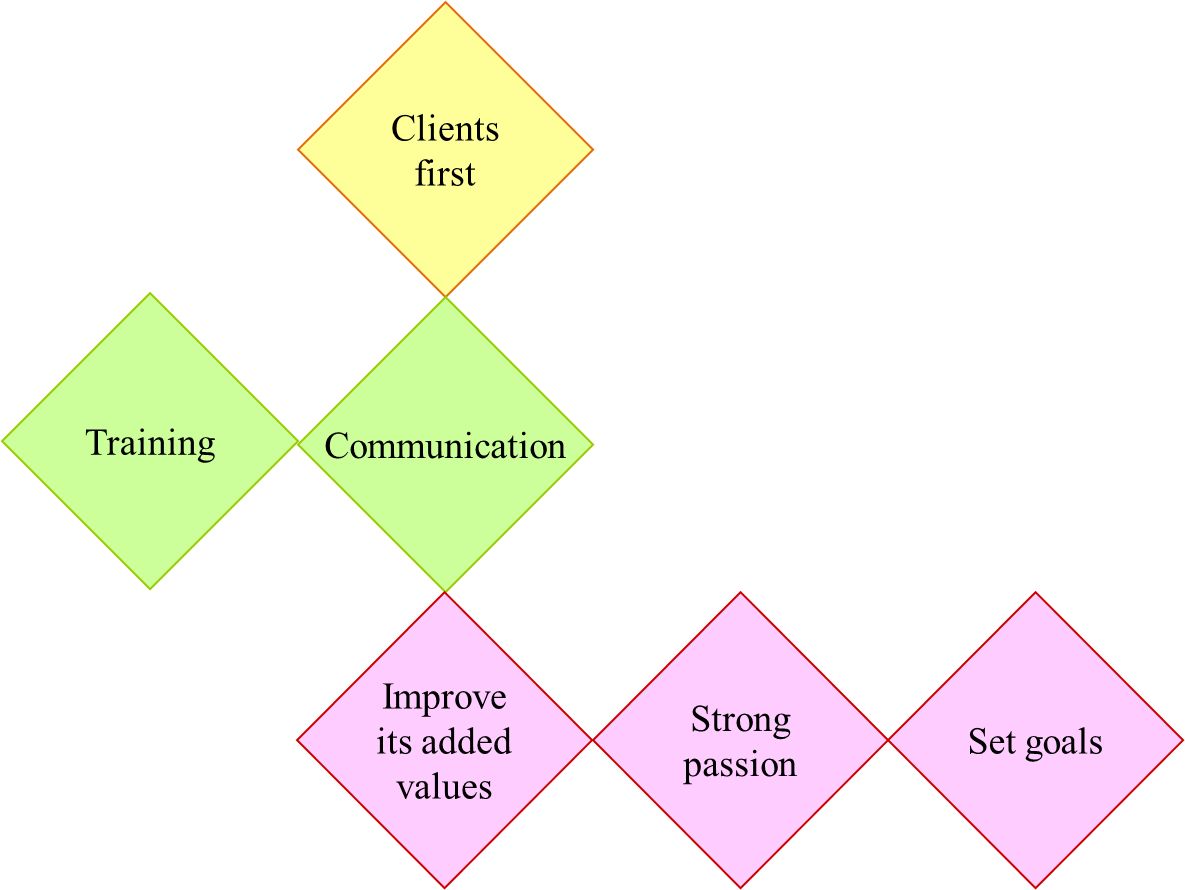
Our logo is a collection of cubes with an infinite number of stairs. This collection is our company itself, and each cube represents each employee. The 6 facets of the cubes represent six values which all employees share and consider valuable. Our corporate identity represents these values in three tiers; clients, company and employees. |
(From the company's website)
(From the company's website)
The above diagram is the unfoldment of the cube. According to the President Ichikawa, it emphasizes “clients first; this is where it all starts." Furthermore, the logo represents “training employees” and “communication with clients and among employees.” These are important values to the company. Additionally, we implore employees to “improve its added values,” “have passion” and “have a sense of purpose.”
Employees are to uphold this company policy as their creed and follow these principles at all times.
In August 2024, they set a new “purpose,” which indicates the linkage between corporate ethos and the meanings of existence, when formulating a new medium-term management plan.

(Taken from the reference materials of Digital Information Technologies Corporation)
Recognizing the risk that the company will be left behind the times soon unless they take measures in response to changes in the world, they consider that it is not good to maintain the status quo and defined “responsiveness” as taking on challenges constantly, while positioning it as an important concept.
They believe that their company’s mission is to contribute to society by offering value tailored to changes in the times and achieving continuous growth and enrich the lives of various stakeholders.
1-3 Market environment
The outlines of the market environment and growth potential of each business unit of the company mentioned in Section 1-4 “Business Description” are as follows.
(1) Business Solutions Unit
IT solutions that contribute to labor elimination and operational efficiency improvement, especially DX, are becoming increasingly important issues for companies. According to a survey of Fuji Chimera Research Institute, Inc., the DX-related investment amount keeps increasing, although the speed of DX-related investment varies among industries, and the DX-related investment amount in the subject industry in FY 2026 is expected to exceed 7 trillion yen. From now on, it is forecast that DX-related investment will be conducted under the assumption that generative AI or AI agents will be utilized, and it will become active in various fields, so the amount will exceed 10 trillion yen in FY 2030.
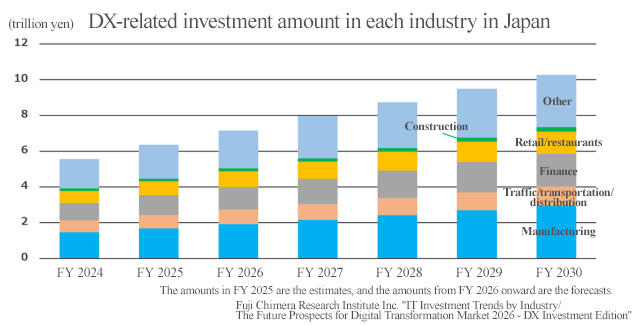
(Source: Fuji Chimera Research Institute Inc. "IT Investment Trends by Industry/The Future Prospects for Digital Transformation Market 2026 - DX Investment Edition")
*This material was provided by Digital Information Technologies Corporation and published by Investment Bridge Co., Ltd.
(2) Embedded Solutions Unit
According to Yano Research Institute Ltd., the new keyword “software defined vehicle (SDV)” has been attracting attention, replacing connected, autonomous, shared & service, electric (CASE) in the field of in-vehicle software since several years ago. Groups of software designed and developed for SDVs (SDV solutions) have been released mainly by semiconductor makers for IT one after another since around 2023, and their presence is growing rapidly. Recently, the use of AI, including AI agents and generative AI, has become active, and activities for evolution into AI defined vehicles (AI-DVs) are emerging. Accordingly, the total scale of markets of control systems, in-vehicle IT, SDVs, and AI-DVs is projected to reach 1.5 trillion yen in 2028 and 2 trillion yen in 2030, showing a rapid growth.
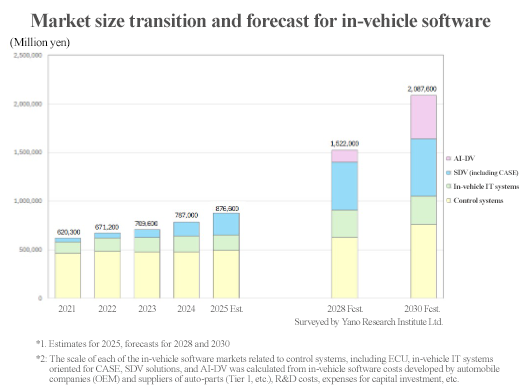
(Source "In-Vehicle Software (Automotive Companies, Automotive Parts Suppliers, Etc.) Market Research 2026," Yano Research Institute Ltd.)
*This material was provided by Digital Information Technologies Corporation and published by Investment Bridge Co., Ltd.
(3) Product Solutions Unit
① Market of information security products
Due to the spread of COVID-19, corporate work styles have shifted from office work to remote working, and activities in the digital space have increased, resulting in the increase of security risks such as phishing attacks, malware infections, security breaches of corporate systems, and unauthorized ID use. International Data Corporation Japan, which specializes in IT research, estimates that the domestic security software market in 2021 was 370.3 billion yen (based on sales), up 17.2% from the previous fiscal year, and is expected to expand to 463.7 billion yen by 2026.
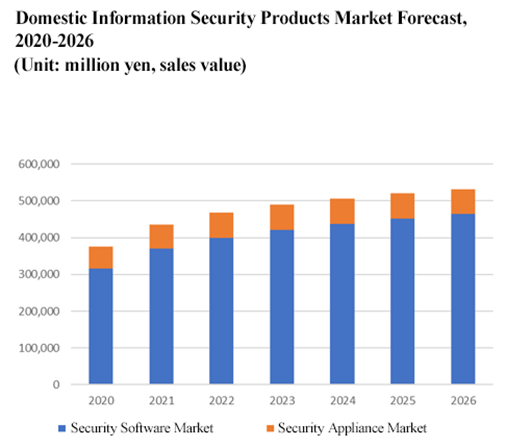
(Source "Latest Domestic Information Security Market Forecast, May 2022," IDC Japan K.K.)
*This material was provided by Digital Information Technologies Corporation and published by Investment Bridge Co., Ltd.
Additionally, as cybersecurity risks increase, damage caused by ransomware is rapidly rising.
Ransomware, a word coined by combining Ransom and Software, is malware that infects a computer with a virus and makes it unusable by locking it or encrypting its files and then demands a ransom in exchange for restoring the computer.
Every year, the Information-technology Promotion Agency, Japan (IPA) selects threat candidates from information security incidents that occurred in the previous year and are considered to have had a large impact on society and forms the “Top 10 Threats Selection Committee,” consisting of approximately 250 members including information security field researchers and business executives, which deliberates and votes on threat candidates, and then determines and announces the “Top 10 Information Security Threats.” In the “Top 10 Information Security Threats 2026,” based on the threats that occurred in 2025, “damage caused by ransomware” was ranked first in the organizational field for the sixth consecutive year from 2021. Thus, it is a major threat to society. In addition, “cyber risks associated with the use of AI” ranked third for the first time. The need to constantly update information security systems is also increasing.
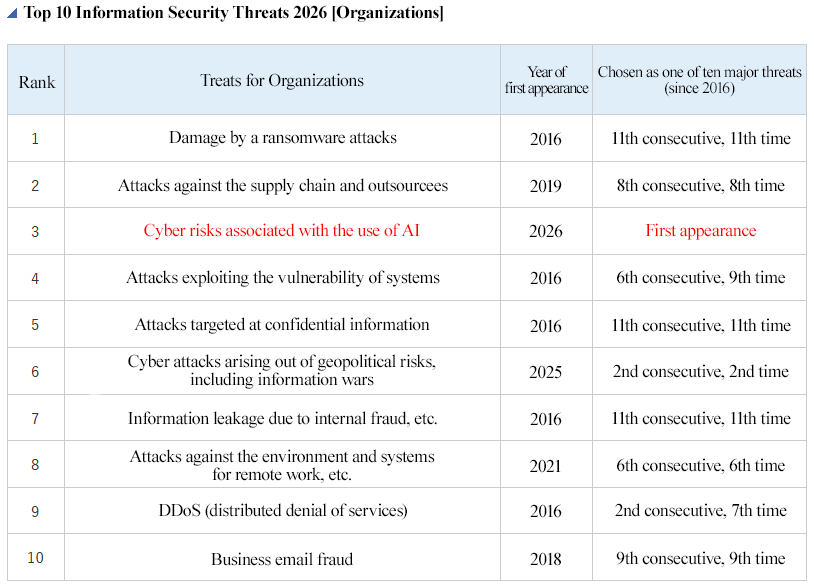
(From the website of the Information-technology Promotion Agency, Japan (IPA):
https://www.ipa.go.jp/security/10threats/10threats2026.html
② Market of products for streamlining business operations
RPA (Robotic Process Automation), which is a system for supporting the significant streamlining of business operations, is attracting attention.
RPA means the automation of processes using robots. By using technologies, such as artificial intelligence (AI) and machine learning, in which AI learns things through repetition, white-collar tasks, especially back-office ones, are handled. Just by registering procedures of human tasks on an operation screen, it is possible for them to handle the tasks using various apps, including software, browsers, and cloud. It is expected to spread rapidly, as one mean for reforming the ways of working, which is an issue to be overcome by Japanese enterprises.
According to “Survey on the trend of utilization of RPA in Japan in 2024” conducted by MM Research Institute, Ltd. (as of March 2024), 15% of SMEs with annual sales of less than 5 billion yen adopted RPA. This percentage is up 3 points from the previous year. The ratio of such SMEs has been increasing, and 23% of enterprises are making preparations or thinking of adopting RPA. Accordingly, it is expected that “the growth will continue.”
Among medium-sized and leading enterprises with annual sales of 5 billion yen or over, 44% adopted RPA. This percentage is down 1 point from the previous survey, showing sluggish growth. Since it exceeded 40% in FY 2021, it has been flat. The ratio of enterprises that are thinking of adopting RPA was 18%, showing no significant change, but over half of medium-sized and leading enterprises are trying to actualize company-wide automation by utilizing all kinds of tools, including RPA. As part of such efforts, some enterprises that have adopted RPA are combining generative AI and RPA to automate a wider range of operations. The ratio of enterprises that started utilizing RPA on a full-scale basis is still as low as 10%, but 21% of enterprises have conducted tentative operation or partially started RPA, and 53% are making preparations or having discussions on RPA. Accordingly, there are significant expectations.
Like this, RPA has been adopted by all sorts of enterprises, including SMEs, and it is expected that the scope of application will expand when combined with generative AI.
1-4 Business Description
1. Segments
There are two segments: software development business and system sales business. The software development business consists of 3 business units: Business Solutions Unit, Embedded Solutions Unit and the Product Solutions Unit (former Original Product Unit).
The Business Solutions Unit develops systems for business operations and supports the operation of such systems, while the Embedded Solutions Unit develops and inspects embedded systems.
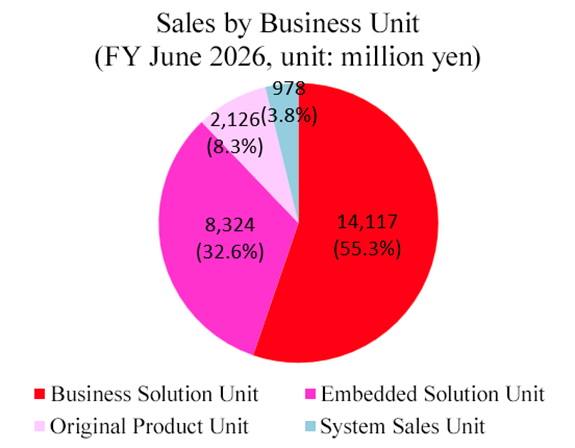
|
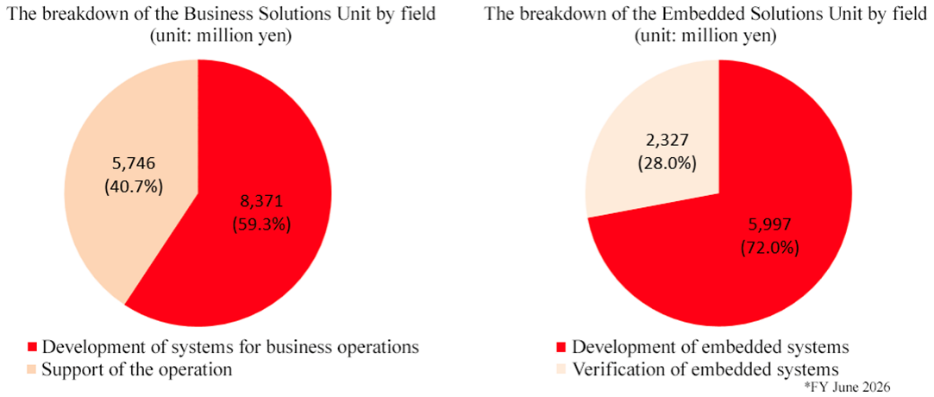
|
(1) Software Development Business
① Business Solutions Unit
(Business system development unit)
The sales for this business unit is mostly from custom development for end-users and information systems companies which are clients’ subsidiaries in a wide variety of industries including finance, medicine/pharmacy, communications, distribution and transportation as well as for leading SI vendors.
Specifically, development for websites and key systems, front and back office operations, new system development and maintenance development with technologies developed in each area. The company has developed trustworthy relationships with leading companies in each area which enables them to secure stable orders.
(Operation support unit)
Main clients include communications carriers, total human service corporations and information system companies which are airlines subsidiaries.
This “business unit to support clients’ daily operations through IT” has stable revenue as it is an ongoing business in line with the business website domains of leading companies.
Specific business includes:
*Support desk operation for end-users who use various business systems.
*Build and maintain infrastructure (servers and networks).
*Efficient system operations in line with the latest technology trends.
② Embedded Solutions Unit
(Embedded product development unit)
This business unit is trusted by leading manufacturers to directly develop custom software for in-vehicle devices, mobile devices, information home appliances and communication devices.
For in-vehicle devices, mobile devices and information home appliances, the unit develops custom software for overall systems including firmware, device business unit controls and applications.
It focuses on Auto-Drive related field with new technology, as well as infotainment for in-vehicle devices as the demand for this market is expected to grow. In addition, it undertakes software development for wireless base stations and communication module devices for communication devices.
(Embedded product verification unit)
This business unit verifies and makes suggestions to improve qualities and functions of products through its verification service.
It provides verification services domestically and internationally (North America, Asia, Europe, etc.) including laboratory tests using specialized devices to verify product operation and function, field tests to verify products in the actual environments, as well as overall system tests conducted as the final quality verification from the perspectives of the third party.
Some of the overseas field tests are designated to its subsidiary, DIT America, LLC, which provides fast service with verification of product usability from the perspective of local staff.
The range of products for verification includes in-vehicle devices, medical devices, communication devices and mobiles.
③ Product Solutions Unit
As a growth field, the business develops and sells products with unique technologies. It also handles products with high social needs through its alliances.
Currently, the company strongly focuses on the sales of two products, “WebARGUS,” a system security solution, which detects tampered website simultaneously as it occurs and instantly restores the original normal condition, “xoBlos,” an Excel work innovation platform, which features data decomposition and restoration as well as meeting various forms of data business processing needs, “DD-CONNECT,” electronic contract outsourcing service, etc.
There are other products such as “RezOT,” a security solution for embedded devices, “APMG (Anti Phishing Mail Gateway),” a solution to prevent damages from phishing and illegal use of brands by automatically adding electronic signatures on e-mails, and “Shield CMS” a CMS (content management system), which enables editing and updating websites easily.
(2) System Sales Business
The company and its subsidiary, DIT Marketing Service Co., Ltd., sell “Rakuichi,” a business support mission-critical system, for small and medium enterprises, manufactured by Casio Computer Co., Ltd.
The sales area is started at Kanagawa first and expanded to Tokyo, Chiba, Gunma, Ehime, and Shizuoka successively. The Company provides substantial support for their users to increase the client retention rate. In addition, they set up a call center to attract and build a new client base. The number of sales for “Rakuichi” has been recorded to be the highest across all agencies for 22 consecutive years.
2. Main Strategic Products
(1) "WebARGUS," a server security solution
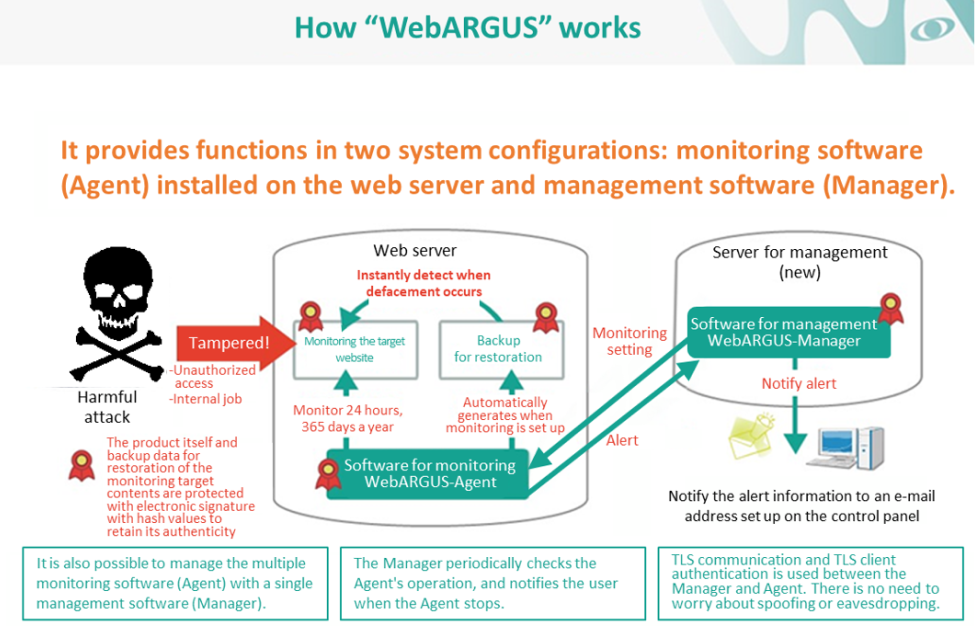
WebARGUS is a new security solution which detects tampered system instantaneously and immediately restores it to its original state. By detecting and restoring immediately when incident occurs, WebARGUS protects various corporate servers from damage caused by malicious and unknown cyber-attacks and simultaneously prevents the escalation of the damage from viruses spreading via the tampered server.
(Taken from the reference materials of Digital Information Technologies Corporation)
◎ Increasing tampering of websites
According to the incident report published by “JPCERT Coordination Center (*)”, about 100 cases are reported every month, and websites including the ones of government agencies are constantly exposed to threats, whether the case is major or minor.
“JPCERT Coordination Center” (*): This center receives reports concerning computer security incidents including hacking via internet and service disturbance in Japan. It also supports measures, grasps how the problems are generated, analyzes the methods, investigates and advises on measures to prevent recurrences from a technical point of view.
◎ The background of the development of "WebARGUS"
Under these circumstances, the company, which had already released a solution called “APMG” to prevent damage from phishing and illegal use of brand by automatically adding electronic signature in e-mails, started developing “WebARGUS,” based on a core security technology in the spring of 2013, after 2 years of research. Then in July 2014, it released “WebARGUS.”
The major characteristic and strength of the company is that it has a variety of rich IT related technologies and has a highly standardized core security technology. This is because its engineers have a mindset to embrace challenges and are not afraid to take risks. Thus, they are not satisfied with just developing custom products. This is strongly influenced by the company’s organization strategy represented by its corporate culture and in-house company system which will be explained later in this report.
◎ The features and overview of the product
Instant detection and restoration for minimizing tampered system to nearly zero |
Provide protection from tampering by a fake identity posing as a registered member, internal attack and new methods which can be difficult to protect from. |
It detects with high accuracy and uses “electronic signature” technology which protects from even 1 bit of tampering. |
Protects from high level attacks aimed at applications and settings files. |
The CPU load (usage rate) on a server is less than 1% while it is monitoring on a regular mode. |
Equipped with preservation of evidence function which stores the tampered files as evidence. |
When a website has been tampered with, it can take an average of one month to restore. This is because the restoration process includes disabling the website, identifying the damaged files, strengthening protection, website restoration and re-enabling the website. For an e-commerce related website, the damage can be serious, including a drop-in sales, time and effort to announce the re-enabling of the website and the difficulties in re-attracting clients who left the website.
On the other hand, if “WebARGUS” is installed, because it instantly detects and restores websites when tampered with, the condition of a system can be maintained in the normal state. Thus, the website does not need to be disabled in a rush when the application detects a threat. Companies can concentrate on pursuing the cause and strengthening protection while its website is kept open to public.
Most of the detection software detects tampered website with a periodic monitoring on pre-configured, specified timing or intervals. With this method, there will be a time lag between when the website is tampered with and when it was detected, so it is inevitable for the website to be tampered. In addition, if the interval is shortened to reduce the time lag, there are other challenges such as increasing CPU load.
On the other hand, when some kind of event occurs (such as data deletion or addition excluding browsing), “WebARGUS” conducts real time scanning to detect the event. Therefore, such problems do not occur.
The major feature of this product is that it is also equipped with an instant restoring function which enables restoration to the original state in less than 0.1 seconds after the detection (average time under the demo environment: 0.03 seconds per file). This instant restoration is its unique technology.
The annual license fee of “WebARGUS” is JPY528,000 (incl. tax) per OS with support.
This also includes free update modules for minor version updates.
◎ Introduction and sales
When WebARGUS was released, the sales growth was rather slow because general understanding of website security was mainly about protection against hacking into a computer system and awareness about “tampering” was limited. However, the acknowledgment that “software for detection is needed as well as for protection” is growing rapidly due to the more frequent mentioning of the independent administrative agency, “IPA (Information Processing Association),” taking measures to prevent defacement. This agency is established to support the IT national strategy from a technical and personnel aspect perspective and is supervised by the Ministry of Economy, Trade and Industry.
In addition, the Ministry of Economy, Trade and Industry added "establishing mechanisms to respond to cybersecurity risks related to 'detection of attacks' and 'recovery'" as new important items in the revised points of the "Cybersecurity Management Guidelines" announced on November 16, 2017. Furthermore, there is a strong demand for stable operation of servers that support core business and business infrastructure in BCP (Business Continuity Planning) and BCRP (Business Continuity and Resiliency Planning) in recent years, and as a result, business inquiries about such mechanisms have increased even further.
Under these circumstances, the company has carried out promotion and marketing including organizing seminars for target users who recognize the necessity for a higher level of security, and participation in exhibitions.
It focuses on agency sales to strengthening marketability.
They have been actively involved in development collaborations with data centers and cloud service corporations. Furthermore, the company is expected to expand its business overseas as well as product sales in Japan. The company is preparing to provide support for the tampering of systems across the globe.
◎ Strengthening the feature of merchandise
Initially, WebARGUS was only available for Linux, but a Windows version was released in April 2016, and the enterprise edition, which was targeted at large-scale companies in September 2017. In February 2018, the company began offering a next-generation cloud WAF (WebARGUS Fortify), which dramatically strengthens the functionality of comprehensive web security. In particular, because of the release of the enterprise edition, which was targeted at large-scale companies, an increasing number of large companies (mainly listed companies) adopt WebARGUS.
The company also began offering “SaaS” in May 2018 to enhance user convenience and further popularize the products, and collaborated in full scale with With-Secure Corporation, a Finnish cyber security company, in June 2018. The company established a total security provision system using the complementary relationship between With-Secure’s “F-Secure RADAR,” a vulnerability scanning tool for IT system, and DIT’s “WebARGUS.”
It began collaboration with Secure Age, a cyber security company based in Singapore, on information leakage measures (encryption technology) in December 2019 and with SSH Communication Security, a cyber security company based in Finland, on access route optimization in January 2020. The company will continue to establish such alliances actively.
The company enhanced the varieties of the security solution products through various measures including the above alliance, and it is also considering expanding the range of applications of products in anticipation of needs for security measures for the IoT generation, including WebARGUS “RezOT” for embedded products.
For example, the spread and penetration of automatic driving have made the securement of safety an important mission for the companies providing automatic driving systems, and it is expected that the field where they work actively will grow further.
They completed the development of major functions of RezOT and released it in September 2025. In cooperation with partner companies that possess plenty of knowledge and experience in the industrial field, they will make preparations, including customized development for installation of actual equipment, with the aim of establishing systems for releasing and promoting products early.
◎ Expansion of the security domain: Sentinel ARGUS
A rapidly increasing number of people suffer from ransomware.
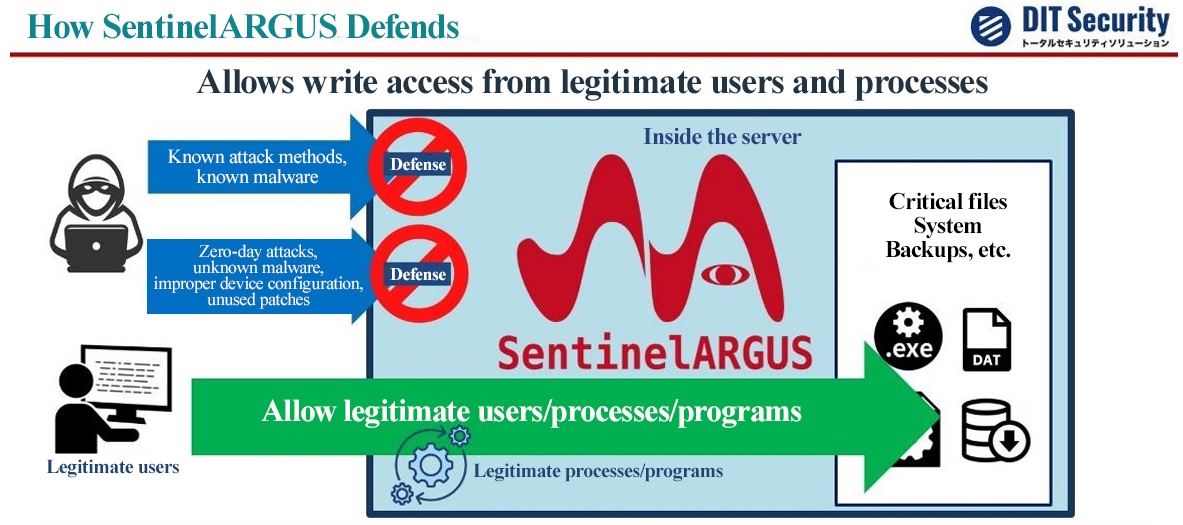
In this situation, the company released the Intel 64 version of "WebARGUS for Ransomware," in November 2022, followed by the ARM64 version in January 2023 which is equipped with the function to block the malicious programs to change or delete important data on a real-time basis and protect important data from various risks (such as cyberattacks, inside jobs, and encryption of data by ransomware), in addition to “WebARGUS,” which detects website falsification and repair the websites instantly.
As there are many command patterns of ransomware, “WebARGUS for Ransomware” can block about 30 command patterns. The company believes that there is no other product of its kind with such a wide range of control patterns. By combining it with the conventional "WebARGUS," it is possible to establish stronger server-side security.
First, the company announced to existing "WebARGUS" users, especially the current enterprise version users, that the data protection function has been added to the product, and the introduction of the product as a replacement for the existing "WebARGUS" has begun.
In July 2025, the company has begun full-scale operation of "Sentinel ARGUS," which is mounted with the functions to prevent the augmentation of damage by ransomware and block unauthorized access to important data, as a new product for meeting the needs in the market of security products. They plan to actively develop new services, to enhance their services in the domain of cyber security, which is increasingly demanded as part of the national policy.
(Taken from the reference materials of Digital Information Technologies Corporation)
(2) “xoBlos,” an Excel® work innovation platform
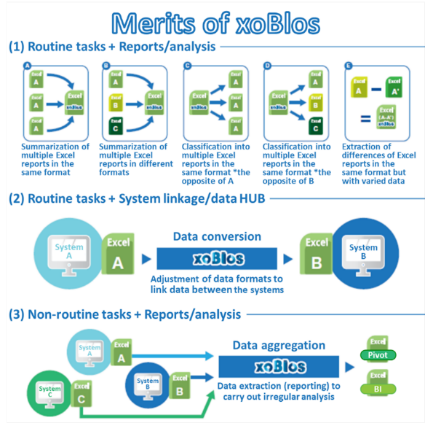
Even in advanced corporations with a high level of IT, there are numerous Excel®-based tasks including manual operations in the office. Most non-routine tasks consist of repetitive manual operations such as processing Excel® reports by manually inputting data from paper reports, aggregating totals from multiple Excel® sheets and visualizing and analyzing CSV data extracted from packaged system.
The company's original-brand, "xoBlos," entirely automates these inefficient Excel®-based tasks and provides drastic improvements to workflow.
(From the company's website)
◎ Background of development
Many corporations use Excel®, the major spreadsheet software, for generating quotations and invoices. However, in cases where they generate these documents in different formats for each client according to the clients’ requirements, manual input is mandatory because it is difficult to tally, sort and analyze in a systematic way. For this, the company developed “xoBlos,” an Excel® work innovation platform, to automate tasks and significantly improve workflow efficiency.
◎ Product feature, overview and an example of introduction
Enables management of different data formats for tallying and processing |
Enables increased efficiency with current Excel® spreadsheets. |
Process up to dozens of times faster than using macros. |
Can be embedded into other packaged products as an engine to output Excel® spreadsheets. |
xoBlos was released about ten years ago with the aim of drastically improving the efficiency of work using Excel®. It is now receiving considerably more attention due to its efficiency “to create a company-wide platform which covers everything from improving work efficiency to providing information useful in managerial decisions, while diverting workflow from areas currently using Excel®,” in addition to the convenience and relatively cheap introduction cost, because work-style reform trends centered on revising long work hours grow stronger. Indeed, the times have caught up with xoBlos and the company.
For further enhancement of product competitiveness, the company strengthened the automatic processing of Excel® work by providing a function linked with RPA* products and other systems in February 2018. This function can be operated on a PC client as well as a Web Server, leading to improvements in convenience for wider users.
The domestic RPA market is projected to double to 80,000 million yen in the next few years, and RPA-related services, which occupy 80% of the market, are expected to have a higher growth rate than RPA tool products, which occupy only 20%. Based on this, xoBlos, which can be considered as an RPA-related service, is anticipated to have high growth potential.
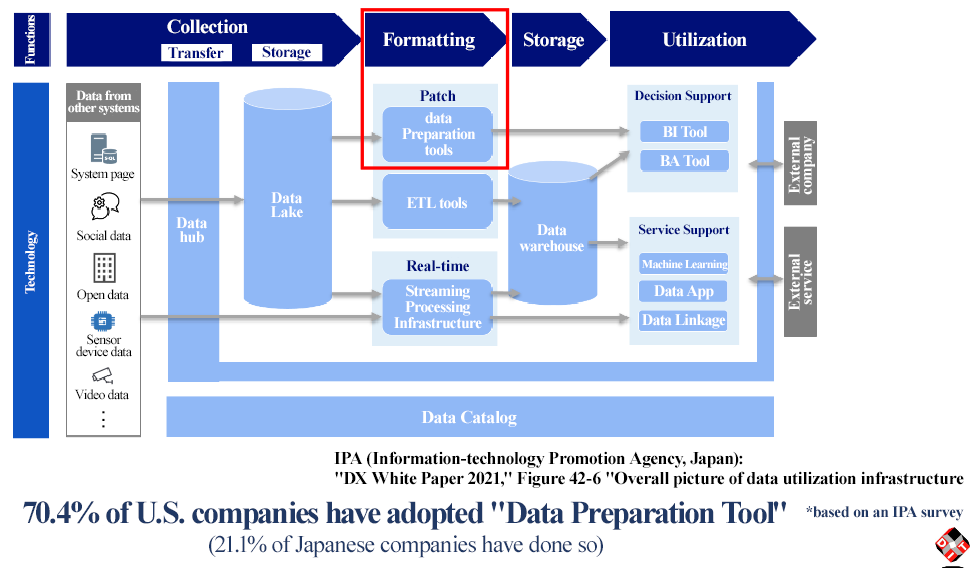
In addition, the company has recently clearly introduced the concept of an “Excel®-type data preparation tool.”
“Data Preparation Tool” is a tool that enables both IT department and business department users to easily and quickly confirm and format data. While about 70% of companies in the U.S. have adopted this tool, only 20% of companies in Japan have done so.
To effectively utilize collected data in the field, it is necessary to process and format data neatly for analysis and system integration. However, in reality, there are discrepancies in expression, erroneous conversions, missing values, and format differences scattered throughout the data, and 50-80% of the work is spent on correcting them. Some of these tasks have been streamlined through the use of macros and VBA, but since the settings depend on individuals, there is a possibility that ongoing work cannot be continued when there are personnel changes.
On the other hand, xoBlos, an “Excel®-type data preparation tool,” can clean and format data that have different formats and styles automatically, allowing for output in the desired format. Additionally, since it is possible to design without code, it can prevent the drawbacks of personalization.
The company aims to promote the value of xoBlos as a “data preparation tool” in order to further increase the number of installations.
 |
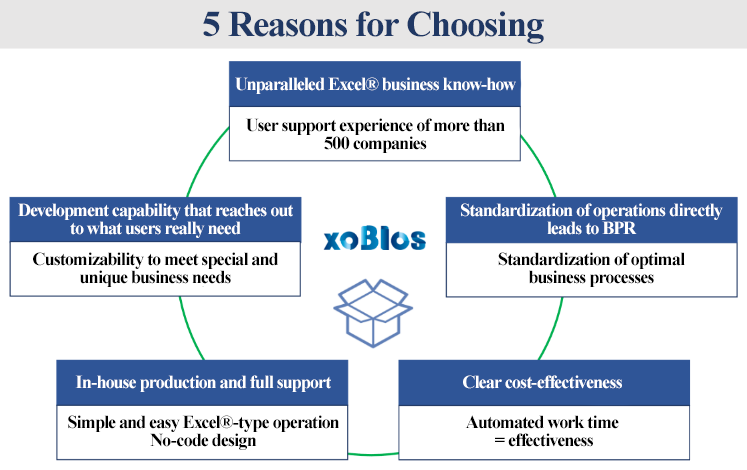 |
(Taken from the reference materials of Digital Information Technologies Corporation)
◎ Toward further value improvement of the platform “xoBlos Plus-One Concept”
“xoBlos” is already highly rated as a work innovation platform that supports in bringing significant operational efficiency by fully automatizing the inefficient work based on Excel®, but the company started taking initiatives to make it a platform that offers more high-added value to clients to respond to the changing times and customer needs.
“xoBlos Plus-One Concept” is the result of the above initiatives.
The main concept of “xoBlos Plus-One Concept” is “improvement of data value.”
Companies carry out various activities, and they have different systems for the management of each activity.
For example, a company has a system for ERP, which drafts a plan for the appropriate distribution of resources including personnel, things, capital and information, and their effective utilization, at the top, and other systems for CRM for customer management, inventory management, management of acceptance & placement of orders, attendance data, personnel, and accounts.
A large amount of data is extracted from each system, and in recent years, there has been a skyrocketing need for enhancement of operational efficiency and visualization of a company’s own state by integrating and combining the data, instead of handling them individually.
However, realization of the above is not easy for a company as it requires a large number of work hours and involves huge costs.
In such a situation, clients who installed xoBlos, which processes data efficiently at high speed, achieved efficiency in reporting and are able to utilize the data of by integrating and combining the data easily at a reasonable cost.
Also, it is one of the major features of “xoBlos Plus-One Concept” that it allows the use of data in a desired format of each division and department, from the upstream management team to downstream departments of production, sales, general affairs and administration.
It plans to link various systems on xoBlos through tie-ups with manufacturers and propose a concrete image of “xoBlos Plus-One Concept” to its client companies.
Many companies, including the following case studies, have achieved significant improvements in operational efficiency.
* Prepared by Investment Bridge Co., Ltd. based on materials provided by the company and interviews.
*Case of adoption: JCB Co., Ltd.-Addressing In-House System Development Needs with xoBlos
(Background behind considering the adoption of xoBlos)
At JCB Co., Ltd. (hereinafter “JCB”), a credit card company, a significant portion of operations involved individual employees manually aggregating and verifying data output from various systems using Excel®. To improve operational efficiency, JCB had been using a macro developed by an external vendor; however, issues such as a lack of flexibility during operational changes and rising costs emerged. Considering the need for sustainability and long-term operability, JCB sought an in-house solution. Upon learning about xoBlos, which allows users to build a company-wide platform while utilizing existing Excel®-based workflows, JCB recognized its efficiency, user-friendliness, and relatively low implementation cost, and contacted DIT for consultation.
(Status of xoBlos implementation)
Until recently, xoBlos had mainly been used as a tool for centralized management of forms/ledgers across departments, with DIT handling customization and delivery on a contract basis.
However, in recent years, reflecting the growing trend toward low-code and no-code applications, demand for in-house system development has been increasing. As corporate IT literacy improves, the understanding has spread that if users are capable of using basic Excel® functions, they can also easily operate xoBlos. Consequently, xoBlos adoption has been steadily expanding.
On the other hand, when automation and efficiency are prioritized above all else, leading to outsourcing development to external vendors or relying on in-house employees to develop macros, there is a significant risk that business continuity will be compromised. This occurs as “each system becomes a black box,” where only the external vendor or the employee who developed the system possesses detailed knowledge.
Recognizing this issue, more companies are adopting the idea of independently organizing their business processes while operating systems that are sustainable and adaptable. JCB, likewise, has adopted xoBlos as an in-house development tool, installing it on individual employees’ terminals for use.
JCB has entered its third year since adopting xoBlos. In the first year, the implementation began as a PoC (Proof of Concept) within two small departments. While conducting verifications with a limited number of users, DIT concurrently developed and provided user manuals and samples essential for individual in-house development, responding to specific customer needs over the course of a year.At the time of initial introduction, there were around 10 accounts. However, as JCB realized the effectiveness of xoBlos, the number of departments utilizing it expanded, and currently, the number of accounts is approximately 50.
* A PoC (Proof of Concept) is a test or experiment conducted to demonstrate the feasibility of a new idea, technology, or concept before proceeding to full-scale development.
The increasing need for in-house development, as illustrated above, has contributed to the expansion of xoBlos adoption.At JCB, to further promote internal development, new members are recruited every six months for comprehensive training sessions. Employees who participate in these programs work on developing xoBlos applications for actual business operations.As a result, as of May 2025, the number of business processes developed using xoBlos was 85, and 53 employees acquired xoBlos development skills, indicating rapid progress in the company’s in-house development initiatives.
(Diversification of Business Models)
In JCB's case, customized manuals and samples were provided free of charge, as the company viewed this as an opportunity to thoroughly gather customer needs and feedback. However, DIT plans to leverage this experience to enhance profitability through value-added services, such as paid educational packages designed to help clients effectively utilize xoBlos.
◎ Customers and Sales Methods
Currently, the company promotes the value of xoBlos as a "data preparation tool" as previously mentioned to make xoBlos a more marketable product and is working on various sales initiatives.
*Target customer
Initially, the company was mainly making introductions to medium-sized companies, but as the need for efficiency in on-site work has increased, there have also been more introductions to large companies. Currently, about 70% of newly introduced companies are large companies. At present, the company made introductions to over 560 companies. In terms of new installations, the company is focusing not only on increasing the number of corporate customers, but also on introducing xoBlos to major companies where significant license increases can be expected internally.
In August 2020, it began using a subscription mode to expand sales stably and improve profitability.
Particularly, they are actively promoting the adoption of xoBlos, targeting mainly the industries of architecture, real estate, local government, and retail, which are facing challenges in DX while needing to improve efficiency and conduct work-style reform.
*OEM
The company is also focusing on OEM providing the powerful features of xoBlos as an option for project management tools and RPA products handled by other companies.
In December 2022, a new optional OEM service called "xoBlos for OBPM" was launched, which allows project management data accumulated in the integrated project management tool "OBPM Neo" developed and provided by System Integrator Co., Ltd. (TSE Standard, 3826) to be processed and formatted into Excel® reports.
"OBPM Neo" is a project management tool that can comprehensively manage project-related data, including costs and profits, progress, personnel, risks, obstacles, and issues. Although it has screens and functions that enable various analyses, customers faced the challenge of having to spend additional time aggregating and processing data and creating reports, especially for custom reports required for meetings. To address this issue, both companies conducted discussions and decided to offer "xoBlos for OBPM" as a new optional OEM service for OBPM Neo.
By using "xoBlos for OBPM," the manual collection and processing work can be automated, resulting in up to 90% reduction in work hours. Standard templates for frequently used reports (such as budget vs. actual analysis, quality analysis, and operational status) are prepared for OBPM Neo data, and additional templates will be added regularly.
Additionally, by using the xoBlos client, users can edit templates and create custom report templates that meet their specific information and formatting needs.
Moreover, several other projects, including RPA, are currently underway.
*Agencies
Regarding sales activities, the company is marketing products by utilizing a wide range of customers, bases, and sales capabilities of Dai-ko Electronic Communication Co., Ltd. (8023, TSE Standard), one of its main agencies, through joint seminars and other events. The company has built a network of about 30 agencies, including Dai-ko Electronic Communication.
The company plans to continue strengthening its agency network but will also aim to clarify its target audience for agency selection, focusing on agencies that have expertise in approaching local governments, experience with IT subsidy introduction, and have their own products that are easy to coordinate with xoBlos.
*Advertising and Promotion for Increased Awareness
In addition to conventional outbound sales, the company is also working to strengthen inbound sales, which increase customer inquiries while enhancing information dissemination.
As part of its information dissemination efforts, the company is conducting webinars and advertising and promotional activities, including the use of social media in conjunction with company’s other products such as WebARGUS and shield cms.
Regarding advertising and promotion, the planning and sales department, which is newly established in FY 6/23 under the Product Solutions Division, which is responsible for the company's products, including xoBlos, is working to optimize marketing and advertising activities.
* Provision of the xoBlos Starter Kit
The company offers the xoBlos Starter Kit for promoting xoBlos.
Most clients want to solve trouble, but don’t know concrete measures for solving trouble.
Accordingly, the company designs and execute the procedures for initial setting and automation within the price range (up to 3 million yen) of the xoBlos Starter Kit. Clients can use them as they are, and if they want more systems, the company undertakes the development of them or gives instructions to them for solving issues.
Like this, the company can promote the adoption of xoBlos by selling the introductory package at the price 3 million yen, which is relatively affordable for clients and worth taking some man-hours for the company.
The company is actively proceeding with business negotiations by utilizing the xoBlos Starter Kit, and discussing new solutions combining xoBlos and AI technologies.
(3) Electronic Contract Outsourcing Service, DD-CONNECT
In September 2020, the company signed a partnership agreement with NS Solutions Corporation to sell the electronic contract cloud CONTRACTHUB @absonne, which has had the largest share of sales in the electronic contract service market for six consecutive years.
In October 2020, the company started selling DD-CONNECT, an outsourcing system that handles a series of services from the introduction to operation and maintenance of CONTRACTHUB on behalf of customers.
(Overview of CONTRACTHUB and DD-CONNECT)
CONTRACTHUB has been deployed mainly by large companies in various industries since the service started in 2013 and is now a pioneer of electronic contract services used by more than 130,000 users.
Since it can be flexibly linked with ERP and sales systems, it can improve the productivity of various operations related to contracts, and both the vendor and the customer can review the electronic contract history, including its conclusion and revisions, on the cloud. Thus, it can improve the efficiency of contract management tasks.
DIT's DD-CONNECT is a series of services that offer testing support related to the introduction of CONTRACTHUB, operation support, and maintenance support. Since DD-CONNECT provides the necessary services collectively, it is easier to introduce than an electronic contract system software package alone. Therefore DD-CONNECT is expected to contribute to further cost reduction and labor-saving.
By regularly sharing human resources and knowledge with NS Solutions, the company provides a wide range of higher value-added electronic contract services, such as measures to improve the efficiency of domestic companies' contract operations and the promotion of going paperless and Hanko (Japanese stamp)-less.
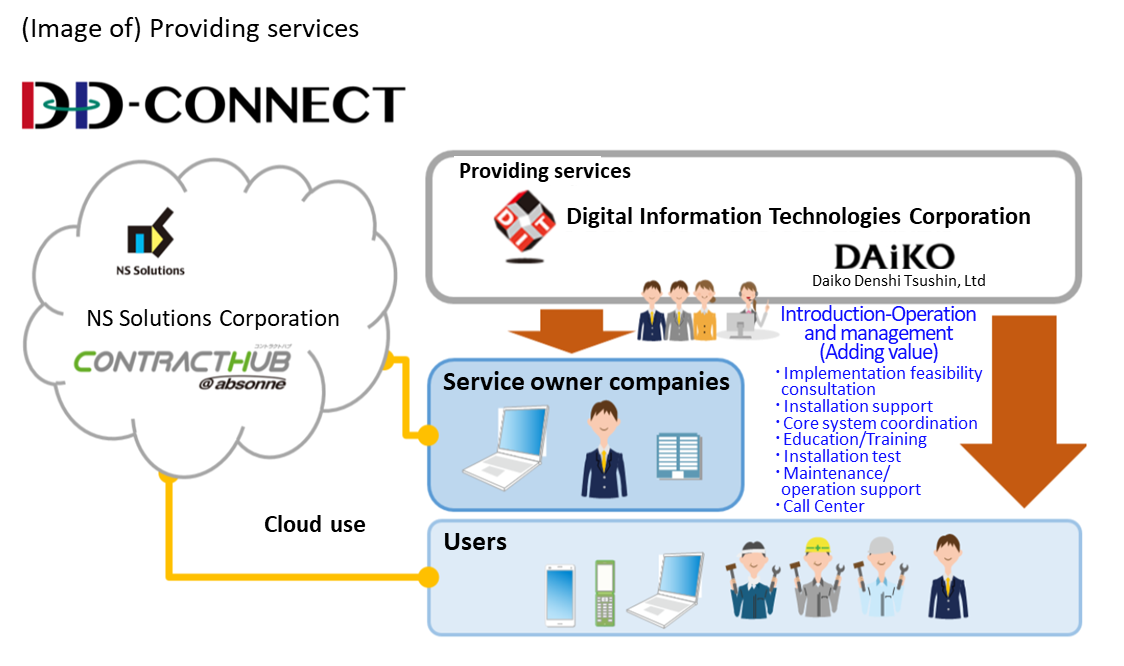
(Taken from the reference materials of Digital Information Technologies Corporation)
(Strengths and Features)
"DD-CONNECT" can be easily and seamlessly linked with other systems for order receipt/placement and billing. This feature sets it apart from other electronic contract systems and is one of its forte.
(Successful Implementations)
Currently, the product is mainly used by major housing equipment manufacturers, construction, and real estate-related companies. The company's main target industries and customers include those with high potential for DX and digitalization, including local governments. As the electronic contract system is suitable for construction contracts, the company has steadily met the needs for complying with the Electronic Books Maintenance Act.
The company offers its customers added value in terms of support for the installation, operation and management of its cloud system, CONTRACTHUB, and this is highly valued by its customers.
Furthermore, product development, including functional improvements, is carried out by NS Solutions, which means that the company has a significant advantage as it requires little investment.
Initially, the company and its partner, Daiko Electronics Communication Inc. (TSE Standard, 8023), each conducted their own sales activities, but in order to better utilize each other's strengths, the company clarified the division of roles: Daiko Electronics Communication is responsible for sales, while the company is responsible for installation and maintenance operations, which require technical support.
Sales and profit grew considerably, as their efforts for not only introducing “DD-CONNECT,” but also developing peripheral systems to be linked with the existing mission-critical systems of client companies paid off.
1-5 Characteristics and strengths
(1) Multifaceted and diverse IT company
The company has expanded its business areas by flexibly responding to the progress of information technology, from business system development business to computer sales (current: system sales), embedded product development and verification business, and operational support business as well as working on its original products based on its technical strengths which have been developed during the process of business expansion.
One of the major characteristics of the company is that it is a multifaceted and diverse IT company and has a wide range of business activities and provides own-brand product with originality.
In order to improve the strengths and characteristics of the company, it is essential to acquire new technology and improve the on-site capabilities.
The company has been providing training and education to the employees; however, it is establishing a stronger education system, as it is important to have the latest knowledge ahead of customers in times of rapid changes.
From the perspective of diversity, the company is also working to create an environment in which female employees can easily demonstrate their abilities.
It is making efforts to provide not only on the job training, but also training on managerial skills to promote female employees from mid-level positions to managerial positions including executive positions.
(2) A wide range of customer base
There are about 2,900 client companies. Main clients for the software development business are listed companies and their affiliates, while main clients for the system sales business are small and medium-sized enterprises. Since the business categories of clients are diverse as shown below and stable long-term business is mainly operated, its business base is stable.
The ratio of sales of end users, including information system subsidiaries, is about 80%.
Another characteristic of the company is that the sales in the in-vehicle system domain in the manufacturing field account for over 50%.
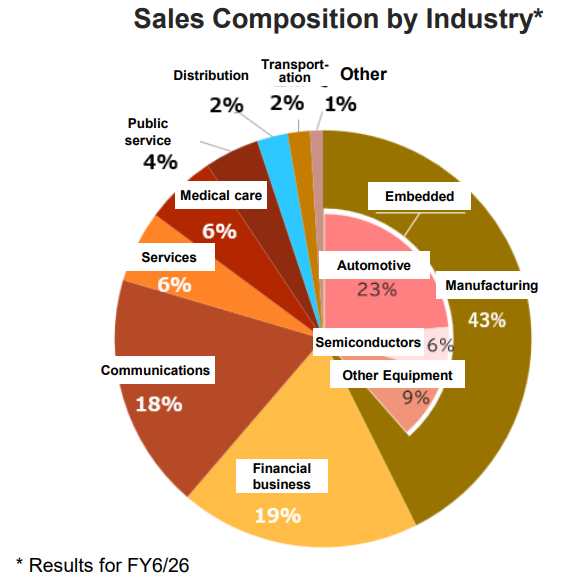
(From the company's FY6/26 financial results presentation)
(3) Organizational strategies of partial and total optimization
Another significant characteristic of the company is that it has an organizational strategy with two opposite factors, partial and total optimization in a well-balanced manner.
For partial optimization, the company has specialized companies under an in-house company system which aim to be the best in each field. It also provides training and produces entrepreneurs with innovative spirits.
For total optimization, the company pursues synergy between companies while respecting independence of each in-house company; through scrap and build done by the divisions, collaboration between each in-house company and development of new business areas.
(Outlines of in-house companies and each division)
Division | In-house company | Overview |
Client Service (CS) Division | Business Solution Company | This company develops a proposal style SI business to provide solutions for clients. Especially in the fields of finance, communications and distribution, based on the business knowledge and technical foundations cultivated over many years, this company undertakes design and development of a wide range of software such as general-purpose systems, website systems, mission-critical systems and information systems for leading companies in each industry. It also provides a new business area, ASP business for "Insurance Pharmacy Integrated Management System (Phant's)." |
e-business Services Company | This company provides website system architecture and maintenance for e-commerce websites and service websites for clients mainly for finance and major retail industries for many years. It provides a service to suit clients’ requirements with technologies which it has developed through experience. | |
Support Business Company | This company’s engineers have a wide range of knowledge enabling it to provide one stop optimal IT environment (service) to suit clients' requirements including support for introducing systems, infrastructure-building, network operation management and middleware development. | |
Technology Solution (TS) Division | Embedded Solution Company | This company specializes in control system development focused on embedded systems for in-vehicle devices, communication devices, industrial equipment and digital home appliances. It has many engineers with highly specialized skills for embedded system development. Because of the physical conditions of hardware, embedded systems development can be very restrictive, and requires a meticulous level of problem-solving that differs from general application development. |
Quality Engineering Company | This company has a wide range of software validation and verification businesses from in-vehicle devices such as car navigation systems to medical devices, communication infrastructure and mobile terminals. It gives priority to improving the quality of products and provides total service from planning, designing, implementing, operating, and analyzing tests to consulting. It has collaborated with DIT America, LLC, a local subsidiary in the U.S.A. since 2011. It also provides verification services overseas. | |
Western Japan Business (NB)Division | Western Japan Company | Activities are based west of Nagoya, with a focus on Osaka. DIT takes part in three businesses: business system development and operational support, mobile and web application development, and embedded systems development (in-vehicle devices and security-related matters). Recently, the company is aiming to expand into the IoT and Web service businesses, taking advantage of multi-skilling. |
Ehime Regional Company | This company is located in Ehime and provides a high added-value one stop service for product development to meet the regionally specific requirements for a variety of industries and businesses as well as sales of software and system devices, operation and system support, and contributes to local revitalization. It also employs engineers locally at a multi-purpose IT development center to tackle the engineer shortage in the other companies, which enables nearshore development. | |
Product Solution (PS) Division | Composed of IT Security Business Department, xoBlos Business Department, DX Business Department, Sales Promotion Department, and Business Development Promotion Department. | |
Corporate Planning Division | Composed of Corporate Planning Department, Project Promotion Department, IR/Marketing Department, Group Control Department, and R&D Department. | |
Administration Division | Human Resources Planning Department, General Affairs Department, Accounting Department, and Partner Promotion Department. | |
(4) Development and sales of original own-brand products
The company has developed a variety of original own-brand products like “xoBlos” and “WebARGUS” with its unique technologies cultivated over many years. The company has a rich lineup, including the electronic contract outsourcing service “DD-CONNECT” based on partnership contracts. The ratio of sales of the Product Solutions Unit, which has a high profit margin and is considered as promising, has steadily increased, and they are striving to further increase it as a revenue source.
2. Fiscal Year Ended June 2026 Earnings Results
2-1 Consolidated business results
| FY 6/25 | Ratio to sales | FY 6/26 | Ratio to sales | YoY | Ratio to forecast |
Sales | 24,159 | 100.0% | 25,546 | 100.0% | +5.7% | -1.7% |
Gross Profit | 6,145 | 25.4% | 6,425 | 25.2% | +4.5% | - |
SG&A | 3,131 | 13.0% | 3,372 | 13.2% | +7.7% | - |
Operating Income | 3,013 | 12.5% | 3,053 | 12.0% | +1.3% | +0.1% |
Ordinary Income | 3,027 | 12.5% | 3,076 | 12.0% | +1.6% | +0.9% |
Net Income | 2,178 | 9.0% | 2,092 | 8.2% | -3.9% | -4.9% |
*Unit: million yen. Net income is net income attributable to shareholders of the parent company. Hereinafter the same will apply.
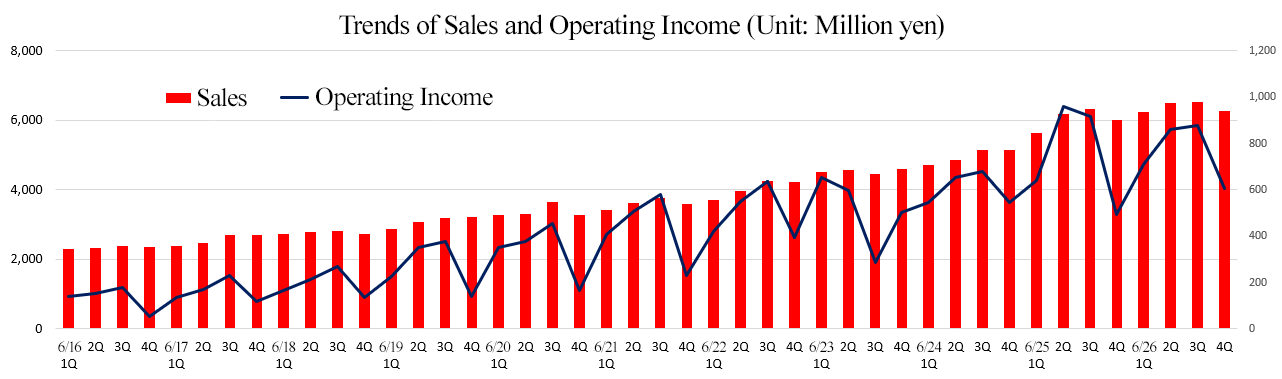
Sales and profit increased for the 16th consecutive fiscal year. Sales, operating income, and ordinary income reached record highs.
Sales grew 5.7% year on year to 25,546 million yen. While the outlook for the Embedded Solutions Unit was uncertain due to the U.S. trade policy and the revision to the investment policies of automobile makers, they steadily met the healthy corporate demand for IT investment.
Operating income rose 1.3% year on year to 3,053 million yen. Thanks to the sales growth, gross profit increased 4.5% year on year. SG&A expenses augmented due to the investment in AI and strategic product development for business growth, but it was offset, and they secured a profit growth. Amid the harsh business environment, each section and each company strove to grow earnings, so sales and profit increased for the 16th consecutive fiscal year. Sales fell below the forecast slightly, but profit was almost in line with the forecast.
2-2 Trends by segment
| FY 6/25 | Composition ratio | FY 6/26 | Composition ratio | YoY | Ratio to forecast |
Software Development Business | 23,292 | 96.4% | 24,568 | 96.2% | +5.5% | -2.1% |
System Sales Business | 866 | 3.6% | 978 | 3.8% | +12.9% | +8.7% |
Total sales | 24,159 | 100.0% | 25,546 | 100.0% | +5.7% | -1.7% |
Software Development Business | 2,934 | 12.6% | 2,918 | 11.9% | -0.6% | - |
System Sales Business | 79 | 9.2% | 134 | 13.8% | +69.0% | - |
Total operating income | 3,013 | 12.5% | 3,053 | 12.0% | +1.3% | +0.1% |
*Unit: million yen. Sales mean sales to external clients. The composition ratio of operating income means the ratio of operating income to sales.
(Sales trends by business unit)
| FY 6/25 | Composition ratio | FY 6/26 | Composition ratio | YoY | Ratio to forecast |
Sales |
|
|
|
|
|
|
Business Solutions | 13,198 | 54.6% | 14,117 | 55.3% | +7.0% | -2.0% |
Business System Development | 7,764 | 32.1% | 8,371 | 32.8% | +7.8% | -2.7% |
Operational Support | 5,434 | 22.5% | 5,746 | 22.5% | +5.8% | -0.9% |
Embedded Solutions | 7,816 | 32.4% | 8,324 | 32.6% | +6.5% | -0.9% |
Embedded System Development | 5,492 | 22.7% | 5,997 | 23.5% | +9.2% | 0.0% |
Embedded System Verification | 2,324 | 9.6% | 2,327 | 9.1% | +0.1% | -3.0% |
Product Solutions | 2,277 | 9.4% | 2,126 | 8.3% | -6.6% | -7.6% |
System Sales Business | 866 | 3.6% | 978 | 3.8% | +12.9% | +8.7% |
Total (Sales to external customers) | 24,159 | 100.0% | 25,546 | 100.0% | +5.7% | -1.7% |
Gross Profit |
|
|
|
|
|
|
Business Solutions | 3,347 | 25.4% | 3,713 | 26.3% | +10.9% | - |
Business System Development | 2,042 | 26.3% | 2,211 | 26.4% | +8.3% | - |
Operational Support | 1,305 | 24.0% | 1,502 | 26.1% | +15.1% | - |
Embedded Solutions | 2,507 | 32.1% | 2,533 | 30.4% | +1.0% | - |
Embedded System Development | 1,795 | 32.7% | 1,871 | 31.2% | +4.2% | - |
Embedded System Verification | 711 | 30.6% | 661 | 28.4% | -7.0% | - |
Product Solutions | 917 | 40.3% | 823 | 38.8% | -10.3% | - |
System Sales Business | 285 | 33.0% | 343 | 35.1% | +20.4% | - |
Adjustment | -911 | - | -987 | - | - | - |
Total (Gross profit on the income statement) | 6,145 | 25.4% | 6,425 | 25.2% | +4.5% | - |
*Unit: million yen. The composition ratio of sales is the ratio to total sales. The composition ratio of gross profit means the ratio of gross profit to sales for each business segment.
◎ Software Development Business
Sales grew but profit decreased.
*Business Solutions Unit
Sales and profit grew. In addition to strong demand, the expansion of high value-added services in operational support has contributed to improve profitability.
・Business System Development
Sales and profit grew. There was no longer the special demand for public projects with large budgets, which was seen in the previous fiscal year, but it was covered by the recovery of sales in the fields of telecommunication, pharmaceutical products, and ERP. They are proceeding with the utilization of generative AI tools according to customer needs, accumulating know-how and developing the base for the utilization.
・Operational Support
Sales and profit grew. They increased their share among major clients, and grew their value-added services, such as cloud infrastructure development, data analysis, and Microsoft Power Platform*. As they strengthened the stable revenue base, gross profit margin rose significantly by 2.1 points.
*Microsoft Power Platform: A group of Microsoft cloud services for producing apps for business, automating business operations, analyzing data, and establishing websites with a small number of codes. Even if you have no technical knowledge of programming, you can produce a system with intuitive operation and support from AI (Copilot).
*Embedded Solutions Unit
Sales and profit grew. Since the third quarter, the demand for in-vehicle systems, which are the mainstay, declined further, but they increased projects in the non-in-vehicle system field steadily. Due to the change in the project composition, gross profit margin decreased 1.7 points from the previous fiscal year.
・Embedded System Development
Sales and profit grew. The effect of the curtailment of IT investment by major clients in the fields of in-vehicle systems and semiconductors was covered by the increase of transactions in other fields, including industrial equipment. The company is also focusing on security projects for the compliance with European CRA (*).
*European Cyber Resilience Act (CRA): A European regulation designed to protect consumers of products containing digital components and to obligate manufacturers to ensure the cybersecurity of their products. Provisions regarding vulnerability and incident reporting obligations will take effect on September 11, 2026, and the CRA will be fully applied on December 11, 2027. CRA integrates compliance status for covered products into the CE marking for management purposes; products without the CE marking will no longer be permitted for sale on the European market.
・Embedded System Verification
Sales grew slightly, and profit dropped. Large-scale verification projects for in-vehicle systems ended early as clients changed their plans, and the U.S. subsidiary was affected by Japanese enterprises’ revision to the plan for investment in EVs since the third quarter. For verification, they cultivated the non-embedded system field, and started marketing activities for test automation services by utilizing AI.
*Product Solutions Unit
Sales and profit declined. Sales declined, due to the discontinuation of software for New Year’s cards and the decline of sales from permanent licenses of xoBlos in the wake of sale to many customers. As they offered additional services for peripheral development projects related to electronic contract services, costs augmented. Gross profit margin decreased 1.5 points.
・Security products and services
The sales of WebARGUS licenses and vulnerability diagnosis services grew. Regarding the IoT version of the security system “RezOT,” they are promoting preparations for development for equipment installation and so on, in cooperation with overseas OS makers as business partners.
・Products for streamlining business operations
The performance of xoBlos was affected by the decline of sales in the wake of sale of permanent licenses, but they have steadily increased new clients, by attracting prospective clients at exhibitions, etc. In April 2026, they released “xFormly,” a data structuring tool specializing in the extraction of ledgers in Excel format, by utilizing some functions of xoBlos.
・Other products
Regarding two additional projects related to DD-CONNECT, an electronic contract service, which emerged in the third quarter, one project has been finished, while the other project is still ongoing under the agreement with the client. By posting provisions, they curtailed the impact on the performance in the fiscal year ending June 2027. Jungle, Inc., which withdrew from the sale of software for producing New Year’s cards, improved profitability considerably, as the sales of products targeted at corporations grew.
◎ Systems Sales Business
Double-digit growth in both sales and profit.
The sales system of the office in the Hokuriku region, where they took over business in the second half of the previous fiscal year, took root steadily, they met the demand for PCs compatible with Windows 11, and the revision to the maintenance fee of “Rakuichi” contributed. Gross profit margin improved significantly by 2.1 points from the previous fiscal year.
2-3 Financial condition and cash flow
◎Main BS
| End of June 2025 | End of June 2026 | Increase/ Decrease |
| End of June 2025 | End of June 2026 | Increase/ Decrease |
Current assets | 9,474 | 10,245 | +771 | Current liabilities | 2,791 | 2,791 | +0 |
Cash and deposits | 5,354 | 6,167 | +813 | Accounts payable | 857 | 825 | -31 |
Trade receivables | 3,736 | 3,720 | -16 | Fixed liabilities | 297 | 316 | +19 |
Noncurrent assets | 1,797 | 2,045 | +248 | Total labilities | 3,088 | 3,108 | +19 |
Tangible fixed assets | 188 | 224 | +36 | Net assets | 8,182 | 9,181 | +999 |
Intangible fixed assets | 691 | 516 | -175 | Retained earnings | 8,170 | 9,093 | +923 |
Investments and other assets | 916 | 1,304 | +387 | Treasury stock | -1,315 | -1,415 | -99 |
Total assets | 11,271 | 12,290 | +1,019 | Total liabilities, net assets | 11,271 | 12,290 | +1,019 |
*Unit: Million yen. Trade receivables include contract asset.
Total assets increased 1,019 million yen from the end of the previous fiscal year to 12,290 million yen, mainly due to an increase in cash and deposits and investment securities. Total liabilities stood at 3,108 million yen, nearly unchanged from the end of the previous fiscal year. Net assets grew 999 million yen from the end of the previous fiscal year to 9,181 million yen, mainly due to an increase in retained earnings.
As a result, equity ratio rose 2.1 points from the end of the previous fiscal year, remaining at a high level of 73.7%.
◎ Cash Flow
| FY 6/25 | FY 6/26 | Increase/Decrease |
Operating Cash Flow | 2,394 | 2,531 | +137 |
Investing Cash Flow | 10 | -736 | -747 |
Free Cash Flow | 2,405 | 1,794 | -610 |
Financing Cash Flow | -1,546 | -1,246 | +299 |
Cash, Equivalents | 5,337 | 5,900 | +562 |
*Unit: Million yen
Investment cash flow turned negative due to increased expenditures related to the acquisition of investment securities, among other factors, and the surplus of free cash flow decreased.
Cash position increased.
3. Fiscal Year Ending June 2027 Earnings Forecasts
3-1 Full-year earnings forecast
| FY 6/26 | Ratio to sales | FY 6/27 (Est.) | Ratio to sales | YoY |
Sales | 25,546 | 100.0% | 26,700 | 100.0% | +4.5% |
Operating Income | 3,053 | 12.0% | 3,200 | 12.0% | +4.8% |
Ordinary Income | 3,076 | 12.0% | 3,200 | 12.0% | +4.0% |
Net Income | 2,092 | 8.2% | 2,190 | 8.2% | +4.6% |
*Unit: Million yen. The estimated values are from the company.
Aim to increase sales and profit for the 17th consecutive fiscal year
Sales are expected to grow 4.5% year on year to 26.7 billion yen and operating income is projected to rise 4.8% year on year to 3.2 billion yen. The business environment related to in-vehicle devices is severe, but they aim to increase sales and profit for the 17th consecutive fiscal year, by meeting the firm demand for DX in the non-in-vehicle device-related field without fail.
They will proceed to the phase of adopting a “model for coexistence with AI,” which is considered as a growth leverage. They will reinforce the base for medium/long-term growth, by continuously investing in the use of generative AI and the development of strategic products.
They plan to pay dividends totaling 42.00 yen/share, up 4.50 yen/share from the previous fiscal year on a post-split basis (a common dividend of 39.50 yen/share and a commemorative dividend of 2.50 yen/share for the 45th anniversary of establishment). The expected payout ratio is 57.4%.

In the first half of the fiscal year, sales grew and profit declined from the first half and also the second half of the previous fiscal year. Performance is expected to recover from the second half.
3-2 Trend of each business unit and initiatives for this fiscal year
(Trend of sales)
| FY 6/26 | Composition ratio | FY 6/27 (Est.) | Composition ratio | YoY |
Software Development Business | 24,566 | 96.2% | 25,700 | 96.3% | +4.6% |
Business Solutions Unit | 14,117 | 55.3% | 15,000 | 56.2% | +6.2% |
Business System Development | 8,371 | 32.8% | 9,000 | 33.7% | +7.5% |
Operational Support | 5,746 | 22.5% | 6,000 | 22.5% | +4.4% |
Embedded Solutions | 8,324 | 32.6% | 8,400 | 31.5% | +0.9% |
Embedded System Development | 5,996 | 23.5% | 6,050 | 22.7% | +0.9% |
Embedded System Verification | 2,327 | 9.1% | 2,350 | 8.8% | +1.0% |
Product Solutions Unit | 2,126 | 8.3% | 2,300 | 8.6% | +8.3% |
System Sales Business | 978 | 3.8% | 1,000 | 3.7% | +2.2% |
Total | 25,546 | 100.0% | 26,700 | 100.0% | +4.5% |
*Unit: Million yen
Sales are expected to grow in all business fields, but the sales of the Embedded Solutions Unit are conservatively projected to be unchanged, up only 0.9% from the previous fiscal year, as they took into account the effect of reduction of investment related to in-vehicle systems. The Product Solutions Unit, which saw a decline in sales in the previous fiscal year, aims to recover its performance by promoting in-house products and projects related to AI and DX.
(1) Business Solutions Unit
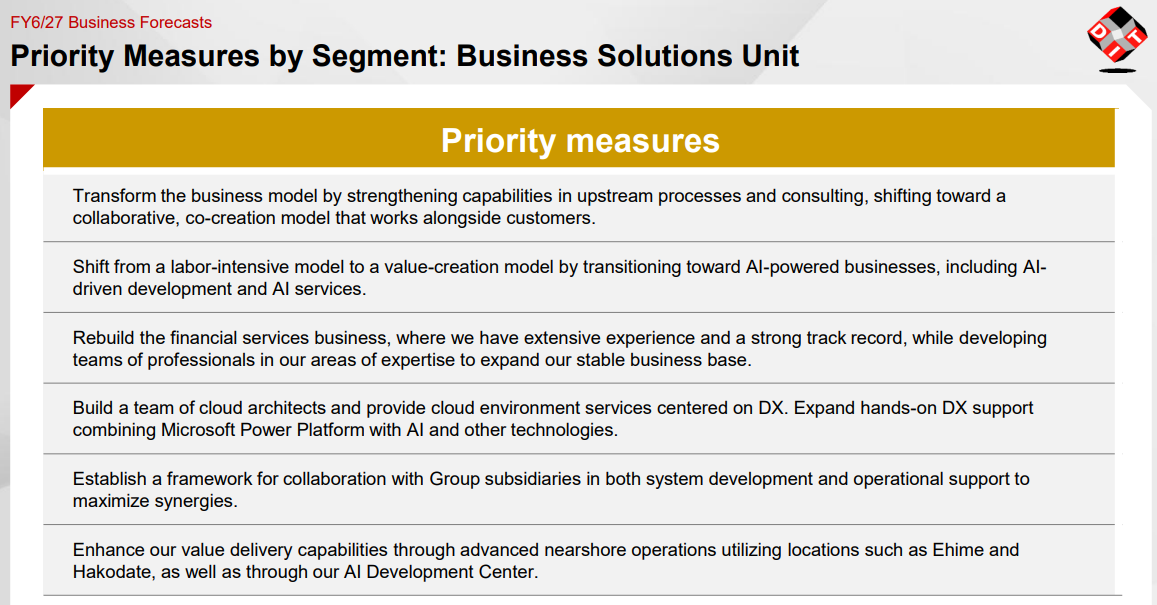
Sales are expected to grow, as they will steadily meet the strong demand for IT. By utilizing generative AI, low-code or code-free systems, they will promote the improvement in value to propose and productivity.
■Business System Development
They will accelerate the shift to a hands-on system integrator through the cooperation with other companies while sharing the strengths of each company. They will improve productivity by accumulating experience and know-how of AI-driven development.
■Operational Support
By expanding their share among major clients, they will reinforce the revenue base. They will enhance the development of cloud infrastructure and support for automation based on Microsoft Power Platform.
(Taken from the reference materials of Digital Information Technologies Corporation)
In the upstream process before the development phase and the field of consultation, they will become more familiar with the business operations of clients, and take measures.
In the development phase, they will shift from labor-intensive business to value creation business by utilizing AI.
(2) Embedded Solutions Unit
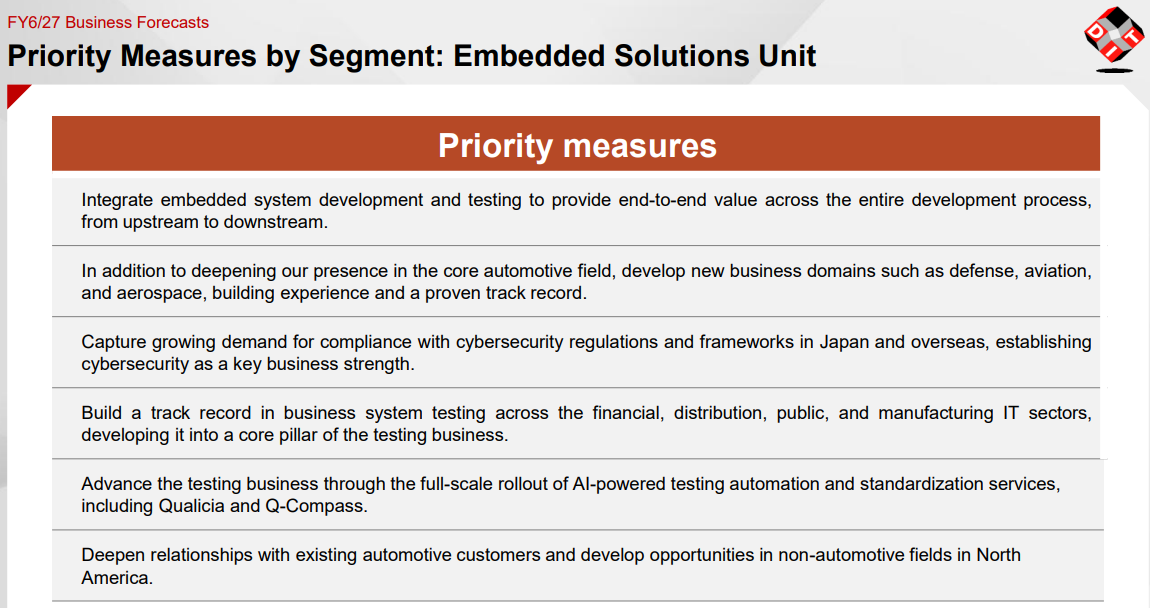
There are uncertainties over the trend of investment in the fields of in-vehicle systems and semiconductors, but sales are expected to grow as they will pursue transactions with major clients and cultivate the non-in-vehicle system field.
■Embedded system development
While increasing projects for IoT and industrial equipment, they will cultivate the fields of defense, aviation, and outer space. They will keep giving proposals for compliance with security regulations, such as CRA in Europe and JC-STAR*.
*JC-STAR: A system for evaluating the conformity with security requirements and labeling. This is a Japanese system for evaluating the security levels of IoT products connected to the network and visualizing them with labels that indicate the number of stars and a two-dimensional barcode.
■Embedded system verification
Based on in-vehicle system verification, they will make inroads into the business operation system field. They will offer the AI-based verification service “Qualicia” and accelerate the evolution into a quality service business.
“Qualicia” is a quality assurance service using AI and security technologies. It utilizes AI for the quality assurance process, which tends to depend on individual skills in IT development, realizes safe cloud utilization with their unique security technology, and minimizes the variation in quality through verification based on output items.
(Taken from the reference materials of Digital Information Technologies Corporation)
In order to cultivate the fields of defense, aviation, and outer space, they will use various approaches, including alliances with enterprises closely related to these fields and the contact with related enterprises via routes of venture capital in which they invest. Based on the experience of attending to enterprises that have various business types or models by utilizing their strengths, they will implement the same kinds of initiatives and expand their market share.
(3) Product Solutions Unit
They will increase recurring revenues steadily to establish a revenue model that does not depend on human resources too much. They aim to recover from a decline in sales in the wake of discontinuation of software for producing New Year’s cards of Jungle, Inc.
*Security products and services
They will enhance sales, while focusing on WebARGUS and Sentinel ARGUS, to meet the expanding demand. We heard that they receive an increasing number of inquiries about Sentinel ARGUS from government agencies, financial institutions, etc. as their interest in the product is growing while multiple leading companies have suffered cyberattacks. While looking ahead to the actual installation this fiscal year, they are making preparations.
Regarding RezOT, they aim to release it and establish a business model early in cooperation with OS makers as overseas partners, while expecting the demand for the conformity with CRA in Europe.
*Products for streamlining business operations
In addition to the sale of xoBlos and xFormly, they will offer hands-on support services for establishing “data management infrastructure” based on these products. With “xFormly,” they will meet the demand for data preparation, which is indispensable before the use of AI.
* Other new products
Regarding the additional measures for the electronic contract service “DD-CONNECT,” they will follow the schedule agreed with clients and recover revenues while incorporating the second and third development processes. In addition, they will make efforts to expand direct sales and win projects for peripheral system integration projects and governmental projects. Many local governments need to conduct digital transformation (DX), so they are developing easy-to-install systems, targeting Hakodate City, Hokuto City, etc., to which they are closely related.
Regarding Jungle, Inc., they will promote the sale of products targeted at corporations, from which stable revenues can be expected. These products include Data Migration Box (DMB), a tool for high-speed data migration from on-premise equipment to a cloud system or from a cloud system to another cloud system, for which DIT possesses exclusive dealership, and PDF-Xchange Editor, general multifunctional PDF software for editing PDF files freely, which is sold as “Platinum Reseller.” PDF-Xchange Editor is handled by about 200 distributors globally. Among them, Jungle, Inc. is a leading one, being one of the top 5 distributors. Profit margin, too, is high, so we heard that it is expected to contribute to revenues significantly.
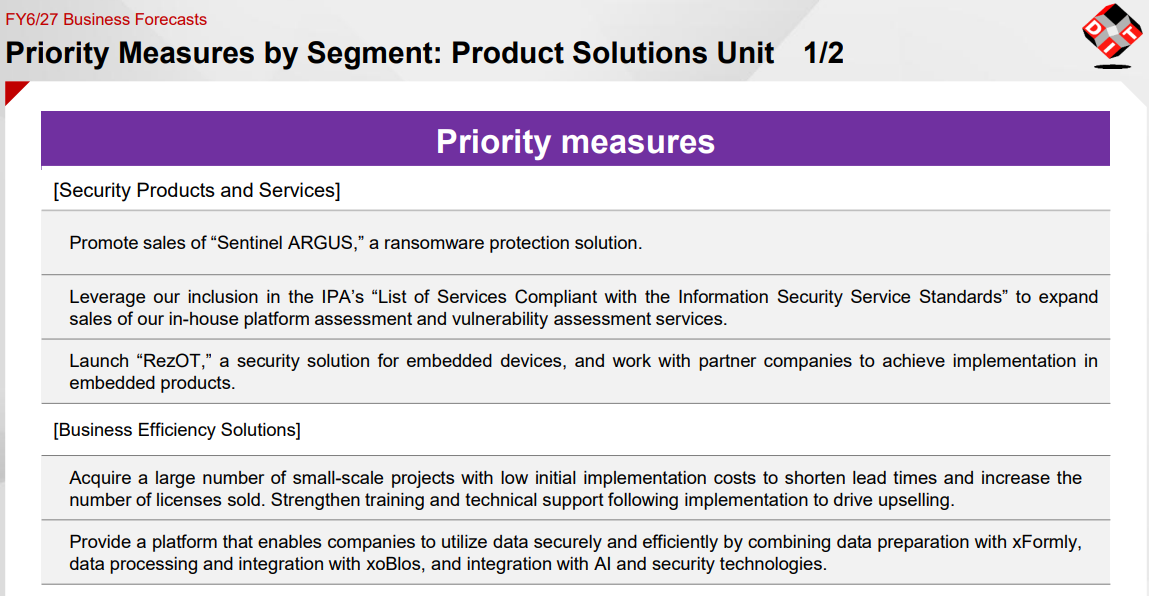
(Taken from the reference materials of Digital Information Technologies Corporation)
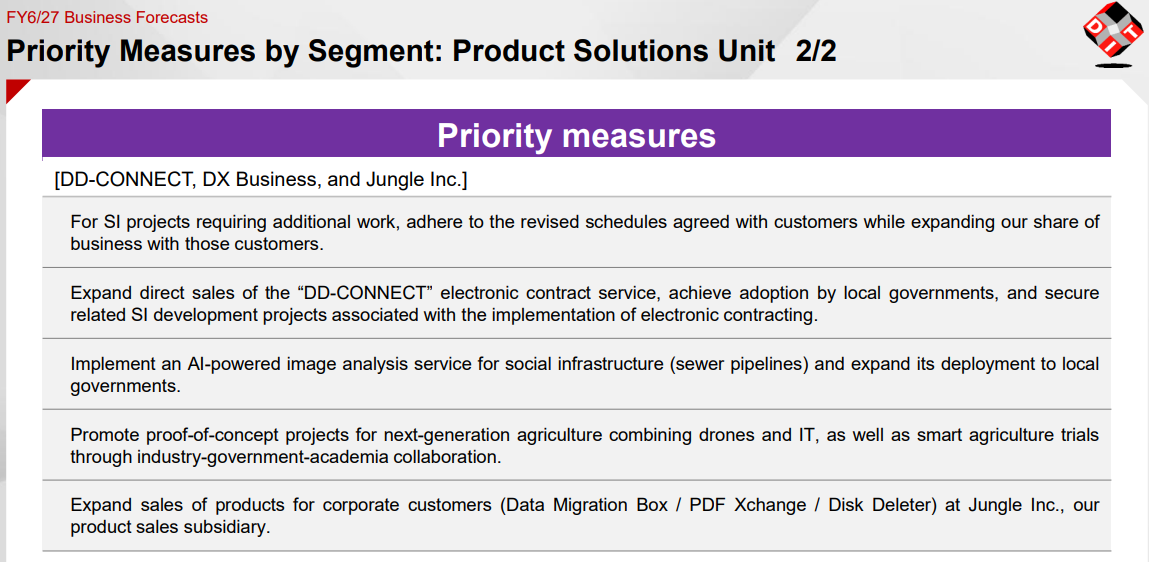
(Taken from the reference materials of Digital Information Technologies Corporation)
(4) System Sales Business
Sales are expected to grow, thanks to the stable base of repeat customers. As the number of small-scale business operators is decreasing in the market, they will switch their revenue structure from that composed of mainly one-shot revenues to that composed of mainly recurring revenues, to reinforce the revenue structure further. They will evolve their support system into “customer success,” and enhance cross-selling based on hands-on support according to the business operation environment of each client. They aim to reel in new clients, by promoting systems for receiving and placing orders, which are in high demand, CMS, and the new version of “Rakuichi” with enhanced EC linkage.
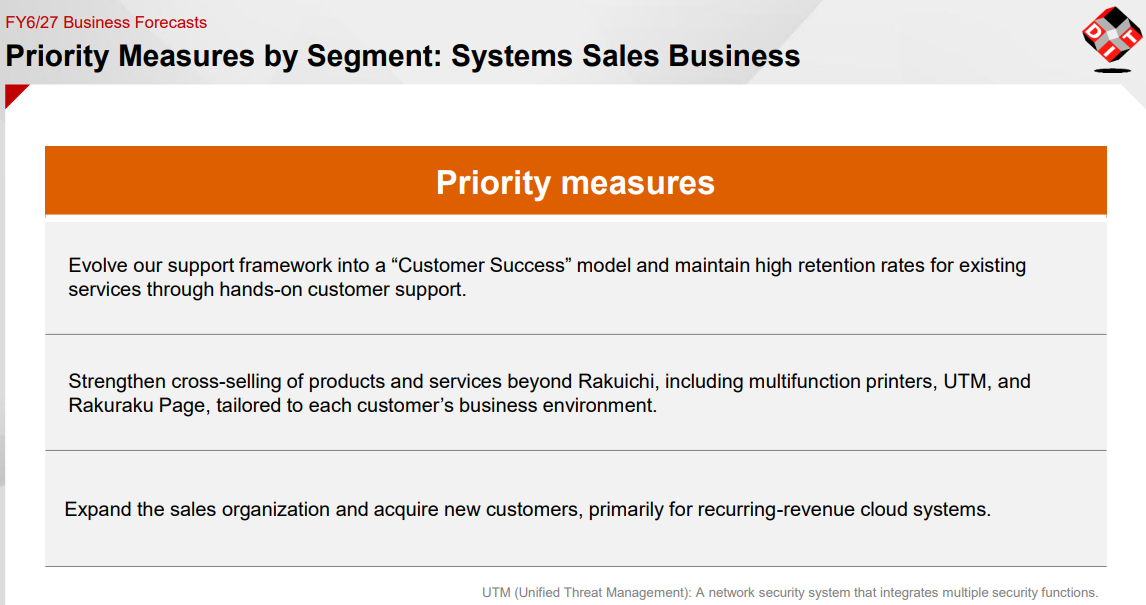
(Taken from the reference materials of Digital Information Technologies Corporation)
4. Moving the Model for Coexistence with AI into the Implementation Phase
The rapid evolution of AI and its penetration into all sectors produced a significant impact on the company’s business. While demand for generic skills, such as coding skills, is clearly declining, there is a surge in demand for human resources who possess expertise in the industry and operations, as well as the ability to utilize AI.
In this situation, the company will restructure its business with a view of utilizing AI, and, while leveraging its strengths in the four key areas of AI-driven development, a data utilization base, quality assurance and verification, and security technology, they will focus on accelerating monetization as a hands-on AI/DX integrator.
4-1 Creation of Services through FDE
Specifically, the company uses FDE* to gather clients’ insights and identify their needs, and then incorporates these into its own services.
Although it utilizes AI, the company believes that its differentiating factor lies not in AI itself, but in the added value it provides through the combination of its expertise in the industry, its four key focus areas and its hands-on supporting capabilities.
*FDE (Forward Deployed Engineer): A system in which engineers gain a deep understanding of the client’s operations while being deployed on-site at the client’s premises, utilizing AI and the company’s valuable accumulated expertise and products to provide end-to-end support, including identifying issues, design, implementation, operation and adoption.
The company has long maintained an on-site presence among many of its key clients, operating as an indispensable partner. Going forward, the company aims not only to continue delivering value through its staff, but also to further enhance customer value by sharing internal expertise through the use of AI and other means.
<FDE Case: Solving Clients’ Challenges and Identifying Their Needs through the Use of AI>
The company approached a long-standing client with the proposal to verify the effectiveness of generative AI using data from past projects. The client agreed to conduct the verification on the condition that the data be masked to prevent sensitive information from being leaked externally through the Internet.As a result, the use of generative AI improved efficiency by 75% and was highly praised by the client. At the same time, the company identified a need for data masking within the manufacturing sector, driven by concerns that “confidential information should not be handled by AI.”
The company believes that it was able to identify this need precisely because its staff are deployed on-site at the client’s premises and are always in direct contact with clients.
The company believes that rather than simply utilizing AI, its ability to solve customers’ challenges by working closely with them through FDE constitutes a key competitive advantage that will bring significant business opportunities; consequently, it will vigorously promote the development of an AI-integrated model under the leadership of its president.
With regard to data masking technologies and the utilization of AI, the R&D department, serving as the hub for promoting AI adoption across the entire company, is responsible for conducting research into cutting-edge technologies and sharing knowledge and insights.
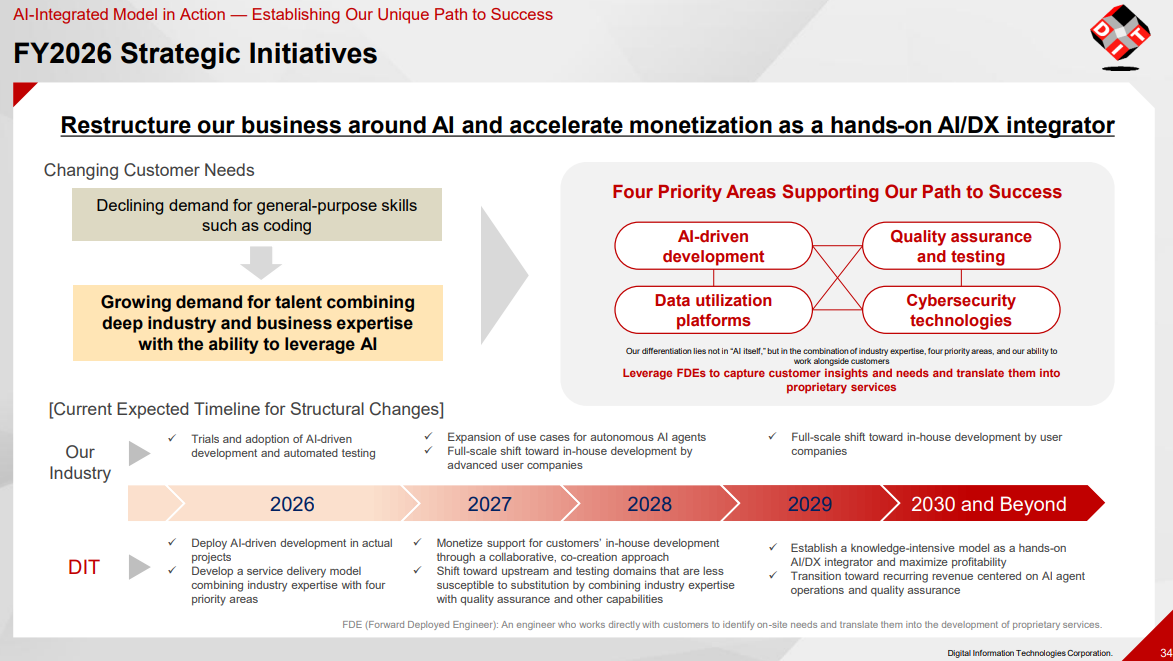 |
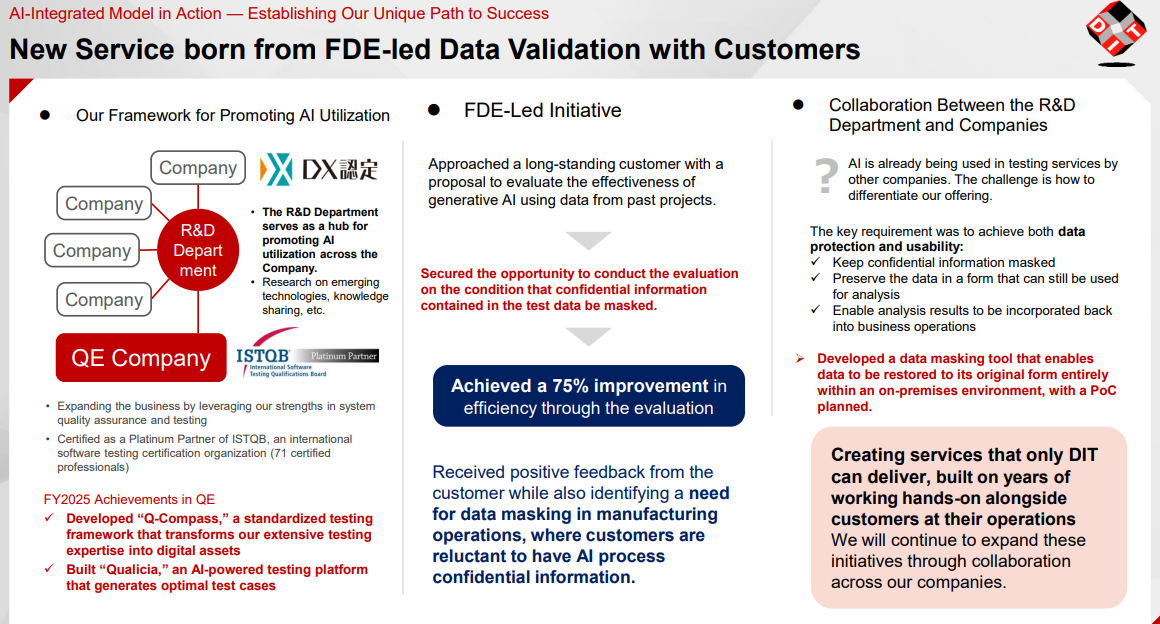 |
(Taken from the reference materials of Digital Information Technologies Corporation)
4-2 Three Key Strategies Utilizing AI
The company has set out the following three key strategies: “1. Business model transformation (adding high value) through AI-driven development and the use of generative AI”; “2. Building solutions by combining our unique strengths with AI”; and “3. Creating new businesses (expanding into new fields).”
3. Regarding New Business Creation (Exploring New Areas), the company believes that, in addition to integrating AI into existing products within the Product Solutions Unit, utilizing AI for Rakuichi—a product for small and medium-sized enterprises and micro-enterprises offered by the Systems Sales business—could enable the provision of products that meet end-users’ needs with short lead times and at low prices.
With regard to promoting the development of new areas, the company will roll out initiatives such as the proof-of-concept testing using AI-based image analysis within deteriorated sewer pipelines, primarily in the southern Hokkaido region, and next-generation agricultural support services combining drones and IT.
In the field of security, which is one of the company’s key strengths, it concentrate on expanding the deployment of RezOT, a security solution for embedded devices released in September 2025. While conventional security products are unable to respond to unknown attacks, RezOT is capable of responding to unknown attacks involving AI.
Overseas OS manufacturers and domestic companies providing integration and management services have shown strong interest in forming alliances with RezOT in order to enhance their own services.
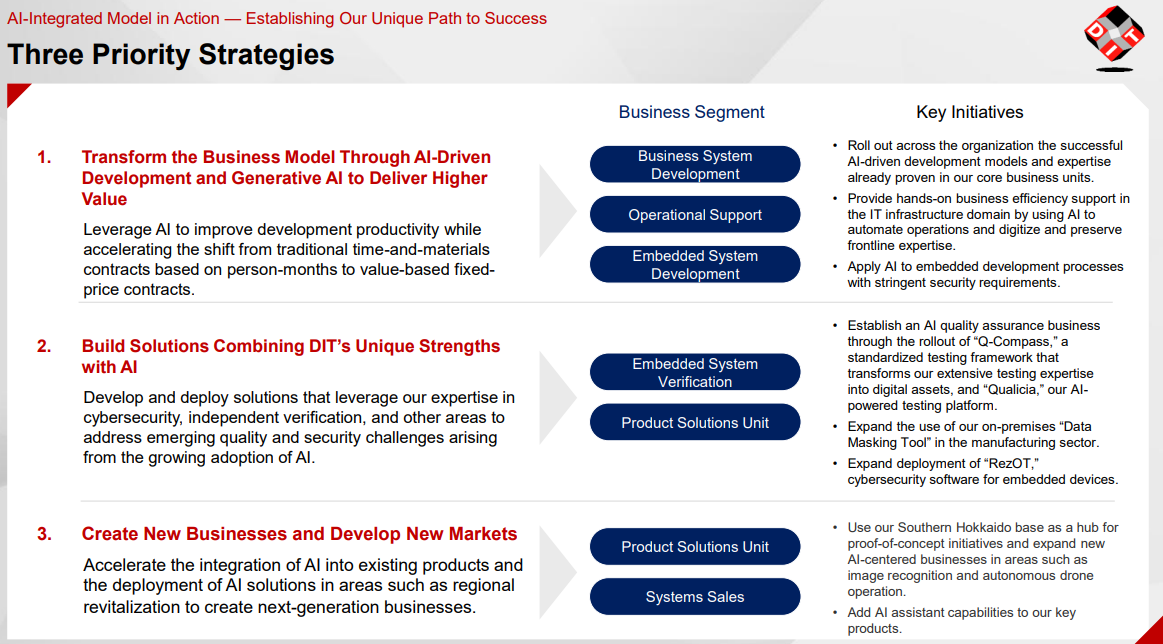
(Taken from the reference materials of Digital Information Technologies Corporation)
5. Progress on the Medium-Term Management Plan and the Vision for 2030
5-1 Outline and direction
In its “Vision for 2030,” the company aims to build a trusted and chosen DIT brand. The company has defined its medium/long-term growth model as strengthening its “two-pronged business promotion,” comprising “further expansion of the business base” and “provision of new value and services as growth factors,” which have supported the company's growth to date. The company aims to expand its business foundation further and promote the provision of new value and services.
The theme of the current medium-term management plan (FY 6/25 - FY 6/27), which is the second step in the process, is “realizing a growth path.”
The entire company will pursue growth by promoting the following three strategies, under the purpose “Enrich people's lives by supporting a digital society (change) that continues to “progress” with the power of IT (adaptability)” in addition to “Guiding Principles,” “Corporate Philosophy and Management Philosophy” and “Management Policy.”
(Growth steps toward the year 2030)
They will actualize “DIT Vision for 2030” through the following three steps.
Fiscal Years June 2022 –June 2024 | Promoting the Reform of Business Structures |
Fiscal Years June 2025 – June 2027 | Achieving a Growth Trajectory |
Fiscal Years June 2028 – June 2030 | Establishing purpose-driven management
|
5-2 Three basic strategies
① Business foundation
To strengthen the base revenue business model by further improving the capability of co-creation of value and market competitiveness.
Recognizing the challenges from the previous medium-term plan as “shifting to a business model based on service proposals,” “strengthening on-site capabilities through human investment” and “the ability to solve social issues by promoting digital transformation,” the company is working on “project management capabilities,” “providing the latest methods and technologies,” “building a value delivery system,” “consulting and proposal-based marketing,” “promoting DX and developing high-level IT human resources.”
② Growth factors
To accelerate product businesses that are sensitive to the ever-evolving digital society and work to create next-generation businesses.
Recognizing the challenges from the previous medium-term plan as “improving the ability to respond to changes in trends and new technologies” and “accelerating the product business by strengthening product competitiveness to meet market needs,” the company will work on “pursuing added value through generative AI,” “expanding DX business areas,” “expanding security areas” and “next-generation business through new technologies and services.”
③ Management foundation
To establish a management foundation that enables sustainable growth in response to all kinds of changes in the business environment.
Recognizing the challenges from the previous medium-term plan as “further strengthening the management foundation to enable sustainable growth,” “promoting ESG initiatives” and “clarifying growth investment areas and executing investments,” the company will set up group-wide committees such as Human Value Enhancement Committee, Sustainable Management Review Committee, New Technology R&D Committee, Project Quality Management Enhancement Committee and Internal Environmental DX Review Committee, to work on these issues with a higher priority.
5-3 Cash allocation
The company will actively execute growth investments from a medium- to long-term perspective to continuously increase its value, and will also be more proactive in returning profits to shareholders.
With regard to shareholder return, the company will raise its target dividend payout ratio to 50% or higher and continue to pay stable dividends. Dividend increases will be considered after taking all relevant factors into account. The company will also make decisions regarding share repurchases, taking into account market conditions and other factors.
5-4 M&A Strategy
Rather than simply aiming to expand in scale, the company will actively pursue M&A with a view to the AI era. They have focused on securing human resources, but as AI evolves and becomes more widespread, the company intends to selectively invest in firms that possess key technological capabilities or services, with a view to enhancing the added value of the company and the group as a whole.
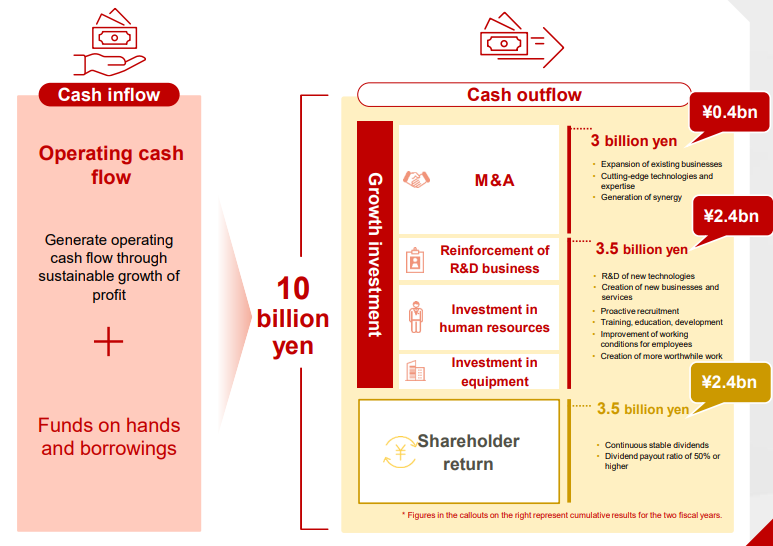 |
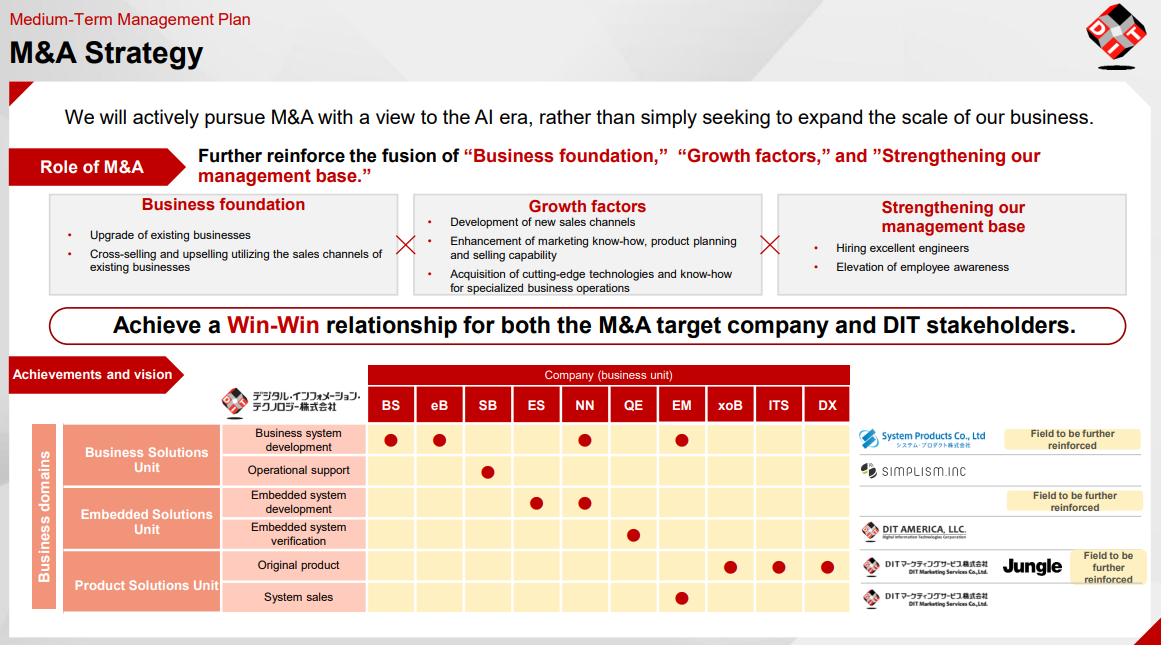 |
(Taken from the reference materials of Digital Information Technologies Corporation)
5-5 Management targets
The initial plan for the financial year ending June 2027 remained unchanged due to uncertainties over the current demand trend. No changes have been made to the non-financial indicators.
◎ Financial indicators
| FY 6/25 (results) | FY 6/26 (results) | FY 6/27 | CAGR |
Net sales | 220 → 241 | 242 → 255 | 267 | +10.3% |
Operating income | 26.0 → 30.1 | 28.7 → 30.5 | 32.0 | +9.7% |
Operating income margin | 11.8% →12.5% | 11.9% → 12.0% | 12.0% | - |
ROE | 29.0% | 24.4% | To maintain a minimum of 25% | |
Dividend payout ratio | 49.0% | 57.4% | To maintain a minimum of 50% | |
*Unit: 100 million yen. The figures for FY 6/27 mean the targets. CAGR stands for compound annual growth rate for the period from FY 6/24 to FY 6/27.
◎ Non-financial indicators
| FY 6/27 (target) |
Percentage of female managers | 20% or higher |
Number of employees who have obtained an advanced IT qualification | 2x |
Percentage of employees who have attended the purpose-related training. | 100% |
*It also aims to increase “triple A” personnel through the use of talent management tools.
5-6 Slogan
As part of its 2030 Vision, the company has adopted the slogan “Aiming to Break 50, 50, and 50!” which sets out targets of 50 billion yen in sales, 5 billion yen in operating income, and a dividend payout ratio of 50 percent or over.
While this approach will continue in the fiscal year ending June 2027, in light of the rapid advancements in AI technology and the resulting changes in customer needs, plans are in place to prioritise enhancing added value when formulating the next medium-term management plan, including a review of certain targets. While recognizing that achieving the revenue target has become more challenging, the company intends to increase operating income through measures such as the development of an AI-integrated business model.
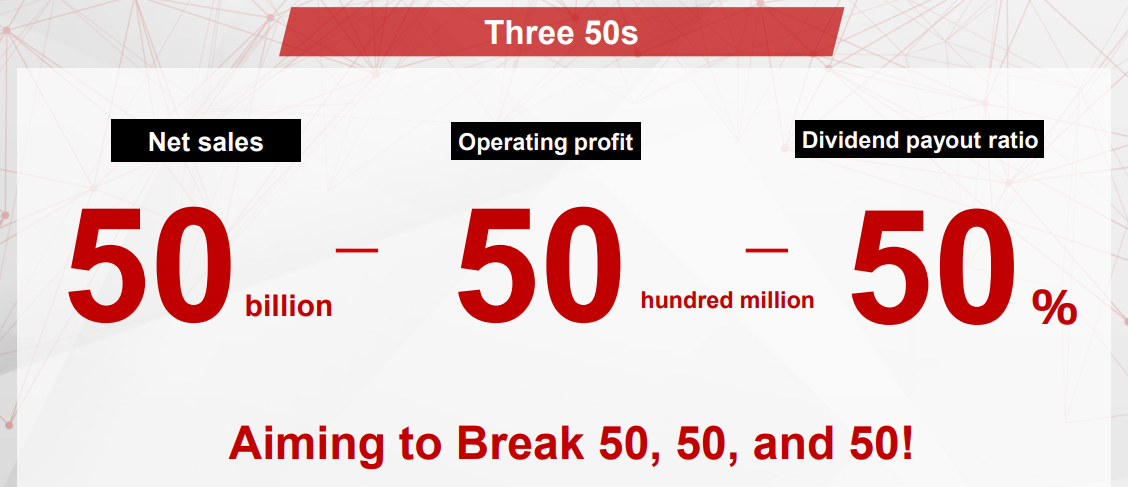
(Taken from the reference materials of Digital Information Technologies Corporation)
6. Message from President Ichikawa
The rapid evolution of AI is having a significant impact on the IT industry and our company. It is inevitable that demand will decline for generic skills that can easily be replaced by AI. At the same time, however, there is a growing recognition that it is difficult for every company to utilize AI to develop all the functions it requires.
Given this situation, we have held extensive internal discussions regarding the direction our company should take going forward. As a result, we have concluded that what will be required of us in the future is the ability to work closely with our clients, gain a thorough understanding of their business operations, and utilize AI to deliver value that only our company can provide, thereby resolving their challenges.More specifically, we will restructure our business with a view to utilizing AI, and, while leveraging our strengths in the four key areas of AI-driven development, a data utilization base, quality assurance and verification, and security technology, we will strive to enhance our profitability as a hands-on AI/DX integrator.
In the area of Quality Assurance and Verification, which is one of our four priority areas, we wished to verify the effectiveness of the generative AI we utilize by applying it to actual client data. When we approached our clients, some of them declined, stating that they could not allow sensitive information to be processed by AI; however, one client agreed on the condition that the data be masked to preserve its confidentiality. We therefore manually masked a large volume of data to verify the effectiveness of generative AI and achieved excellent results, with a 75% efficiency improvement. During this process, we identified a need for an automated system to handle masking and restoration; we subsequently commercialized this solution, which received very positive feedback.
Through this process, we were able to recognize the need for data masking specifically, the desire not to have confidential information processed by AI. We believe that we were able to identify this need precisely because we are stationed on-site at our clients’ premises and are always in direct engagement with them.
In this way, rather than simply utilizing AI, we believe that our strong competitive advantage and path to victory lies in identifying our clients’ needs through our FDE approach and resolving their challenges.
While we have experienced sluggish growth in both sales and profit over the past few years, causing concern among our shareholders and investors, we are restructuring our business while assuming the utilization of AI and aim to return to a growth path as a hands-on AI/DX integrator while leveraging our strengths.
As our group's strength lies in our ability to adapt to change, this also represents an opportunity to further enhance our presence. We would appreciate your continued support from a medium- to long-term perspective.
7. Conclusions
They mentioned “the shift of their business models (adding high value) through AI-driven development and utilization of generative AI” as one of priority strategies for adopting a model for coexistence with AI. As primary measures, they enumerated “the sharing of successful models and know-how for AI-driven development that have been demonstrated in the primary department with other departments,” “automation of operations in the IT infrastructure field,” “hands-on support for the streamlining of business operations through the digitalization and sharing of on-site workers’ knowledge with AI,” and “utilization of AI for embedded development processes with high security requirements.” These measures have already produced some effects.
When they gave an explanation about these measures to an institutional investor at a one-on-one meeting, the investor commented that there have been no companies that gave such concrete explanation like DIT, although they have often heard about “AI-driven development” and “productivity improvement.”
Their business environment remains severe, but we would like to pay attention to the progress of return to a high growth track through the cultivation of the non-in-vehicle device field, the adoption of a model for coexistence with AI, the market cultivation with “RezOT,” a security measure for IoT, etc.
<Reference : Regarding Corporate Governance>
◎ Organization type, and the composition of directors and auditors
Organization type | Company with auditors |
Directors | 7 directors, including 4 external ones (including 4 independent ones) |
Auditors | 3 auditors, including 2 external ones (including 2 independent ones) |
Corporate Governance Report
Last Update: May 15, 2026
<Basic principle>
The company recognizes that compliance with laws and regulations, maintaining transparency in management, and improving the soundness and sustainability of its corporate value are the most important management issues.
To tackle these issues and to fulfill social responsibilities to shareholders and other stakeholders, the company has established the following corporate governance system. The company considers it important to further strengthen this system, verify its functions on a regular basis, and implement necessary measures.
<Reason for not Following the Principles of the Corporate Governance Code (Excerpts)>
Principles | Reasons for not implementing the principles |
< Supplementary principle 3-1-3> | (1) Sustainability initiatives The DIT Group Code of Conduct requires business and individual activities to be environmentally conscious. Based on this, we strive to tackle environmental issues earnestly and gain a public understanding of the business activities. As stated in the Medium-term Management Plan, we will enhance employees’ welfare, promote diversity by recruiting women for managerial positions, and carry out appropriate business management with an emphasis on governance. We also aim to promote a convenient and safe Internet society, improve the productivity of the society, and contribute to the environment, the society, and the corporate growth through our products and services, such as security products and work style reform-related products.
(2) Investment in human capital and intellectual property ① Investment in human capital In the Medium-term Management Plan, we have formulated a basic strategy of establishing a business administration base that enables us to grow sustainably, and one of the major policies is to generate human capital, which is aimed at increasing and developing employees who are the assets of our company. We will promote the proactive recruitment of new graduates and mid-career employees, the expansion and systematization of education and training systems, and the improvement of a program that provides personnel with the fees needed to acquire qualifications.
② Investment in intellectual property Based on our basic strategy of “accelerating the growth of the product business and creating next-generation business” in the Medium-term Management Plan, we will continue to work on product development that meets the needs of the times and promote investment in intellectual property such as research and development and patents.
(3) The impact of risks and business opportunities related to climate change on our business activities and profits, etc. Our company propels forward information disclosure in accordance with the TCFD Recommendations concerning the impacts that climate change-related risks and revenue opportunities would have on our business activities, revenue, and the like. We, however, have not yet calculated or disclosed any concrete amount of financial impact that climate change could have on our business and finance at the moment. We will develop and analyze data and hold discussion with the aim of making quantitative assessment and disclosure. |
<Disclosure Based on the Principles of the Corporate Governance Code (Excerpts)>
Principles | Disclosure contents |
<Principle 1-4> | <Policy and principle related to reduction in strategically-held shares> In case the company expects synergy effects with its important stakeholders such as business partners, it will strategically hold the shares of the concerned companies, based on its basic principles to enhance corporate value in the mid/long term and ensure sustainable growth while promoting co-existence and co-prosperity with all the stakeholders. The company will clarify the objective when acquiring new shares and verify the trading activity periodically after the acquisition. If the company finds no mid/long term prospect of enhancing its corporate value, it will reduce the number of shares through sale or any other means.
<Verification details to determine the appropriateness of holding strategically-held shares> The appropriateness of possessing strategically-held shares is verified periodically. Once a year, the Board of Directors reviews the appropriateness of holding policy shareholdings by examining their contribution to improving corporate value over the medium to long term and confirming the appropriateness of continued ownership.
<Standards for exercising voting rights concerning strategically-held shares> The company will decide whether to give approval for exercising the voting rights of strategically-held shares after a careful individual examination to confirm that there is no possibility of damaging our corporate value. |
<Supplementary Principle 2-4-1> | 1. Regarding ensuring diversity in recruiting the core human resources, the DIT Group Code of Conduct stipulates that we should not discriminate in recruiting based on gender, age, place of origin, nationality, race, ethnicity, etc., and that the human rights should be respected. The status and future goals for ensuring diversity in recruiting core human resources are as follows.
① Recruitment of women: As of the end of June 2025, we have 9 female managers, accounting for 7.8% of all managers. Going forward, we will continue to actively promote talented women for managerial positions, aiming to increase the ratio of female managers to 20%.
② Recruitment of mid-career personnel for managerial positions: We have many mid-career hires, and the ratio of mid-career hires to managerial positions already exceeded 70%, so we have not set any future goals.
③ Recruitment of foreigners: We mainly hire foreigners as new graduates, and as of the end of June 2025, the company has 10 foreigners, accounting for less than 1%. We will continue to actively hire talented human resources, whether they are new graduates or mid-career.
2. The policy for ensuring diversity was also stated in the Medium-term Management Plan. As part of the company's measures to strengthen the management base for improving corporate value over the medium to long term, we will endeavor to establish a system for the company that includes organizations and policies, to create an environment that provides employees with job satisfaction, and to increase human resources, which are considered assets for the company, and train them. |
<Supplementary Principle 4-11-1> | Our company select candidate directors from personnel who can exert their management abilities in each domain, personnel who are adequate for business administration, and other intelligent personnel. Outside directors are selected from those who possess plenty of experience and profound technical knowledge as employers, to develop a structure oriented toward the balance and diversity of the board of directors and secure the effectiveness of the board of directors. In addition, the board of auditors of our company is composed of 1 full-time auditor and 2 independent outside auditors. Those who possess advanced technical knowledge of legal affairs and accounting are selected as auditors, to secure the effectiveness of the board of auditors. Furthermore, by cementing the cooperation with comptrollers, they can conduct an audit to a sufficient degree. We regularly analyze and evaluate the effectiveness of the board of directors while enlisting support from external specialized institutions and strive to improve its function. *The skill matrix is shown on page 9 of the convocation notice of our company.
|
<Principle 5-1> | Our company is making efforts in collaboration with relevant departments, led by the President, to achieve constructive dialogue with shareholders. As an action to enrich dialogue methods other than individual meetings, the company hosts financial settlement briefings every half-period for the analysts and institutional investors. The IR Department also proactively receives IR interviews through meetings and phone calls from investors. Furthermore, our company strives to foster their understanding of our company’s business and business administration policies by holding information sessions for individual investors several times. As a measure to provide shareholders’ opinions and concerns appropriately and effectively to the executives and board directors, the company regularly reports the questions raised at the financial settlement briefings and opinions from shareholders and investors to the management executives. The company also ensures appropriate management of insider information during dialogues with shareholders and investors in accordance with the internal regulations. |
<Measures for realizing business administration conscious of capital cost and share price> | What is described: Disclosure of initiatives (first time) Whether or not disclosure is made in English: No
Our company is making efforts to secure profitability exceeding capital cost in order to attain the managerial goal of achieving an ROE of 25% or higher in the period of the Medium-term Management Plan (FY 6/25 to FY 6/27). In addition, we have secured transparency by disclosing appropriate information while trying to realize sustainable growth and improve capital efficiency by disclosing information on cash allocation in order to improve shareholder value. We will consider using loans, mergers and acquisitions, and other relevant measures as necessary so that we can grow sustainably while further increasing the capital efficiency. |
This report is not intended for soliciting or promoting investment activities or offering any advice on investment or the like, but for providing information only. The information included in this report was taken from sources considered reliable by our company. Our company will not guarantee the accuracy, integrity, or appropriateness of information or opinions in this report. Our company will not assume any responsibility for expenses, damages or the like arising out of the use of this report or information obtained from this report. All kinds of rights related to this report belong to Investment Bridge Co., Ltd. The contents, etc. of this report may be revised without notice. Please make an investment decision on your own judgment. Copyright(C) Investment Bridge Co., Ltd. All Rights Reserved. |