



Bridge Report:(6089)WILL GROUP the Fiscal Year ended March 2026

 Yuichi Sumi Representative director and President | WILL GROUP, INC. (6089) |
 |
Company Information
Exchange | TSE, Prime Market |
Industry | Services |
Chairman | Yuichi Sumi |
HQ | 1-32-2 Honcho, Nakano-ku, Tokyo, Japan |
Year-end | March |
Website |
Stock Information
Share Price | Number of shares issued (End of the term) | Total market cap | ROE (Act.) | Trading Unit | |
¥1,016 | 22,912,778 shares | ¥23,279 million | 12.3% | 100 shares | |
DPS (Est.) | Dividend Yield (Est.) | EPS (Est.) | PER(Est.) | BPS (Act.) | PBR (Act.) |
¥44.00 | 4.3% | ¥96.38 | 10.5x | ¥883.37 | 1.2x |
*Stock prices as of the close on June 18, 2026. Each figure is taken from the financial statements for the fiscal year ended March 2026. The number of shares issued is obtained by deducting the number of treasury shares from the number of shares issued.
Trends in Consolidated Performance (Voluntary adoption of IFRS)
Fiscal Year | Sales | Operating Income | Ordinary Income, Pretax Profit | Profit attributable to owners of parent | EPS (¥) | DPS (¥) |
March 2023(Act.) | 143,932 | 5,318 | 5,146 | 3,236 | 143.20 | 44.00 |
March 2024(Act.) | 138,227 | 4,525 | 4,417 | 2,778 | 122.37 | 44.00 |
March 2025(Act.) | 139,705 | 2,338 | 2,177 | 1,155 | 50.64 | 44.00 |
March 2026(Act.) | 146,856 | 3,279 | 3,139 | 2,314 | 101.01 | 44.00 |
March 2027(Est.) | 157,000 | 3,400 | 3,191 | 2,208 | 96.38 | 44.00 |
*Estimated by the Company. Unit: Million yen or yen.
This Bridge Report reviews the fiscal year ended March 2026 earnings results, the fiscal year ending March 2027 earnings estimates, the priority strategy in the medium-term management plan “WILL-being 2029,” the interview with President Sumi, and so on.
Contents
Key Points
1. Company Overview
2. Fiscal Year ended March 2026 Earnings Results
3. Fiscal Year ending March 2027 Earnings Estimates
4. Key Strategies of the New Medium-term Management Plan "WILL-being 2029"
5. Interview with President Sumi
6. Conclusions
<Reference: Regarding Corporate Governance>
Key Points
- In the fiscal year ended March 2026, sales revenue grew 5.1% year on year to 146,856 million yen. Operating income rose 40.2% year on year to 3,279 million yen. Sales revenue hit a record high for the first time since FY 3/2023, as the Domestic Working business grew steadily mainly in the field of construction engineers and the sales from dispatch of workers in the Overseas Working business were healthy. In terms of profit, gross profit increased thanks to the reshuffling of the business portfolio in the Domestic Working business and the curtailment of SGA and the growth of sales from introduction of workers in the Overseas Working business and there was no longer impairment loss, which was posted in the same period of the previous year, contributing to a significant increase in profit. In addition, normalized operating income* rose 32.8% year on year.*Normalized operating income: Operating income excluding temporary profit/loss, such as the impairment loss and income from governmental subsidies in the “Overseas Working business” segment and gain on sale of real estate in the “Other” segment.
- For the fiscal year ending March 2027, sales revenue is expected to increase 6.9% year on year to 157.0 billion yen and operating income is forecast to rise 3.7% year on year to 3.4 billion yen. A growth of sales revenue is expected to be seen in the dispatch of full-time employees, undertaking of tasks, support for employment of non-Japanese workers, and introduction of talent in the Domestic Working business, and the dispatch and introduction of workers in the Overseas Working business. Regarding operating income, an increase in gross profit is expected thanks to the reform of the revenue structure in the Domestic Working business, but the revenue from governmental subsidies in the Overseas Working business has not been taken into account in the forecast like before. Normalized operating income, which excludes temporary profit/loss, is projected to rise 13.1%. The company plans to pay a dividend of 44 yen/share like in the previous fiscal year. The expected payout ratio is 45.7%.
- We interviewed President Yuichi Sumi about the characteristics and competitive advantages of the company, initiatives in the field of construction engineers, where their business moved into the black, points of the new medium-term management plan, and his message toward shareholders and investors. He said, “I think that it is reasonable to feel such concern because leading companies focus almost completely on the administrative field in the human resources industry, and it is inevitable that jobs especially in the field will be replaced by generative AI. Our company, therefore, has run business in the other fields than administrative work that leading companies do not engage in since our establishment. This has consequently allowed us to establish our current unique position in which we demonstrate our advantages in essential fields* that are less influenced by generative AI. In addition, we conduct business on a par with local leading companies in overseas countries in which economic growth is expected, and I would like you to recognize our company as a unique and one-in-a-million player that possesses two growth drivers, which are essential fields and the overseas markets, in the human resources industry. I would like you to look forward to our company’s future growth.”*Essential fields: Fields that are essential for maintaining social life and not easily replaced by AI or automated, including the fields of the so-called essential workers
- We also interviewed him about “their measures for training personnel in the field of construction engineers, where their business moved into the black, and measures for improving employees’ retention rate,” “points of the new medium-term management plan,” etc. We hope you will read it.
- In FY 3/2027, the new medium-term management plan “WILL-being 2029” started and will end in FY 3/2029. It’s likely that the Domestic Working business will drive the growth of the company. In the business of dispatch of full-time employees and undertaking of tasks, they will expand the essential domain where the gap between supply and demand is significant and AI cannot be adopted easily. In the business of supporting the employment of non-Japanese people, they support all processes including recruitment and retention of workers. In the business of introducing workers, they will accelerate the growth of mainly the essential domain, through the personnel introduction business, which is repeatable and was acquired through M&A. Key performance indicators (KPIs) are the number of dispatched full-time employees and enrolled workers for entrusted tasks in the business of dispatch of full-time employees and undertaking of tasks, the number of non-Japanese workers whose employment was supported by the company in the business of supporting the employment of non-Japanese people, and the number of workers introduced by the company in the business of introducing workers. It is noteworthy whether they can increase these KPIs steadily. As mentioned in the interview with the president, the fact that their position is not easily affected by generative AI is an important perspective for evaluating the shares in the company.
1. Company Overview
While it is said that the balance between labor supply and demand will worsen as the number of workers in the production and clerical fields will become excessive, while the number of experts who can lead technological innovation and apply new technologies to business will become insufficient (which will be hereinafter called “the vocational mismatch”) in Japan in the late 2020s, the corporate group is striving to solve “the vocational mismatch” by offering human resources services, and “maximize and optimize the career paths for helping workers become experts.” The corporate group offers services of introducing and dispatching workers, undertaking tasks, and supporting the employment of non-Japanese workers in Japan, while specializing in some occupations, such as sales, marketing, call center operation, clerical work, factory work, nursing care, construction, and IT. They also offer human resources services for mainly white-collar occupations not only in Japan, but also in Australia and Singapore. The corporate group possesses a well-balanced portfolio, including sales support, call center, factory work, nursing care business support, construction engineer, and overseas staffing, without placing excessive emphasis on a specific business area, so that their business can grow stably and sustainably.
[1-1 WILL Vision and Management Philosophy]
The corporate group's management philosophy is to continue delivering positive choices to workers.
With a mission to be a “Change Agent Group that positively transforms individuals and organizations,” the company provides staffing services in categories, including sales, call centers, factory operations, nursing care, and construction management engineers both in Japan and overseas (including Australia and Singapore).
◆The MISSION is to be a Change Agent Group that positively transforms individuals and organizations.
◆VISION is to create a brand developing company with high expected value in the "Working,” "Interesting,” "Learning" and "Living" domains, and to be the best in each domain.
Working | Business field to support “Working” |
Interesting | Business field to support “Interesting” |
Learning | Business field to support “Learning” |
Living | Business field to support “Living” |
◆VALUE is Believe in Your Possibility
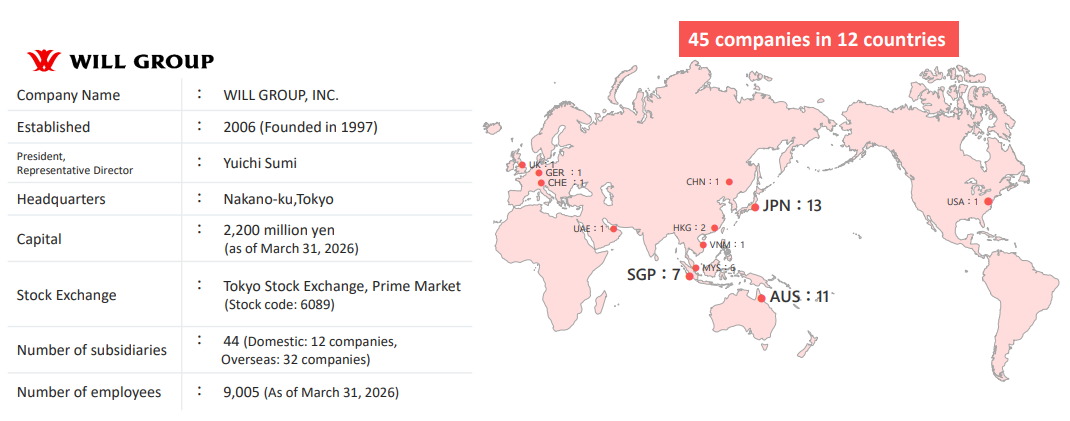
(Reference material of the company)
[1-2 Business description]
Business segments
The company has three business segments: the Domestic Working business, the Overseas Working business, and other business. The domestic business accounts for 60% of consolidated sales, while the overseas business makes up 40%.
One of the strengths of the corporate group is their business portfolio that allows the company to grow stably and sustainably, without placing excessive emphasis on specific business domains, while the economic situation and markets are changing rapidly.
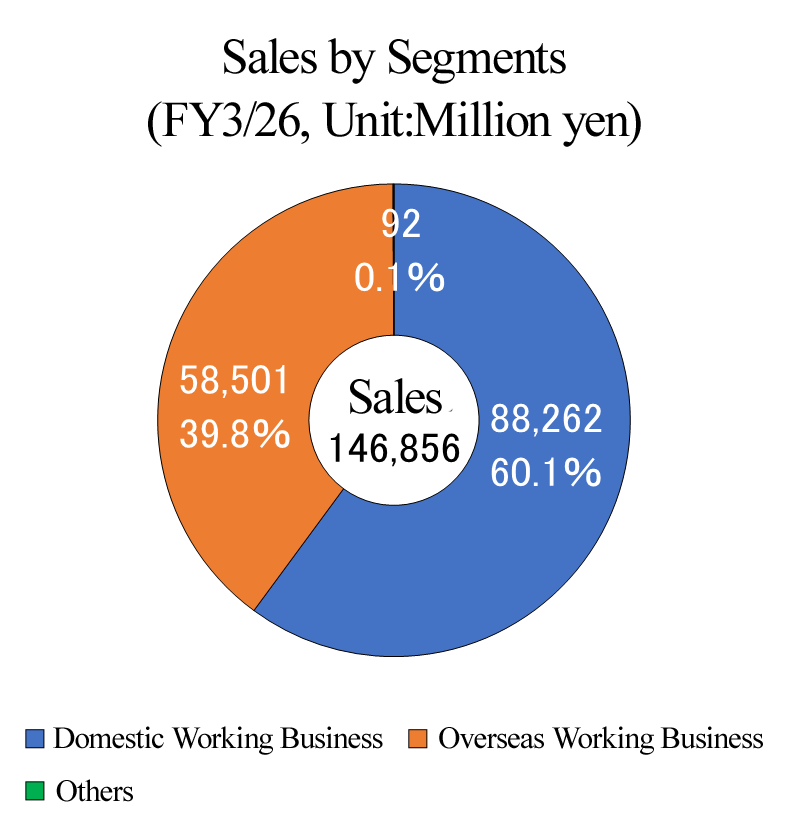
*External sales before the elimination of inter-segment sales.
Domestic Working business
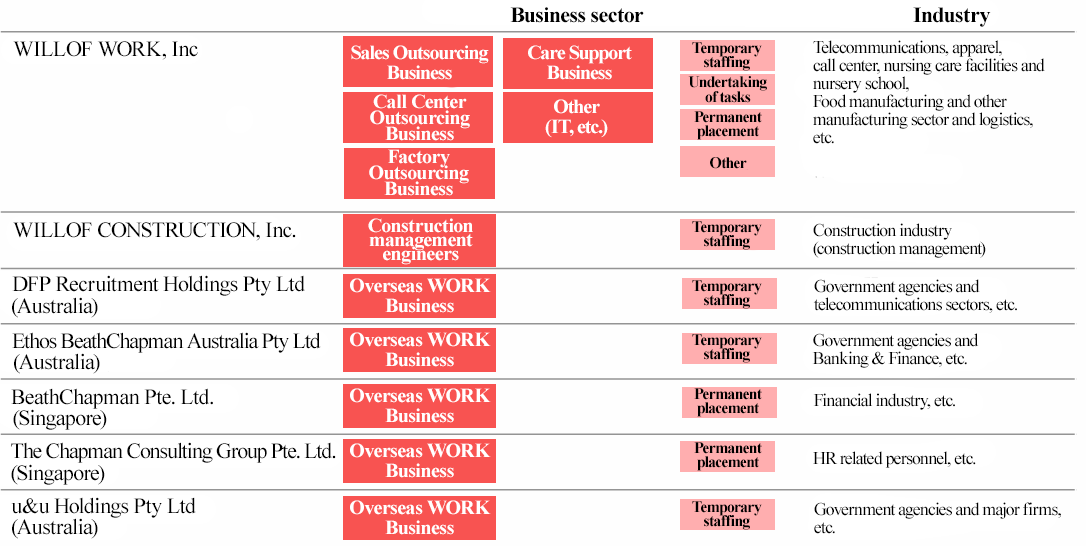
The company dispatches and introduces personnel and undertakes tasks in each of the sales support, call center, factory, nursing care business support, and construction engineer field in Japan.
Overseas Working Business
The company offers HR services, including the dispatch and introduction of personnel, mainly in Australia and Singapore. Regarding the dispatch of personnel, they dispatch workers to mainly governments, municipalities, etc., which are not easily affected by economic swings. Regarding the introduction of personnel, they operate business in a broad range of fields, including finance and information and telecommunications.
Others
Other businesses include the business of supporting DX in the private sector and local governments.
[1-3 Market Share by Category]
| Dispatch of Sales Staff | Dispatch of Operators | Dispatch of Nursing Care Staff | Dispatch of Food and Manufacturing Staff | Dispatch of Construction Management Engineers |
Ranking in the Industry | 2nd place | 1st Place | 3rd Place | 8th Place | 7th Place |
Business Domain | Sales Outsourcing | Call Center Outsourcing | Nursing Care Business Support | Factory Outsourcing | Construction Management Engineers |
Major Competitors (Listed Companies) | Like Co., Ltd. (2462) HITO-Communications Holdings Inc. (4433) | S-Pool Inc. (2471) CRG Holdings Co., Ltd. (7041) | - | UT Group Co., Ltd. (2146) Nisso Holdings Co., Ltd. (9332) | Open Up Group Inc. (2154) COPRO-HOLDINGS Co., Ltd. (7059) Nareru Group Inc. (9163) |
* Prepared by Investment Bridge Co., Ltd. based on disclosed materials.
[1-4 Strengths]
(1) Pursuit of Results | ◆ High operational capabilities based on specialization in specific categories, and a commitment to pursuit of results as a partner that responds to client needs. |
(2) Human resource development capabilities | ◆ Through on-the-job training (OJT) programs, such as the Hybrid Temporary Staffing model (system in which full-time employees are stationed on-site to provide support), the company ensures the early development of inexperienced workers into productive members of the organization. |
(3) Improving Retention Rate | ◆ Among industries with high turnover rates, the company has improved employee retention by enhancing their on-site communication and follow-up system through hybrid temporary staffing and other measure |
Through the hybrid temporary staffing model, which includes on-site managers, the company contributes to both temporary staff and clients by implementing the PDCA cycle to produce good results.
“Hybrid temporary staffing” is a unit-based staffing model in which the company’s full-time employees referred to as “Field Supporters” (FS) are stationed on site to support both client representatives and temporary staff. This system, in which the company’s FS provide on-site support to temporary staff, is particularly well-suited to the placement of foreign nationals (FS are foreign nationals with Japanese university degrees who are full-time employees of the company). Compared to general temporary staffing, hybrid staffing is characterized by: (1) higher commitment to task performance, (2) stronger teamwork, (3) smoother command and order flow, and (4) easier information sharing.
The company boasts the large number of dispatched workers in service: about 20,000 in the Domestic Working business and about 4,000 in the Overseas Working business.
[1-5 Business Model and Revenue Structure]
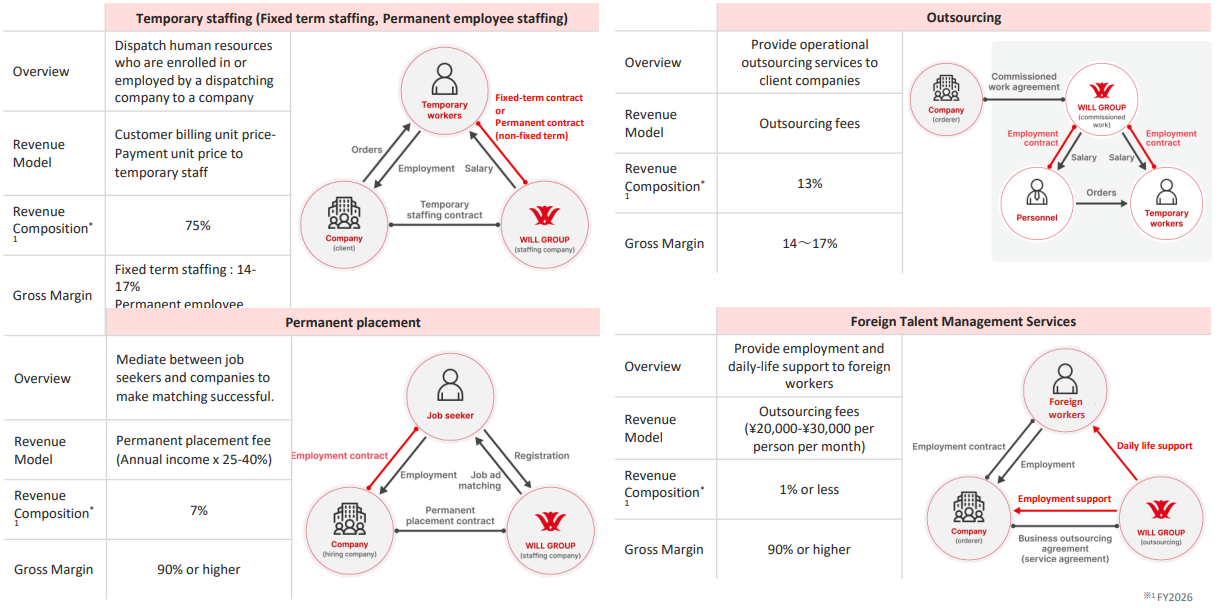
(Reference material of the company)
[1-6 Major group companies]
(Reference material of the company)
[1-7 Business performance]
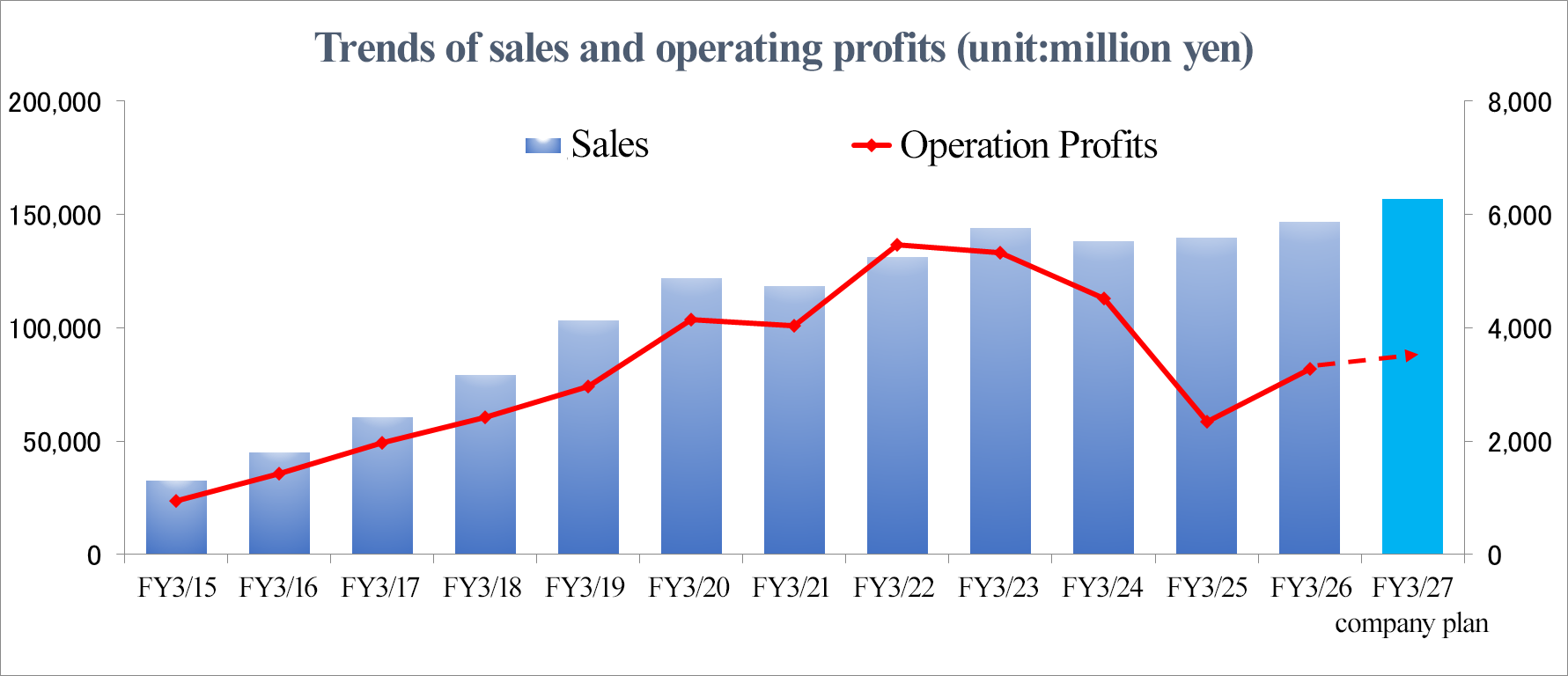
*The Japanese standards had been applied until fiscal year ended March 2018, and IFRS has been applied since fiscal year ended March 2019.
The company was established in Osaka in 1997, started human resources services for the manufacturing industry in 2000, and entered new business domains, including sales, call center operation, overseas business, nursing care, and construction, achieving sustainable growth. By specializing specific categories (occupations), they acquired a top-level share in each category, although they made inroads into each field later than competitors. In 2013, the company went public and was designated to the First Section of the Tokyo Stock Exchange in just one year. Despite the impact of the COVID-19 pandemic, the company's performance has been on an upward trend since its establishment. The decrease in profit in the fiscal year ended March 2025 was significant, because the result in the fiscal year ended March 2024 includes the temporary profit from the gain on sale of shares of subsidiaries.
2. Fiscal Year ended March 2026 Earnings Results
[2-1 Consolidated earnings results (IFRS)]
| FY 3/25 | Ratio to sales | FY 3/26 | Ratio to sales | YoY |
Sales | 139,705 | 100.0% | 146,856 | 100.0% | +5.1% |
Gross Profit | 29,383 | 21.0% | 32,392 | 22.1% | +10.2% |
SG&A | 27,270 | 19.5% | 29,510 | 20.1% | +8.2% |
Operating Income | 2,338 | 1.7% | 3,279 | 2.2% | +40.2% |
Pretax Profit | 2,177 | 1.6% | 3,139 | 2.1% | +44.2% |
Profit Attributable to Owners of Parent | 1,155 | 0.8% | 2,314 | 1.6% | +100.3% |
*Unit: Million yen.
Sales revenue grew 5.1% year on year. Operating income rose 40.2% year on year.
Sales revenue grew 5.1% year on year to 146,856 million yen. Operating income rose 40.2% year on year to 3,279 million yen.
The corporate group worked on the expansion of the construction engineer field and the enhancement of dispatch of full-time employees and support for employment of non-Japanese workers, to achieve the regrowth of the Domestic Working business, which is the basic policy set in the medium-term management plan “WILL-being 2026,” which ended in the fiscal year ended March 2026.
In Japan, stable revenue growth and achievement of profitability in the construction management engineering sector contributed significantly to the company’s performance, and the sales and factory outsourcing sectors, where the company is actively expanding its full-time employee staffing and foreign worker employment support services also performed steadily. For the purpose of improving their capability of recruitment in Japan, they aired TV commercials in 18 prefectures, including those in the Kanto area, which is the largest commercial area for the company, to promote the brand “WILLOF,” and implemented promotional strategies utilizing web commercials and social media. Outside Japan, market conditions remain uncertain due to post-COVID environmental changes and the impact of inflation, but the company implemented cost controls to strengthen its profit structure and achieved a recovery in earnings through productivity improvements.
Revenue reached a record high, the first time since the fiscal year ended March 2023 driven by the steady expansion of the Domestic Working business, particularly in the construction management engineering segment, as well as strong staffing revenue in Singapore and year-on-year growth in recruitment revenue in Australia within the Overseas Working business.
Operating income increased significantly due to a rise in gross profit resulting from the successful restructuring of the business portfolio in the Domestic Working business, as well as increase in gross profit in the Overseas Working business segment driven by reduced selling, general, and administrative expenses and increased revenue from recruitment services. Additionally, the absence of the impairment loss recorded in the same period of the previous fiscal year contributed to the substantial increase in operating income. On the other hand, normalized operating income rose 32.8% year on year (*Normalized operating income: operating income excluding the temporary gain and loss from impairment losses in the "Overseas Working Business," government subsidy income, and gains from the sale of real estate in "Other").
Gross profit margin rose 1.1 point year on year, and gross profit grew 10.2% year on year. In addition, the ratio of SG&A expenses increased 0.6 point year on year to 20.1%. Accordingly, operating income margin rose 0.5 points year on year to 2.2%. EBITDA (operating income + depreciation and amortization) increased 15.0% year on year to 5.63 billion yen.
[2-2 Trend of quarterly results]
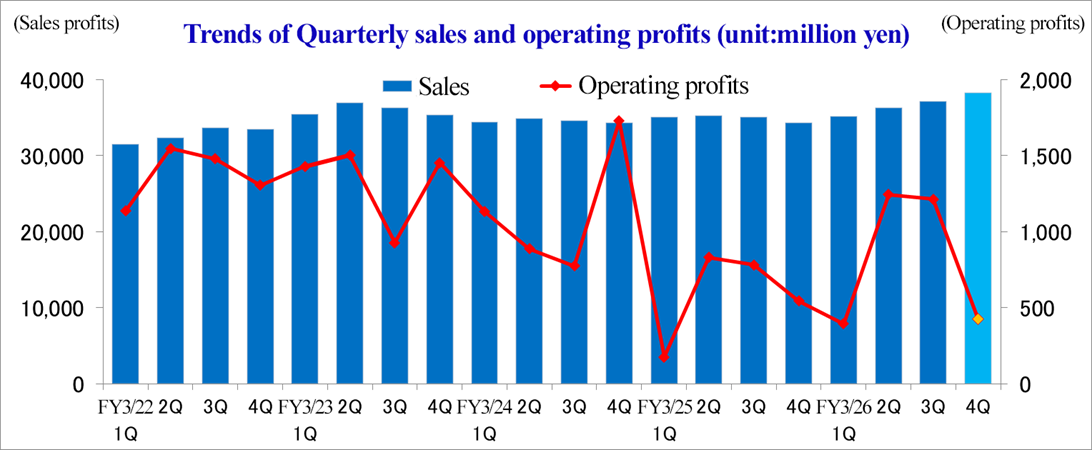
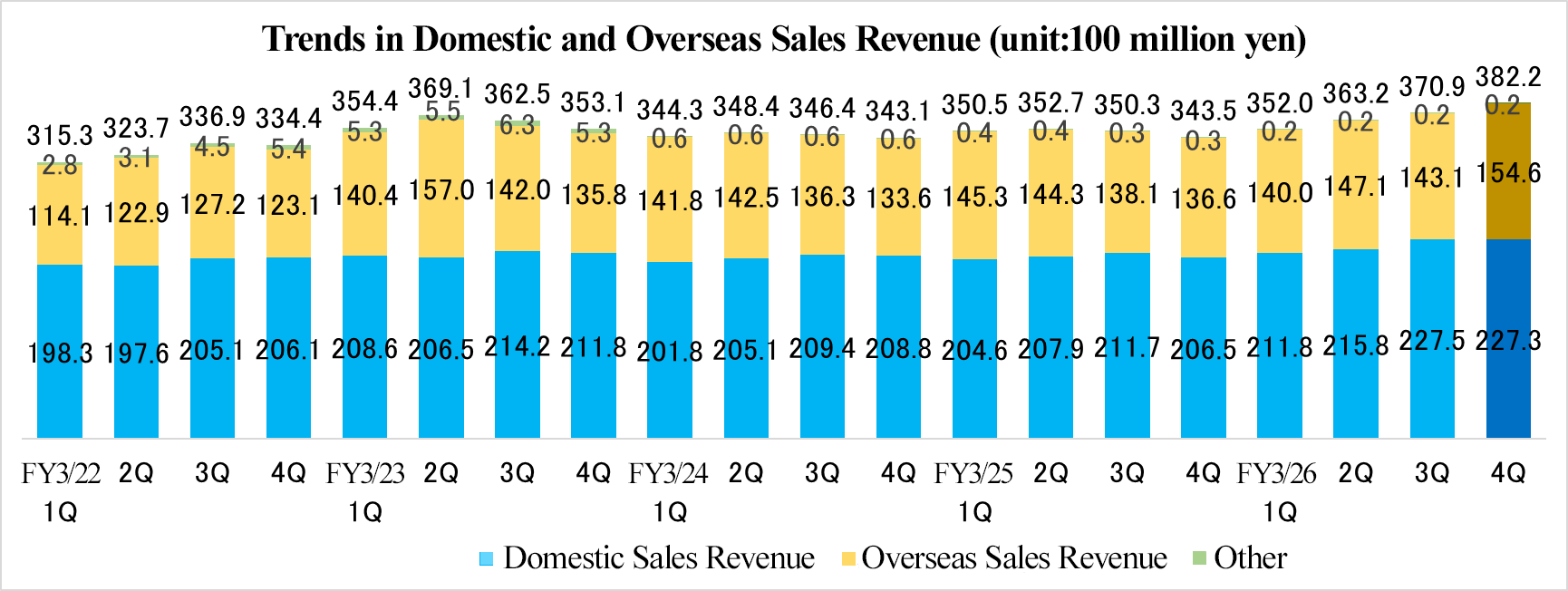
In the fourth quarter (Jan. to Mar.) of the fiscal year ended March 2026, sales grew and profit dropped year on year. In the fourth quarter (Jan. to Mar.), sales revenue increased 3.87 billion yen year on year (of which 150 million yen was due to foreign exchange effects), setting a new record high for quarterly sales. Meanwhile, consolidated operating income in the fourth quarter (Jan. to Mar.) decreased 120 million yen year on year. In the Domestic Working business, in addition to upfront investments made to drive growth in the fiscal year ending March 2027, adjustments increased due to expenses related to changes in the shareholder benefits program. Furthermore, compared to the previous quarter (Oct.–Dec.), revenue increased while profit decreased.
[2-3 Trend by Segment]
| FY 3/25 | Ratio to sales | FY 3/26 | Ratio to sales | YoY |
Domestic Working business | 83,099 | 59.5% | 88,262 | 60.1% | +6.2% |
Overseas Working business | 56,448 | 40.4% | 58,501 | 39.8% | +3.6% |
Other | 157 | 0.1% | 92 | 0.1% | -41.2% |
Revenue | 139,705 | 100.0% | 146,856 | 100.0% | +5.1% |
Domestic Working business | 3,251 | 72.9% | 3,579 | 62.8% | +10.1% |
Overseas Working business | 1,432 | 32.1% | 2,427 | 42.6% | +69.4% |
Others | -223 | -5.0% | -306 | -5.4% | - |
Adjustments | -2,121 | - | -2,420 | - | - |
Operating Profit | 2,338 | - | 3,279 | - | +40.2% |
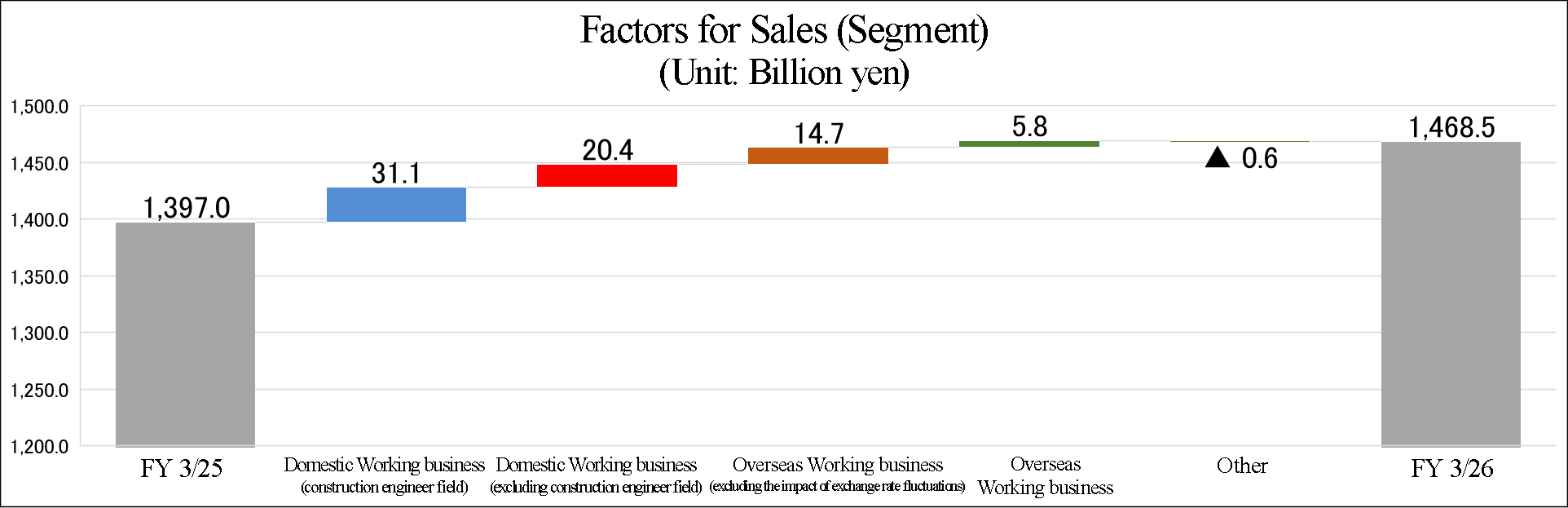
*Created by Investment Bridge Co., Ltd. with reference to disclosed material.
The factors in increasing/decreasing sales in the Domestic Working business (excluding the construction engineer field) are as follows: +1.34 billion yen in the sales outsourcing field, +470 million yen in the IT engineer field, +470 million yen in the field of nursing-care business support, +290 million yen in the factory segment, -1.52 billion yen in the call center field, and +970 million yen in the other Domestic Working field. The factors in increasing/decreasing sales in the Overseas Working business (excluding the impact of exchange rate fluctuations) are as follows: +1.18 billion yen in the worker dispatch field and +270 million yen in the personnel introduction field.
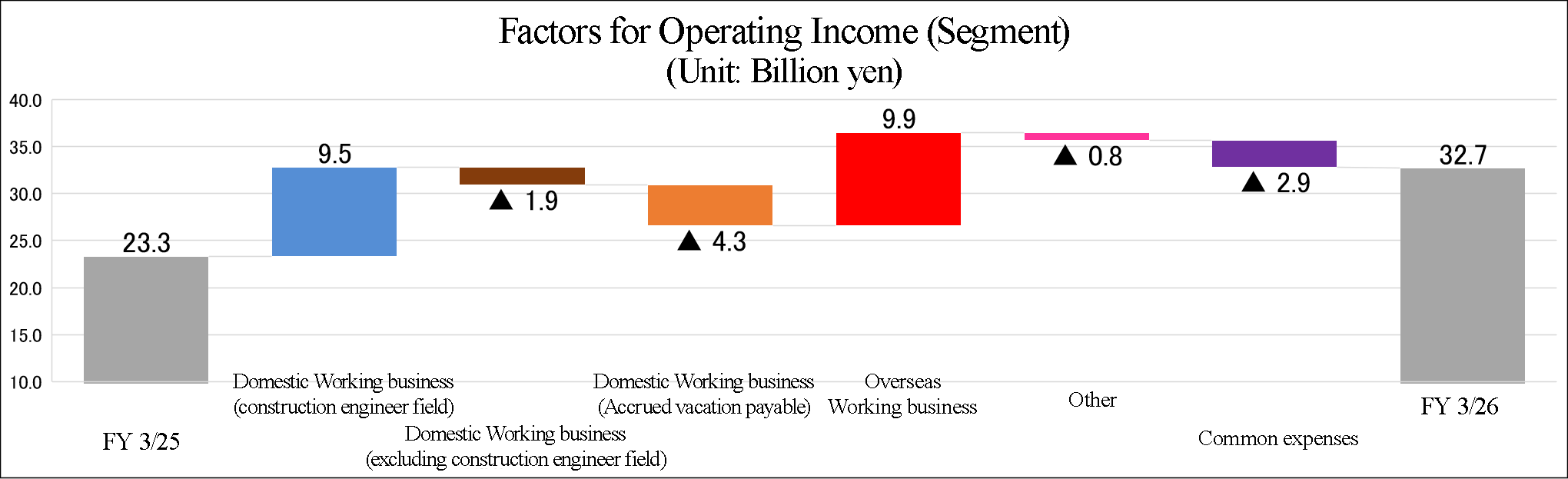
*Created by Investment Bridge Co., Ltd. with reference to disclosed material.
The factors in increasing/decreasing operation income in the Domestic Working business (excluding the construction engineer field) are as follows: +90 million yen in the factory segment, +50 million yen in the sales outsourcing field, +20 million yen in the IT engineer field, -0 million yen in the field of nursing-care business support, -120 million yen in the call center field, and -220 million yen in the other Domestic Working field. The factors in increasing/decreasing operation income in the Overseas Working business are as follows: an impairment loss recognized in the previous fiscal year (+470 million yen), an increase in gross profit (+390 million yen), a decrease in selling, general, and administrative expenses (+300 million yen), the impact of foreign exchange rates (+30 million yen), and a decrease in subsidy revenue (-210 million yen). The increase in common expenses was primarily due to higher head office expenses.
Domestic Working business
Sales revenue increased 6.2% year on year to 88,262 million yen, while segment profit increased 10.1% year on year to 3,579 million yen.
Domestic Working business, which dispatches and introduces personnel and undertakes tasks in each of the sales support, call center, factory, nursing care business support, construction engineer field in Japan, achieved increased revenue due to steady performance in the construction management engineering, sales outsourcing, and factory outsourcing sectors, as well as an increase in recruitment revenue resulting from the inclusion of HR CAREER Inc. in the scope of consolidation.
In terms of profits, the increase was driven by the construction management engineering sector entering a phase of profit growth, as well as an expansion in gross profit resulting from a focus on dispatching full-time employees across multiple sectors and supporting the employment of foreign nationals. Additionally, the increase in profits was due to the expansion of gross profit driven by steady growth in key performance indicators particularly the “number of active full-time employees on dispatched assignments” and the “number of foreign nationals supported in employment,” as well as higher unit prices resulting from continuous price negotiations in the construction management engineering sector.
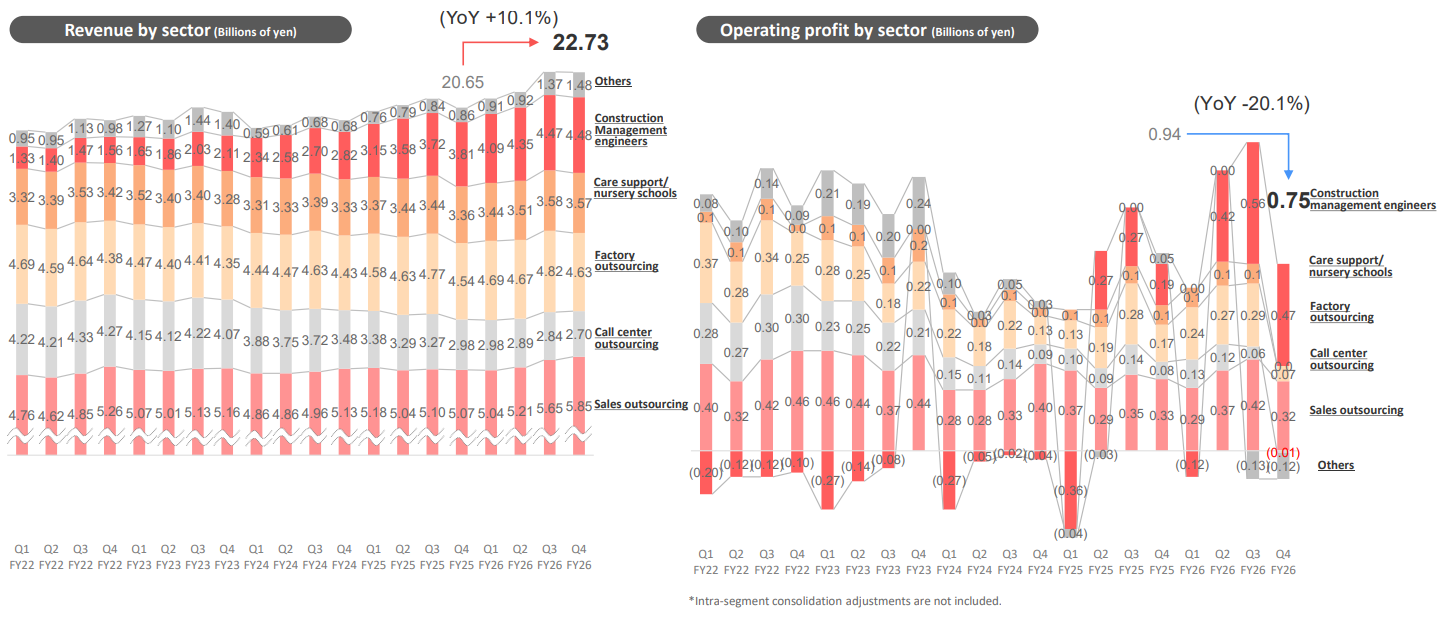
(Reference material of the company)
Revenue in each domain remained at a record high on a quarterly basis. In particular, the construction management engineer and sales outsourcing segments performed strongly. Operating income in each domain decreased 190 million yen from the fourth quarter of the fiscal year ended March 2025, primarily due to the implementation of promotional initiatives centered on taxi advertising, as well as the upfront recognition of expenses aimed at driving growth in the fiscal year ending March 2027. The construction management engineers segment has entered a phase of profit growth, recording a significant increase in operating income of 138.2% from the fourth quarter of the fiscal year ended March 2025.
Overseas Working business
Sales revenue grew 3.6% year on year to 58,501 million yen, and the profit in this segment grew 69.4% year on year to 2,427 million yen.
In the Overseas Working business, which operates primarily in Australia and Singapore, sales increased despite the market environment remaining unfavorable. This was driven by both temporary staffing and recruitment agency sales exceeding those in the same period of the previous year on a local currency basis, as well as positive foreign exchange effects (approximately 582 million yen).
In terms of profits, significant profit growth was achieved due to an increase in gross profit resulting from reduced selling, general, and administrative expenses and higher recruitment agency sales, as well as the absence of the impairment loss (473 million yen) recorded in the same period of the previous year.
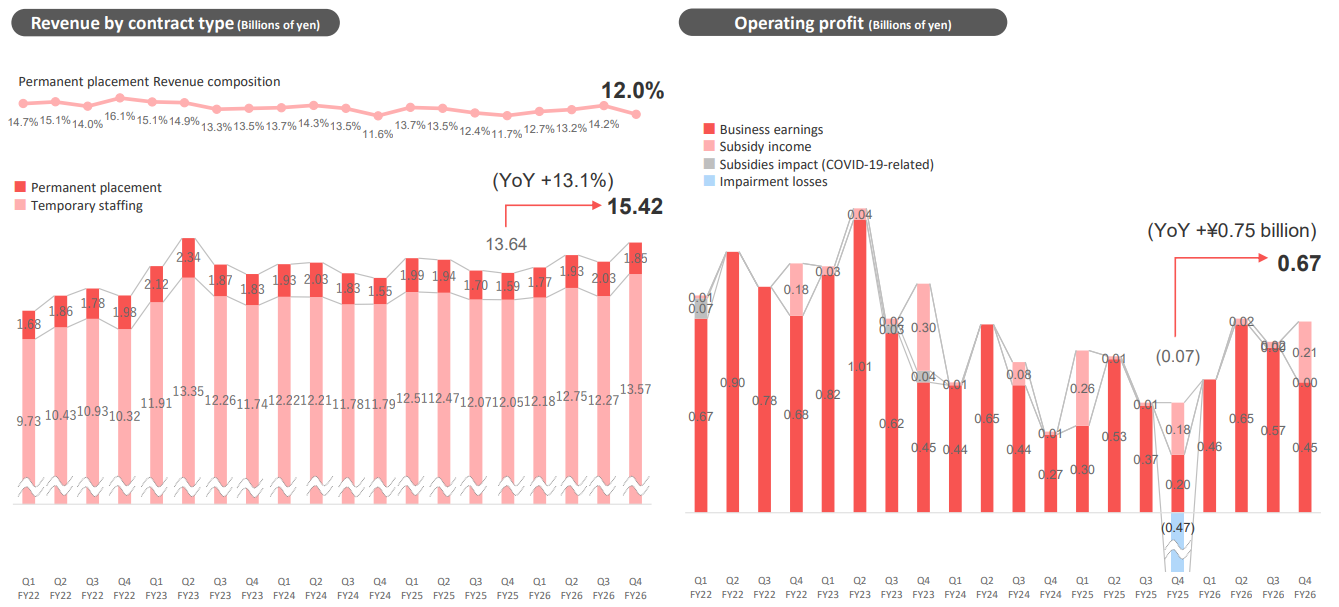
(Reference material of the company)
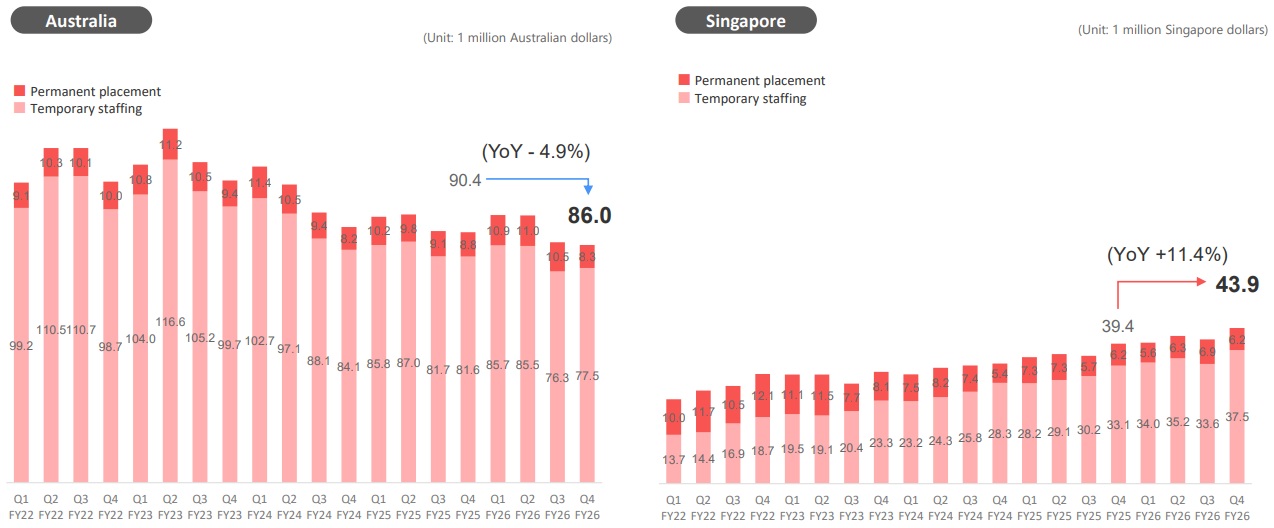
Leveraging its existing customer base and expertise, the company strengthened its temporary staffing services, expanded business in key sectors, and improved productivity.
(Reference material of the company)
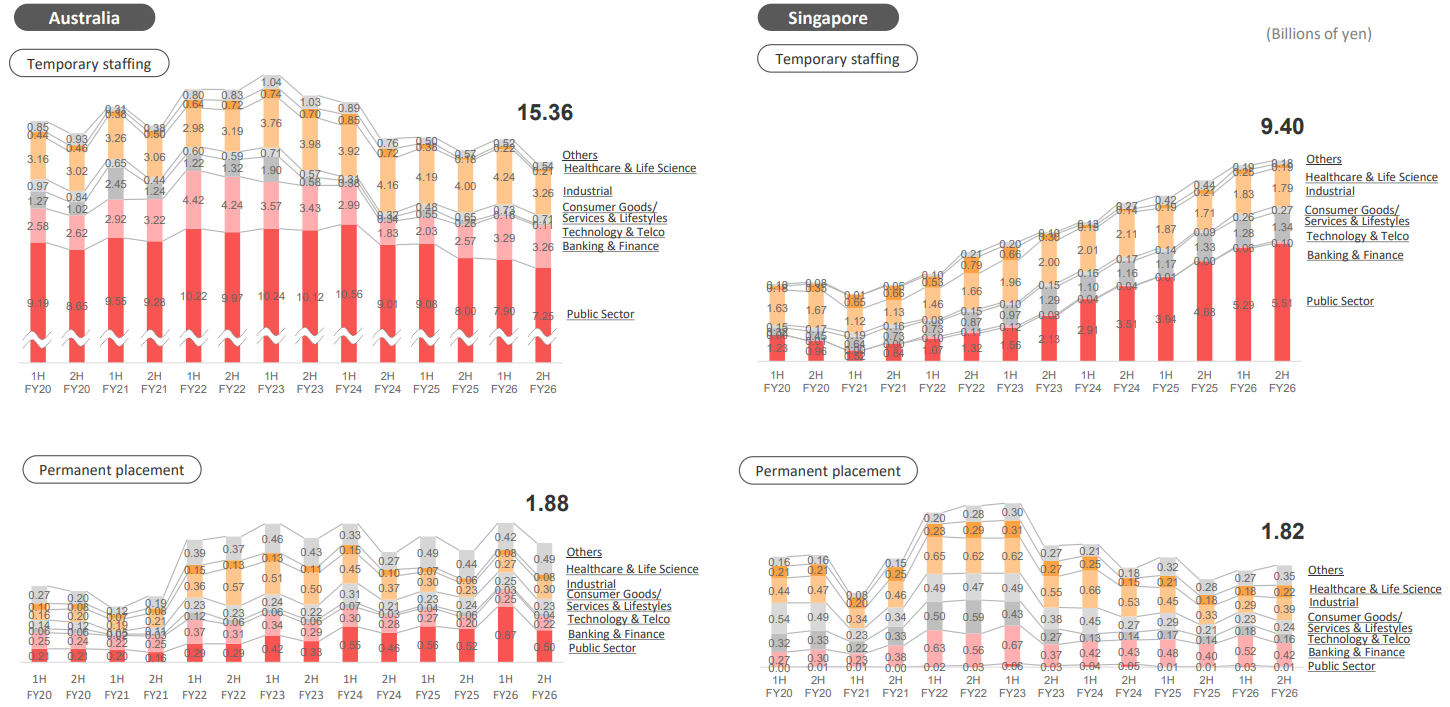
On a local currency basis, sales in Australia declined 4.0 million Australian dollars in temporary staffing and 0.4 million Australian dollars in recruitment services from the fourth quarter of the fiscal year ended March 2025. Sales in Singapore increased 4.3 million Singaporean dollars in temporary staffing and remained unchanged in recruitment services from the fourth quarter of the fiscal year ended March 2025.
(Reference material of the company)
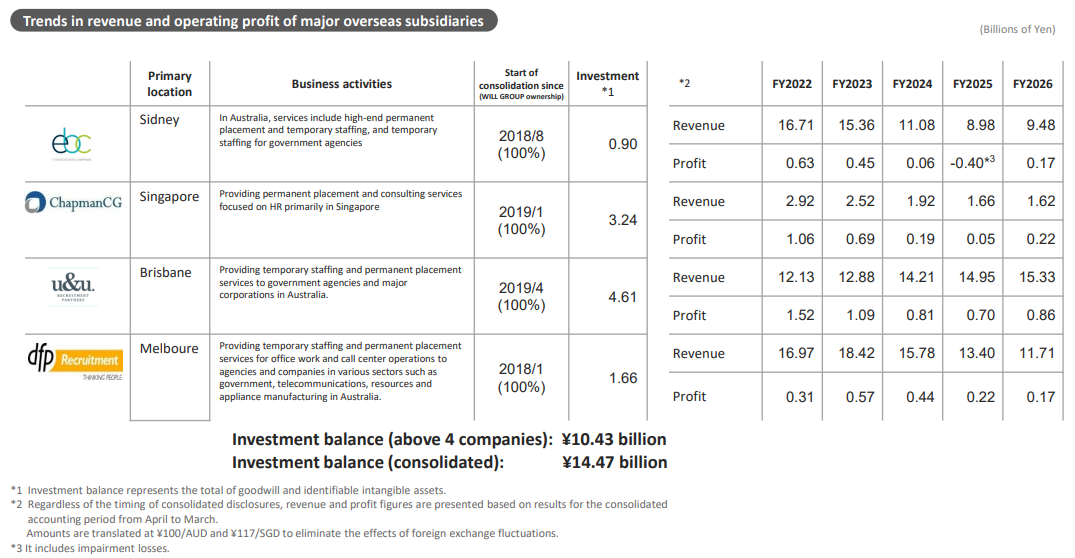
Despite the continuing challenging market conditions, the results of the impairment test indicate that it is unnecessary to post impairment loss.
(Reference material of the company)
Other
Sales revenue decreased 41.2% year on year to 92 million yen, while a segment loss of 306 million yen was posted (a loss of 223 million yen was posted in the previous fiscal year).
The sales in other businesses decreased mainly due to the transfer of “ENPORT mobile,” a mobile communications business for non-Japanese people, in fiscal year ended March 2025.
[2-4 Progress toward forecast KPIs]
Priority strategy | KPI | Evaluation | |||||
KPI | FY3/26 Plan | FY3/26 Result | Ratio to the forecast | ||||
Domestic Working | Strategy I | Further growth and monetization of the construction engineer field | Number of recruits per year | 1,500 | 1,672 | 111.5% | 〇 |
Retention rate | 71.5% | 70.8% | -0.7pt | △ | |||
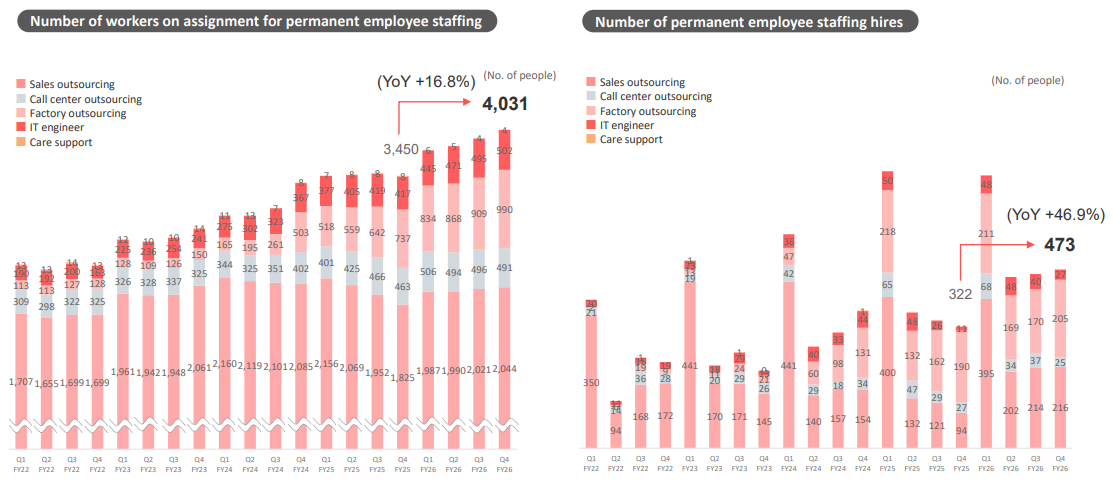
Strategy II | Regrowth of the Domestic Working business (excluding the construction engineer field) | Number of newly dispatched full-time employees | 3,500 | 4,031 (up 581from the end of the previous fiscal year) | 115.2% | 〇 | |
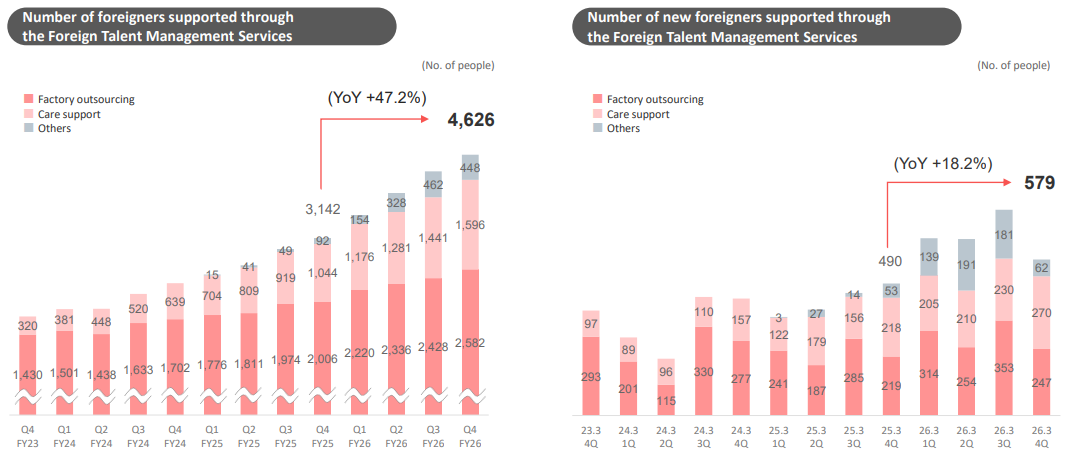
Increase in the number of non-Japanese employees for which the company supports employment | 3,500 | 4,626 (up 1,484 from the end of the previous fiscal year) | 132.2% | ◎ | |||
In the construction management engineering sector, annual hiring targets were met as a result of efforts to expand the talent pool, strengthen collaboration with external recruitment agencies, and build a foundation for hiring foreign nationals. Although employee retention rate fell short of the target, measures such as a review of the HR system and improvements in compensation and benefits proved effective, leading to a 2.4-point increase compared to the fiscal year ended March 2025. The number of full-time employees on assignment outside the construction management engineers segment increased, primarily in the Factory Outsourcing and Sales Outsourcing segments, and achieved the full-year target. In addition, the IT Engineers segment also achieved high growth. The number of foreign nationals supported in employment expanded steadily across all segments, driven by the cumulative increase in new hires, and significantly exceeded the full-year target.
◎ Strategy I (Domestic Working business): Further growth and monetization of the construction engineer field (Progress of the construction engineer field (1))
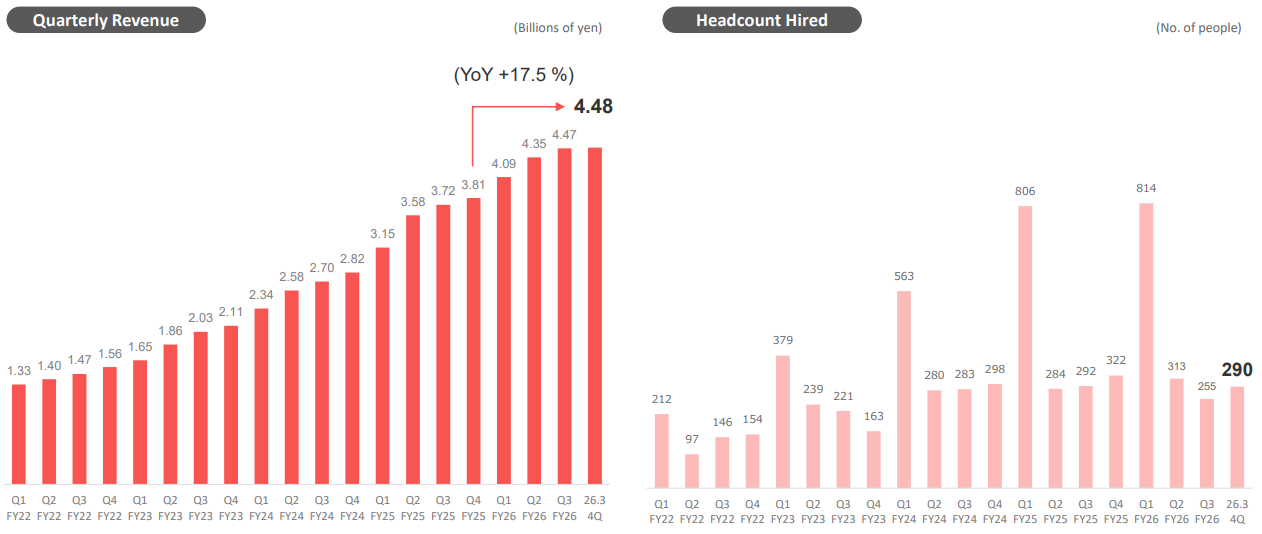
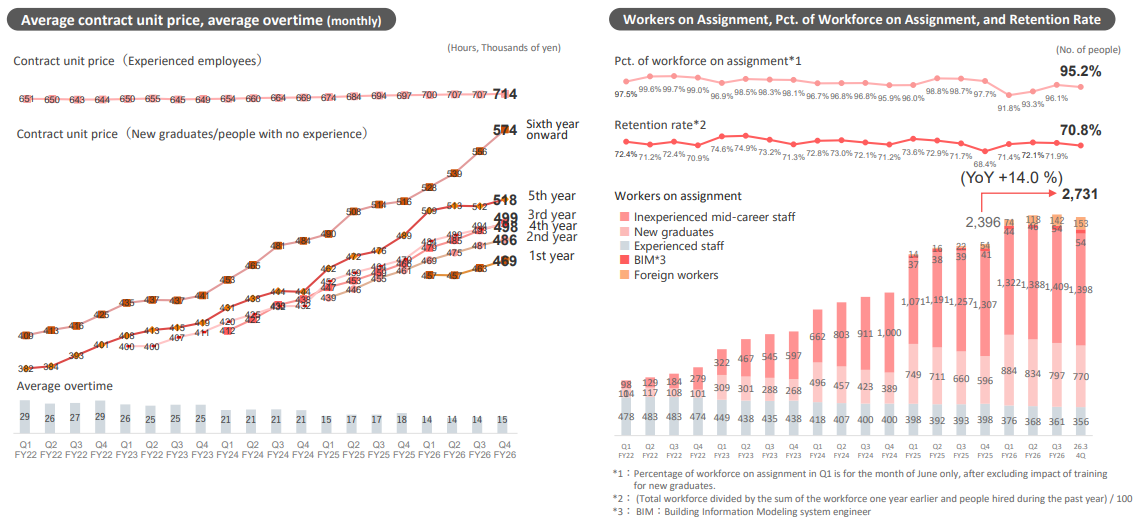
Sales increased 17.5% from the fourth quarter of fiscal year ended March 2025, thanks to the growth in the number of active employees and an increase in average contract rates. As a result of efforts to expand the talent pool, strengthened collaboration with external recruitment agencies, and the development of a recruitment framework for foreign nationals, the total number of hires for the fiscal year reached 1,672, exceeding the target of 1,500 (in the first quarter, the hiring of 418 new graduates is included [453 new graduates in the previous fiscal year]).
(Reference material of the company)
◎ Strategy I (Domestic Working business): Further growth and monetization of the construction engineer field (Progress of the construction engineer field (2))
The average contract rate for new graduates and mid-career individuals with no prior experience remained approximately 5% higher year on year, supported by continued efforts in negotiating rates with clients. Employee retention rate improved 2.4 percentage points from the fourth quarter of the fiscal year ended March 2025, reflecting the success of measures such as a review of human resources policies and improvements in compensation and benefits. Moving forward, the company will work to reduce employee turnover during waiting periods and increase the number of active employees by improving the accuracy of placement decisions, conducting continuous follow-up interviews, and expanding the number of orders acquired through a strengthened sales structure.
(Reference material of the company)
◎ Strategy II: Regrowth of Domestic Working business (other than the construction engineer field) (Progress of the dispatch of full-time employees)
The number of full-time temporary staff in active assignments increased 581 from the fourth quarter of the fiscal year ended March 2025. The factory outsourcing and sales outsourcing sectors drove this increase, and the IT engineering sector also achieved strong growth. Despite a challenging hiring environment, the number of full-time temporary staff recruitments steadily increased, primarily in the sales outsourcing segment, resulting in a net increase of 151 employees from the fourth quarter of the fiscal year ended March 25 (including 318 new graduates hired in the first quarter of the fiscal year ended March 2026; 249 in sales, 28 in call centers, 25 in factory operations, and 16 in IT).
(Reference material of the company)
◎ Strategy II: Regrowth of Domestic Working business (other than the construction engineer field) (Progress of the support for employment of non-Japanese workers)
The number of non-Japanese workers supported expanded steadily across all sectors, driven by a significant increase in new hires resulting from strengthened order acquisition capabilities and improved staffing efficiency utilizing recruitment expertise, achieving a substantial increase of 1,484 people from the fourth quarter of fiscal year ended March 2025. To further expand the scale of operations, the company will focus on acquiring new clients in the industrial product manufacturing sector within the factory outsourcing segment; expand its order intake base by deepening relationships with existing clients and acquiring new customers in the nursing care business support segment; and promote expansion into new markets in other segments.
(Reference material of the company)
◎ Key Management Indicators
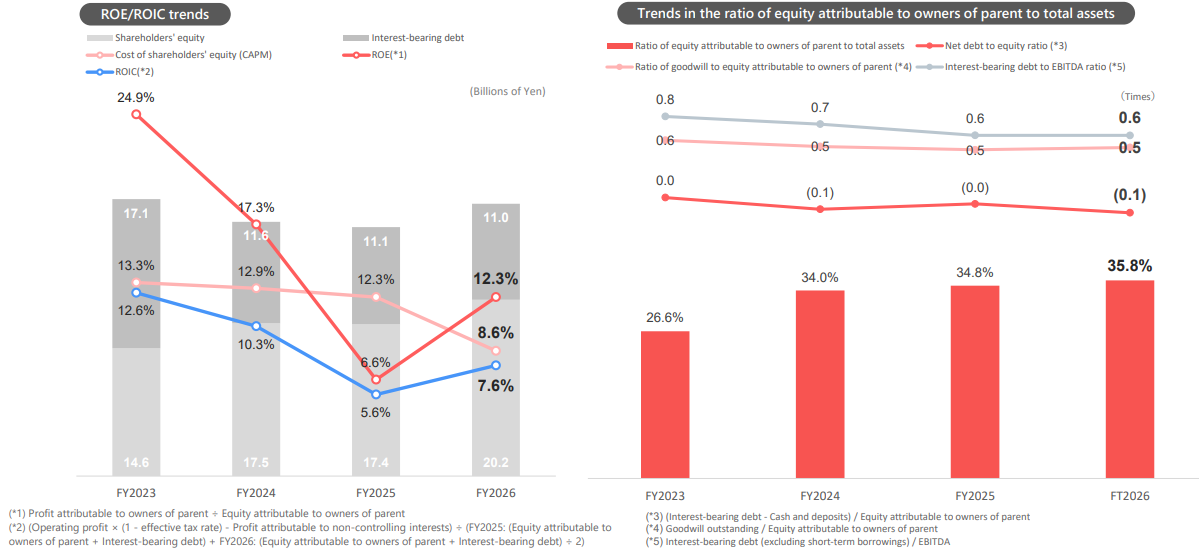
Capital efficiency (ROE and ROIC) has started to improve against the backdrop of progress in revenue structure reforms, marking a transition into a recovery phase. The ratio of equity attributable to owners of the parent company remained stable at 35.8%. Other financial indicators also show no concerns regarding financial stability.
(Reference material of the company)
[2-5 Financial Position and Cash Flow]
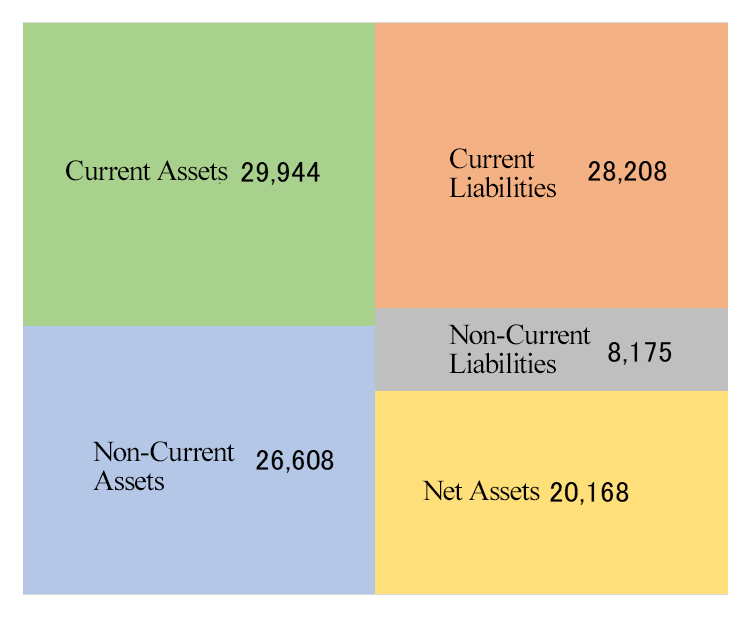
◎ Balance Sheet
| Mar. 2025 | Mar. 2026 |
| Mar. 2025 | Mar. 2026 | |
Current Assets | 26,551 | 29,944 | Current liabilities | 25,208 | 28,208 | |
Cash | 6,936 | 7,974 | Operating debts, other debts | 16,956 | 20,101 | |
Receivables, other receivables | 18,136 | 20,305 | Other current liabilities | 2,297 | 2,390 | |
Non-Current Assets | 23,371 | 26,608 | Non-current liabilities | 7,354 | 8,175 | |
Tangible fixed assets | 1,109 | 1,405 | Other financial debts | 3,636 | 3,873 | |
Right-of-use assets | 4,391 | 4,897 | Total liabilities | 32,563 | 36,384 | |
Goodwill | 8,166 | 9,856 | Total equity | 17,359 | 20,168 | |
Other Intangible Assets | 5,605 | 6,381 | Equity attributable to owners of the parent augmented | 17,392 | 20,240 | |
Other Financial Assets | 2,160 | 1,690 | Total liabilities and equity | 49,923 | 56,552 | |
Total assets | 49,923 | 56,552 | Borrowings | 6,605 | 5,980 | |
*Unit: Million yen | ||||||
*Created by Investment Bridge Co., Ltd. with reference to disclosed material.
Total assets as of the end of March 2026 stood at 56,552 million yen, up 6,629 million yen from the end of the previous fiscal year. On the asset side, current assets amounted to 29,944 million yen, up 3,393 million yen from the end of the previous fiscal year. This was primarily due to increases of 2,168 million yen in trade and other receivables and 1,038 million yen in cash and deposits. Non-current assets totaled 26,608 million yen, up 3,236 million yen from the end of the previous fiscal year. This was primarily due to an increase of 1,690 million yen in goodwill, 775 million yen in other intangible assets, and 505 million yen in right-of-use assets driven by new consolidations and foreign currency translation effects offset by a decrease of 469 million yen in other financial assets.
On the liabilities and equity side, current liabilities totaled 28,208 million yen, up 3,000 million yen from the end of the previous fiscal year. This was primarily due to a 647 million yen decrease in borrowings, offset by increases of 3,144 million yen in trade and other payables and 386 million yen in income taxes payable, respectively. Total equity amounted to 20,168 million yen, up 2,808 million yen from the end of the previous fiscal year. This was primarily due to an increases of 1,956 million yen in foreign currency translation adjustments for overseas operations and 1,316 million yen in retained earnings offset by a decrease of 390 million yen in other equity instruments. As a result, the ratio of equity attributable to owners of the parent was 35.8% (34.8% at the end of the previous fiscal year).
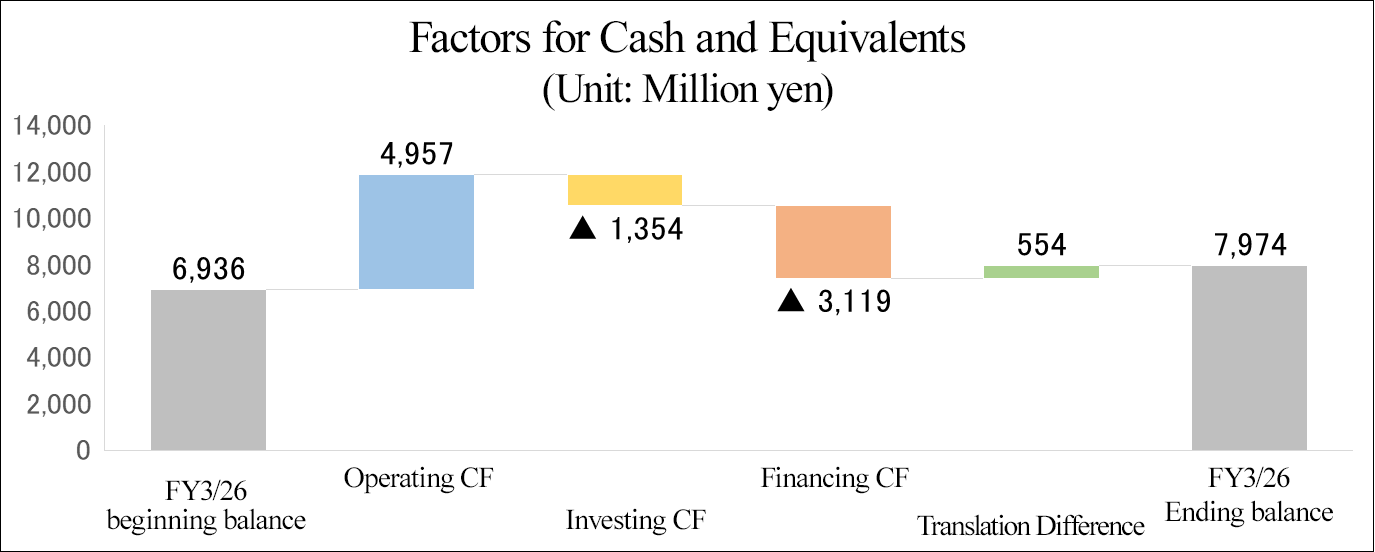
◎ Cash Flow
| FY 3/25 | FY 3/26 | YoY | |
Operating cash flow | 1,806 | 4,957 | 3,151 | +174.5% |
Investing cash flow | -695 | -1,354 | -659 | - |
Free cash flow | 1,111 | 3,603 | 2,492 | +224.3% |
Financing cash flow | -1,233 | -3,119 | -1,886 | - |
Cash, equivalents at term-end | 6,936 | 7,974 | 1,038 | +15.0% |
*Unit: Million yen
*Created by Investment Bridge Co., Ltd. with reference to disclosed material.
In terms of cash flows, operating cash flow improved due to factors such as an increase in profit before taxes, an increase in trade payables, and a decrease in corporate income tax payments. Although investing cash flow worsened due to factors such as increased expenditures related to the acquisition of subsidiary shares resulting from changes in the scope of consolidation, free cash flow also improved. Additionally, financing cash flow worsened due to factors such as a decrease in short-term borrowings. As a result, the year-end cash position increased 15.0% compared to the previous fiscal year.
[2-6 Topics for the Fiscal Year Ended March 2026]
◎ Acquisition of Shares in HR CAREER, Inc., and Conversion into a Consolidated Subsidiary
On October 1, 2025, the company acquired shares in HR CAREER, Inc., a firm that specializes in recruitment services for the healthcare and welfare industries, making it a consolidated subsidiary. The company aims to enhance the competitiveness of its recruitment business while accelerating the “maximization” and “optimization” of career paths expanding from temporary staffing to permanent placement and from production and administrative roles to specialized professions with the goal of increasing corporate value of the entire group.
◎ Issuance of Paid Stock Options
The company will issue Paid Stock Options, a form of self-investment subject to future performance with the aim of further strengthening employee unity and motivation to contribute to the company’s medium/long-term business growth and enhancement of corporate value. The exercise condition is that consolidated operating income must exceed 5.5 billion yen in any one of the fiscal years ending March 2029 or March 2031.
◎ Collaboration with the Nezu Engagement Fund
After receiving a proposal for collaboration from the Nezu Engagement Fund through the acquisition of company’s shares, the company will transfer a portion of 232,000 shares (approximately 1% of the total number of outstanding shares) held by Mr. Ikeda, the chairperson of the company. The company's plan is to enhance its corporate value over the medium/long term through corporate actions, such as a review of its equity story and strategic review, a review of shareholder benefits and the introduction of a stock-based compensation system, and collaborative engagement, such as improvement of IR activities.
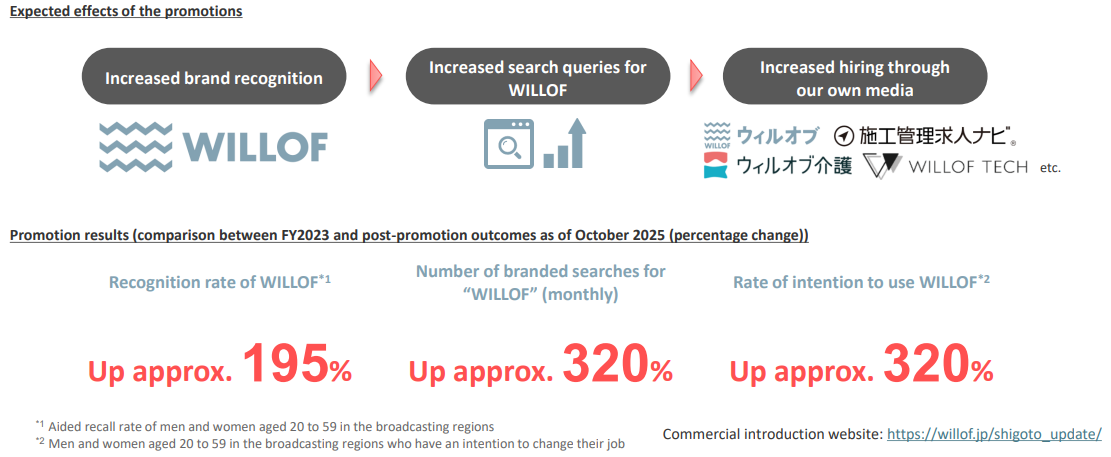
◎ Implementation of Brand Promotion
Since July 2023, the company has been continuously conducting brand promotions featuring celebrities to raise awareness of the “WILLOF” brand. During the fiscal year ended March 2026, the company distributed terrestrial TV commercials and online advertisements on platforms such as YouTube in June and October. Compared to the fiscal year ended March 2023, prior to the launch of promotion, there has been a significant increase in brand awareness, branded search volume, and intentions to use the brand.
(Reference material of the company)
3. Fiscal Year ending March 2027 Earnings Estimates
[3-1 Consolidated Earnings Estimate]
| FY 3/26 | Ratio to sales | FY 3/27 (Est.) | Ratio to sales | YoY |
Sales | 146,856 | 100.0% | 157,000 | 100.0% | +6.9% |
Gross Profit | 32,392 | 22.1% | 37,200 | 23.7% | +14.8% |
Operating Income | 3,279 | 2.2% | 3,400 | 2.2% | +3.7% |
Pretax Profit | 3,139 | 2.1% | 3,191 | 2.0% | +1.6% |
Profit attributable to owners of parent | 2,314 | 1.6% | 2,208 | 1.4% | -4.6% |
*Unit: Million yen
Sales increased 6.9% year on year, and operating income increased 3.7% year on year.
For FY 3/2027, sales revenue is expected to grow 6.9% year on year to 157 billion yen and operating income is forecast to rise 3.7% year on year to 3.4 billion yen.
In the Domestic Working business, they will further expand the business of dispatch of full-time employees, the business of undertaking tasks, and support for employment of non-Japanese people, which grew considerably in the period of the previous medium-term plan, as a strategic theme of the new medium-term plan, and for the purpose of establishing a new revenue base, they will concentrate on the introduction of talent, and optimize the business portfolio for improving profitability. In the Overseas Working business, they will strive to reinforce the revenue base focused on productivity that will not be easily affected by the external environment, while considering changes in the global situation and fluctuations in exchange rates.
A growth of sales revenue is expected to be seen in the dispatch of full-time employees, undertaking of tasks, support for employment of non-Japanese workers, and introduction of talent in the Domestic Working business, and the dispatch and introduction of workers in the Overseas Working business.
Operating income is forecast to rise 3.7% year on year as an increase in gross profit is expected thanks to the reform of the revenue structure in the Domestic Working business, but the revenue from governmental subsidies in the Overseas Working business has not been taken into account in the forecast like before. Normalized operating income, which excludes temporary profit/loss (income from governmental subsidies in the “Overseas Working business” segment), is projected to rise 13.1%. Gross profit margin is forecast to rise 1.6 points year on year to 23.7%, and operating income margin is forecast to be unchanged from the previous period at 2.2%. EBITDA (operating income + depreciation and amortization + impairment losses) is forecast to increase 14.4% year on year to 6.44 billion yen.
The company plans to pay a dividend of 44 yen/share like in the previous fiscal year. The expected payout ratio is 45.7%.
[3-2 Estimate in Each Segment]
[Revenue]
| FY 3/26 Result | FY 3/27 Company Plan | YoY (Increase/ Decrease) | YoY (Increase/ Decrease Ratio) |
Domestic Working Business | 882.6 | 938.5 | +55.9 | +6.3% |
Overseas Working Business | 585.0 | 629.4 | +44.4 | +7.6% |
Other | 0.9 | 1.9 | +1.0 | +112.2% |
Revenue | 1,468.5 | 1,570.0 | +101.4 | +6.9% |
*Unit: 100 million yen.
[Operating Profit]
| FY 3/26 Result | FY 3/27 Company Plan | YoY (Increase/ Decrease) | YoY (Increase/ Decrease Ratio) |
Domestic Working Business | 35.7 | 42.9 | +7.1 | +19.9% |
Overseas Working Business | 24.2 | 21.8 | -2.4 | -10.2% |
Other | -3.0 | -4.1 | -1.1 | - |
Adjustments | -24.2 | -26.6 | -2.4 | - |
Operating profit | 32.7 | 34.0 | +1.2 | +3.7% |
*Unit: 100 million yen.
Domestic Working business
Sales revenue is expected to grow 6.3%, as the businesses of dispatch of full-time employees/undertaking of tasks, support for employment of non-Japanese people, and introduction of talent are forecast to grow. Profit is expected to grow 19.9%, thanks to the growth of gross profit due to the progress of reform of the revenue structure.
Overseas Working business
Sales revenue is expected to grow 7.6%, as the sales from the dispatch and introduction of workers are forecast to increase in local currency, and the yen weakened year on year. Profit is projected to drop 10.2%, when governmental subsidies (270 million yen in FY 3/2026) are not taken into account. Normalized segment profit is forecast to grow 1.2% year on year.
For fiscal year ending March 2027, it is assumed that 1 Australian dollar = 105 yen (100 yen in fiscal year ended March 2026) and 1 Singaporean dollar = 121 yen (117 yen in fiscal year ended March 2026). Regarding foreign exchange sensitivity per year, a 1-yen appreciation/depreciation of the yen with respect to the Australian dollar would change sales revenue by 360 million yen and profit by 10 million yen, while that with respect to the Singaporean dollar would change sales revenue by 160 million yen and profit by 10 million yen.
[3-3 Shareholder Return]
[Dividend Forecast]
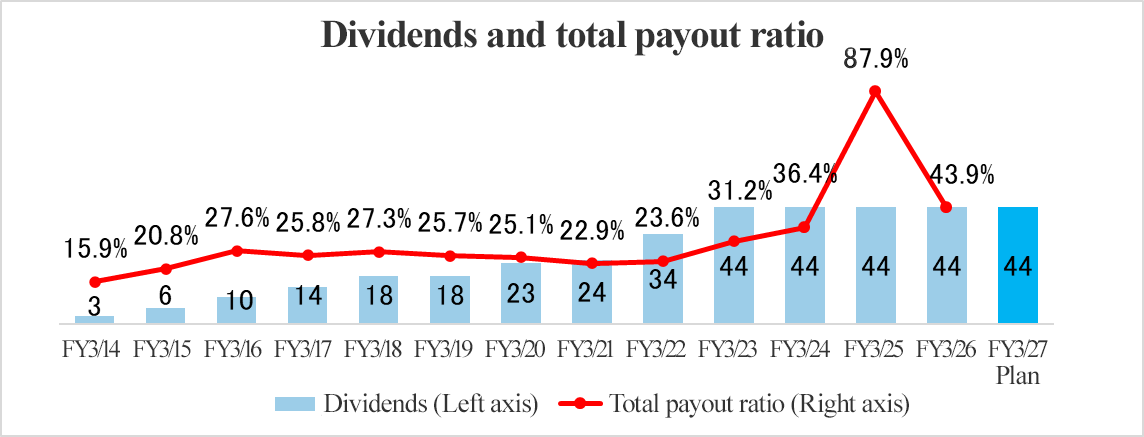
As the shareholder return policy set in the medium-term management plan (fiscal year ending March 2027 to fiscal year ending March 2029), they will maintain or increase the dividend amount from the previous fiscal year (in principle, they will not decrease the dividend amount, but maintain or increase the dividend amount) and discuss the acquisition of treasury shares in a flexible manner according to the progress of business, while aiming to achieve a total payout ratio of 30% or higher.
The dividend for fiscal year ending March 2027 is expected to be unchanged from the previous fiscal year (44 yen/share), in accordance with the shareholder return policy.
[Shareholder Benefits]
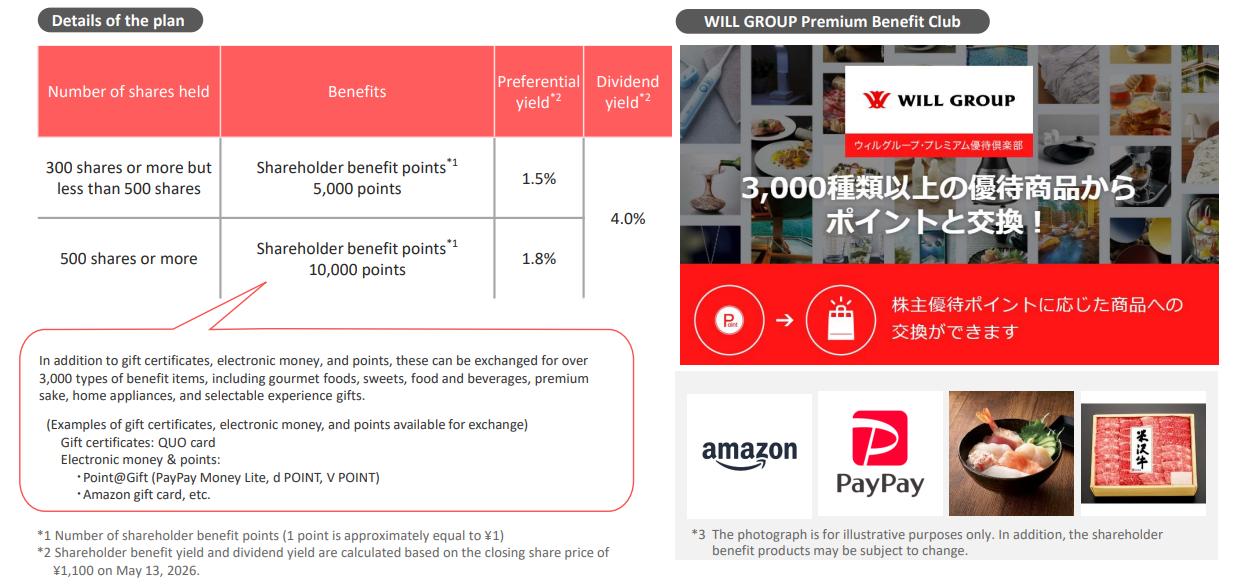
In November 2025, they announced the revision to the shareholder benefit system for the purpose of making the investment in shares in the company more attractive.
In the new system, they present shareholder benefit points that can be exchanged with cash vouchers, electronic money, other points, etc. through “WILL GROUP Premium Shareholder Benefit Club.”
(Reference material of the company)
4. Key Strategies of the New Medium-term Management Plan "WILL-being 2029"
On May 14, 2026, the company announced its new medium-term management plan, "WILL-being 2029," covering the period until the fiscal year ending March 2029.
Under the new plan, the corporate group will continue to prioritize the essential domain*, such as construction and nursing care, where it has built and expanded its business so far. The essential domain is characterized by significant labor supply-demand gaps and a relatively low risk of replacement by AI and robots. In the Domestic Working business, the company will continue to position the essential domain as its primary business arena while expanding its business of human resources, including full-time employee and non-Japanese workers. In the Overseas Working business, it will strengthen its earning capacity by placing greater emphasis on productivity. At the same time, the company will strengthen its earning capacity in countries where it already operates business, and seek opportunities in new countries and business fields to drive medium/long-term growth.
*Essential domain: Domain that is indispensable to maintaining society and is less susceptible to replacement by AI or automation. The term includes sectors generally regarded as essential worker fields.
[Management Targets]
The new medium-term management plan targets a normalized consolidated operating income of 4.7 billion yen, excluding one-off gains and losses, in FY 3/2029. As normalized consolidated operating income was 3.0 billion yen in FY 3/2026, the target CAGR is 16.1%.
The Domestic Working business will serve as the primary driver of profit growth, while the Overseas Working business will focus on generating stable earnings that are less dependent on market conditions. The plan provides further growth potential beyond its existing businesses through new business development, M&A, and other initiatives.
Rather than pursuing revenue growth alone, the company will prioritize reforming its earnings structure to ensure the achievement of its target: 4.7 billion yen. The plan is designed with a strong emphasis on achievability. As an additional upside target, the company also aims to achieve 5.5 billion yen, which is the performance threshold for the exercise of its stock options.
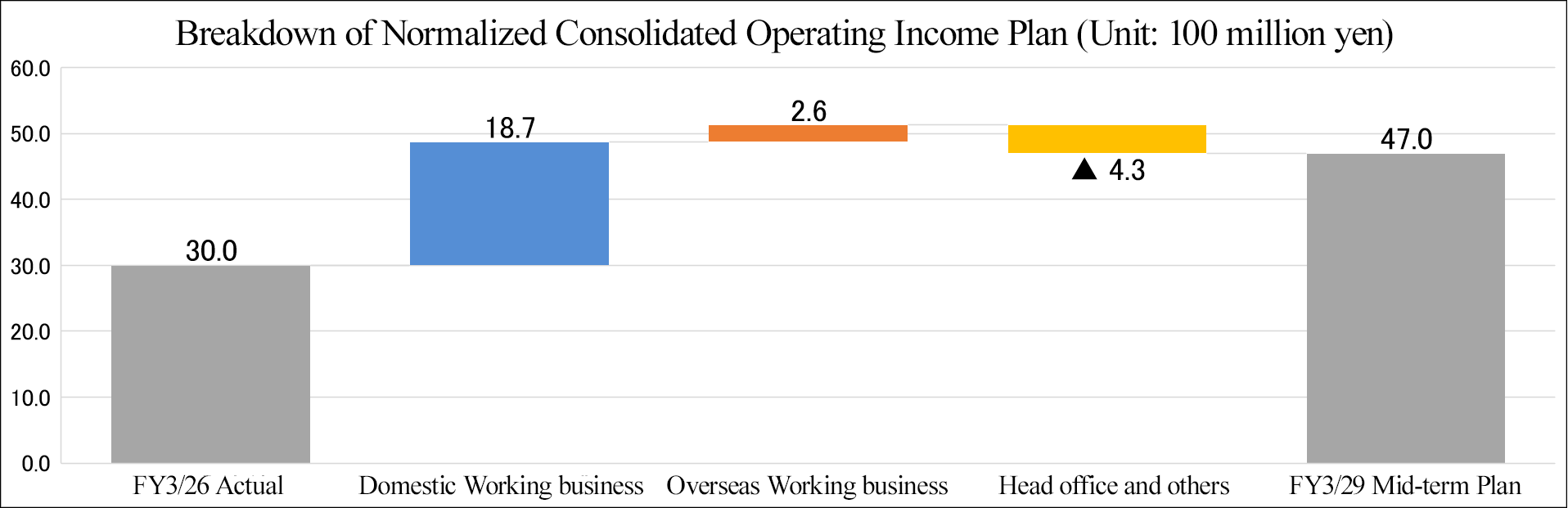
*Breakdown of the cumulative three-year change in normalized consolidated operating income, excluding one-off gains and losses.*For the Head Office and Others, the costs of maintaining corporate functions as well as growth investments are taken into account.
[Strategic Themes]
◎ Domestic Working Business
Through the expansion of its business of human resources, including full-time employees and non-Japanese workers, the company aims to increase the profit of this segment from 3.6 billion yen in FY 3/2026 to 5.4 billion yen in FY 3/2029, representing a CAGR of 15.1%.
Dispatch of Full-time Employees and Undertaking of Tasks | To continue expanding businesses that have demonstrated strong investment efficiency under the previous medium-term management plan. |
Non-JapanesePeople Employment Support | |
Introduction of Talent | Business acquired through M&A as a new growth driver. To drive expansion by leveraging highly scalable operating models. |
The company will continue to focus on business areas that demonstrated strong investment efficiency under the previous medium-term management plan and offer a higher gross margin, a higher retention rate, and greater market growth potential than general staffing and fixed-term contracting.
◆ Permanent Employee Staffing / Contracting
The corporate group will expand its business of dispatching full-time employees and undertaking tasks in the essential domain, where labor supply-demand gaps remain significant and the risk of replacement by AI is low.
Market Opportunity | Labor shortages worsened mainly in the essential domain. ・Significant labor supply-demand gaps exist in construction, manufacturing, nursing care, and other sectors. ・Demand is shifting beyond simple job matching to encompass employee retention and training support. |
Competitive Advantages | Leverage existing assets to support expansion in a repeatable manner. ・Leverage the recruitment, placement, and retention know-how developed through the general staffing business. ・Leverage the customer base in the essential domain and the nationwide network of business bases. |
<KPI: Number of dispatched full-time employees/workers engaged in entrusted tasks (results)>
FY 3/23 | FY 3/24 | FY 3/25 | FY 3/26 |
3,923 employees | 5,304 employees | 5,911 employees | 6,878 employees |
*No target has been established for this KPI, but actual results will continue to be disclosed.
◆ Support for Hiring Foreign Nationals
The corporate group will expand its business of supporting the employment of non-Japanese people as a growth area by providing integrated support from recruitment through employee retention.
Market Opportunity | As government policies tighten and regulatory enforcement becomes more stringent, the importance of employment of non-Japanese people supported by appropriate acceptance procedures continues to grow. ・Demand for non-Japanese workers supported by appropriate acceptance procedures is expanding across manufacturing, nursing care, hospitality, food service, and other industries. ・The number of sectors facing labor shortages that cannot be adequately addressed by the domestic workforce alone continues to increase. |
Competitive Advantages | The compliance-focused operating framework provides a competitive advantage as regulatory enforcement becomes increasingly stringent. ・Industry-leading track record in support. ・End-to-end support from recruitment through employee retention. |
<KPI: Number of Individuals Supported through the Non-Japanese People Employment Support Business (Results)>
FY 3/23 | FY 3/24 | FY 3/25 | FY 3/26 |
1,750 | 2,341 | 3,213 | 4,626 |
*No target has been established for this KPI, but actual results will continue to be disclosed.
◆Permanent placement
The corporate group will accelerate growth in the essential domain by leveraging the repeatable recruitment operations acquired through M&A.
Market Opportunity | Demand for specialized professionals and full-time employees continues to grow mainly in the essential domain. ・In sectors such as nursing care, healthcare, and construction, the number of positions that cannot be filled through direct hiring alone continues to increase. ・Growing demand for immediately productive and specialized talent is driving recruitment placement fees upward. |
Competitive Advantages | They can utilize the existing customer base together with the repeatable recruitment operations acquired through M&A. ・The client base and touch points with clients developed in the essential domain make it easier to identify clients’ needs for talent introduction. ・The talent introduction operations acquired through M&A provide a foundation for expansion with a high degree of repeatability. |
<KPI: Number of Recruits Introduced (Results)>
FY 3/23 | FY 3/24 | FY 3/25 | FY 3/26 |
3,361 | 2,895 | 3,174 | 4,741 |
*No target has been established for this KPI, but actual results will continue to be disclosed.
By expanding its high-margin business of human resources, including full-time employees and non-Japanese workers, the company will drive group-wide earnings structure reform through improvements in gross profit within the Domestic Working business.
<Changes in Gross Profit from Dispatch of Full-time Employees/Undertaking of Tasks, Support of Employment of Non-Japanese Employees, and Talent Introduction>
| FY 3/23 | FY 3/26 | Interim period of FY 3/29 |
Gross profit | 15.5 billion yen | 19.1 billion yen | 25.0 billion yen or more |
Gross profit margin | 18.5% | 21.7% | - |
Composition ratio | 39.4% | 61.2% | 75% or more |
*Gross profit generated by the businesses of Dispatch of Full-time Employees/Undertaking of Tasks, Support of Employment of Non-Japanese Employees, and Talent Introduction, and its ratio to total gross profit.
*Excluding the impact of the sale of subsidiaries and the exclusion of them from the scope of consolidation.
◎Overseas Working business
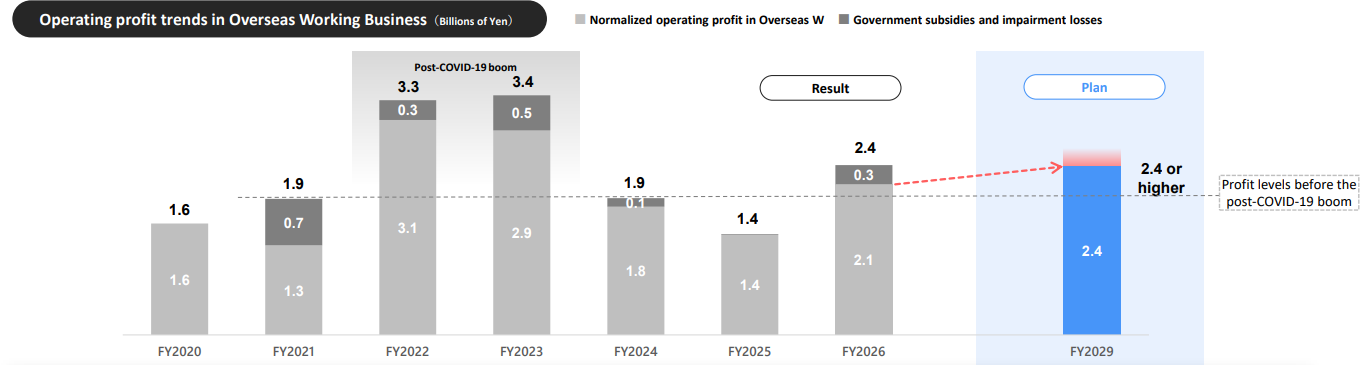
The company aims to increase the profit in this segment from 2.1 billion yen in FY 3/2026 to 2.4 billion yen in FY 3/2029 by strengthening their earning capacity through a continued focus on productivity
(CAGR: 3.9%).
Focus on Productivity | Continue initiatives that proved effective in strengthening their earning capacity under the previous medium-term management plan. |
To Allocate Resources to High-Growth Areas | |
To Explore New Countries and Business Areas | Expand into new countries and business areas with attractive earnings potential, including the essential domain that are less susceptible to AI-driven replacement. |
Despite a declining trend in recruitment demand, the company restored profitability under the previous medium-term management plan by capturing resilient demand and improving productivity. Looking further ahead, with population and GDP growth expected to support medium/long-term demand, the new medium-term management plan will continue to pursue business expansion by strengthening their earning capacity with productivity at its core.
◆Australia
Leveraging its broad customer base across both the private and public sectors, the company will strengthen the earning capacity of its Australia business by capturing demand for high-margin talent and improving productivity.
Key Characteristics of the Australia Business | (1) Maintains a broad customer base spanning both the private and public sectors. (2) Provides talent services across a wide range of occupations as a full-service staffing company. (3) Operates an extensive branch network centered on Australia’s three major cities: Sydney, Melbourne, and Brisbane. |
Strategy | ◆ To meet private-sector demand to diversify the customer base and expand earning opportunities. ◆ To allocate resources to high-margin sectors and customers to enhance their profit earning capability. ◆ To improve profitability by promoting the use of AI and partially integrating back-office and middle-office functions across group companies. |
◆Singapore
Against the backdrop of Singapore's continued economic expansion, the company will strengthen the earning capacity of its Singapore business by expanding talent services in digital/AI and other high-value-added sectors, where active government investment is expected.
Key Characteristics of the Singapore Business | ◆Regarding the customer mix, private-sector clients account for 75% and public-sector clients make up 25%. ◆Holds a leading client share among the core institutions driving the Singaporean government’s digitalization and AI initiatives. ◆Provides talent services across a broad range of occupations as a full-service staffing company. ◆Has a dedicated talent introduction team specializing in high value-added sectors. |
Strategy | ◆To capture talent demand driven by digitalization and the utilization of AI and expand business transactions with existing clients. ◆To expand talent services in high value-added sectors. ◆To improve profitability by promoting the use of AI and partially integrating back-office and middle-office functions across group companies. |
While closely monitoring changes in market conditions and risks arising from foreign exchange and policy changes, the company aims to generate stable earnings of approximately 2.4 billion yen (the earnings level achieved prior to the post-pandemic demand surge) through productivity improvements, excluding the impact of government subsidies.
(Reference material of the company)
[Management with an Emphasis on Capital Cost and Share Price]
◎ Portfolio Management
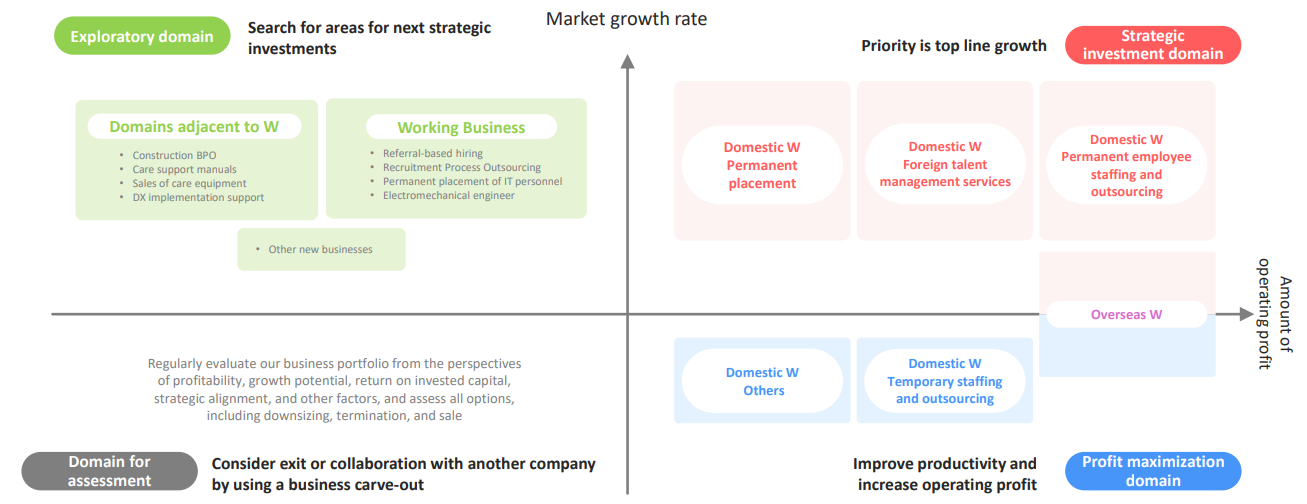
To improve net profit margin, the company will evaluate its businesses from both growth and profitability perspectives. Through portfolio management, it will clearly define businesses for strategic investment, profit maximization, exploration, and assessment, and review them on a regular basis.
(Reference material of the company)
◎ Cash Allocation Policy
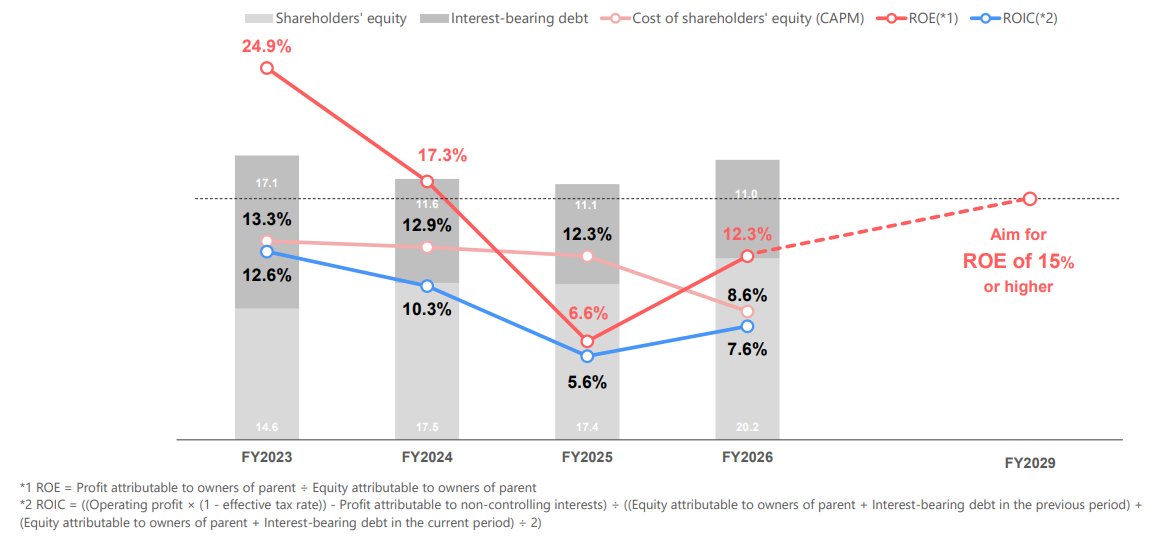
Reflecting the priority of investment based on portfolio management in cash allocation, they aim to improve ROE through the investment for growth, M&A, optimization of shareholder return and financial leverage, etc.
Cash Allocation Policy | |
Investment for growing the existing businesses | Investment in mainly the strategic investment domain and the profit maximization domain for growth |
M&A, etc. | Fortification of the business base (M&A budget: 10 billion yen in 3 years) |
Shareholder return | Progressive dividend |
Reduction of interest-bearing liabilities | To be conducted arbitrarily according to investment opportunities |
Acquisition of treasury shares | To be conducted flexibly according to share price and business performance |
Holding as cash on hand and in banks |
|
*Listed in the order of priority of investment
◎ Improvement in ROE
They aim to achieve an ROE of 15% or higher in FY 3/2029, by improving capital efficiency through the growth of the existing businesses, M&A, etc. based on portfolio management as well as profit growth.
(Reference material of the company)
◎M&A Policy
While considering M&A as an important means for growth, they define investment targets and evaluation standards clearly for each purpose and conduct M&A.
| M&A as strategic investment | Exploratory M&A |
Positioning | Improvement in sales, operating income, and productivity | To find new targets with an eye to sustainable growth |
Investment targets | Dispatch of engineers, industry-specific BPO To complement the functions of the Working business | Medium/long-term growth opportunities with an eye to the compatibility with the existing businesses |
Hurdle rate | To consider only projects that will exceed capital costs in 3 years after acquisition | To assess each project while considering the strategic meaning, potential, and compatibility with the existing businesses |
Funds | Utilization of cash on hand and in banks and bank loans | To prioritize cash on hand and in banks |
Investment budget | 10 billion yen | Within the amount of cash on hand and in banks |
◎ Shareholder return
The shareholder return policy in the period of the new medium-term management plan (FY 3/2027 to FY 3/2029) is to stick to the progressive dividend policy they have upheld so far in the period of the new medium-term plan with the aim of improving corporate value through profit growth.
Progressive dividend | In principle, they do not decrease the dividend amount, but increase or maintain it. |
Total return rati 30% or higher | To consider the swift acquisition of treasury shares when necessary according to the performance during each fiscal year |
5. Interview with President Sumi
We interviewed President Yuichi Sumi and asked him about the company’s characteristics and competitive advantages, initiatives in the construction engineer field that the company successfully turned into the black, points of the new medium-term management plan, and his message to the shareholders and investors.
Q: Could you give us your insight into the factors behind the strong performance from the perspectives of WILL GROUP’s characteristics and competitive advantages?
Our company has been shifting to highly profitable fields since we formulated the medium-term management plan (WILL-being 2026) three years ago.
Specifically, we have shifted our focus to highly profitable occupational fields not by temporarily dispatching workers on fixed-term contracts, but by enabling workers to work as full-time employees on indefinite-term contracts and requiring them to acquire more extensive expertise, with which we achieved progress as planned.
I believe that what underlies the success in this shift is the fact that our company has engaged in various occupational fields in a well-balanced manner.
Companies specializing in dispatching nursing care providers or sales workers, for example, may face great difficulty in bringing about such a shift; however, our company has dealt with a wide variety of occupational fields and thus succeeded in undergoing the shift smoothly.
Our company received orders for dispatching workers for operations that require full-time employees not from new clients, but from the existing clients, with whom our company has already formed relationships at a certain level, through initiatives such as shifting from dispatching workers as sales staff to dispatching workers as marketing personnel and, in factories, from light work to full-fledged manufacturing fields that require greater expertise, which I believe resulted in our company’s strong performance.
Q: A shift to highly profitable fields may sound simple, but it will not actually be that simple when considerable expertise is required. Your company has considered the capability of training personnel to be one of your strengths that enable you to take a share in a market even if your company enters the market late. I think that this viewpoint is also an important point.
That is right. We are endeavoring to come up with innovative ideas in each field.
For example, regarding a shift from dispatching sales staff to dispatching marketing personnel, we dispatch our employees as supervisors (SVs) who will give advice about training in how to sell products to the staff at stores and, in factories, we have our full-time employees be stationed in the same workplaces and work together with the factory staff to increase and improve the accuracy and efficiency of their operations, which are initiatives that we are pursuing to boost the level of staff. The capability of training personnel through not only training programs or classroom learning, but also on-the-job training is our company’s enormous competitive advantage that is based on the know-how and knowledge which we have acquired since our establishment.
Q: Next, we would like to ask you about the construction engineer field that your company has successfully turned into the black. We believe that you have made multifarious efforts to come up with innovative ideas from the perspective of personnel training in the field as well.
How we should train personnel differs completely between the field of sales or factories and the construction field.
There are a countless number of construction sites in Japan, and they keep changing as construction projects reach completion; therefore, we cannot dispatch workers as field supporters or similar positions. What we do, thus, is to focus on developing personnel through systems and programs, and one of the essential elements is the personnel evaluation system.
There are several categories in the construction field, such as architecture, civil engineering, and maintenance. If a worker engages in architecture for two years and then in civil engineering for two years, the worker may not be able to obtain necessary qualifications and the worker’s career may be derailed considerably.
Our company, therefore, has adopted a system in which we determine in which category each worker should develop his or her career, such as architecture or civil engineering, and then seek feedback on the worker from our clients as well as assessment of the worker by ourselves. Furthermore, qualifications that a worker obtains will be reflected in the worker’s salary, which means that our company’s evaluation and personnel system give our workers concrete ideas of what they should do to raise their levels and what evaluations they need to increase their salaries.
The presence of career managers who are in charge of each one of our technical staff and engineers is vital for operating the system. A career manager grasps how the technical staff member whom he or she is in charge of hopes to curve a career and then considers how to support the staff member as he or she works at different worksites each year.
Our career managers work together with technical staff or engineers and help them find their own career paths by giving them ideas, for example, that a technical staff member or engineer who begins with a job at a construction site for a small apartment may be able to reach a higher level at which he or she can become highly regarded if the technical staff member or engineer engages in projects entrusted by the super general contractors (which are Japan’s top five general contractors) at larger-scale development sites for several years. Our career managers then advise technical staff or engineers about qualifications that they should obtain using our company’s internal qualification assistance program because their salaries will be raised in accordance with the evaluation system.
While many people dream of working in the dynamic construction industry, it is extremely difficult to get employed by the super general contractors or major general contractors. In the past, however, some people worked at our company for several years, were recognized by our clients for their performance, and then moved to general contractors. Our company supports such cases as one of the possible career paths.
These are our company’s unique approaches to developing personnel, which has been a solid basis for the growth of the construction engineer field.
Q: While employee retention rate fell below the forecast, it grew steadily from the fiscal year ended March 2025. What initiatives is your company promoting?
This is an extremely important point because an improved employee retention rate means an increase in the top line.
One of our initiatives is the personnel evaluation system that I mentioned earlier.
It has been verified that there is clearly a positive correlation between remuneration and employee retention rate. Our personnel evaluation system allows persons being evaluated to expect that they will receive salaries properly as long as they make steady progress with their performance, which helped us increase retention rate by about two points.
It is also crucial to select worksites to which our company dispatches workers. When we compare small-scale worksites with large-scale ones, retention rate is clearly higher in large-scale worksites. This indicates that it is more comfortable for workers to engage in operations in an environment where they have a lot of people whom they can ask for advice or rely on. Our company, therefore, strives to increase the number of workers whom we dispatch for employment at medium/larger-scale worksites as much as possible.
Q: According to your self-evaluation, your company has taken the 7th largest share in the construction engineer field. What is the most important point for reaching a higher rank?
It will be the marketing capability.
We have about 20 clients in this field, including super general contractors and major general contractors. The key will be how many orders we can receive from these clients for large-scale projects in metropolitan areas. It is relatively easy for the workers whom we dispatch to be employed if we have abundant orders for such large-scale projects, and as I mentioned earlier, employee retention rate will increase because workers can work in supportive environments.
We have changed our systems and increased the number of marketing staff members with the aim of enhancing our marketing capability. Although our company conventionally carried out marketing activities separately for new clients and existing clients, it was very inefficient to do marketing activities respectively for new clients and existing clients at the construction division and the civil engineering division in the Tokyo branch of the super general contractor A. This fiscal year (FY March 2027), thus, we removed the barriers between new clients and the existing ones and shifted to a system under which we engage in comprehensive marketing activities. The persons in charge of our major 20 clients, which are our principal targets, will enhance their respective marketing capabilities and focus on winning orders for profitable projects by carrying out marketing activities all across Japan.
Q: Our next question is about your new medium-term management plan. You forecast that in the fiscal year March 2029, operating income will increase 1.7 billion yen in the fiscal year March 2026 to 4.7 billion yen, 1,870 million yen of which will be contributed by the Domestic Working business. Could you tell us about the point regarding this matter?
Our company will focus on essential fields that are facing greater labor shortages while social needs and demand are significant and are less influenced by the generative AI technology. We consider that construction engineers, IT infrastructure, and nursing care are the core fields and the dispatch of full-time employees/the undertaking of tasks, support for the employment of non-Japanese workers, and the permanent placement of workers are the core businesses.
Regarding the field of IT, while such domains as application development and debugging are projected be replaced by AI, IT infrastructure including network monitoring and maintenance will remain the domain that human beings must be in charge of. Furthermore, our management strongly keeps in mind to achieve our forecast of a record-high operating income of 5.5 billion yen while aiming at an ROE of over 15%.
Q: Meanwhile, what do you think about the impact brought by generative AI on such fields as sales outsourcing, call center outsourcing, and factory outsourcing among your existing businesses?
In the call center field, we already recognize that generative AI is having impact and it is unlikely that the field will recover or grow; therefore, as countermeasures, our company aims to shift from call centers to contact centers and from temporary worker dispatch to business process outsourcing (BPO). In addition, we have shifted from a vertically divided organization to a regionally divided organization in some areas and relocated our personnel to other businesses by utilizing our personnel assets, and we have yielded results in the areas where we have undergone the shift.
In the sales field, the impact brought by generative AI is not that significant at present. Our company dispatches workers to the mobile device industry and the apparel industry. In the apparel industry, while products are sold more through e-commerce, shops are an important infrastructure in which apparel manufacturers share their own aesthetic and do promotional activities, and demand is growing gradually.
Further growth cannot be expected in the mobile device industry given the current smartphone penetration rate; however, the contract details are complex and campaigns are run frequently, and we forecast that demand will arise continuously at a certain degree.
Q: Your company forecasts 800 million yen for operating income on an upside basis for the fiscal year ending March 2029. What is this forecast based on?
We have set the target of an operating income of 4.7 billion yen for the fiscal year ending March 2029 quite conservatively. The upside factors are such fields as the dispatch of full-time employees, the permanent placement, and the overseas business on which we are focusing. In addition to them, we expect contribution of M&A and new businesses.M&A is not included in 4.7 billion yen.
Q: What do you think about issues that your company may face when realizing medium-term growth and resources that your company should enhance, including the new medium-term management plan?
It will be further enhancement of our human capital.
What is particularly crucial is to increase the number of career consultants in the permanent placement service that we are aiming at growing further. For this, we conducted the M&A of HR CAREER Co., Ltd. that engages in the permanent placement of workers exclusively for the medical and welfare industries in October 2025. HR CAREER has extremely advanced operational and managerial capabilities and began to function as part of our corporate group faster than any other group companies because we sent some of our company’s core members at an earlier stage with the aim of strengthening the middle management.
We are currently focusing on raising the number of career consultants as well as employing workers from the outside and allocating our staff internally.
In addition, what is required for our company to succeed in the service of dispatching full-time employees is to maximize the life time value (LTV) of each worker. Each worker’s LTV will be increased by tens of times if his or her period of employment is extended as much as possible and the worker’s value is enhanced, through which both the worker and our company will gain significant value. In years to come, we would like to establish a mechanism that allows a worker who is at a certain stage and has a certain job to reach a certain LTV level.
Q: Thank you very much. Finally, could you give a message to the shareholders and investors?
At present, investors seemingly hold low expectations of the human resources industry due not only to the declining population in Japan, but also to the impact of generative AI. I think that it is reasonable to feel such concern because leading companies focus almost completely on the administrative field in the human resources industry, and it is inevitable that jobs especially in the field will be replaced by generative AI.
Our company, therefore, has run business in the fields that leading companies do not engage in since our establishment because there is no chance that our company will win by facing directly at them. This has consequently allowed us to establish our current unique position in which we demonstrate our advantages in essential fields that are less influenced by generative AI.
In addition, we conduct business on a par with local leading companies in overseas countries in which economic growth is expected, and I would like you to recognize our company as a unique and one-in-a-million player that possesses two growth drivers, which are essential fields and the overseas markets, in the human resources industry. I would like you to look forward to our company’s future growth.
6. Conclusions
In the fiscal year ended March 2026, sales grew 5.1% year on year and operating income rose 40.2% year on year, showing favorable results, and they were able to achieve target KPIs set in the previous medium-term management plan “WILL-being 2026” as a whole. In the domain of construction engineers, into which they put energy, they enhanced the formation of the population, cemented the cooperation with external agents, and established the base for recruiting non-Japanese people, so the number of recruits per year reached the annual target. The number of dispatched full-time employees in service outside the domain of construction engineers grew considerably also in the domains of factory outsourcing, sales outsourcing, and IT engineers, and the number of non-Japanese workers for whom they supported employment reached the target number. Accordingly, it can be concluded that WILL-being 2026 was fruitful. In the new medium-term management plan “WILL-being 2029,” which will end in FY 3/2029, they will keep concentrating on the essential domain, including construction and nursing care, where labor supply-demand gap is significant and the risk of replacement by AI or robots is low. In the Domestic Working business, they aim to expand the business of human resources, including full-time employees and non-Japanese workers, while considering the essential domain as their main field. In the Overseas Working business, they will strive to enhance their earning capacity while putting importance on productivity. They plan to explore new countries and fields for medium/long-term growth, while enhancing the earning capacity in countries where they already operate business. In the business of introducing talent, which is a growth driver, they accelerate growth mainly in the essential domain, by taking advantage of the repeatable operation for talent introduction, which was acquired through M&A.
In addition, they consider M&A as an important means for growth, and plan to invest 10 billion yen in M&A as a strategic investment in 3 years in accordance with the new medium-term management plan. With expectation, we would like to pay attention to whether attractive M&A that would accelerate the growth of the company will be conducted. As mentioned in the interview with the president, the fact that their position is not easily affected by generative AI is an important perspective for evaluating the shares in the company.
<Reference: Regarding Corporate Governance>
Organization type, and the composition of directors and auditors
Organization type | Company with auditor(s) |
Directors | 5 directors, including 3 external ones |
Auditors | 3 auditors, including 3 external ones |
Corporate Governance Report: Updated on June 23, 2025
Basic policy
In order to make our business administration transparent and compliant with law, our company will develop a structure for swiftly and flexibly responding to the changes in the business environment of the entire group of our company, while enriching corporate governance. We will implement a variety of company-wide measures for diffusing our corporate ethics, philosophy, etc. among all employees of our corporate group.
<Disclosure Based on the Principles of the Corporate Governance Code (Excerpt)>
Our company follows all principles of the Corporate Governance Code.
<Disclosure Based on the Principles of the Corporate Governance Code (Excerpt)>
[Principle 1-4 Strategically Held Shares]
(1) Policy on Strategically Holding Shares
Our company does not hold any shares strategically, except when we judge that strategically held shares will contribute to the enhancement of our corporate value by comprehensively considering such matters as the creation of business opportunities and the establishment, maintenance, and strengthening of business relationships and partnerships. In case that we strategically hold shares and if we judge that the significance of holding them is limited in light of the aforementioned policy, we will reduce the number of the strategically held shares as swiftly as possible.
(2) Details of Verification Relating to Strategically Held Shares
If we strategically hold shares, we will assess such matters as economic rationality, including the advantages, risks, and return on investment against the capital cost brought by the strategically held shares, and future outlooks regularly at meetings of the board of directors and decide whether we should continue holding them.
(3) Criteria for Exercising the Voting Rights Relating to Strategically Held Shares
We will exercise our voting rights relating to strategically held shares not by uniformly deciding whether we should do so or not but by deciding whether we should do so regarding each case from the perspective of the enhancement of our medium/long-term corporate value and shareholder returns while fully respecting matters such as the business policies and strategies of the companies in which we invest.
[Supplementary Principle 2-4-1① Ensuring Diversity Within the Company, Including Promotion of Women’s Activities]
In an era where market conditions are rapidly changing and a future is difficult to predict, the company recognizes the importance of utilizing diverse perspectives and values in corporate management, in order to create new business opportunities without being bound by the current business domain. Therefore, the corporate group actively and continuously hires and promotes diverse human resources, including women, non-Japanese nationals, and mid-career workers with a variety of work experiences, and promotes initiatives such as development of a working environment that makes the most of individual characteristics and abilities, as well as management-level education. They will continue to work to have a ratio of core personnel equal to respective employee ratios by 2030.
(1) Promotion of Female Core Personnel.
In recent years, the company has been actively promoting the advancement of women, and has conducted career development training for young employees, as well as training program for developing next-generation female leaders. While the percentage of female employees among full-time employees is 49.6%, the percentage of female managers is 30.5%, falling below the percentage of female employees. Aiming to increase the ratio of female managers to 40% by 2030, the company will continue to improve the workplace environment, foster career awareness, etc., and increase the number of female employees who will be involved in management decision-making in the future.
(2) Promotion of non-Japanese employees as core personnel
Our corporate group not only owns 35 overseas consolidated subsidiaries, but also offers staffing services with non-Japanese personnel in Japan, so many non-Japanese employees belong to our company. The ratio of non-Japanese employees to regular employees is 29.1% and the ratio of non-Japanese managers is as high as 37.0%. We will keep promoting non-Japanese employees actively inside and outside Japan.
(3) Promotion of mid-career workers as core personnel (in Japanese enterprises only)
Our corporate group actively recruits mid-career workers with various work records, and promotes them to managerial positions. The ratio of mid-career workers to regular employees is 67.9%, and the ratio of managers promoted from mid-career hires is 64.5%, securing the same level. We will continue the recruitment, training, and promotion of new graduates and mid-career workers.
[Supplementary Principle 3-1 (3) Initiatives Regarding Sustainability]
(1) Policy on Sustainability
Pursuing a mission of “becoming a ‘change agent group’ that brings positive change to individuals and organizations,” our corporate group has achieved sustainable growth while aiming at positively changing as many individuals and organizations as possible. We will contribute to creating a sustainable society together with the stakeholders towards the future by accurately grasping social changes so that we can bring about positive changes in the world and grow on a sustainable basis.
(2) Initiatives Regarding Sustainability
As our company recognizes that measures against various issues surrounding sustainability, such as the environment, society, and governance, are crucial business issues that could mitigate risks and open up revenue opportunities, our board of directors is moving forward initiatives to deal with them through our corporate activities based on our business philosophy as well as has identified priority issues. We will contribute to solving social issues through our corporate activities based on our sound business foundation by defining priority issues for further enhancing this activity.
Our company discloses the details of our initiatives regarding sustainability via our integrated reports, website, and securities reports.
(Initiatives regarding sustainability: https://willgroup.co.jp/sustainability/)
(Securities report: https://willgroup.co.jp/ir/library/annual_securities_report/)
(3) Initiatives Regarding Climate Change
Setting an environmental target of reducing CO2 emissions by 20% in total by the fiscal year ending March 2031 compared to the fiscal year ended March 2020, our corporate group is pursuing initiatives that contribute to creating a decarbonized society. In addition, our company has expressed our support of the recommendations by the Task Force on Climate-related Financial Disclosures (TCFD) and discloses relevant information in accordance with the framework as we joined the TCFD consortium in January 2023.
Our company discloses the details of our initiatives regarding climate change on our website. We will disclose more information gradually and enrich the quality and quantity of the overall information that we disclose.
(Initiatives regarding the environment: https://willgroup.co.jp/sustainability/environment/)
(4) Sustainability Promotion System
Our corporate group considers measures for sustainability to be one of the priority business issues and has set up a sustainability committee with the aim of balancing the sustainable growth of our corporate group as a whole with solutions to social issues. The committee consists of our company’s president as the chairperson and the internal directors and executive officers of our company and the directors of Japanese leading companies as the members, and in principle, we hold meetings of the committee twice a year. The committee discusses and decides on matters such as setting, monitoring, and revisions of sustainability policies, priority issues, and key performance indicators (KPIs), and crucial matters are deliberated by the board of directors. Furthermore, we have set up a sustainability promotion team inside the corporate planning headquarters, which means that we have a cross-organizational promotion system in place.
(Corporate governance system: https://willgroup.co.jp/sustainability/governance/governance/)
(5) Strategies, Indicators, and Objectives Regarding Human Capital
(Personnel development policy and internal environment development policy)
In the current medium-term management plan, our company has adopted a slogan of realizing the maximization and optimization of careers that make workers experts through our human resources services and considered the enhancement of human capital to be a priority issue to tackle. We believe that it is required to foster the well-being, job satisfaction, and diversity for each one of our employees in order to achieve sustainable growth; therefore, we have identified seven indicators as priority items and will enhance our initiatives relating to them and proactively disclose them.
The indicators so identified are targeted not at the overseas subsidiaries, but at our company and the consolidated subsidiaries included in the Domestic Working business because we believe that we have issues to prioritize in our company and the consolidated subsidiaries in Japan.
(Indicators and objectives)
While following the aforementioned policies, we have held discussion many times mainly at meetings of the sustainability committee. We will enrich information disclosure regarding human capital in order to raise our corporate value on a sustainable basis.
(Initiatives regarding personnel: https://willgroup.co.jp/sustainability/social/humanresources/)
(Integrated report: https://willgroup.co.jp/sustainability/report/)
(Securities report: https://willgroup.co.jp/ir/library/annual_securities_report/)
[Principle 5-1 Policies related to Constructive Interaction with Shareholders]
Our company has formulated a disclosure policy composed of “Basic Policy regarding Information Disclosure,” “Standards for Information Disclosure,” “Methods of Information Disclosure,” “Regarding Future Prospects” and “About the Quiet Period,” which we have publicly announced on our website.
(Disclosure policy: https://willgroup.co.jp/ir/disclosure/)
Further, the following are our policies aimed at promoting constructive interaction with our shareholders.
(1) In our company’s IR activities, the representative director, and executive officers in charge of the management headquarters aggressively take part in dialogues and aim for communication that is favorable to both sides while focusing on fairness, accuracy, and continuity with regard to management and business strategies, financial information etc.
(2) The management headquarters takes a central role, and the management planning, general affairs, financial affairs, accounting, legal affairs department and the people in charge of each business shall work in coordination with each other and carry out the disclosure of information in a timely, fair, and suitable fashion.
(3) As a means of dialogue, the company holds company briefings for individuals, as well as financial results briefings for institutional investors. In addition, the company will continue to enhance IR activities by posting video clips of briefings, contents of question-and-answer sessions, and other information on the company’s website.
(4) Individual meetings with shareholders will be conducted, with the IR Group of Corporate Secretariat as the point of contact. Based on the shareholder’s request and the purpose of the meeting, executives, directors including outside directors, or corporate auditors will meet with the shareholders and provide appropriate responses within a reasonable scope.
(5) In addition to setting up a quiet period based on our disclosure policies, we shall also apply and enforce regulations regarding the management of insider information.
(6) In addition to establishing a quiet period in accordance with the Disclosure Policy, the Company will operate and thoroughly implement rules and regulations regarding the management of insider information.
*The disclosed documents relating to the above items can be found on the company’s website (https://willgroup.co.jp/ir/news/).
This report is not intended for soliciting or promoting investment activities or offering any advice on investment or the like, but for providing information only. The information included in this report was taken from sources considered reliable by our company. Our company will not guarantee the accuracy, integrity, or appropriateness of information or opinions in this report. Our company will not assume any responsibility for expenses, damages or the like arising out of the use of this report or information obtained from this report. All kinds of rights related to this report belong to Investment Bridge Co., Ltd. The contents, etc. of this report may be revised without notice. Please make an investment decision on your own judgment. Copyright(C) Investment Bridge Co., Ltd. All Rights Reserved. |