


Bridge Report:(6890)Ferrotec the Full-Year Earnings Results for the Fiscal Year ended March 2026

 President He Xian Han | Ferrotec Corporation (6890) |
 |
Company Information
Exchange | TSE Standard Market |
Industry | Electric Equipment (Manufacturing) |
President | He Xian Han |
HQ Address | Nihonbashi Plaza Building, Nihonbashi 2-3-4, Chuo-ku, Tokyo |
Year-end | December |
Website |
Stock Information
Share Price | Shares Outstanding (Term end) | Market Cap. | ROE (Act.) | Trading Unit | |
¥10,260 | 46,838,318 shares | 426,228 million | 6.0% | 100 shares | |
DPS (Est.) | Dividend Yield (Est.) | EPS (Est.) | PER (Est.) | BPS (Act.) | PBR (Act.) |
¥200.00 | 1.9% | ¥436.78 | 23.5x | ¥5,526.83 | 1.9x |
*Share price as of closing on June 25. Shares outstanding (Excluding Treasury Shares), DPS, EPS, and BPS are taken from the summary of full-year financial results of the fiscal year ended March 2026. ROE is the actual value for the previous fiscal year.
Consolidated Earnings Trends
Fiscal Year | Sales | Operating Income | Ordinary Income | Net Income | EPS (¥) | DPS (¥) |
March 2023 (Act.) | 210,810 | 35,042 | 42,448 | 29,702 | 644.81 | 105.00 |
March 2024 (Act.) | 222,430 | 24,872 | 26,537 | 15,154 | 322.65 | 100.00 |
March 2025 (Act.) | 274,390 | 24,089 | 25,558 | 15,692 | 334.13 | 141.00 |
March 2026 (Act.) | 288,933 | 27,561 | 26,063 | 14,886 | 317.88 | 148.00 |
December 2026 (Est) | 350,000 | 38,000 | 36,000 | 23,000 | 436.78 | 200.00 |
*The forecast is from the company. Unit: million-yen, yen. Net income is net income attributed to parent shareholders. The same shall apply hereafter.
This Bridge Report reviews the overview of Ferrotec’s full-year earnings results for the fiscal year ended March 2026.
*Ferrotec Holdings performed an absorption-type merger with Ferrotec Material Technologies Corporation, a Japanese subsidiary, on July 1, 2025, and changed the company name to “Ferrotec Corporation.”
Table of Contents
Key Points
1. Company Overview
2. Full-Year Earnings Results for the Fiscal Year ended March 2026
3. Full-Year Earnings Estimates for the Fiscal Year ending December 2026
4. Mid-Term Management Plan
5. Conclusions
<Reference 1: Measures for Achieving Management Conscious of Capital Costs and Stock Price>
<Reference 2: Regarding Corporate Governance>
Key Points
- In the fiscal year ended March 2026, sales grew 5.3% year on year to 288,933 million yen, exceeding the company’s forecast (285 billion yen), and operating income rose 14.4% year on year to 27,561 million yen. Annual operating income margin increased year on year from 8.8% to 9.5%, but operating income margin in the fourth quarter dropped to 7.4%, because of the metal processing factory in Malaysia, which was still under construction, and a decline in inventory valuation in the quartz crucible business, in which they decreased products for PV, in the fourth quarter of the fiscal year ended March 2026. As a result, operating income margin slightly fell below the target annual operating income margin (10%). In addition, due to the posting of an exchange loss (an exchange gain posted in the previous fiscal year), an increase in income taxes, etc., the year-on-year increase rate of ordinary income was only 2.0%, and net income attributed to parent shareholders decreased 5.1% year on year. These factors in decreasing profit were assumed when they revised their full-year plan, so this is not a negative surprise.
- Regarding the performance of each segment, the semiconductor equipment-related business, which accounts for 64% of sales, has grown significantly by meeting the strong demand for mainly Vacuum Feedthroughs, metal processing, and ceramics from American and Chinese makers, and the electronic device business, which is highly profitable, drove the improvement of overall business performance, due to the expansion of sales of thermos-electric modules for optical transceivers through the investment in generative AI servers. On the other hand, the domains of in-vehicle components, quartz crucibles, etc. related to EVs and solar panels remained sluggish, but overall growth momentum can be said to be strong.
- This fiscal year, the account closing month changed from March to December, so the period of the fiscal year ending December 2026 is extraordinary, being 9 months. However, the account closing months of consolidated subsidiaries have been December since before the change, so only the parent company’s performance will be affected by the 9-month accounting period (the effect on sales is around 5 billion yen), and the effect on consolidated performance is limited. For the fiscal year ending December 2026, the company forecasts that sales will be 350 billion yen, operating income will be 38 billion yen (operating income margin: 10.9%), and net income will be 23 billion yen. At a results briefing session, the President He Xian Han left the informal comment “I would like to pursue sales of 400 billion yen and an operating income of 50 billion yen.” Whether the progress of their business will be in line with the company’s forecast or the president’s comment will attract attention from the market.
- For medium-term growth, they have steadily increased capital investment and inventory assets, so their preparations for the increase of order receipt and production output can be said to be sufficient. If offensive and defensive strategies dovetail with each other in the broad portfolio management of the company, further growth can be expected. Needless to say, the mis-prediction of demand would lead to the risk of decreases in inventory valuation and utilization rate, so we need to pay attention to the quality of inventory. We would like to pay attention to how swiftly they will make a management judgment in such a case.
- Their business administration conscious of share price and capital cost turned out to be effective, so PBR exceeded 1 and remains over 1. In order to raise valuation further, they are required to achieve stable growth of sales and profit based on the previous investment for growth, improve ROE, and enhance their shareholder return measures, in addition to taking advantage of the favorable external environment. In this light, they show a more concrete positive attitude by announcing the purchase of treasury shares worth 25 billion yen in 3 fiscal years, in addition to the attitude of aiming to achieve a total return ratio of 50% while setting the lower limit of DOE at 3.5%. However, the pursuit of both investment and shareholder return may shackle their business activities during a downward trend. Accordingly, we would like to pay attention to whether they can establish strategies flexibly.
1. Company Overview
Ferrotec Corporation develops, manufactures, and sells silicon products, magnetic fluid, sensors, and products to which such items are applied, as well as Vacuum Feedthroughs that are used in equipment for manufacturing semiconductors and flat panel displays (FPDs), quartz products, ceramics products, CVD-SiC products, silicon parts, crucibles, and thermo-electric modules used in temperature controllers.
These products are categorized roughly into either the “semiconductor equipment-related business,” “the electronic device business,” or “the automotive-related business.” The core products and the major companies in each segment are as follows:
| Segment | Core products | Major companies | |
| Semiconductor equipment-related business | Vacuum Feedthroughs | Development, manufacturing, sale | Ferrotec CorporationFerrotec (USA) Corporation |
| Development, sale | Hangzhou Dahe Thermo-Magnetics Co., Ltd. (FTH) Zhejiang Advanced Precision Machinery Co., Ltd. Ferrotec (Zhejiang) Semiconductor Material Co., Ltd.KSM FerroTec Co., Ltd.Ferrotec Manufacturing Malaysia Sdn. Bhd. | ||
| Quartz products | Development, sale | Hangzhou Dahe Thermo-Magnetics Co., Ltd. (FTH)Ferrotec (Zhejiang) Quartz Technology Co., Ltd.Aliontek Corporation. | |
| Sale | Ferrotec CorporationFerrotec (USA) CorporationFERROTEC CORPORATION SINGAPORE PTE LTDFerrotec Taiwan CO., LTD. | ||
| Ceramics products | Development, manufacturing, sale | Ferrotec CorporationHangzhou Dahe New Material Technology Co., Ltd.Ferrotec (Zhejiang) Semiconductor Material Technology Co., Ltd. | |
| Sale | Ferrotec (USA) CorporationFERROTEC CORPORATION SINGAPORE PTE LTD | ||
| CVD-SiC products | Development, manufacturing, sale | Ferrotec Corporation | |
| Equipment parts cleaners | Development, sale | Ferrotec (Anhui) Technology Development Co., Ltd. | |
| Silicon parts | Development, sale | Hangzhou Dunyuan Juxin Semiconductor Technology Co., Ltd. (FTHS)Zhejiang Dunyuan Juxin Semiconductor Technology Co., Ltd.Ferrotec Silicon Materials (Malaysia) Sdn Bhd. | |
| Quartz crucibles | Development, manufacturing, sale | Ningxia Dunyuan Juxin Semiconductor Technology Corporation (FTNC) | |
| Others | Development, sale | Anhui Changjiang Reclaim Semiconductor Material Co., Ltd.Hangzhou Semiconductor Wafer Co., Ltd. (CCMC) | |
| Electronic device business | Magnetic fluid | Development, manufacturing, sale | Ferrotec CorporationFerrotec (USA) Corporation |
| Sale | Shanghai Shenhe Investment Co., Ltd. (FTS) | ||
| Electronic device business and automotive-related business | Thermo-electric modules | Development, sale | Ferrotec CorporationFerrotec (USA) Corporation RMT Ltd |
| Sale | Ferrotec Europe GmbH | ||
| Manufacturing | Hangzhou Dahe Thermo-Magnetics Co., Ltd. (FTH)Shanghai Shenhe Investment Co., Ltd. (FTS) | ||
| Power semiconductor substrates | Development, manufacturing, sale | Jiangsu Ferrotec Semiconductor Technology Co., Ltd. (FLH)Ferrotec (Sichuan) Semiconductor Technology Co., Ltd. (FLHC)Ferrotec Power Semiconductor Malaysia Sdn. Bhd. | |
| Sensors | Development, manufacturing, sale | OHIZUMI MFG. CO., LTD.Ferrotec (Zhejiang) Sensor Technology Co., Ltd. | |
| Others | Development, manufacturing, sale | Ferrotec (USA) CorporationShanghai Shenhe Investment Co., Ltd. (FTS)Shanghai Hanhong Precision Machinery Co., Ltd.Hong Kong First Semiconductor Technology Co., Ltd.Ningxia Shenhe New Material Technology Co., Ltd. | |
(Excerpt from the company’s Annual Securities Report for FY 3/26)
Ferrotec was born as a company with highly unique technologies including thermo-electric modules with uses in thermal elements and vacuum technologies that respond to magnetic fluids that were born from the NASA space program in 1980. A wide range of diverse technologies cultivated over more than 40 years were applied in the electronics, automobile, next generation energy, and other industries. As a transnational company, Ferrotec deploys its businesses in Japan, Europe, the Americas, China, and Asia, and involves in marketing, development, manufacturing, sales, and management while taking advantage of the strengths of each country and region. A holding company structure was implemented from April 2017. In April 2022, due to market reorganization, the company got listed on the Standard Market of TSE.
1-1 Business Segments
Ferrotec’s operations includes semiconductor seal related products such as Vacuum Feedthrough, quartz products, ceramic products, etc. used in manufacturing equipment of semiconductor, FPD, LED etc., electronic device business centering on thermo-electric modules, “the automotive-related business,” which handles mainly thermos-electric modules for in-vehicle systems, substrates for power semiconductors, and sensors, and business segments that are not included in the reportable segments. Other businesses, which handle silicon crystal and solar cell wafers, saw blades, machine tools, surface treatment, industrial washing machines etc.
Semiconductor Equipment-related Business
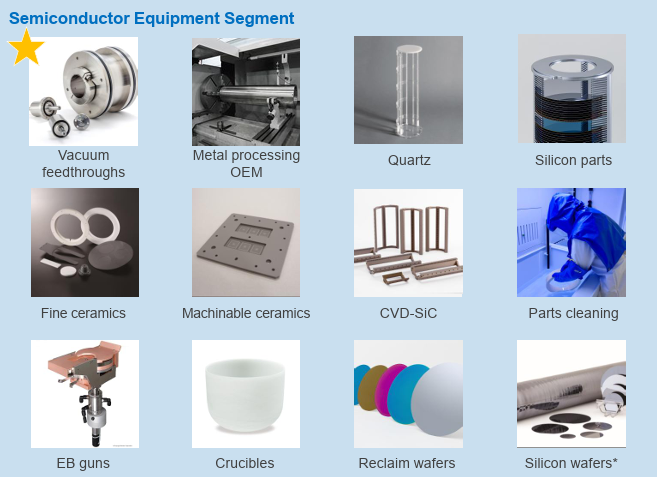
Ferrotec provides total engineering services in the Equipment Related business segment, including the manufacture and sale of Vacuum Feedthrough of equipment parts for solar power, semiconductor, FPD and LED applications, consumable products used in manufacturing of devices, quartz products, ceramic products, CVD-SiC products, quartz crucibles, silicon wafer processing and equipment cleaning services.
Vacuum Feedthroughs, which are the company’s mainstay products, are functional parts that transmit rotational motion to the inside of manufacturing equipment while preventing foreign substances, including gas and dust, from entering the inside of equipment. This Vacuum Feedthrough boasts the top market share in the world. These Vacuum Feedthrough use magnetic fluids (Fluids that respond to magnetic fields), which has been a core technology of Ferrotec since its founding. All of the business fields, however, are easily affected by capital investment, and the company focuses also on entering general fields with relatively stable demand, including conveyers and precision robots. In addition, Ferrotec has also focused its efforts upon assuming consigned manufacture of vacuum chambers that use Vacuum Feedthrough and gate valves (Both use vacuum related equipment).
At the same time, quartz products, ceramic products, CVD-SiC products, and quartz crucibles are critical elements in the process of semiconductor manufacturing. Quartz products are able to resist high temperature conditions that exist in the semiconductor manufacturing process and are a high purity silica glass product that protects semiconductors from undergoing chemical reaction by preventing it from activating with gas. The Company boasts of semiconductor manufacturing equipment manufacturers as their main clients in Japan and overseas who purchase ceramic products, which are Ferrotec’s core material and technology, with machinable ceramics for semiconductor inspection jigs and fine ceramics used as parts for semiconductor manufacturing equipment being the two main products in this ceramics business. CVD-SiC products are the term used to describe SiC products manufactured by "CVD method (Chemical Vapor Deposition method)" (created from compounds of silicon and carbon gas). Currently, semiconductor equipment and structural parts are provided, and research and development for products used in aeronautics and space (Turbine, mirrors), automobile (Power semiconductors), energy (Nuclear power related), information technology (Semiconductor manufacturing equipment parts) and other applications are also being conducted. With regard to silicon wafer processing, the company manufactures wafers in sizes of 6 inches (diameter), 8 inches, and 12 inches. It has a large market share accounting for more than half of the manufacturing equipment cleaning market in China.
(Taken from the reference material of the company)
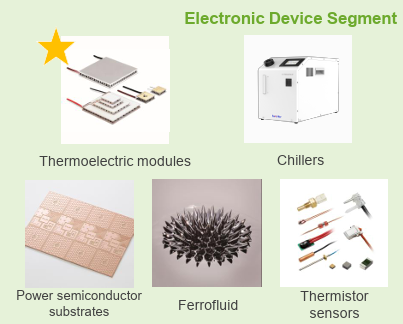
Electronic Device Business
Thermal element “thermo-electric modules” are products that can instantly raise or lower temperatures to a highly precise degree and are a core product of this business.
Thermo-electric modules are mainly used for automotive temperature control seats and many other purposes, including wafer temperature control in semiconductor manufacturing equipment, genetic testing apparatus, optical communications, home appliances, and other application products such as power semiconductor substrates. The company has the largest share in the global market of thermo-electric modules. By developing new products using high-performance materials and reducing costs and improving quality by adopting automated manufacturing lines, the company is stirring new demand and diversifying purposes of use of its products.
The company has the biggest share in the global market of magnetic fluid, which is increasingly used for such newly developed applications as linear vibration motors for smartphones, speakers for 4K-resolution televisions and automobiles, and high-sound-quality headphones. Furthermore, OHIZUMI MFG. CO., LTD., one of its consolidated subsidiaries, engages in a business of temperature sensors.
(Taken from the reference material of the company)
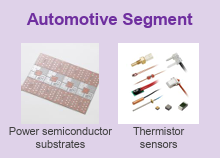
Automotive-related Business
Thermo-electric modules, power semiconductor substrates and sensors for in-vehicle systems, which used to be included in the electronic device business, have been disclosed as an automotive-related business since the first quarter of the fiscal year ended March 2025.
(Taken from the reference material of the company)
2. Full-Year Earnings Results for the Fiscal Year ended March 2026
2-1 Consolidated Earnings
| FY 3/25
| Ratio to sales | FY 3/26 | Ratio to sales | YoY | The company’s plan | Achievement rate |
Sales | 274,390 | 100.0% | 288,933 | 100.0% | +5.3% | 285,000 | 101.4% |
Gross Income | 73,361 | 26.7% | 81,317 | 28.1% | +10.8% | - | - |
SG&A | 49,271 | 18.0% | 53,755 | 18.6% | +9.1% | - | - |
Operating Income | 24,089 | 8.8% | 27,561 | 9.5% | +14.4% | 30,000 | 91.9% |
Ordinary Income | 25,558 | 9.3% | 26,063 | 9.0% | +2.0% | 28,000 | 93.1% |
Net Income | 15,692 | 5.7% | 14,886 | 5.2% | -5.1% | 16,000 | 93.0% |
*Unit: million yen.
Sales exceeded the forecast.
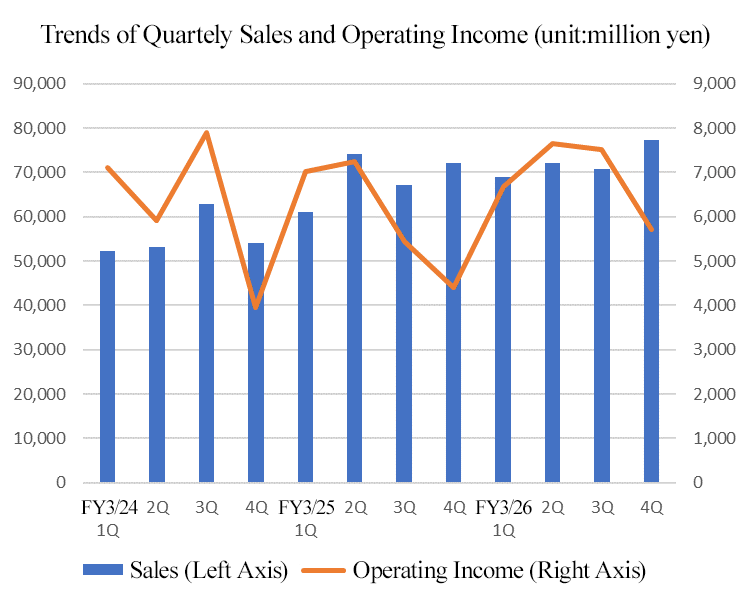
In the fiscal year ended March 2026, sales grew 5.3% year on year to 288,933 million yen and operating income rose 14.4% year on year to 27,561 million yen (the average exchange rate in the fiscal yea 1 US dollar = 149.78 yen [152.24 yen in the previous fiscal year], 1 yuan = 20.87 yen [21.12 yen in the previous fiscal year]). Sales exceeded the forecast, but all kinds of profits fell below the forecasts. While the demand for EVs is stagnant, the investment in generative AI is active, so sales grew steadily. Operating income margin increased from 8.8% in the previous fiscal year to 9.5%, thanks to the improvement in factory utilization rate and profitability of the new factory, changes in the sales mix, etc. in addition to the sales growth. It fell below the target 10%, mainly because of the decline in profit margin caused by the metal processing factory in Malaysia, which was still under construction in the fourth quarter, the decline in inventory valuation in the crucible business, in which they decreased the production of quartz crucibles for PV, etc. In ordinary income, a larger gain on reevaluation of investment securities was posted, but due to the posting of an exchange loss (an exchange gain was posted in the previous fiscal year), year-on-year profit growth rate was only 2.0%. It is noteworthy that net income attributed to parent shareholders decreased, as income taxes increased and the negative adjustment of income taxes, which was posted in the previous fiscal year, was not posted.
2-2 Business Segment Trends
Business Segment Sales and Profits
| FY 3/25 | Composition ratio Profit margin | FY 3/26 | Composition ratio Profit margin | YoY |
Semiconductor Equipment-related | 165,245 | 60.2% | 185,139 | 64.1% | +12.0% |
Electronic Device | 50,487 | 18.4% | 57,584 | 19.9% | +14.1% |
Automotive-related | 30,463 | 11.1% | 29,245 | 10.1% | -4.0% |
Others | 28,194 | 10.3% | 16,964 | 5.9% | -39.8% |
Consolidated Sales | 274,390 | 100.0% | 288,933 | 100.0% | +5.3% |
Semiconductor Equipment-related | 12,305 | 7.4% | 16,048 | 8.7% | +30.4% |
Electronic Device | 8,250 | 16.3% | 10,465 | 18.2% | +26.8% |
Automotive–related | 3,599 | 11.8% | 2,694 | 9.2% | -25.1% |
Others | 843 | 3.0% | -297 | -1.8% | - |
Adjustments | -909 | - | -1,349 | - | - |
Consolidated Operating Income | 24,089 | 8.8% | 27,561 | 9.5% | +14.4% |
*Unit: million yen.
(1) Semiconductor Equipment-related Business
Sales in the semiconductor equipment-related business increased 12.0% year on year to 185,139 million yen, and operating income increased 30.4% year on year to 16,048 million yen. Since the demand for semiconductors and equipment for manufacturing semiconductors was strong, they received more orders for Vacuum Feedthroughs, processed metal products and ceramic products for manufacturing equipment from U.S. and Chinese makers. The sales of quartz products and parts cleaning services grew thanks to the recovery of factory utilization rate. On the other hand, the sales of quartz crucibles kept decreasing because the demand for solar panels remained stagnant, and the sales of CVD-SiC dropped because the establishment of a factory in China did not progress smoothly.
| FY 3/25 | FY 3/26 | YoY |
Quartz products | 31,930 | 34,376 | +7.7% |
Silicon parts | 13,687 | 13,363 | -2.4% |
Ceramics products | 33,155 | 40,662 | +22.6% |
CVD-SiC products | 8,192 | 7,588 | -7.4% |
Vacuum Feedthroughs, metal processing | 39,195 | 49,218 | +25.6% |
Equipment parts cleaning | 15,306 | 18,603 | +21.5% |
EB-Gun, LED deposition equipment | 8,242 | 7,536 | -8.6% |
Recycled wafers | 2,856 | 4,878 | +70.8% |
Quartz crucibles | 12,668 | 8,909 | -29.7% |
Sales of Semiconductor Equipment-related Business | 165,245 | 185,139 | +12.0% |
(2) Electronic Device Business
Sales in the electronic device business increased 14.1% year on year to 57,584 million yen and operating income rose 26.9% year on year to 10,465 million yen. As the investment in generative AI servers was strong, shipments of thermos-electric modules for optical transceivers remained strong. Sales of power semiconductor substrates grew mainly in the energy field. The net sales of sensors increased, as revenues were posted from the second quarter of the fiscal year ended March 2025, because of the change in the accounting period of OHIZUMI MFG. CO., LTD., which is a consolidated subsidiary.
| FY 3/25 | FY 3/26 | YoY |
Thermo-electric modules | 27,225 | 30,821 | +13.2% |
Power semiconductor substrates | 18,152 | 19,576 | +7.8% |
Ferrofluid, Others | 1,137 | 1,205 | +6.0% |
Sensors | 3,971 | 5,980 | +50.6% |
Electronic Device Business | 50,487 | 57,584 | +14.1% |
(3) Automotive-related Business
Sales of the automotive-related business decreased 4.0% year on year to 29,245 million yen, and operating income decreased 25.1% year on year to 2,694 million yen. Since the EV market, which is a major market, remained sluggish, the sales of both thermos-electric modules and power semiconductor substrates (such as AMB and DCB substrates) kept dropping. In particular, the drop in the selling price of AMB substrates from the middle of the year affected profitability significantly.
The net sales of sensors increased, as revenues were posted this fiscal year while revenues were not posted in the first quarter of the fiscal year ended March 2025, due to the change in the accounting period of OHIZUMI MFG. CO., LTD., which is a consolidated subsidiary, like in the case of the electronic device business.
| FY 3/25 | FY 3/26 | YoY |
Thermo-electric modules | 6,412 | 4,535 | -29.3% |
Power semiconductor substrates | 19,250 | 18,057 | -6.2% |
Sensors | 4,801 | 6,653 | +38.6% |
Sales of Automotive-related Business | 30,463 | 29,245 | -4.0% |
(4) Other Businesses
Sales in the other business segment decreased 39.8% year on year to 16,964 million yen, while operating income became a deficit of 297 million yen. Sales decreased significantly due to a continued decline in shipments of silicon products for solar cells coupled with a reactionary decline in sales of machine tools, which had increased shipments in the same period of the previous fiscal year.
2-3 Financial Condition
| End of Mar, 2025 | End of Mar, 2026 | Increase Decrease |
| End of Mar, 2025 | End of Mar, 2026 | Increase Decrease |
Current Assets | 295,367 | 338,977 | +43,610 | Current Liabilities | 151,750 | 163,052 | +11,301 |
Cash | 117,727 | 129,918 | +12,191 | Payable | 59,591 | 58,954 | -637 |
Receivable | 92,608 | 101,710 | +9,102 | St Interest-Bearing Liabilities | 59,074 | 67,222 | +8,148 |
Inventory | 72,077 | 88,307 | +16,230 | Noncurrent Liabilities | 125,292 | 164,110 | +38,817 |
Noncurrent Assets | 305,226 | 350,260 | +45,033 | Lt Interest-Bearing Liabilities | 103,222 | 135,122 | +31,900 |
Tangible Asses | 245,064 | 281,107 | +36,043 | Total Liabilities | 277,043 | 327,162 | +50,119 |
Intangible Assets | 6,166 | 5,795 | -371 | Net Assets | 323,549 | 362,075 | +38,525 |
Investments and Other Assets | 53,996 | 63,357 | +9,361 | Retained Earnings | 90,435 | 97,829 | +7,394 |
Total Asset | 600,593 | 689,238 | +88,644 | Total Liabilities and Net Assets | 600,593 | 689,238 | +88,644 |
*Unit: million yen. Interest-bearing liabilities do not include lease obligations.
Total assets stood at 689,238 million yen, up 88,644 million yen from the end of the previous fiscal year. Cash & deposits, accounts receivable, and buildings & structures increased significantly. Interest-bearing liabilities augmented in parallel with the increase in tangible fixed assets, mainly because of capital investment at the Malaysian factory. As a result, equity ratio decreased from 39.4% in the previous fiscal year to 37.6%, but this is in line with the medium-term capital policy.
2-4 Cash Flow
| FY 3/25 | FY 3/26 | Increase Decrease |
Operating Cash Flow | 26,066 | 29,255 | +3,188 |
Investing Cash Flow | -39,627 | -66,856 | -27,228 |
Free Cash Flow | -13,561 | -37,600 | -24,039 |
Financing Cash Flow | 18,965 | 38,798 | +19,832 |
Cash and Equivalents at the end of term | 108,899 | 113,960 | +5,061 |
The year-end balance of cash and cash equivalents stood at 113,960 million yen, up 5,061 million yen from the previous fiscal year. Operating cash flow increased steadily, but the capital investment, etc. at the factory in Malaysia augmented the cash outflow from investment activities, so the free cash flow remains negative.
2-5 Topics
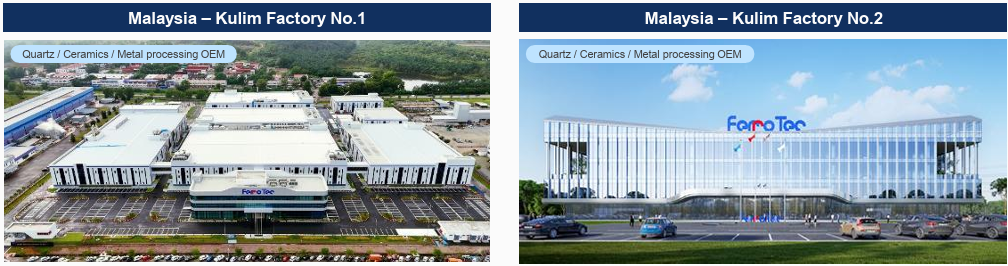
◎ Upgrade of the manufacturing system in Malaysia to meet the demand related to semiconductors
As the needs for manufacturing outside China from mainly European and U.S. clients are strong, the company established a large-scale base for manufacturing in Malaysia. In detail, Kulim Factory No. 1 was approved by clients and started mass production, so production volume is increasing steadily. The building of Kulim Factory No. 2 was completed in August 2026, and its operation is expected to start by the end of this year. We heard that they are considering the establishment of the third factory, while assuming that a factory building will be rented.
(Taken from the reference material of the company)
◎ Upgrade of the production system for meeting semiconductor-related demand also in China
In China, they aim to improve their ability to attend to customers, meet the demand for domestic production, and expand the sale of high value-added products in China, by establishing factories near bases of clients. In detail, they are constructing Beijing Factory with the aim of starting its operation in June 2027, and Shaoxing and Wuhan Factories are scheduled to start operation in the summer of 2027.
◎ Shareholder return policy
They stick to the existing policy, and by setting the lower limit of DOE at 3.5% and flexibly planning to purchase treasury shares while considering the financial standing, they aim to achieve a total return ratio of 50%. For the fiscal year ended March 2026, the dividend was 148.0 yen/share and payout ratio was 46.6%. For the fiscal year ending December 2026, they plan to raise the dividend amount to 200.0 yen/share, including an extraordinary dividend of 50.0 yen/share (payout rati 5.8%).
3. Full-Year Earnings Estimates for the Fiscal Year ending December 2026
3-1 Full Year Consolidated Earnings
| FY 3/26 | Ratio to sales | FY 12/26Plan | Ratio to sales |
Sales | 288,933 | 100.0% | 350,000 | 100.0% |
Operating Income | 27,561 | 9.5% | 38,000 | 10.9% |
Ordinary Income | 26,063 | 9.0% | 36,000 | 10.3% |
Net Income | 14,886 | 5.2% | 23,000 | 6.6% |
*Due to the change in the accounting period, the period of FY 12/26 is 9 months, so year-on-year increase/decrease rate has been omitted.
*Unit: million yen
The impact of the change in their accounting period is minor.
This fiscal year, their account closing month will be changed from March to December. Accordingly, the period of the fiscal year ending December 2026 is extraordinary, being 9 months. Since the account closing months of consolidated subsidiaries have been December since before the change, so their performance in 12 months will be taken into account for the fiscal year ending December 2026, and the performance in 9 months will be taken into account only for the parent company. Its effect on sales will be around 5 billion yen.
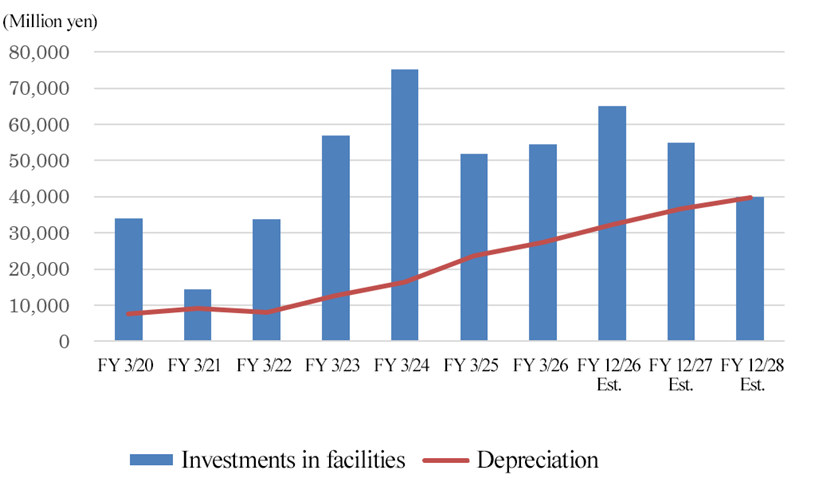
For the fiscal year ending December 2026, it is forecast that sales will be 350 billion yen, EBITDA will be 70,172 million yen, and operating income will be 38 billion yen. The capital investment amount is expected to increase from 54,598 million yen to 65 billion yen. It is assumed that 1 US dollar will be 150 yen (149.78 yen in the previous fiscal year) and 1 yuan will be 21 yen (20.87 yen in the previous fiscal year) on average.
As they will select and concentrate on specific businesses, CRSM, which operates the recycled wafer business, is expected to change from a consolidated subsidiary into an equity-method affiliate in July 2026 through capital increase (In the fiscal year ended March 2025, sales were 2,869 million yen and operating income was -1,483 million yen).
They assume macroeconomically that the demand for semiconductors will grow at an accelerated pace in 2026 as well, the investment in data centers will keep contributing to business, and the sales of memory and logic will keep growing significantly. Regarding the demand for semiconductor manufacturing equipment, the investment in memory manufacturing equipment is expected to increase considerably, due to the skyrocketing of memory prices caused by the growth of investment in generative AI. As the forecast demand for wafer fab equipment (WFE) has been revised upwardly, the demand from semiconductor-related enterprises is expected to grow. On the other hand, it is kept in mind that the prolongation of conflicts in the Middle East would affect the supply and maritime transportation of petroleum-related products and energy-related resources. They recognize that it is necessary to deal with the procurement of materials and the augmentation of costs.
At a results briefing session, the President He Xian Han said, “We would like to pursue sales of 400 billion yen and an operating income of 50 billion yen.” He left that unofficial comment while sensing the on-site atmosphere. The market will keep an eye on which figure will be achieved.
3-2 Trend in each segment
| FY 3/26 Full Year results | FY 12/26 The company’s plan |
Quartz products | 34,376 | 38,912 |
Silicon parts | 13,363 | 17,198 |
Ceramics products | 40,662 | 49,036 |
CVD-SiC products | 7,588 | 4,416 |
Vacuum Feedthroughs, metal processing | 49,218 | 68,307 |
Equipment parts cleaning | 18,603 | 22,848 |
EB-Gun, LED Deposition Equip., Others | 7,536 | 7,059 |
Recycled wafers | 4,878 | 2,943 |
Quartz crucibles | 8,909 | 11,471 |
Sales of Semiconductor Equipment-related Business | 185,139 | 222,190 |
Thermo-electric modules | 30,821 | 40,526 |
Power semiconductor substrates | 19,576 | 22,511 |
Ferrofluid, Others | 1,205 | 1,534 |
Sensors | 5,980 | 9,394 |
Electronic Device Business | 57,584 | 73,965 |
Thermo-electric modules | 4,535 | 5,846 |
Power semiconductor substrates | 18,057 | 22,247 |
Sensors | 6,653 | 8,042 |
Sales of Automotive-related Business | 29,245 | 36,135 |
Others | 16,964 | 17,710 |
Consolidated sales | 288,933 | 350,000 |
*Unit: million yen
4. Mid-Term Management Plan (FY 12/26 – FY 12/28)
4-1 Basic policies of the mid-term management plan
The company updated the medium-term management plan disclosed on May 30, 2025 as a rolling strategy on May 29, 2026. The updated basic policies are as follows.
Business growth | ➣Expand production in Malaysia and other locations to address the Ex-China production needs of Japanese, U.S., and European customers, while strengthening customer engagement in China to achieve growth, as demand for semiconductor-related products continues to grow. ➣Pursue growth by expanding the semiconductor, electronic device, and automotive businesses, with a particular focus on AI and data center-related businesses. |
Improving profitability and production efficiency | ➣Improve profitability by expanding production and enhancing efficiency at the Malaysia factories (Kulim and Johor). ➣Drive group-wide cost management and reduction through PDCA cycles. ➣Pursue improved production efficiency and enhanced competitiveness through digitalization, automation, and AI adoption. ➣Advance and strengthen the development of new products and technologies at the research centers of each business, while maintaining rigorous quality control under the principle that “Quality is Everything.” |
Strengthening human capital and corporate culture | ➣Recognize corporate culture as the foundation of the Company, and continue to promote our guiding principles: “Respect customers and employees, value diligence and integrity, act steadily, and pursue innovation.” ➣Position human capital as a key management strategy, conduct training in each business, and promote the recruitment and development of talent. |
Financial and shareholder returns | ➣Strengthen shareholder returns by adopting DOE with a minimum level of 3.5%. Flexibly consider share buybacks, taking into account financial conditions and other factors, and aim for a total payout ratio of 50%. Maintain this policy unchanged. ➣Divest group assets totaling 50.0 billion yen over the period from FY 3/26 through FY 12/27. ➣Carry out share buybacks of up to 25.0 billion yen over the period from FY12/26 through FY12/28. |
(Produced by Investment Bridge Co., Ltd. with reference to disclosed material.)
4-2 Numerical Targets of Mid-term Management Plan
(million yen) |
| |||
FY 3/26 (Act.) | FY 12/26 (Est.) | FY 12/27 (Est.) | FY12/28 (Est.) | |
Sales | 288,933 | 350,000 | 400,000 | 450,000 |
Operating income | 27,561 | 38,000 | 48,000 | 57,000 |
Operating income margin | 9.5% | 10.9% | 12.0% | 12.7% |
Net income | 14,886 | 23,000 | 30,000 | 38,000 |
ROE | 6.0% |
| 11.0% | |
ROIC | 3.2% |
| 7.0% | |
Equity ratio | 37.6% | 40% | 40% | 40% |
Investment amount | 54,598 | 65,000 | 55,000 | 40,000 |
Dividend per share (yen) | 148.00 | 200.00 | Lower limit for DOE at 3.5% Total return ratio of 50% | |
*ROIC = Net income attributable to owners of the parent / (interest-bearing liabilities + net assets); Net assets do not include share acquisition rights or non-controlling shareholders’ equity.
(Produced by Investment Bridge Co., Ltd. with reference to disclosed material.)
4-3 Progress of the medium-term management plan
Performance | ➣In FY 3/26, net sales were 288.9 billion yen, operating profit was 27.6 billion yen, profit attributable to owners of parent was14.9 billion yen. Profit growth was constrained due to increased inventory write-downs at new factories and other factors. ➣FY 12/26 full-year forecast: net sales 350.0 billion yen, operating income 38.0 billion yen, profit attributable to owners of parent 23.0 billion yen. |
Customer trend | ➣As AI-driven semiconductor investment and production continue to gain momentum, progress has been made in addressing the Ex-China production needs of U.S. SPE customers. ➣Increased investment and production in China’s semiconductor industry are driving growing inquiries for metal processing, ceramics and other products as we advance customer engagement. ➣In thermoelectric modules, inquiries for optical communication module applications remain robust. |
Capital investment | ➣Customer qualification and ramp-up at the Kulim Factory in Malaysia are progressing smoothly. The second factory (ceramics, quartz, and metal processing OEM) is scheduled to commence operations in 2026. Given strong demand and further capacity expansion requests from customers, additional expansion is under consideration. ➣A new Beijing Factory (parts cleaning, metal processing OEM and ceramics) is being established to strengthen customer engagement. |
Shareholder return, etc. | ➣Plan to carry out share buybacks of up to 25.0 billion yen over the period from FY 12/26 through FY 12/28. ➣For FY 12/26, an increased dividend is planned, with a full-year dividend of 200 yen /share (ordinary dividend: 150 yen, special dividend: 50 yen). |
(Produced by Investment Bridge Co., Ltd. with reference to disclosed material.)
4-4 Capital investment plan
In response to the growth of demand for semiconductors and requests from clients, they will establish Beijing Factory for cleaning parts, etc. and conduct investment for increasing the production output of ceramics, etc. To meet the demand for production outside China, they plan to carry out additional investment in the factory in Malaysia. The amount is up 20 billion yen from the previous forecast for the fiscal year ended March 2026 and up 25 billion yen from the previous forecast for the fiscal year ending December 2026. On the other hand, it is assumed that they will sell some assets of the corporate group for 50 billion yen from the fiscal year ended March 2026 to the fiscal year ending December 2027. There are no changes to the numerical goals of achieving sales of 500 billion yen and a net income of 50 billion yen in the fiscal year ending December 2030 (in the fiscal year ending March 2031 when the previous accounting period is applied) under their long-term vision.
(Produced by Investment Bridge Co., Ltd. with reference to disclosed material.)
5. Conclusions
While the businesses related to semiconductors and AI (semiconductor equipment-related business and thermos-electric modules as electronic devices) contribute to overall performance, the automotive-related business is sluggish due to the stagnant demand for EVs. The growth drivers are mainly the businesses for AI and data centers, so whether this demand will last determine the overall business performance. As they have established a business portfolio appropriately, we would like to pay attention to the changes in the situation as well as the progress of their capital investment plan, while highly evaluating the fact that they took advantage of the growth of demand for AI and data centers. Since the mis-prediction of demand would lead to the risk of decreasing inventory valuation and utilization rate, we should not forget that it is necessary to pay extra attention to the quality of inventory. We would like to see how swiftly they can make a judgment for management when such risk emerges.
They increased the budget for capital investment from the fiscal year ended March 2026 to the fiscal year ending December 2027 to 174.6 billion yen. Accordingly, FCF remains in the red, and interest-bearing liabilities exceed 200 billion yen. Equity ratio decreased to 37.6%. Going forward, we need to take into account the period in which the new factory shifts from mass production to full-scale operation and starts contributing to profit and financial burdens during that period. They plan to sell some assets of the corporate group for 50 billion yen during that period, so it seems that we need to carefully watch their financial standing.
Their business administration conscious of share price and capital cost turned out to be effective, so PBR exceeded 1 and remains over 1. So that share price will rise further, they are required to achieve stable growth of sales and profit based on the previous investment for growth, improve ROE, and enhance their shareholder return measures, in addition to taking advantage of the favorable external environment. In this light, they show a more concrete positive attitude by announcing the purchase of treasury shares worth 25 billion yen in 3 fiscal years, in addition to the attitude of aiming to achieve a total return ratio of 50% while setting the lower limit of DOE at 3.5%. However, the pursuit of both investment and shareholder return may shackle their business activities during a downward trend. Accordingly, we would like to pay attention to whether they can establish strategies flexibly.
<Reference 1: Measures for Achieving Management Conscious of Capital Costs and Stock Price>
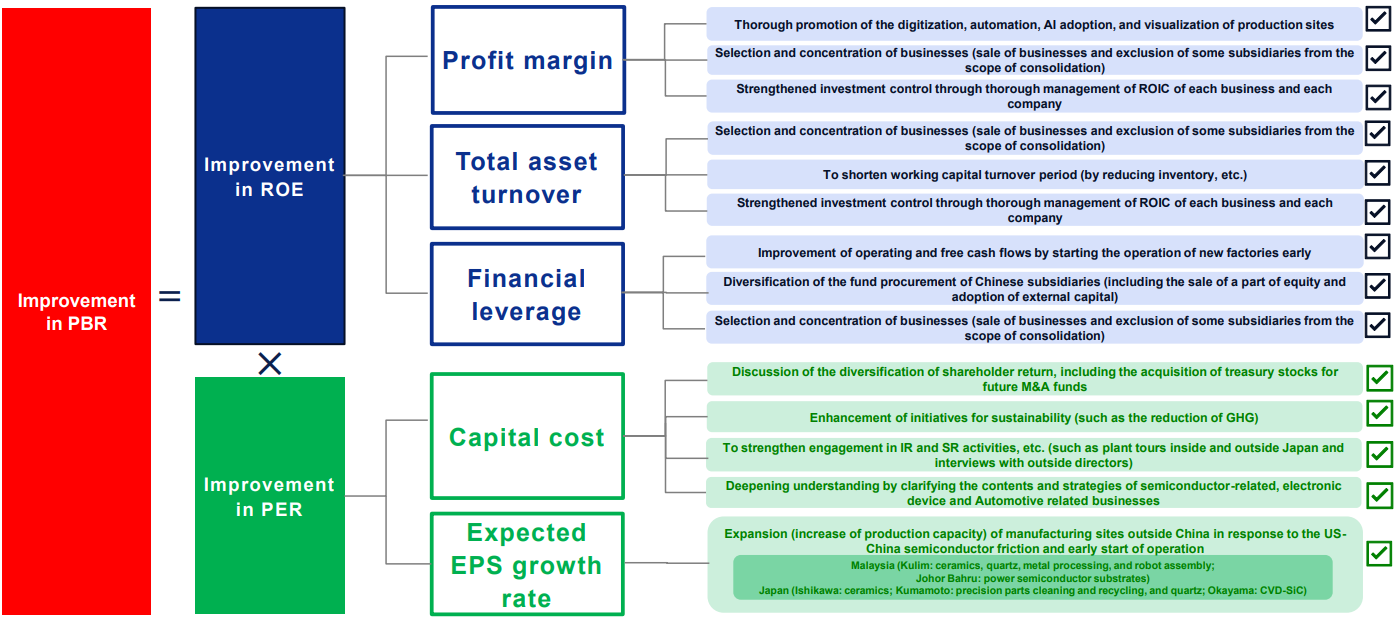
On July 31, 2024, the company disclosed its initiative on "Measures for Achieving Management Conscious of Capital Costs and Stock Price." The gist of the medium-term management plan, which was disclosed this time, remains unchanged, except the change in the shareholder return policy from “focusing on a payout ratio of 20-30%” to “3.5% for the lower limit of DOE and 50% for total return ratio.” Key points are as follows.
The company has calculated its shareholder equity cost at 9.94% for FY 3/25, calculated using the Capital Asset Pricing Model (CAPM). The assumptions for this calculation include a risk-free rate of 2.532% (20-year government bond yield), a β of 1.610 (for the semiconductor manufacturing equipment industry), and an equity risk premium of 4.60%. The company's ROE for FY 3/25 was 7.1%, falling below its shareholder equity cost, which is considered as the primary reason for its PBR (Price-to-Book Ratio) remaining below 1. Recognizing the urgent need to enhance profitability above its shareholder equity cost, the company has set a target of achieving an ROE of 15%. To reach this goal, it plans to drive business and profit growth, strengthen profitability, implement effective ROIC management, focus on business selection and concentration to improve total asset turnover, and optimize financial leverage. Additionally, the company aims to improve its PER (Price-to-Earnings Ratio) through enhanced shareholder return policies and the further strengthening of non-financial strategies. The specific initiatives to achieve these goals are outlined below.
Note: GHG stands for Greenhouse Gas, mainly CO2.
(Taken from the reference material regarding their measures for realizing business administration conscious of capital cost and share price)
As achieving the medium-term management plan is essential to meeting these targets, the company has also announced a transition to a performance-linked compensation system, which strengthens both short-term and medium-to-long-term incentives, further aligning executive remuneration with business performance.
<Reference 2: Regarding Corporate Governance>
◎ Organization type, and the composition of directors and auditors
Organization type | Company with auditors |
Directors | 9 directors, including outside ones 3 (including 3 independent executives) |
Auditors | 3 auditors, including outside ones 2 (including 2 independent executives) |
◎ Corporate Governance Report (Updated on October 15, 2025)
Basic policy
While pursuing our corporate principles: “Satisfaction to our Customers ,” “Earth Friendly and Environmentally Conscious,” and “Dreams and Vitality to our Society,” our corporate group has drawn up a code of conduct as follows: From a global perspective, Ferrotec always operates in harmony with the international community and acts in good faith with unwavering corporate ethics and social decency, as well as in compliance with the laws of each country as a company that provides products and services that contribute to everyday life of the people all over the world who are related to us; Ferrotec earns customer trust and satisfies our customers by proposing high-quality products and services and providing cost-competitive products and services mainly in the new energy and electronics industries; Considering proactive eco-friendly activities to be one of our high-profile business issues, Ferrotec contributes to solving global environmental problems by adapting ourselves to the requirements of the latest environmental regulations one by one and developing materials and products that can be used in the new energy industry; and Ferrotec contributes to society through manufacturing based on our core technology, continues to be a company whose stakeholders, including customers, shareholders, employees, business partners, and local communities, are looking forward to seeing it grow, and engages in business activities based on social decency, such as laws, social order, and international rules.
Our company not only proactively promotes environmental preservation activities and our corporate group’s governance pursuant to the aforementioned corporate principles and code of conduct, but also strives to continue being a company whose stakeholders look forward to its growth. We have also formulated a quality philosophy saying that we focus on developing new materials and production technologies, such as semiconductor materials, and pursue customer satisfaction improvement by giving top priority to quality, and are moving forward with automation, digitalization, and standardization of our production processes. Our basic business policies are to increase our share in the global market and form a corporate group with a stable profit structure.
Based on the above corporate principles, code of conduct, and basic management policy, the company considers that it is important to improve its corporate value, emphasize the soundness of its business administration to become an enterprise that will be trusted and supported by stakeholders, including shareholders, customers, business partners, and local communities, and also establish a managerial system responding the rapid changes to the business environment swiftly and accurately.
<Main Reasons for Non-compliance with the Principles of the Corporate Governance Code (Excerpt)>
<Supplementary Principle 1-1-1: Analysis of Reasons Behind a Considerable Number of Opposing Votes at a General Shareholders’ Meeting>
While our company has not set the criterion for a “considerable number” in case a considerable number of opposing votes was cast at a general shareholders’ meeting, we shall consider defining the criterion from now on. In case a considerable number of opposing votes was cast, we shall swiftly analyze the reasons behind the opposition and the cause for the increase of opposing votes and present our view of the issue, such as making a press release of the analysis results.
<Supplementary Principle 2-4-1: Ensuring diversity in promotion to core human resources>
As a basic policy for human capital, the group operates under two major policies regarding organizations and human resources.
The first is to create a company and organization, in which each employee, regardless of their attributes, can act autonomously and with ambition and have a sense of fulfillment in their work. The second is to localize management, make decisions quickly, and manage the business and the organization according to the characteristics of each region.
While our business is expanding on a global basis, our corporate group drastically strengthens our human resources and organization and proactively employs women, foreign nationals, and mid-career workers with extensive skills and experience to raise our corporate value in the medium/long term. In addition, we actively promote women, foreign nationals, and mid-career hires to managerial positions by comprehensively considering and evaluating such factors as their skills and valuable experience cultivated in companies outside of our corporate group.
・Voluntary and Measurable Targets for Ensuring Diversity
A talented human resource strategy and diversity are important, and the company aims to increase the ratio of female recruits to 25% or more by the fiscal year ending March 2028. As of the end of March 2025, the ratio was 22.2%.
・Human Resource Development Policy and Internal Environment Improvement Policy to Ensure Diversity, and their Status
In order to develop an environment in which employees can work with peace of mind, the company aims to increase the retention rate of new graduates and mid-career recruits after three years to 80% or more by the fiscal year ending March 2028. As of the end of March 2025, the rate stood at 77.78%.
Going forward, the company will earnestly consider disclosing its human resource development policy and internal environment improvement policy from a medium- to long-term perspective, including the promotion of women, foreign nationals, and mid-career recruits to management positions, as well as the progress and achievement status of these policies.
<Supplementary Principle 3-1-3: Disclosure of initiatives on sustainability and business strategies, such as investment in human capital and intellectual property>
Following our corporate principles: “Satisfaction to our Customers, Earth Friendly and Environmentally Conscious, and Dreams and Vitality to our Society,” our company has framed a basic policy on materiality and sustainability in 2021 because we consider ESG (Environment, Social, and Governance) to be extremely important for medium- and long-term improvement of our corporate value. We will build an organizational structure, enlighten our employees, and set quantitative goals for promoting ESG. Regarding investment in human capital and intellectual property, our Japanese subsidiaries proactively promote young employees to the position of executive officer and flatten their organizations. Meanwhile, our Chinese subsidiaries actively invest in intellectual property by, as necessary, founding research institutes related to semiconductors, employ a greater number of human resources who have degrees equivalent to doctor’s degrees, and granting their employees awards and rewards for superb patent applications. We will monitor quantitative goals that we set and announce our progress with them via our website, IR material, and other means.
<Main Disclosure Based on the Principles of the Corporate Governance Code (Excerpt)>
<Principle 1-4, Supplementary Principle 1-4-1, Supplementary Principle 1-4-2: Strategically Held Shares>
We define and operate the policy regarding strategically held shares and the criteria for exercising the voting rights stemming from strategically held shares as follows.
1. Our policy regarding strategic shareholding
Our basic policy lies in holding no shares strategically.
However, we hold the shares of other companies only in cases where we judged that it is highly reasonable to hold the relevant shares in terms of the relationship with the issuing company, such as shares of our business partners. The president’s office regularly inspects the reasonableness of holding these shares and presents the findings to the Board of Directors. Regarding the concrete inspection method, the Board of Directors inspects whether the objective for holding the shares is appropriate or not, whether the benefits and risks stemming from holding the shares correspond with the capital cost, etc., and forges ahead with reducing strategically held shares based on the inspection results.
On a Board of Directors’ meeting held in June 2025, we decided to keep holding the shares of seven companies as a result of a careful examination.
2.Our criteria for exercising the voting rights stemming from strategically held shares
With regard to exercising voting rights, we respect the judgment of the Board of Directors of the company that issued the relevant shares as a general rule, and make affirmative judgments in voting unless the matter in question negatively impacts the relationship and transactions with our corporate group, or it can be surmised that it will clearly degrade common interests of shareholders.
3.Response to strategically held shares of our company
Apart from the aforementioned, in case a company that strategically holds our shares expresses the intention to sell these shares, we respond appropriately to the sale, etc., without making any obstructions to the sale, such as implying a reduction in transactions.
<Principle 1-5: The So-Called Anti-Takeover Measures>
We have not adopted any so-called anti-takeover measures at our company.
In case our shares are offered in a takeover bid, our Board of Directors carefully examines its objective and content, and announces our company’s opinion. In case the Board of Directors judges that it is necessary from the viewpoint of maintaining and elevating corporate value, we suggest appropriate measures while taking care so as not to unjustly hinder the right of the shareholder to accept the takeover bid.
<Principle 2-1: Formulation of Management Philosophy as the Foundation for Elevating Corporate Value in the Medium to Long Term>
We engage in business activities in accordance with the three management philosophies, which are “being trusted by customers and gaining their satisfaction,” “contributing to resolving global climate issues” and “contributing to the society through craftsmanship,” in order to pursue harmony between the global society and local societies from a global standpoint and act in a sincere way as a company offering products and services that can contribute to the lives of all kinds of people.
<Principle 2-3: Issues related to sustainability, mainly social and environmental issues>
The semiconductor manufacturing process has a significant environmental load, and solving this is a challenge for the entire industry. The company sells products such as thermo-electric modules, which are CFC-free temperature control devices, and power semiconductor substrates and ferrofluids that effectively reduce power consumption. The company also relies on clean energy, using solar panels in power generation at our factories in Japan and China. Thus, our business activities contribute to reducing greenhouse gases, leading to environmental pollution reduction. In March 2023, the "Sustainability Committee" was established as a committee under the Company's Board of Executive Officers to check the status of sustainability initiatives, review and deliberate on them, and report to the Board of Directors and other relevant bodies when necessary, in order to examine and promote sustainability on a company-wide basis. The number of university students in financial distress is increasing after the COVID-19 pandemic. Therefore, the company supports the Akira Yamamura Scholarship Foundation, which provides scholarships to engineering students to develop talented human resources who can contribute to society in the future.
<Principle 2-4: Ensuring diversity, including active participation of women>
Believing that working with employees who have different experiences and senses of values within a company is an advantage in ensuring sustainable business growth especially when companies operate globally like our company, we endeavor to ensure diversity, including active participation of women, based on our policy of entrusting each of our local subsidiaries with management of their own companies.
<Principle 5-1: Policy for Constructive Dialogue with Shareholders>
To achieve sustainable growth and improve corporate value, we will promote constructive dialogue with shareholders, explain our management policies and business conditions in an easy-to-understand manner, and strive to gain the understanding of shareholders.
- Policy for constructive dialogue with shareholders -
1. Overseeing dialogue with shareholders:
The Director in charge of Management Strategy and Special Assignments from the President, who serves as the IR Officer, has been designated as the management representative responsible for overseeing dialogue with shareholders.
2. A system of collaboration among various internal departments to support dialogue with shareholders:
The IR/Public Relations Department and the Finance and Accounting Department work together to support dialogue with shareholders.
3.Efforts to improve the means of dialogue other than individual interviews:
We utilize various means of communication, including financial results briefings, small meetings, individual investor briefings, business briefings held after the general meeting of shareholders, online meetings, and various printed materials. At financial results briefings and business briefings, the representative director personally gives explanations.
4.Management of insider information during dialogue:
We strictly manage information in accordance with our internal information management regulations.
[Actions to achieve management that is conscious of the cost of capital and stock price] [English description available]
We consider return on equity (ROE) and return on invested capital (ROIC) to be important management indicators and have set an ROE of 15% and an ROIC of 8% as one of our management targets (KPIs) for the period of our medium-term management plan (FY 12/26 to FY 12/28). The Board of Directors periodically reviews the cost of capital and weighted average cost of capital (WACC) and has calculated the cost of equity capital to be in the high-9% range and the WACC to be in the high-8% range for the fiscal year ended March 2025. In contrast, ROE and ROIC for the same consolidated fiscal year were 7.1% and 3.9%, respectively, lower than the cost of capital and WACC, mainly due to a decline in the net income margin attributable to shareholders of the parent company and an increase in tangible fixed assets caused by increased expenses associated with recent large capital investments. Therefore, we recognize that our most important management issue at hand is to stably achieve ROE and ROIC that exceed the cost of capital and WACC, respectively. In addition, our price-to-book ratio (PBR) remains below 1, at 0.53 for the fiscal year ended March 2025, and we recognize the importance of improving our ROE and price-earnings ratio (PER).
For details on the assessment of current statuses of these management issues and various measures, please refer to “Initiatives for Realizing Business Administration Conscious of Capital Cost and Share Price,” disclosed on July 31, 2024 and page 20 of the Medium-Term Management Plan (Rolling Plan) announced on May 30, 2025.
“Initiatives for Realizing Business Administration Conscious of Capital Cost and Share Price”
(Japanese) https://www.ferrotec.co.jp/php/download.php?f=jp/66b077985a236.pdf
(English) https://www.ferrotec.co.jp/php/download.php?f=en/66b0929d8d3aa.pdf
Medium-Term Management Plan (Rolling Plan)
(Japanese) https://www.ferrotec.co.jp/php/download.php?f=jp/20250602577588.pdf
This report is not intended for soliciting or promoting investment activities or offering any advice on investment or the like, but for providing information only. The information included in this report was taken from sources considered reliable by our company. Our company will not guarantee the accuracy, integrity, or appropriateness of information or opinions in this report. Our company will not assume any responsibility for expenses, damages or the like arising out of the use of this report or information obtained from this report. All kinds of rights related to this report belong to Investment Bridge Co., Ltd. The contents, etc. of this report may be revised without notice. Please make an investment decision on your own judgment. Copyright(C) Investment Bridge Co., Ltd. All Rights Reserved. |